Bluetooth Low Energy 4.0 in the smart home — the protocol primer
BLE 4.0 was ratified in June 2010. iPhone 4S (October 2011) was the first major handset to ship with it. By early 2013, BLE peripherals are common — Fitbit Flex ships next month, Pebble shipped in January, and the first BLE smart-lock retrofit (Lockitron) is taking pre-orders. Smart-home is the next wave.
Notes on the protocol underneath, before the smart-home devices arrive.
What "low energy" actually means
BLE is not a faster or longer-range Bluetooth Classic. It's a fundamentally different design optimized for one constraint: peripheral devices that run for a year on a coin cell.
The numbers:
- Classic Bluetooth: average ~30 mW transmit, ~10 mW idle. A coin cell (225 mAh @ 3V) lasts ~20 hours of active use.
- BLE 4.0: ~15 mW peak transmit, sub-microamp idle. Same coin cell lasts a year of typical usage.
Two design decisions pull this off:
- Advertising-based discovery. Instead of holding an active connection, a BLE peripheral broadcasts short advertising packets every N milliseconds (configurable, 20 ms to 10.24 s). Radio on ~1 ms per advertisement, then asleep. Tiny duty cycle.
- Connection intervals. When a connection is established, peripheral and central agree on a connection interval (7.5 ms to 4 s). Radio wakes briefly at each interval; otherwise sleeps. Orders of magnitude lower than Classic's continuous radio activity.
Tradeoff: BLE is slow compared to Classic. Throughput peaks ~305 kbps theoretical, ~100 kbps practical in 2013-era pairings. Fine for sensor data, terrible for streaming audio.
GATT, services, and characteristics
BLE 4.0 defines the Generic Attribute Profile (GATT) — a hierarchical data model:
- Service: a logical group (Battery, Heart Rate, custom-vendor).
- Characteristic: a value within a service (battery level, heart rate BPM).
- Descriptor: metadata on a characteristic (units, valid range, notification enable).
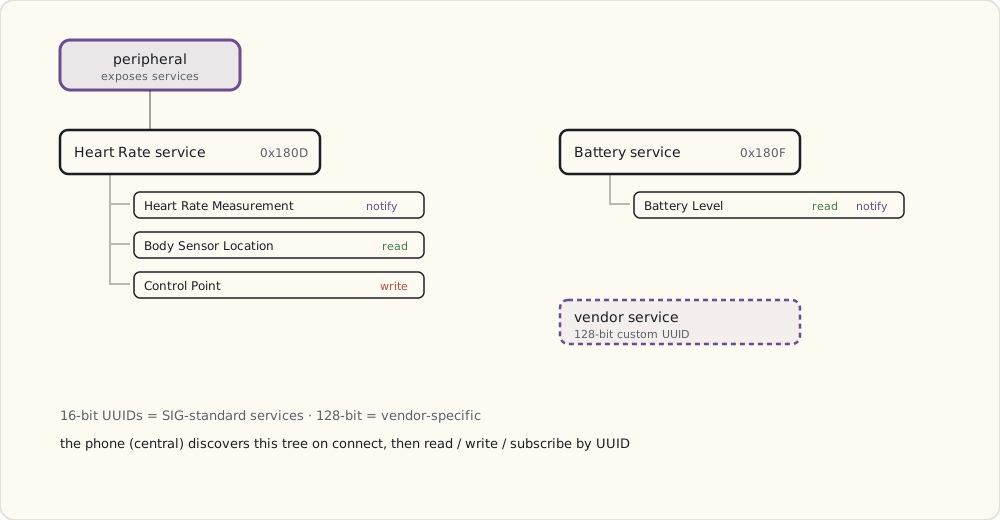
Every BLE peripheral exposes one or more services with characteristics. The phone (central) discovers services on connect, then reads/writes characteristics by UUID:
Heart Rate Service (0x180D)
├── Heart Rate Measurement (0x2A37) — notify
├── Body Sensor Location (0x2A38) — read
└── Heart Rate Control Point (0x2A39) — write

Battery Service (0x180F)
└── Battery Level (0x2A19) — read, notify
Standard services have 16-bit UUIDs assigned by the Bluetooth SIG. Vendor-specific services use 128-bit UUIDs (Nest's thermostat service, for example, is custom).
Apple's iBeacon (rumored for WWDC 2013, soft-leaked already)
Apple's iBeacon spec — coming with iOS 7 this fall — turns BLE advertising into proximity detection. A beacon broadcasts an advertising packet with this payload:
Field         Bytes  Meaning
------------- -----  ---------------------------------------
Prefix        9      Apple-defined fixed prefix
UUID          16     128-bit, identifies the beacon owner
Major         2      16-bit, region identifier (e.g., a store)
Minor         2      16-bit, sub-region (a shelf, a room)
TX Power      1      Calibration byte at 1m, signed dBm
The phone uses RSSI (received signal strength) relative to TX Power to estimate distance:
distance ≈ 10 ^ ((TX_Power - RSSI) / (10 * n))
where n is environment factor, ~2-4
Three distance bands defined: immediate (< 0.5 m), near (~3 m), far (~10+ m). RSSI-based ranging is noisy but works fine for proximity bands.
For smart-home, this matters: iBeacon is the first widely-adopted standard for "I am near this device." Useful for room-level presence detection long before Hue or anyone builds it natively.
Where BLE fits in smart home
Fits:
- Proximity / presence sensors — beacons, tap-to-pair, room-level location.
- Battery-powered sensor peripherals — door/window, temperature, leak (when mesh isn't needed).
- Direct phone-to-device pairing — fitness trackers, smart locks, the rumored Apple wearable (Bloomberg's been hinting at an "iWatch" since last year — vapor for now).
Doesn't fit:
- Always-on actuators (light bulbs). Hue uses Zigbee mesh because BLE 4.0 doesn't have a mesh profile yet — there's talk of mesh being added to a future spec revision, but it's not here.
- Range > 10 m through walls. BLE in 2.4 GHz loses badly to drywall and brick.
- High-throughput devices (cameras, audio streaming).
The architectural rule: BLE is for peripherals talking to one phone at a time. Anything that needs a hub, mesh, or many simultaneous controllers wants Zigbee, Z-Wave, or WiFi.
Power-profile math, in detail
Coin cell (CR2032, 225 mAh @ 3V):
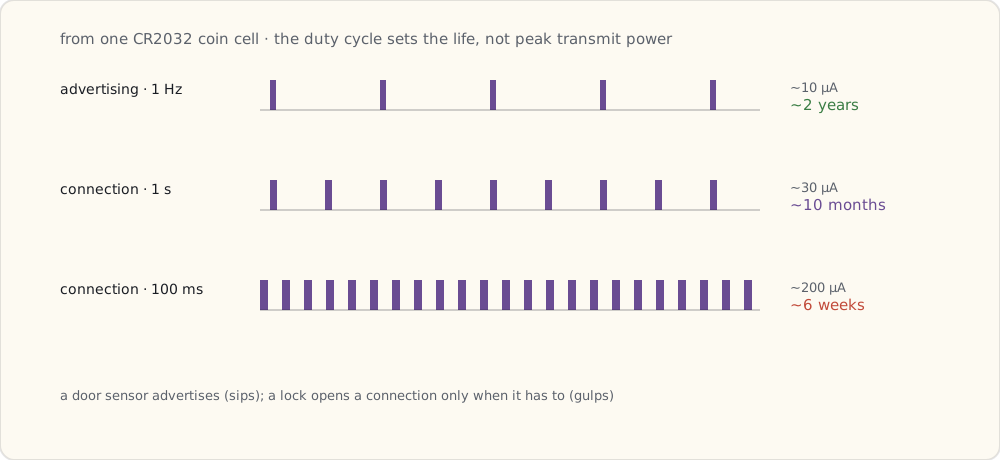
- BLE peripheral advertising at 1 Hz (1 ad packet per second), each packet ~1 ms of radio on at ~10 mA: average current ~10 µA → ~2 year battery life.
- BLE peripheral in persistent connection at 1 s interval: average ~30 µA → ~10 month battery life.
- BLE peripheral at 100 ms connection interval (responsive): average ~200 µA → ~6 weeks battery life.
Door/window sensors and temperature sensors target the advertising-only mode for multi-year life. Locks and locks-class devices use connection mode when active, advertising when idle.
The first BLE smart-home devices I'm watching
- Lockitron — a BLE/Wi-Fi smart-lock retrofit that fits over your existing deadbolt. Kickstarter turned it down as a "home improvement" project last fall, so the team stood up their own pre-order site and pulled in well over a million dollars in the first week. Shipping "later this year," allegedly — crowdfunded hardware timelines being what they are.
- And whatever follows it: a phone-as-key smart lock is the obvious first BLE product for the home, and Lockitron won't be the only one. I'll write about whichever actually lands and is integrate-able.
What's next
WiFi smart plugs are about to flood the market — Wemo is already on shelves, others are coming. The next primer is on WiFi as a smart-home transport, and what it costs (electrically and architecturally) compared to BLE and Zigbee.