 Notebook · 42 parts
 Pet IoT — An Engineer's Field Guide
Atom got the first Whistle in October 2013. Joule, Boson, and Quark came later. Twelve years of every shipping pet device, every protocol shift, every vendor collapse and acquisition — kept the way an engineer keeps notebooks, in the order it happened.
October 2013. Atom — an eight-week-old yellow Lab — comes home. Two months later, the first Whistle Activity Monitor goes on his collar. The first instrument in what becomes a twelve-year experiment that grows to include Joule (cat, 2014), Boson (cat, 2020), and Quark (Lab, 2022), and the connected-pet category that comes to exist around them.
The data is real. The patterns are only visible in long-arc. Cat IoT trailed the dog side by about three years on every axis — devices, vitals, multi-pet features — the dedicated cellular cat tracker gap closed in late 2022 with Tractive's GPS Cat Mini, and the health-vitals generation arrived with the CAT 6 Mini (April 2026, launched with Health Intelligence resting HR + respiratory rate monitoring).
| Years | What shipped | What broke |
|---|---|---|
| 2013-2017 | BLE + cellular fitness trackers, microchip doors | Single-pet assumption everywhere |
| 2018-2020 | LTE-M battery (Fi), early vitals, smart litter | Petnet's 9-day cloud outage |
| 2021-2024 | Vet-grade vitals (Whistle Health), AirTag, Halo Collar, GPS Cat Mini (late 2022 — first form-factor-right cellular cat tracker) | Mars Petcare owns the stack — food, clinics, collars, analytics |
| 2024-2025 | DIY ESP32 feeders, Find My pet trackers, Tractive DOG 6 vitals go independent | Mars divests Whistle to Tractive (July 2025); Whistle's cloud goes dark August 31 |
| 2025- | Tractive's Base Station ships an nRF52840 used as plain BLE; CAT 6 Mini launches April 2026 with Health Intelligence (resting HR + respiratory rate) | 2025 silicon, 2013 architecture — the radio is capable of more than the firmware uses |
Smart-pet-health tag threads from 2021 onward where consumer collars crossed into vet-grade telemetry.
Before buying anything in this category: real-world battery life, not claimed numbers. Device behavior when the vendor cloud is unreachable. Whether there's a no-subscription mode. Whether you can export the data. What else the vendor sells.
 Part 01 of 42
 Atom arrives — Whistle launches a dog fitness tracker
Brought home an 8-week-old yellow lab on Sunday. Named him Atom. Two weeks ago a startup called Whistle shipped the first consumer fitness tracker for dogs. Suspiciously perfect timing.
Brought home an 8-week-old yellow lab puppy on Sunday. Named him Atom. The name fits — particle-physics-themed because we like that around here, and also he is small and energetic and basically all motion. The plan: pet-tech-curious engineer becomes dog person, dog gets all the gadgets, engineer writes about it.
Two weeks ago — October 8 — a startup called Whistle shipped the first consumer-friendly activity tracker for dogs. The timing of Atom's arrival is convenient. I bought one yesterday.
Notes from the install.
What Whistle is, hardware-wise
- A coin-sized aluminum puck (~30 g) that clips to the collar.
- 3-axis accelerometer + minimal MCU.
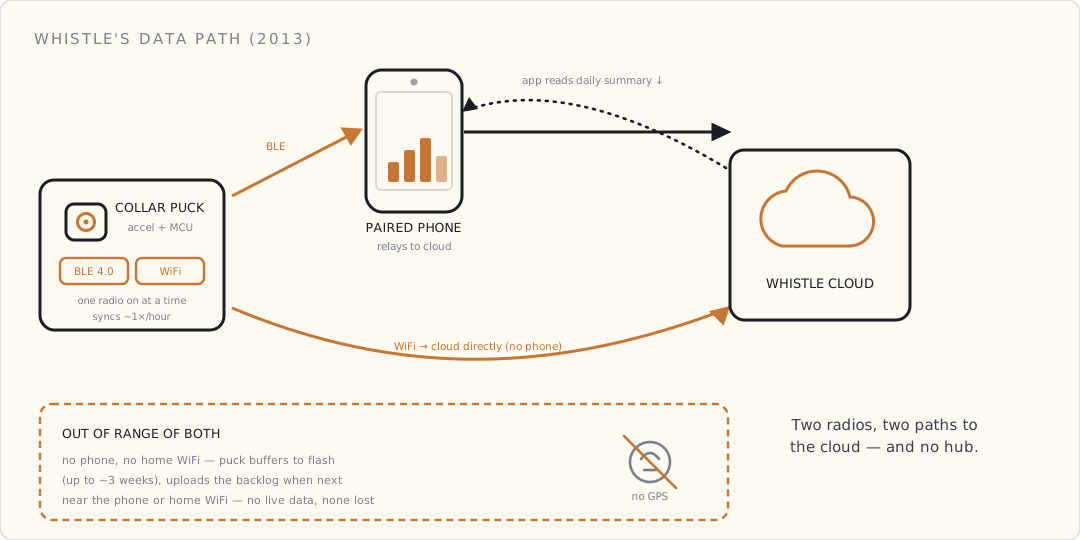
- Two radios on board: Bluetooth 4.0 (BLE) and WiFi (802.11 b/g/n). No separate hub.
- Rechargeable Li-ion battery, claimed 7-10 days.
- Syncs roughly once an hour by either path — BLE to my paired phone (the phone relays the data to the cloud), or the home WiFi network directly (the puck joins our WiFi and uploads to the cloud itself, no phone needed when Atom's home).
The thing I didn't expect: there's no base station. I went in assuming a wall-powered hub — that was the shape of most 2013 home gadgets — and there isn't one. The puck talks to the internet two ways, and it does it on its own. The architecture is collar puck → (BLE-to-phone or WiFi-direct) → Whistle's cloud → iOS app.
The clever bit is power. Both radios are never on at once. The puck keeps BLE up for the low-cost case — staying loosely aware of the paired phone — and when it's time to actually push a batch of data, it powers BLE down, brings WiFi up long enough to sync, then drops WiFi and switches back. A WiFi sync is expensive in milliamp-hours; gating it to roughly hourly bursts and never running it alongside BLE is how a coin-sized Li-ion cell still claims a week and a half.
And when neither path is reachable — Atom's out on a walk, away from both my phone and home WiFi — the puck just buffers to flash, up to about three weeks of activity, and uploads the backlog the next time it's in range of either the phone or the home network. So there's no live tracking off-property, but there's also no data lost. What it genuinely cannot do is tell me where he is the moment he's out of range: there's no GPS and no cellular, only the two short-haul radios.
Compared to Whistle's older competitor:
| Whistle Activity Monitor (2013) | Tagg The Pet Tracker (2011) | |
|---|---|---|
| Radio | BLE 4.0 + WiFi (phone or home network) | Cellular (GSM) direct |
| Primary feature | Activity tracking | GPS location |
| Battery | ~7-10 days | ~2-3 days |
| Out-of-home location | None | Yes (cellular) |
| Subscription | None (one-time $129) | $7.95/month |
| Form factor | Coin-sized clip | Larger puck on collar |
Different products solving different problems. Tagg is "where is my dog if it gets out." Whistle is "how active is my dog." Whistle is cheaper, smaller, longer battery life — at the cost of zero out-of-home awareness.
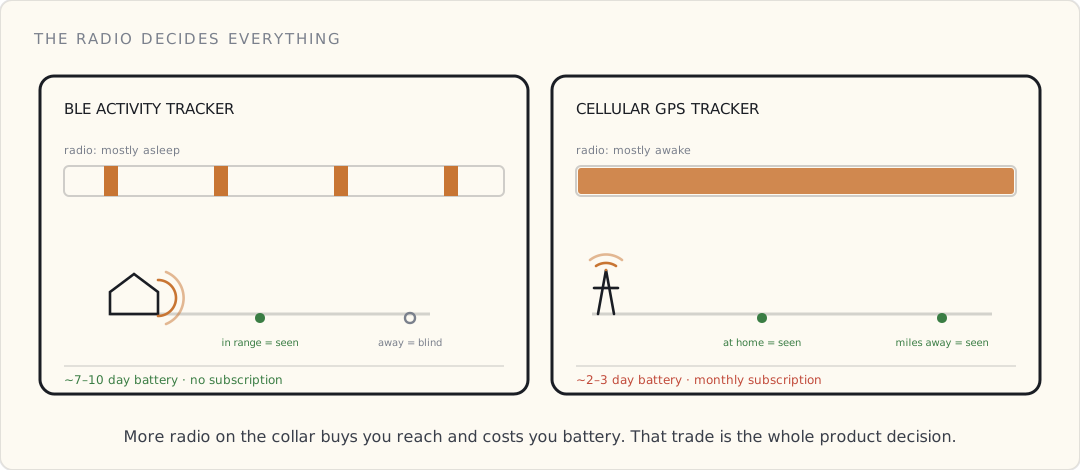
The split isn't really about features; it's about which radio you bolt to the collar, and the radio dictates everything downstream.
For Atom (8 weeks old, going nowhere unsupervised), Whistle's the right starting point. If we lose him, we have bigger problems than the tracker.
The setup, in detail
- Charge the puck on the included USB cradle (the puck drops onto contact pads, no cable into the device itself).
- Open the iOS app, set up an account, name the dog (Atom), enter breed (Labrador), weight (currently 9 lbs, growing rapidly), age (8 weeks).
- Hand the puck your home WiFi. There's no hub to plug in — the WiFi setup happens on the device via the iOS app's temporary-AP-mode dance: the puck briefly broadcasts its own
Whistle.xxxSSID, the phone joins it, the app hands over the home WiFi credentials, the puck stores them and joins the home network, and the phone rejoins home WiFi. After that the puck can upload over WiFi directly. - Clip the device to Atom's collar.
- The app calibrates against the Whistle "breed activity database" — apparently there's a model for what a healthy 8-week Lab should do daily.
Total setup: ~15 minutes. The Lab puppy was uncooperative.
What the data looks like
The iOS app shows:
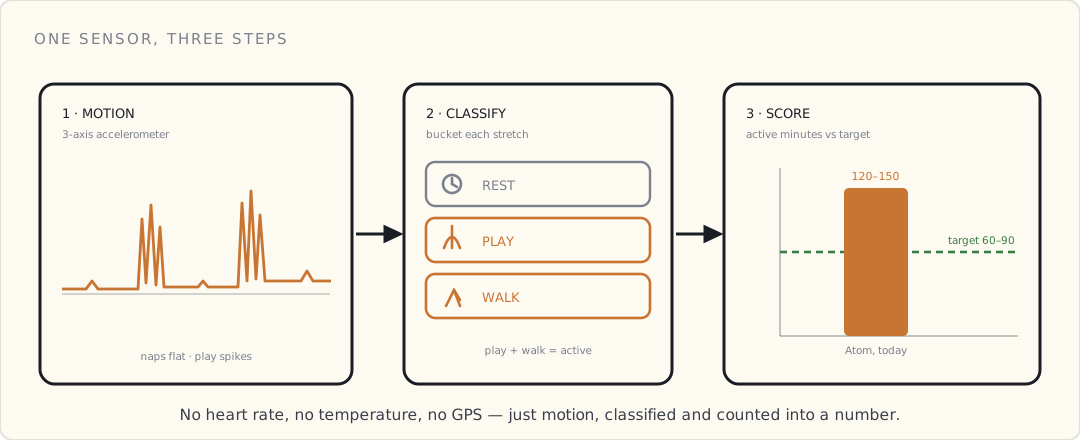
- Activity minutes per day: target based on breed/age. For an 8-week Lab puppy, target is something like 60-90 minutes/day; we've been hitting 120-150.
- Rest vs play vs walk classifications.
- Comparison to other dogs of similar breed/age — a kind of percentile rank.
The classification model is reasonable. The puppy plays in 5-15 minute bursts, then naps for 45-90 minutes. Whistle correctly classifies the bursts as "play" and the naps as "rest."
What's actually happening under the hood is simpler than the app makes it look. There are no medical sensors in the puck — just the accelerometer. The motion signal gets bucketed into rest / play / walk, the active buckets get summed into "activity minutes," and that daily total gets compared against a target the breed-and-age model spat out. Three steps, one cheap sensor.
What it doesn't show, because the hardware can't sense it:
- Heart rate, respiratory rate, temperature (no medical sensors).
- Location outside the home (no GPS).
- Specific behaviors (no camera).
The skeptic's question
Whistle is "Fitbit for dogs." The easy comparison. The harder question — and one I expect to revisit — is whether tracking activity actually tells you anything about a dog's health, or whether it's just a number we humans like looking at.
For a puppy: probably mostly the latter. He's growing; activity will fluctuate wildly; the model has no way to know if today's lower-than-baseline activity is "growing pains" or "vet visit needed." The interesting question is whether activity trends over months reveal anything a watchful owner wouldn't notice anyway.
Going to write that post in a year, after I have data.
What I'm wondering
A few open questions:
- Battery degradation. Li-ion in 7-day cycles will degrade meaningfully in 18-24 months. Replacement cost / strategy?
- Cloud dependency. Whistle's an early-stage startup. If they fold or get acquired, what happens to the cloud? My data?
- Privacy. Activity data on a dog is low-stakes. But it's also a household sensor — Whistle implicitly knows when Atom is home or not, which approximates "when are people home."
- Battery life in winter. The collar's outdoors a lot. Lithium chemistry hates cold. We'll see.
Next steps
- Compare against the Tagg cellular option in a month, after I see how often we actually need out-of-home location.
- Try the data export — Whistle claims a JSON-format export. Going to see what's in there.
- Set up some kind of integration. Whistle's cloud has an unofficial API; some hobbyists on the forums have reverse-engineered enough of it to fetch daily summaries via curl.
Welcome home, Atom. The data starts today.
 Part 02 of 42
 Tagg vs Whistle — cellular vs BLE pet-tracker philosophies
A month into the Whistle on Atom's collar, and I keep almost-buying a Tagg instead. They're the two 2013 answers to the same question — cellular GPS that finds your dog anywhere, or BLE-and-Wi-Fi activity that only syncs near home or your phone — and the difference is in the radio, not the marketing.
A month in with the Whistle on Atom's collar, and I keep finding myself in the same loop: open the app, look at his activity minutes, feel mildly reassured, then wonder what would happen if he actually got out the front door. The honest answer is the Whistle would have no idea. It counts how much he moves; it has no clue where. Which sent me down a rabbit hole on the other thing on the shelf at the pet store — Tagg The Pet Tracker — and what I found is that these two aren't competing products so much as two completely different bets about what a pet tracker is for.
Whistle shipped six weeks ago. Tagg has been out since 2011 — two years older, and built by people who think about radios for a living. Worth understanding both before I spend more money, because the choice isn't really "which is better." It's "which problem do I actually have."
Tagg: a phone for your dog
Tagg came out of Snaptracs, a subsidiary of Qualcomm. Qualcomm makes cellular chips, and you can feel that in the product — Tagg is essentially a tiny phone you bolt to a collar.
- A chunky plastic puck, around 30 g, that clips on.
- A cellular GSM modem and a GPS receiver inside.
- A rechargeable battery. The box claims up to a month — and that's true if it's sitting still in the charger pocket. The moment it's actually tracking, the modem and GPS come alive and you're looking at two, maybe three days between charges.
- No Bluetooth. No Wi-Fi. Just the cellular link.
It's $99 for the hardware and then $7.95 a month (or $79 a year) for the cellular plan, which rides on Verizon's network — fitting, given the device is essentially a Verizon modem with a GPS chip and a dog attached. Stop paying and the device stops working — there's no offline mode, because without the cellular link there's nothing for it to do.
What you get for that: real-time location, anywhere there's cell coverage. Draw a geofence around the house, and if Atom crosses it, the cloud pushes a "your dog left home" alert to my phone with a dot on a map. There's a basic step-counter in there too, but it's clearly a side feature — the accelerometer is along for the ride.
This is the "what if he gets out" product. Hunting dogs, working dogs, fence-jumpers, the dog you genuinely cannot afford to lose. For that job there's nothing else like it in 2013.
Whistle: a Fitbit that needs to come home
Whistle shipped October 8th, and made the opposite bet down to the silicon.
- A smaller, nicer coin-shaped aluminum puck — same ~30 g, but it looks like a piece of jewelry next to the Tagg.
- Two short-haul radios on board: Bluetooth 4.0 (BLE) and Wi-Fi. No cellular, no GPS. No base station — I went in expecting a wall-powered hub and there isn't one.
- Rechargeable, and the 7-to-10-day battery claim has held up so far — I've been charging it about once a week.
- It gets data off the collar two ways, both straight from the puck. Either it talks BLE to my paired phone and the phone relays to the cloud, or it joins the home Wi-Fi and uploads to the cloud itself, no phone needed. One radio at a time, roughly hourly. Out of range of both, it buffers about three weeks of activity to its flash and dumps the backlog the next time Atom's near my phone or home Wi-Fi.
It's $129 up front and no subscription. The history, the breed comparisons, all of it is free.
What it gives you: activity tracking, calibrated to Atom's breed and age — rest, play, walk, broken out by the day, with a percentile against other Labs his age. What it flatly cannot give you is location. None. The hardware can't sense it, so the app doesn't pretend to.
This is the "how's he doing" product. The healthy dog whose owner wants a trend line. Which, for an eight-week-old puppy who isn't allowed off the property unsupervised, is exactly the problem I have.
The whole thing comes down to the radio
Here's the realization that made the two click into place for me. The price difference, the battery difference, the real-time-vs-not difference — they're not three separate design decisions. They're all downstream of one choice: which radio is in the puck. Everything else falls out of that.
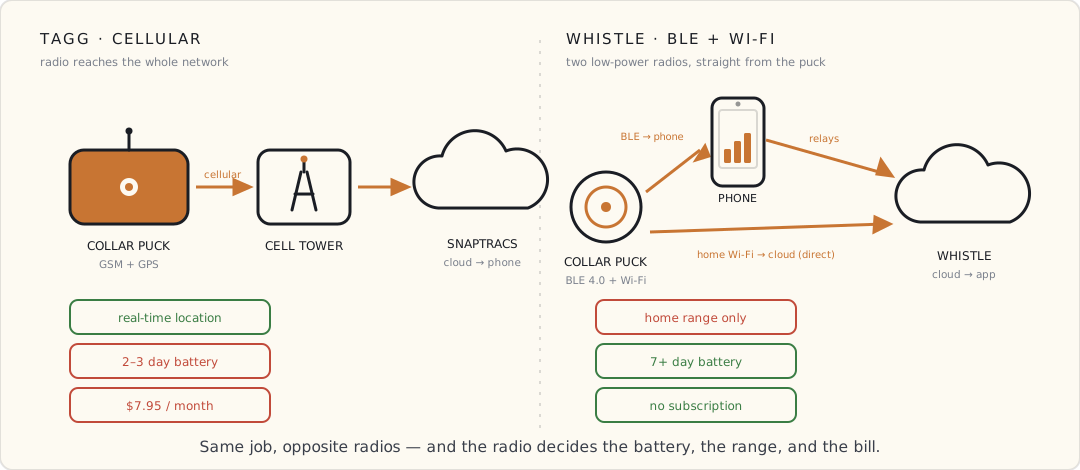
Tagg's path is short and always reaching outward: the puck gets a GPS fix, opens a cellular link straight to the Snaptracs cloud, and the cloud pushes the alert to my phone. End to end that's maybe 30 to 90 seconds — GPS lock, cellular handshake, push delivery. The catch is that a cellular modem can't be deeply asleep and still be reachable; it has to keep waking up to hold its place on the network. A radio that's mostly on is why the battery is mostly dead — two or three days, like I said.
Whistle's path reaches the cloud straight from the puck — two ways — and has a hard boundary. When my phone is near, the collar whispers BLE to it and the phone relays the batch to the cloud; when it's not, the puck brings up its own Wi-Fi, joins the home network, and uploads directly. Either way the app pulls down the day's summary. Both radios sip power next to a cellular modem, and they're never on at once — the puck keeps BLE up for the cheap case and only fires Wi-Fi in short hourly bursts to push a batch — so the collar sleeps most of the time. That's the week-plus battery. But it only works near home or my phone. The instant Atom is out of both — a walk, the car, the vet — the collar quietly buffers to its little flash and goes dark to the cloud until he's back in range of one of them.
Put the two radios on a timeline and the battery story is the whole story. The cellular modem can't ever fully sleep — it has to keep checking in with the tower to stay reachable — so its line is mostly on, and the battery drains in days. Whistle's radios are dark almost all the time and flicker awake just long enough to hand off a batch — a quick BLE advertise to the phone, or a short Wi-Fi burst to the cloud — so the line is mostly off, and the battery coasts for a week.
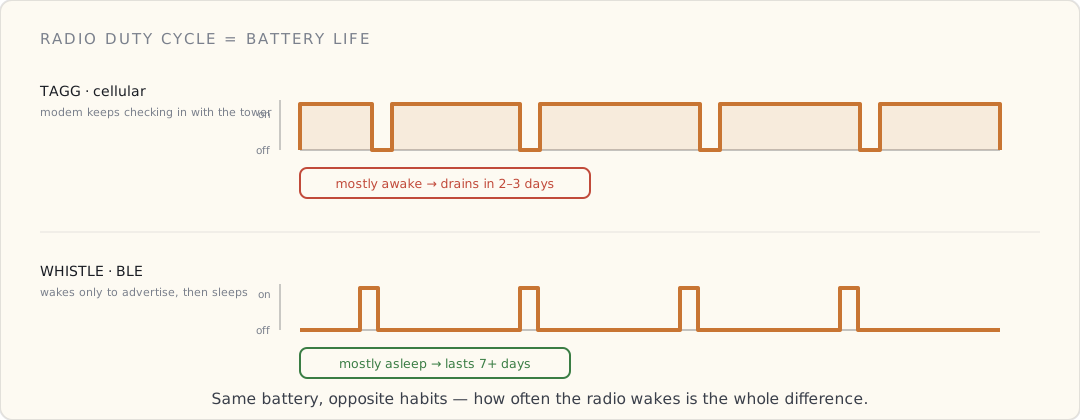
So the two architectures aren't really arguing about price. They're arguing about a physical tradeoff you can't dodge: a radio that reaches the whole cellular network and a battery that lasts the week are, in 2013, mutually exclusive in a 30-gram puck.
What it actually costs over five years
The monthly fee feels like the big number, but stretch it out and it's not even close.
| Tagg | Whistle | |
|---|---|---|
| Hardware | $99 | $129 |
| Subscription / year | $79 | $0 |
| 5-year total | $99 + $395 = $494 | $129 + $129 |
| …plus one battery-death replacement | ~$590 | ~$260 |
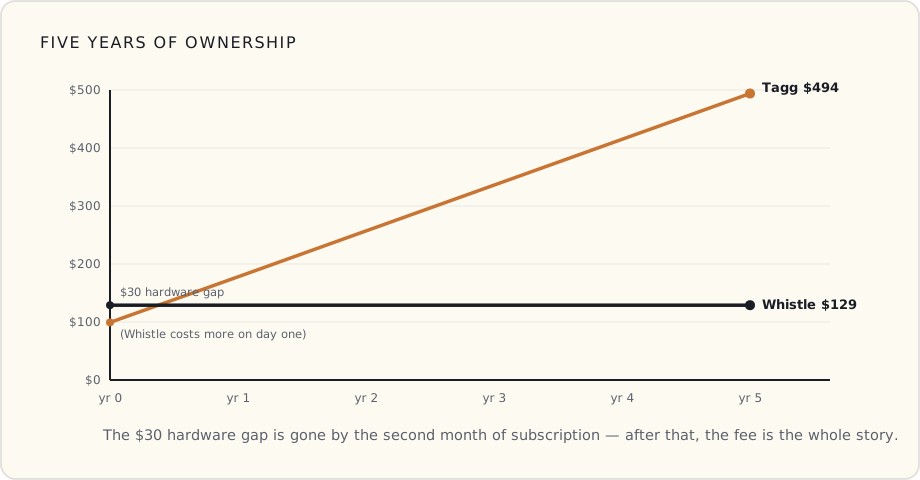
The hardware gap is $30 in Whistle's favor and feels like Tagg's the cheaper entry. Over any real ownership timeline the subscription swamps it — Whistle ends up roughly half the cost for the average dog over five years. You're not paying Tagg for a nicer device. You're paying it for the cellular bytes, every month, forever.
That's not a knock on Tagg. If the thing you need is "find my dog when he's three streets over," $79 a year is cheap insurance and the battery math doesn't matter — you'll charge it constantly and be glad it exists. It's only a bad deal if you're buying it for a job it isn't built for.
So which one for Atom
Laid out as a grid, the decision basically makes itself.
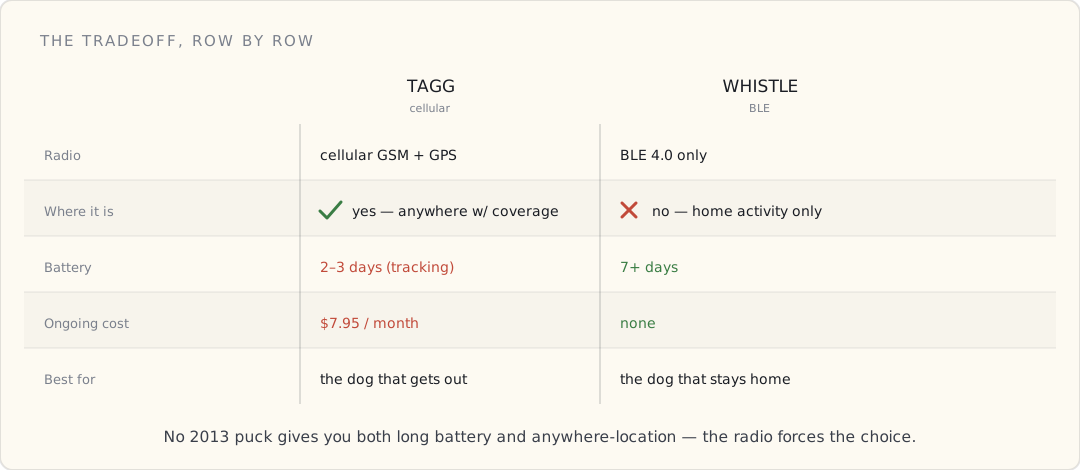
Atom is firmly in the right-hand column. Eight weeks old, never off the property without a leash and a human attached to it. If he goes missing, the tracker is the least of my problems — something has gone very wrong with the human end. What I actually want right now is exactly what Whistle does: a baseline of how a healthy puppy moves, so that a year from now I have something to compare against when I'm wondering whether he's slowing down or I'm imagining it.
If he were a beagle with a nose and a fence to clear, I'd have a Tagg on him by now and I'd grumble about charging it every other night. He isn't. So: Whistle, and the location question stays parked.
Where I think this goes
Both of these are narrow first-generation products, and you can see the move each one has to make.
Tagg already has an accelerometer in the puck — it just doesn't do much with it. Adding real activity tracking is mostly software and a better app; the sensor's already there. The harder problem is the form factor and that monthly bill.
Whistle's missing half is the whole location story, which means cellular and GPS — and that's a much bigger lift, because it drags along the exact battery-and-subscription tradeoff Whistle was built to avoid.
If I had to bet, I'd bet on Whistle making the jump before Tagg fixes its problems. Whistle has the momentum, the nicer hardware, and a brand people actually like; Tagg has the radio expertise but a clunky puck and a fee that's hard to love. The endgame I'd put money on is convergence — one device that leans on its low-power radios while the dog's home, and flips to cellular-and-GPS the moment he isn't. Sip power in the house, spend it only when the dog's actually missing. Split the battery tradeoff across the two situations instead of picking one and living with it.
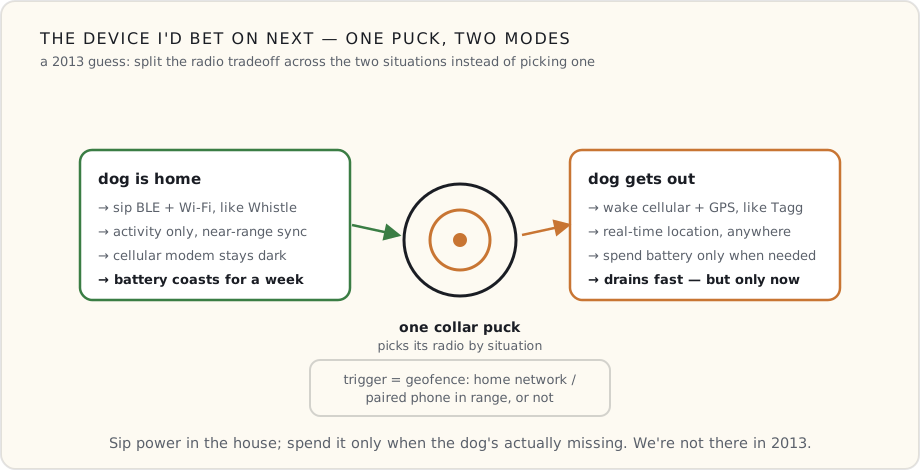
That's the device I'd actually want for Atom: a Whistle that grows a cellular radio for the day he finally figures out the gate. We're not there in 2013. But I'd be surprised if we aren't within a couple of years, and when someone ships it I'll be first in line — and I'll write it up here.
What's next
For now it stays simple: just the Whistle, just activity, and Atom going nowhere unsupervised anyway.
The next member of the household is on the way and is going to be a cat, which throws all of this out the window. Cat tracking in 2013 isn't BLE or cellular — it's a different category entirely: microchips and RFID, short-range and identity-first instead of location-first. So the next one's a primer on that — how the chip under the skin actually works, and why "tracking" a cat means something completely different from tracking a dog.
 Part 03 of 42
 Joule arrives — what a pet microchip actually is
Brought home a 9-week-old tabby and the shelter had already chipped her. So I spent the evening figuring out what's actually under Joule's skin — a battery-less RFID tag the size of a rice grain. It is not a tracker, and that distinction is the whole post.
Brought home a 9-week-old tabby kitten yesterday. Joule — named per the household physics convention (the dog's Atom, so the cat's a unit of energy). She found the highest perch in the house within an hour and stayed there until well after dark.
The shelter had already microchipped her, which is now standard before adoption. The paperwork listed a 15-digit number and a registry name and not much else. I'm six months into putting gadgets on Atom, so my first instinct was to ask the obvious engineer question: what is this thing, exactly, and how does it work? The answer turned out to be more interesting than I expected, and it cleared up a misconception I'd been carrying. So this is a primer — for me, mostly, written down so I stop being fuzzy on it.
The short version, and the thing I want to nail down before anything else: a microchip is an identifier, not a tracker. It will not tell me where Joule is. It will tell a stranger who finds her who she belongs to — and only if that stranger thinks to scan her. Those are completely different jobs, and the whole pet-tech aisle blurs them. Let me take the chip apart.
What's actually under her skin
The chip the shelter implanted is a glass cylinder about the size of a long grain of rice — roughly 12 mm by 2 mm. It sits in the loose skin between the shoulder blades, injected through a needle that's bigger than a vaccine's but not by much. Joule didn't notice; she was busy being furious about the carrier.
Here's the part that surprised me. There is no battery in there. I'd vaguely assumed a chip implanted in an animal must have some power source, a tiny cell that dies after a few years and has to be replaced. It doesn't. There's nothing to die. The chip is inert — completely dead — every second of its life except for the handful of seconds a scanner is held over it. It can sit in Joule for twenty years and work exactly as well on the last day as the first, because for nineteen years and 360-odd days it isn't doing anything at all.
Inside that glass capsule are exactly three things:
- a tiny silicon chip holding a 15-digit number, burned in once at the factory and never changed;
- a coil of copper wire wound around a ferrite core — this is the antenna, and it's also how the thing gets powered;
- a biocompatible glass shell, sometimes with a textured cap so the body grows a thin sheath around it and it doesn't migrate.
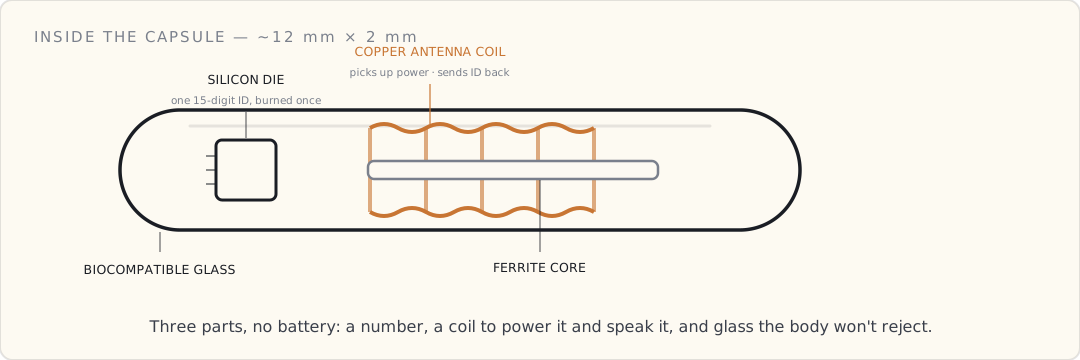
That's the entire device. No processor in the sense you'd mean it, no storage beyond the one number, no radio that transmits on its own. The cleverness is entirely in how it borrows power from the scanner — which is the next section, and the part worth slowing down for.
How a battery-less chip talks: inductive coupling
This is passive RFID, and the trick that makes it work is the same physics as a transformer or a wireless toothbrush charger: inductive coupling.
When the vet waves the handheld scanner over Joule's shoulder, the scanner isn't listening first. It's transmitting — pushing an alternating current through its own coil, which throws out an oscillating magnetic field at 134.2 kHz. That field is the whole power supply for the chip.
The chip's copper coil sits in that field. A changing magnetic field through a coil induces a current in it — that's Faraday's law, the bedrock of every electric motor and generator. So the scanner's field, washing over the chip's antenna, generates just enough current to wake the silicon up. The scanner literally powers the chip across a few centimeters of air and cat. No contact, no battery, no plug.
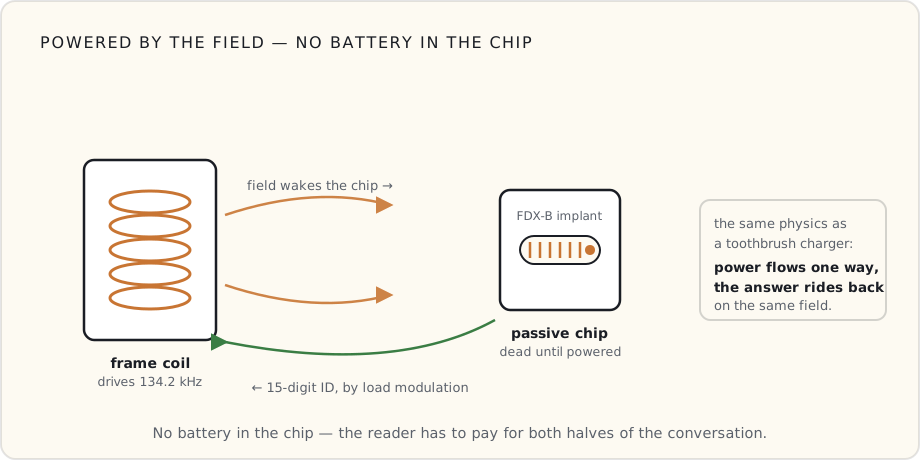
Once it has power — and only then — the chip does its one trick. It sends its number back. But it doesn't have a transmitter of its own to do that; it has no power to spare for one. Instead it does something subtler called load modulation: it switches a load across its own coil on and off in the pattern of its ID bits. Each switch tugs, faintly, on the magnetic field the scanner is still generating — like very lightly resisting a swing someone else is pushing. The scanner feels those tiny tugs as a flicker in the current it's driving, and decodes the flicker back into the 15 digits.
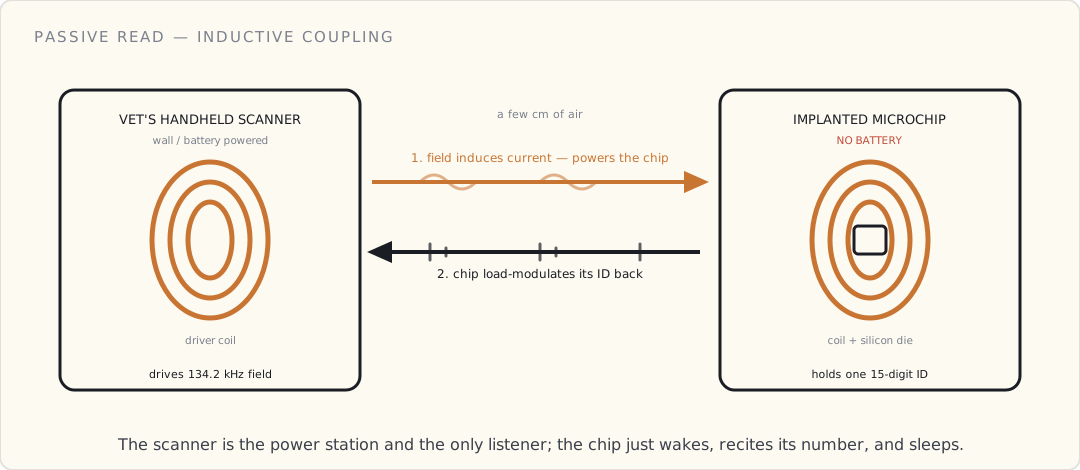
So the conversation is one-sided in a way I find genuinely elegant. The scanner is both the power station and the only thing that hears the answer. The chip is a passenger that wakes up, says its name when shouted at from a few centimeters away, and goes back to sleep. That few-centimeters range isn't a flaw to be engineered away — it falls directly out of the physics. The strength of the inducing field drops off steeply with distance, so by the time you're a hand's width away there isn't enough energy reaching the coil to power the chip at all. A passive tag with no battery cannot have range. The two ideas are the same idea.
The number is a key, not a record
The second thing I assumed wrong: I figured the chip stored Joule's name, my phone number, maybe her shots. It stores none of that. It stores one number and nothing else.
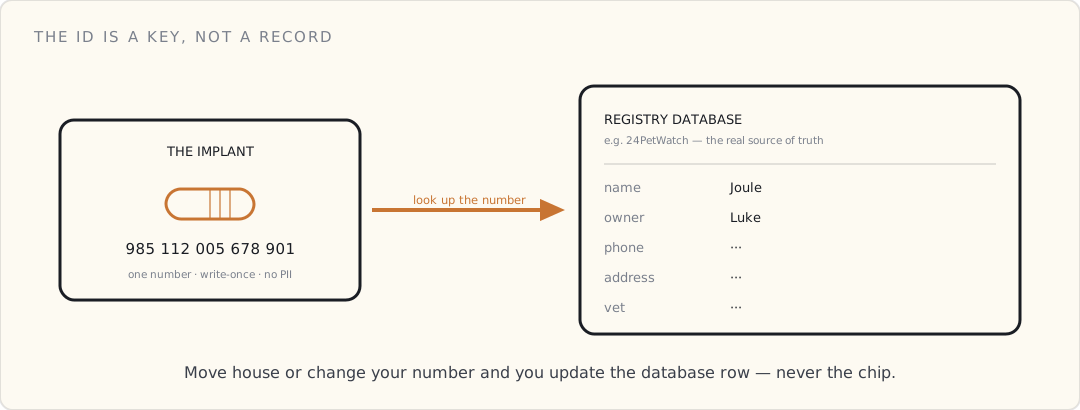
The 15 digits are a key into a database, exactly the way a primary key works in any system I've ever built. The actual record — my name, my number, Joule's details — lives in a registry the shelter enrolled her in (hers is 24PetWatch). When a vet or shelter scans a found animal, they read the number off the chip, then phone or web-lookup the registry that owns that number to reach the owner.
I like this design. It's the right one. Putting only an opaque key on the implant means:
- The implant never goes stale. I move, I change my phone number, I rehome her — I update the registry, never the chip. The chip is write-once and that's fine, because it was never the source of truth.
- There's no personal data riding around in Joule. Anyone with a scanner reads a meaningless number, not my home address. The privacy boundary is the registry login, where it belongs.
The catch is the same catch as any key-plus-lookup system: it's only as good as the row it points to. A chip whose registry entry was never filled in, or still lists the breeder, or points at a phone number from two moves ago, reads back a perfect number that resolves to nobody reachable. The chip can't be out of date; the database can, and that's the failure mode that actually loses pets. So the real task isn't the implant — it's mundane: register the number to me, and keep the contact info current. Did it last night while Joule judged me from the bookshelf.
The bit I keep coming back to: this is not a tracker
I want to hammer this because the pet-tech aisle actively muddies it, and I'd half-muddied it myself. A microchip cannot tell me where Joule is. Not roughly, not "last seen," not at all.
Walk back through the mechanism and it's obvious why. The chip has no power until a reader is pressed almost against it. It has no GPS, no cellular, no Wi-Fi, no clock, no memory of where it's been. It does precisely one thing — recite a number into a reader held a few centimeters away — and only when that reader does the work of powering and interrogating it. If Joule slips out the door and is two streets over, the chip is dark and silent, indistinguishable from a grain of rice, until some human catches her, takes her somewhere with a scanner, and waves it over her shoulder.
That's the line that matters, said plainly:
A microchip identifies a found pet. It does not locate a lost one.
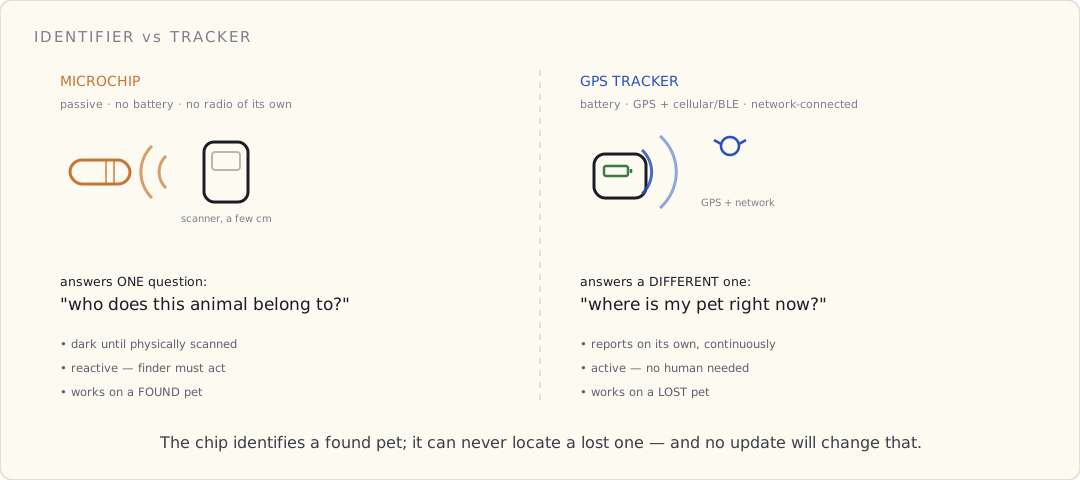
A tracker is the opposite animal in every respect. It has a battery, so it can act on its own. It has a radio that reaches a network — GPS to know where it is, cellular or BLE to report it. It pushes its location out, continuously, without being asked. That's a whole different device with a whole different bill of materials, and it's exactly what I was weighing with Tagg's cellular collar against Whistle's BLE-and-Wi-Fi puck last fall — both of them battery-fed, network-talking things you charge every few days. The microchip is none of that. It's the cheap, permanent, set-and-forget identity layer; a tracker is the expensive, power-hungry, maintained location layer. Joule has the first. If I ever want the second, that's a collar I buy and recharge, not anything you implant.
Conflating the two isn't pedantry — it sets people up to lose pets. Plenty of owners believe a chip means their cat can be located if it bolts, skip the collar tag, and only discover at the worst possible moment that "chipped" never meant "trackable." So I'm writing it down for myself in the bluntest form: the chip is insurance for getting her back if someone finds her, not a way to find her myself.
The one annoyance: which frequency is in there
The one genuinely messy part of pet microchips in the US is frequency. Joule's chip runs at 134.2 kHz, the international standard set by ISO 11784/11785 (which also defines the FDX-B encoding the number rides on). Most of the world standardized on 134.2 kHz years ago. The US dragged.
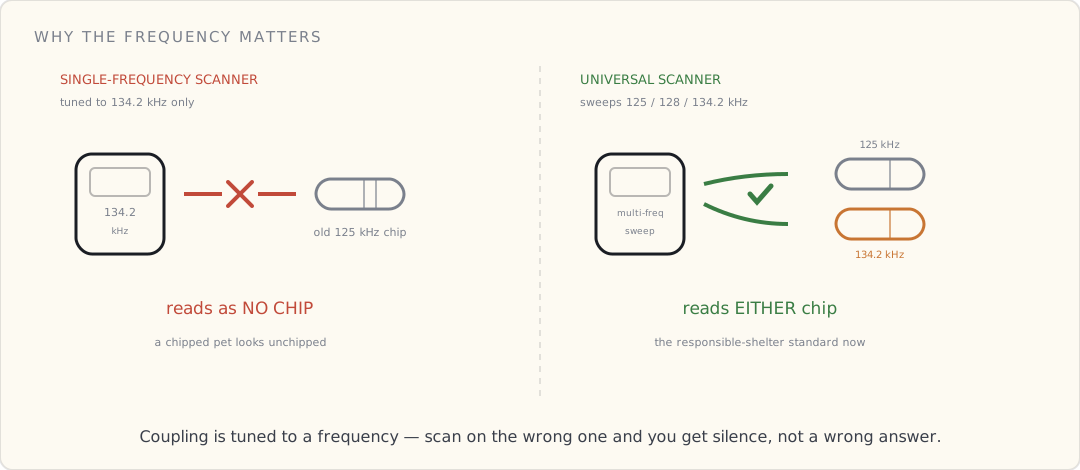
For years US chips were sold at 125 kHz and 128 kHz instead — the old AVID and HomeAgain implants. The problem is the obvious one: a scanner tuned to power and read 134.2 kHz won't necessarily wake a 125 kHz chip, because inductive coupling is tuned to a frequency. Scan a pet on the wrong frequency and you get nothing — not a wrong answer, just silence, which reads exactly like "no chip." A genuinely chipped animal can come back unchipped to a single-frequency reader.
| Implant | Frequency | Encoding | Era |
|---|---|---|---|
| ISO chips (current AVID, HomeAgain) | 134.2 kHz | ISO FDX-B | current |
| HomeAgain (older) | 125 kHz | proprietary | pre-2007 |
| AVID legacy | 125 kHz | proprietary | pre-2007 |
| AVID Friendchip | 128 kHz | proprietary | legacy |
The fix that's now standard is the universal (forward- and backward-reading) scanner — a reader that sweeps multiple frequencies so it can wake an old 125 kHz chip or a current 134.2 kHz one and not miss either. Pushed along after AVID and others were prodded to make 134.2 kHz chips detectable, shelters and vets moved to universal scanners over the last few years; that's the equipment a responsible shelter uses now, and it's why the frequency split is more historical headache than live danger today.
Joule's a kitten with a current ISO chip, so none of this bites her directly. But it's the kind of fragmentation I notice as an engineer, because the moment anyone builds a product that reads pet chips — a feeder that knows which cat showed up, a cat door that only lets the resident in — that product has to cope with whatever chip frequency the animal happens to carry. The standard finally exists; the installed base of old implants is the long tail.
What I'd tell someone with a new pet
Stripping it to what actually matters, now that I understand the thing:
- Get the chip, but it's table stakes, not a safety net. It's cheap, permanent, and battery-free — there's no reason to skip it. Just don't mistake it for protection it can't provide.
- Register the number to you, and keep it current. The implant is only a key; the registry row is the part that brings a pet home, and it's the part that silently rots when you move or change numbers. This is the only ongoing maintenance, and it's the one people skip.
- A chip is not a tracker — if you want location, that's a separate device. A collar tag with your phone number still does real work the chip can't (a finder reads it without a scanner), and if you genuinely need to locate a pet, that's a battery-powered GPS collar you charge, not the implant.
- Ask whether your vet/shelter uses a universal scanner. A single-frequency reader can miss an older chip and call a chipped animal blank.
What's next
The chip settles the identity question for Joule — passively, permanently, with no maintenance past keeping one database row honest. The far more interesting question for an indoor cat is whether identity can be made to do something: a door or a feeder that reads the same chip already in her shoulder and acts on it. That's where passive RFID stops being a filing system and starts being a sensor. There's a product I've got my eye on for exactly that — once Joule's old enough to earn outdoor privileges, it gets its own post.
Welcome home, Joule. You came pre-chipped, which means in the database, at least, you're already ours.
 Part 04 of 42
 2014 in pet IoT — the dog side grew up, the cat side never started
A full year of Whistle on Atom, eight months of Joule. The dog's activity data finally turned into something I trust; the cat's whole stack is still one chip in her shoulder. What I learned about pet-tech this year, and where I think 2015 goes.
This is the first year-end note I can actually write, because it's the first full year I've had anything to grade. Atom got his Whistle two months into his arrival in October 2013 — too late in that year to forecast anything — so there's no 2013 prediction to hold myself to. I'll just take the loss of starting mid-stream and grade 2014 on its own.
The honest one-line summary: the dog side of pet-tech grew up this year, and the cat side never got out of bed. I've got a year of Atom's data I'd act on and eight months of Joule being, technologically, a grain of rice under the skin. That asymmetry is the thing I keep coming back to.
What actually went on a pet this year
Stripped of the marketing, here's what physically entered the house in 2014:
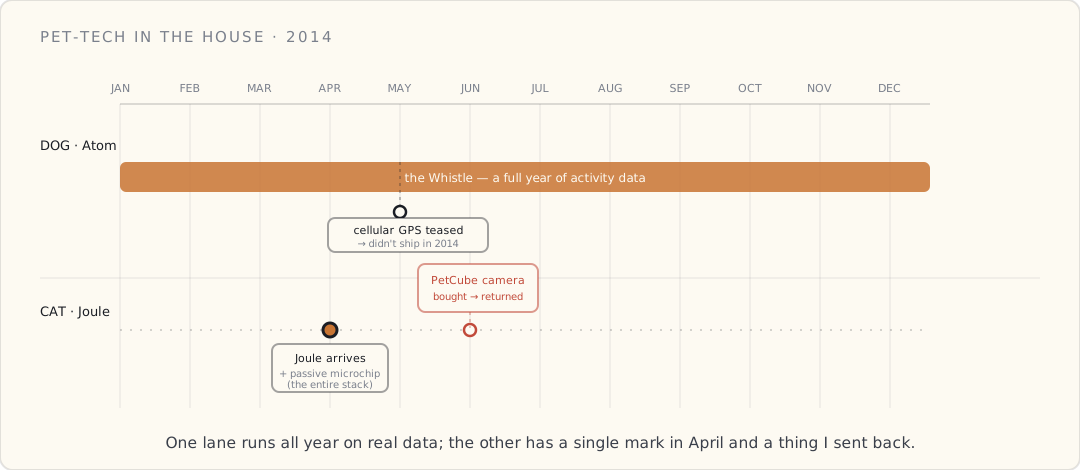
- A full year of the Whistle on Atom. The same coin-sized puck from last October — BLE and Wi-Fi in the device, no base station, no subscription. Nothing changed about the hardware all year; what changed is that I now have twelve months of motion behind it. That's the point of this entry: the device that earned its place this year is the one I already owned, just by accumulating history.
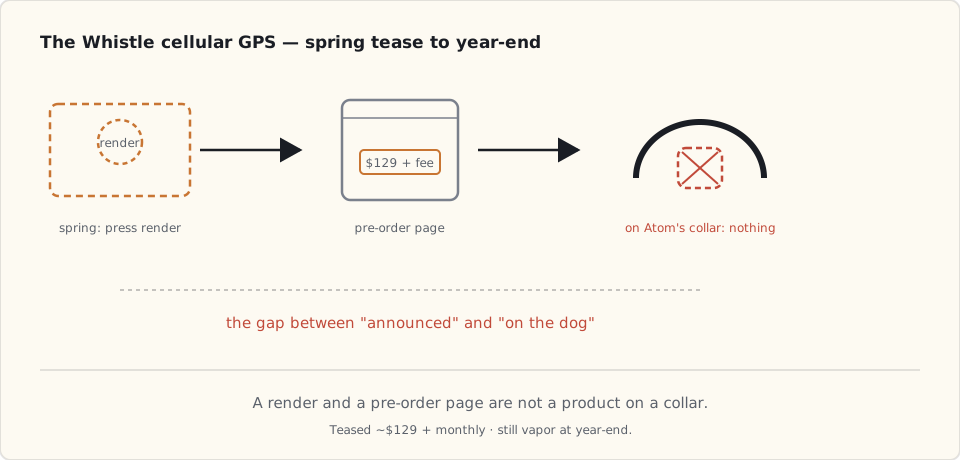
- The Whistle that didn't ship. Back in the spring Whistle teased a cellular-GPS device — the location tracker I keep saying the category needs — at around $129 plus a monthly fee. It hasn't materialized; by year-end it's still a press render and a pre-order page, not a thing on a collar. I'm logging it because it's exactly the convergence I bet on a year ago — low-power radios at home, cellular when the dog's actually missing — and the gap between "announced" and "on Atom's collar" is the whole story of consumer pet hardware.
- Joule's microchip. Implanted at the shelter in April before we brought her home — 134.2 kHz ISO, passive, no battery, fifteen digits of identity and nothing more. It is the entire cat-IoT footprint in this house, and it predates the iPhone as a concept.
- A PetCube I returned. More on that below. It did not survive contact with my actual pets.
That's the year. One device with a year of data, one chip, one return.
The Whistle cellular tease is the clearest example of the gap I keep harping on: a render in the spring, a pre-order page by summer, and at year-end still nothing on Atom's collar. The distance between those three boxes is the distance between a press cycle and a product.
What earned its place
Two things genuinely worked this year, and they're worth separating from everything that merely shipped.
Atom's own baseline finally became useful. Last year I was skeptical that activity minutes told me anything a watchful owner wouldn't already know. A year of data changed my mind — but not in the way Whistle's marketing wants. The useful signal isn't "how does Atom compare to other Labs," it's "how does Atom compare to Atom three months ago." Year over year the trace shifted in a way I can actually see: the puppy pattern of 5-to-15-minute play bursts chased by 45-to-90-minute crash-naps has flattened into adult-dog rhythm — longer continuous activity, fewer hard naps. None of that is medical. But it's a real trend line on a real animal, and the day his line drops for no reason I have a year of "normal" to measure the drop against. That's the whole value, and it took a year to materialize.
The microchip kept being the most boring, most reliable thing in the house. Joule's been to the vet twice. Both times the scanner read her chip on the first pass. No battery to die, no firmware to update, no cloud to go dark, no app to deprecate. Passive RFID from a decade-old standard is the only pet technology I own that I'm certain will still work in ten years — precisely because there's almost nothing in it to break. I keep that in mind every time I get excited about something with a radio and a subscription.
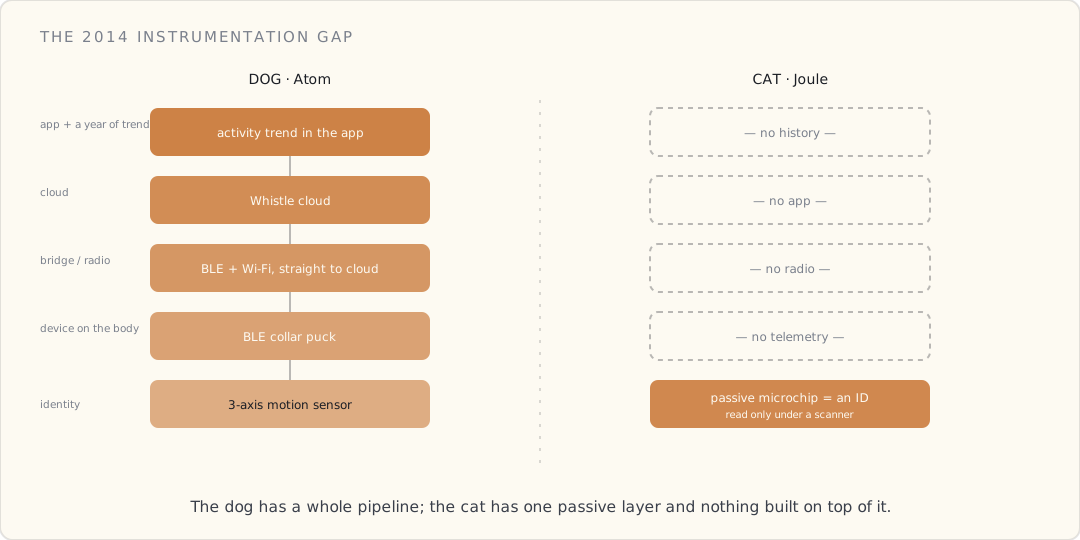
Laid out as a stack, the asymmetry is stark. The dog's pet-tech is a full sensor-to-data pipeline — accelerometer, a BLE-and-Wi-Fi puck that reaches the cloud straight from the collar, the Whistle cloud, a year of trend in the app. The cat's is a single layer: passive identity, read only when a scanner happens to be held over her. Everything above that layer — telemetry, a radio, an app, any history at all — is empty for her, and was empty all year.
What I got wrong, or wasted money on
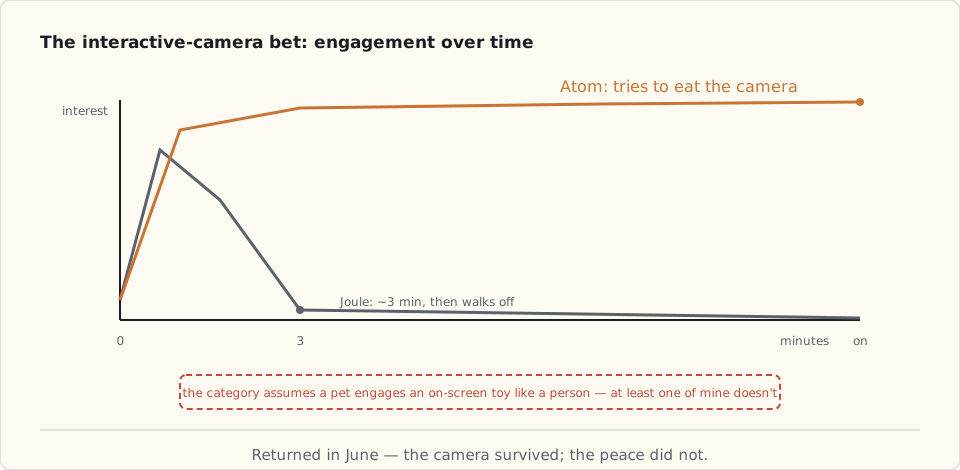
The PetCube was a mistake I should have seen coming. Interactive laser-pointer camera, marketed hard at cat owners. The pitch is that you dote on your cat from your phone. The reality in my house: Joule glanced at the laser, decided it was beneath her, and walked off — about three minutes of mild interest, total, before she lost the plot entirely. Atom, meanwhile, decided the laser was the single greatest thing that had ever happened to him and tried to eat the camera. The camera survived. The peace did not. It went back in June. The lesson generalizes: the whole "interactive camera" category is built on the assumption that a pet will engage with the same on-screen toy the way it engages with a person, and at least one of my two pets proves that wrong on contact.
The two response curves are the whole argument against the category — one pet ignores the toy, the other tries to destroy the hardware, and neither does the thing the product was sold to do.
I trusted a Kickstarter date. I backed the Petnet SmartFeeder this year — a connected, app-controlled food dispenser, exactly the kind of thing I keep saying the category needs. The ship date has already slipped from early 2015 to mid-2015, and that's before it's actually shipped, which is when dates usually slip again. I'm not out much money, but I'm logging the pattern: a connected-hardware Kickstarter date is a hope, not a delivery estimate, and the cloud-dependent ones worry me most — a feeder that bricks if the company folds is a worse feeder than the dumb timer it replaced.
Whistle's social features still leave me cold. Whistle wants me on a neighborhood activity leaderboard — compare your dog to the dogs nearby. A year in, it motivates me exactly zero, and I suspect it does real harm to anxious owners who'll read a low percentile as a verdict on their pet. The breed-comparison number was noise to begin with (Labs vary enormously); turning that noise into a competition is the part of the product I most wish weren't there.
Forecasting 2015 — guesses, with how sure I am
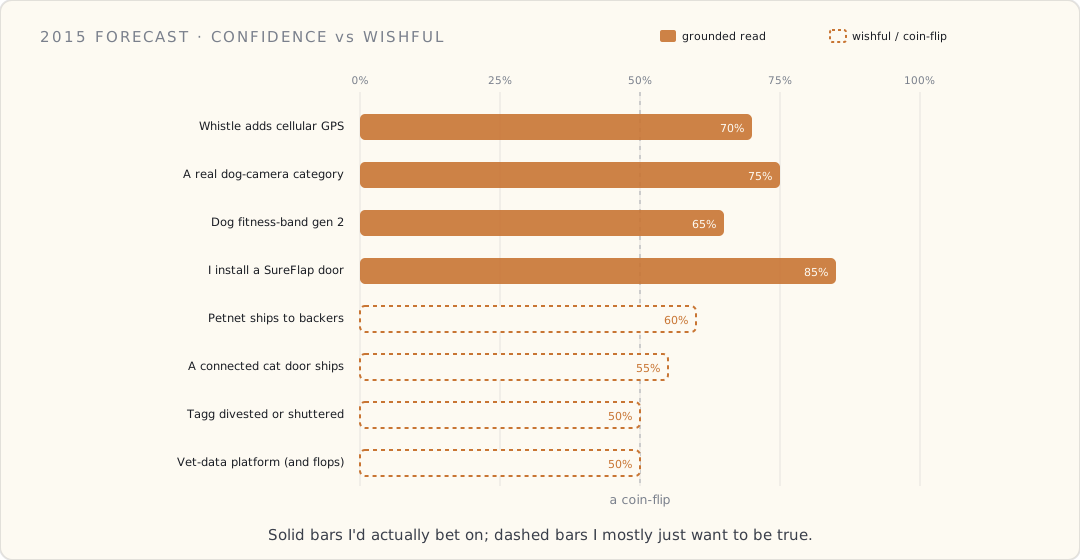
This is the part I want on the record so I can grade myself next December. None of these are knowledge; they're bets, and I'm writing down my confidence so the table is honest about which ones are real reads and which are wishful.
| # | What I expect in 2015 | Confidence | Read or wish? |
|---|---|---|---|
| 1 | Whistle actually ships the cellular-GPS model it teased this spring — or acquires Tagg to get the radio | 65% | Read — the announcement's real; whether hardware follows the render is the bet |
| 2 | Tagg's parent (Snaptracs/Qualcomm) divests or shutters it | 50% | Read — coin-flip; Qualcomm doesn't love consumer hardware |
| 3 | A connected SureFlap-style cat door — chip detection plus an app — reaches retail | 55% | Mostly wish — the hardware exists; the will is the question |
| 4 | Petnet actually ships to backers in 2015 | 60% | Hopeful — I want it; dates say maybe |
| 5 | A real dog-camera category forms (more than one credible product, not just PetCube) | 75% | Read — the demand is obviously there |
| 6 | I install a manual SureFlap microchip door for Joule once she's old enough for outdoor access | 85% | This one's on me, not the market |
| 7 | The dog "fitness band" form factor settles down — a credible second product that fixes the obvious first-gen mistakes (mount slips, battery claims, the social leaderboard nobody asked for) | 65% | Read |
| 8 | Somebody pitches a "send your pet's data to your vet" platform — and it won't get adoption, because vets aren't asking for it | 50% | Read, including the failure |
The thing I'm genuinely unsure about isn't whether the dog side grows. It will; it has products, a market, and money chasing it. The open question — the one this whole notebook keeps circling — is whether the cat side ships a single meaningful connected product in 2015, or whether Joule spends another year as the most analog member of an increasingly instrumented household.
What I'll actually spend money on next year
Separate from the forecast — these are things I intend to buy, market permitting:
- A manual SureFlap microchip door for Joule when she's old enough to go outside. Not the connected version, if it even exists yet — just the proven battery-and-latch one. I want the reliability first and the telemetry later.
- Whatever Whistle actually ships next — the cellular model if the teased one becomes real — mostly to see whether they solve location without wrecking the week-plus battery that's the entire reason the activity puck works.
- An early dog camera, if something credible shows up and the reviews are kind. PetCube taught me to wait for the second product in a category, not the first.
- The Petnet feeder, if and when it actually arrives — and I'll judge it hard on what it does when the cloud is unreachable.
What's next
Two posts I can already see coming. First, mid-year: the SureFlap install — the first piece of real, if dumb, cat hardware in the house, and a primer on how it gates the door on Joule's chip. Then, whenever Whistle finally grows a location radio, the comparison I've wanted since last year — the activity-only puck against whatever-it-becomes, on the same dog, with a year of baseline already in the bank.
The dog side will keep filling in on its own. I'll keep waiting on the cat side, and writing down what I find when I poke at it.
 Part 05 of 42
 SureFlap microchip cat door — Joule's first pet IoT
Joule turned one and earned yard privileges, so I installed a SureFlap microchip cat door. It reads the same chip the shelter put in her shoulder and unlatches only for her. Notes on the read-and-latch loop, the chip allow-list, and why calling this 'IoT' is generous — there's no network anywhere in it.
Joule turned a year old last week. She's been an indoor cat since she arrived as a kitten, but the fenced back yard is hers to earn now, and I wanted her to come and go on her own schedule instead of mine. So this weekend I cut a hole in the back door and installed a SureFlap Microchip Pet Door — the DualScan model, the one that checks her chip on the way out as well as the way in.
I want to be honest about why I'm writing this one up, because the framing matters. I keep wanting to call it Joule's first IoT device — the first connected thing I've put on the cat side of the house, the way Atom's Whistle was the first on the dog side. But that's not what this is. There is no network in this door anywhere. No Wi-Fi, no Bluetooth, no app, no cloud, nothing it phones home to and nothing it talks to. It's a battery, a coil, a little reader, and a latch. Everything it does, it does inside the door frame, and then it forgets it happened.
That gap between what I want to call it and what it actually is turned out to be the whole point. So let me take it apart.
What's in the frame
The door is a frame-mounted flap, roughly 22 by 22 cm of clear plastic on a hinge, set into a hole I cut in the back door. No mains power runs to it — it lives on four C-cell alkalines in the frame, and SureFlap claims about a year on a set. That single fact tells you most of what you need to know about its ambitions: a device that has to sip from four C-cells for a year is not a device that's running a radio.
Inside the frame, in order of how a read actually happens:
- An RFID reader coil wound into the frame around the opening, tuned to read the same passive pet microchips a vet's scanner reads.
- A small microcontroller that decodes the chip number and checks it against a stored allow-list.
- A latching solenoid on the flap — the actuator. It physically holds the flap locked, or pulls a bolt back to release it.
- A few status LEDs on the inside housing: ready, reading, denied.
That's the entire bill of materials, more or less. A reader, a brain, a lock, and a battery. The cleverness is in the loop those four parts run, not in any one of them.
The read-and-latch loop
When Joule walks up to the door, here's what happens, start to finish, in well under a second:
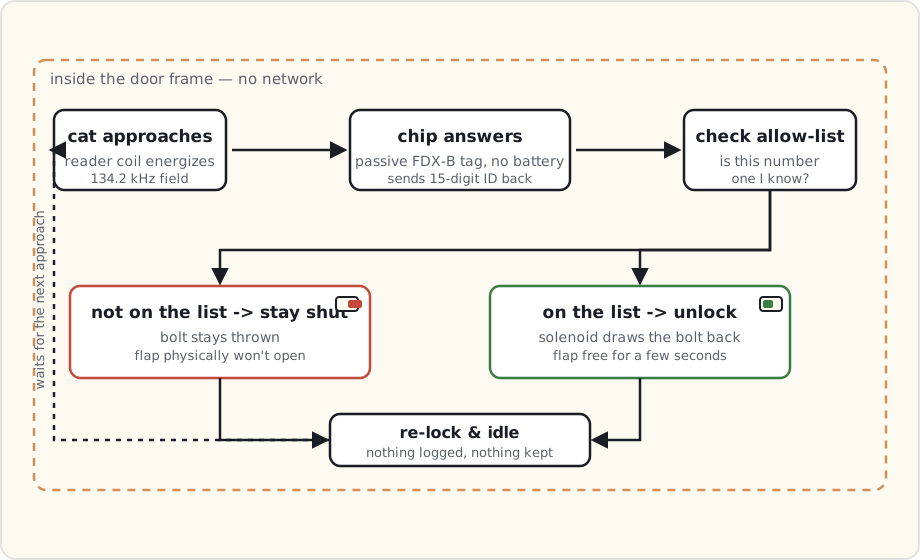
- The reader energizes. The frame coil throws out a 134.2 kHz field, the same trick a handheld scanner uses. (I took this apart in detail when Joule arrived — it's inductive coupling, the same physics as a wireless toothbrush charger.)
- Joule's chip answers. Her implant is a passive ISO FDX-B tag — no battery, dead until a reader powers it. The frame's field wakes it across a few centimeters, and it recites its 15-digit number back by load-modulating the coil.
 3. The microcontroller checks the number against the allow-list stored in the door. This is the entire decision: is this number one I know? 4. The latch acts. Known number, the solenoid pulls the bolt back and the flap is free to swing for a few seconds. Unknown number — or no number at all — the bolt stays thrown and the flap physically won't open. 5. It re-locks and forgets. The door goes back to idle, waiting for the next approach. It doesn't log the read. It doesn't count it. The event is gone the instant it's over.
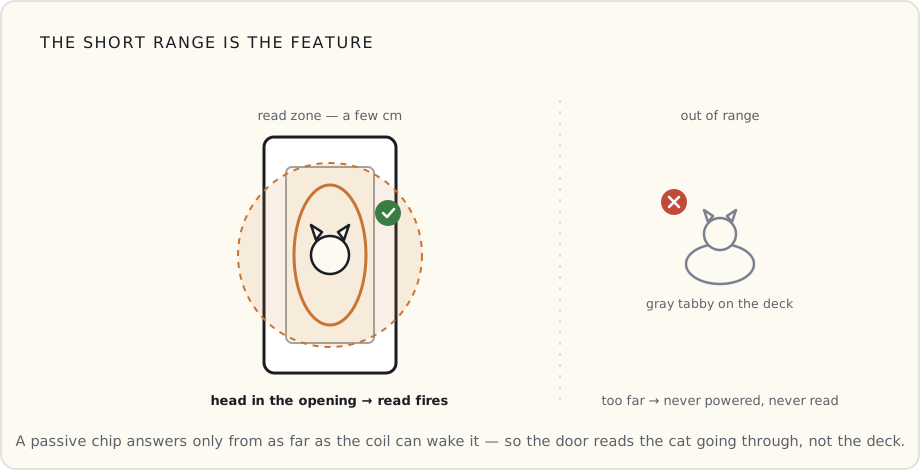
The read range is the thing people get wrong about these doors, and it's worth dwelling on because it's not a flaw — it's the same physics constraint I hit on the implant side. The coil only powers the chip across a few centimeters, so Joule has to bring her head most of the way into the opening before the read fires. You can't game that range up. A passive chip with no battery of its own can only be read from as far as the reader can push enough power to wake it, and that distance is short by nature. Here, short is exactly what you want: it means the door reads the cat going through it, not every animal milling around on the deck.
The allow-list — teaching it Joule
Configuring which animals get in is the part SureFlap got genuinely right, and it's a nice little piece of design precisely because it has no app to lean on. There's no screen, no pairing, no account. The door learns chips by being shown them:
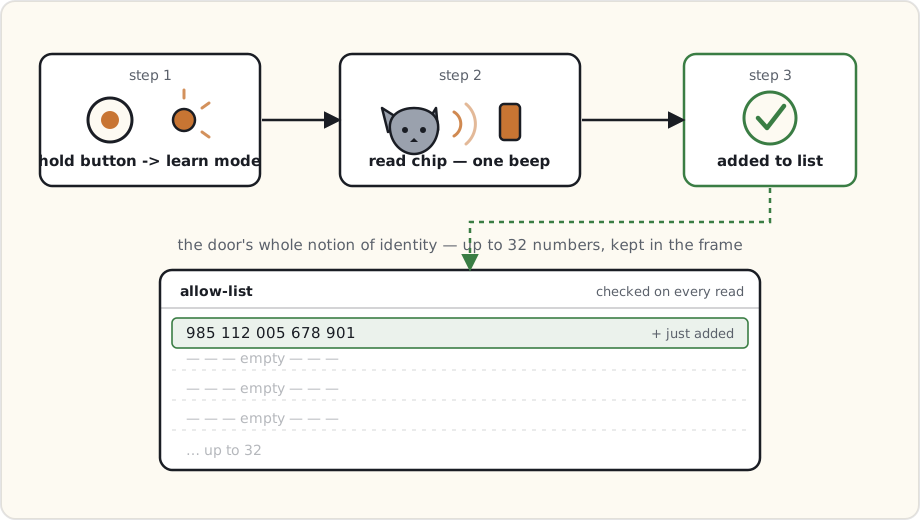
- Hold the button on the back of the frame until the LED flashes — that's learn mode.
- Hold the cat up to the flap. The reader reads her chip the same way it will in normal use, and the door beeps once to confirm it captured the number.
- The number is written to the allow-list. Done. Back out of learn mode and the door now unlocks for Joule and nothing else.
The door holds up to 32 chips, which is its honest answer to the multi-cat household — every resident animal you want through that door gets shown to it once. (Whether anyone has a genuine 32-cat use case I'll leave alone.) The list is the door's whole notion of identity: a flat set of numbers it trusts, checked on every read. It's the simplest possible access-control list, and for one cat and a back door, simple is the right amount.
DualScan — and why I paid the small premium
The base SureFlap reads chips on the way in only: known cats enter, strange cats stay out, and anyone inside can leave freely. The DualScan model I bought reads on the way out as well, which means the door can make per-direction decisions:
Joule:   in  -> allowed always
         out -> allowed (yard privileges)

a future indoor-only cat:
         in  -> allowed always
         out -> denied (kept inside)
For us today — one cat, a fenced yard, me usually around — the outbound check isn't doing much load-bearing work yet. Joule's allowed out, full stop. The reason I paid the small premium anyway is that the local "deny exit to this specific animal" capability is the kind of thing you can't add later in software, because there's no software to add it to. If we ever bring home a second cat that should stay strictly indoors, the door already reads it on the way out and can refuse it. Buying the capability now is cheaper than re-cutting the door later.
A week in
A week of real use, and the honest scorecard:
- Read reliability has been 100%. Joule's gone through perhaps forty times. Every read fired on the first approach. I half-expected to see her sit confused at a door that wouldn't open; haven't once.
- It rejected the neighbor's cat, which was the actual point. There's a gray tabby that's been treating our deck as its own for months. It walked up to the new door, pushed, and the flap simply didn't move — no chip it recognized, no unlatch. It tried a few times and gave up. That's the moment the whole purchase justified itself: an unfamiliar animal physically can't get the door to act for it, because it isn't carrying a number the door trusts.
- Battery indicator still reads full. Too early to grade the year-long claim, but a week in there's no movement.
The failure mode I keep poking at is the battery one. The latch is a solenoid — it needs current to pull the bolt. As the C-cells age, the pull weakens, and the obvious bad day is a dead battery at 2 AM with Joule on the wrong side of a door that no longer has the muscle to unlock. I don't yet know how the door fails — whether it fails locked or fails open as the voltage sags. That's the first thing I'll find out when the batteries get low, and it's exactly the kind of behavior I'd want spelled out and, ideally, warned about in advance. Right now I just have a "battery low" LED and my own attention.
The thing it can't tell me
Here's where I keep circling back, because it's the engineer's itch this door doesn't scratch. It runs that read-and-latch loop dozens of times a day, and it throws every bit of it away. Sitting right there, unrecorded, is data I'd genuinely use:
- How often Joule goes out. A count per day is a behavioral baseline. A cat that suddenly doubles its trips, or stops going out entirely, is telling you something — but only if something's keeping score.
- How long she stays out. Average duration is the kind of routine signal that makes the abnormal day visible.
- How often the neighbor's cat is trying. The door knows every refused read. I'd love to know whether the cat cold-war on the deck is escalating or fading.
- Battery health as a number, not a binary LED — so the 2 AM failure announces itself days early instead of at the door.
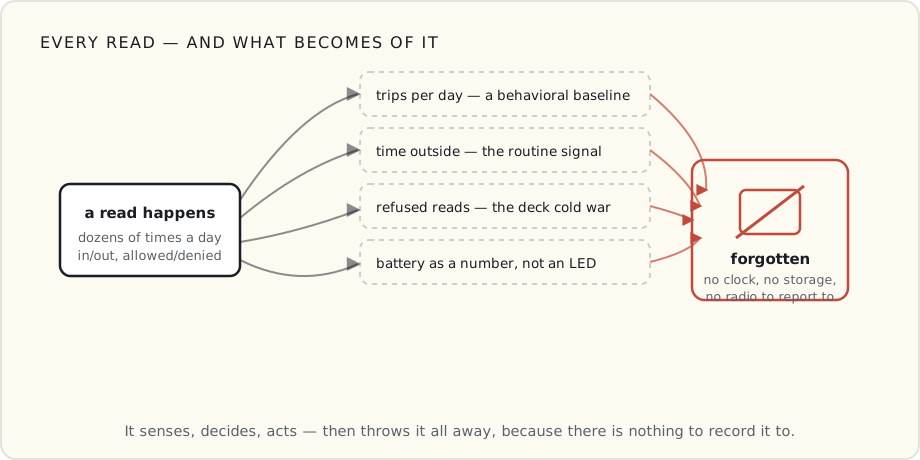
None of that leaves the frame, because none of it is recorded, because there's nothing to record it to. And that's the line I want to sit with rather than gloss over. Every one of those would need the door to remember across reads and then report somewhere — a clock, some storage, a radio, something on the other end listening. The door has none of those, on purpose, because each one costs power it doesn't have and complexity it doesn't need to do its one job. It is a near-perfect example of a device that is "smart" in the narrow sense — embedded logic wrapping a sensor and an actuator — and not at all "connected." In 2015, for a cat door, that narrow kind of smart is the entire market.
So is it IoT?
Back to the framing I started with. I wanted to file this as Joule's first IoT device, and I don't think I honestly can. There's a sensor (the RFID reader), there's logic (the allow-list check), there's an actuator (the latch) — the embedded-systems half of the story is all here. What's missing is the part the "internet" in "Internet of Things" is actually pointing at: the network, the other side, the data that outlives the moment. This door is an island. It senses, it decides, it acts, and it forgets, all within four C-cells and a plastic frame, and it never once needs to reach anything beyond itself.
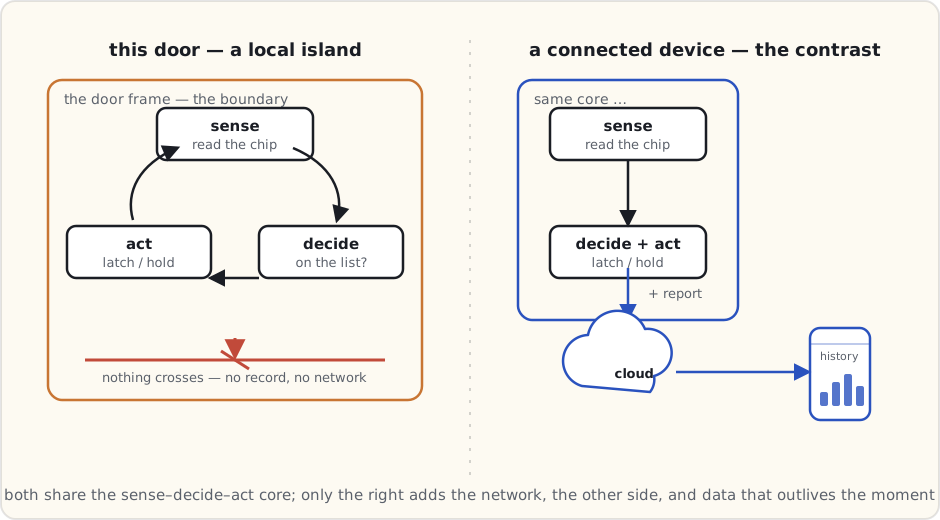
Which makes it a clarifying object to own right at the start of the cat-IoT story. It shows you the floor: you can build something genuinely useful — identity-gated physical access, working reliably, rejecting intruders, on a year of battery — with no network at all. Everything a connected version would add sits on top of this floor, not under it. The read-and-latch loop is the same loop either way; "connected" would just mean a second device, somewhere, that gets to hear about the reads. SureFlap may well build that someday. The door I installed this weekend doesn't, and watching it work has made me a lot more precise about what I actually mean when I call a thing "smart."
What I'd tell someone shopping for one
- Buy it for the access control, not for data — there is no data. It gates who comes through a door, reliably, and that's the whole job. If you want a record of your cat's comings and goings, this is not that device and doesn't pretend to be.
- The short read range is the feature. Don't read "a few centimeters" as a weakness. It's what makes the door respond to the cat using it rather than every animal nearby, and it falls straight out of how a passive chip works.
- Get DualScan if there's any chance of a second, indoor-only cat. The per-direction lock is local and can't be bolted on after the fact. It's a cheap insurance against a future you might have.
- Plan for the battery failure before it happens. Know which way your door fails when the cells sag, keep an eye on the low-battery LED, and don't let a solenoid that's run a year talk you into ignoring it.
What's next
The cat side of the house now has exactly one device, and it's a door that forgets everything. The dog side is about to get more crowded — there's a second activity tracker shipping this summer that I want to put on Atom's collar next to his Whistle and run head-to-head, because two accelerometers on one dog is the only honest way I know to find out which one is telling the truth. That comparison is the next post. For now: hole cut, flap hung, Joule outside in the sun, and the gray tabby across the deck looking personally insulted.
 Part 06 of 42
 FitBark — the pet activity-tracker market in 2015
Two activity trackers on one dog's collar for a week — the bone-shaped FitBark next to Atom's Whistle. Notes on what's actually different (it's the radio, not the data), where they disagree, and whether a second number told me anything the first one didn't.
I backed FitBark on Kickstarter back in 2013 — same season Atom came home and I put a Whistle on his collar. The pitch was a Fitbit for dogs, bone-shaped, cheaper than the Whistle, and tiny. It took its time getting here the way crowdfunded hardware always does, but it finally landed, so I did the obvious thing: clipped it onto Atom's collar right next to the Whistle and ran both for a week. Same dog, same walks, two devices counting the same wiggles. I wanted to know what a second activity tracker would tell me that the first one hadn't — and whether two of them on one Lab would even agree.
This isn't a buyer's-guide post. It's the same question I keep circling in this notebook: does more pet data actually help, or am I just collecting numbers I like looking at?
They look like competitors. The difference is the radio.
On the shelf these read as the same product at two prices — a small thing that clips to the collar, counts how much the dog moves, and shows you a graph on your phone. But the interesting difference isn't the price or the shape. It's the same thing it was when I put Tagg and Whistle side by side two years ago: which radio is in the puck, and therefore how the dog's data gets home.
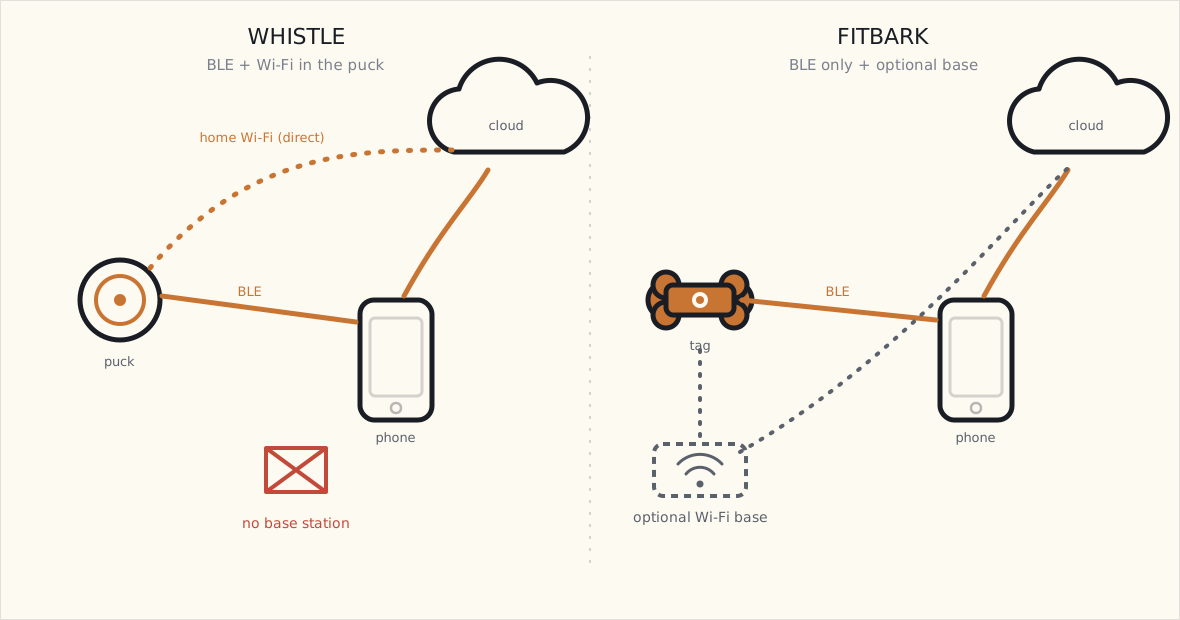
The Whistle Atom wears carries two radios — Bluetooth 4.0 (BLE) and Wi-Fi — right in the puck, and no separate hub. It gets data off the collar two ways, both straight from the device: BLE to my paired phone, which relays to the cloud, or it joins the home Wi-Fi and uploads on its own with no phone in the loop. When Atom's home and I'm at the office, the Whistle still syncs over the house Wi-Fi by itself. I went in two years ago expecting a wall-powered base station and there wasn't one; there still isn't.
The FitBark made the opposite call: BLE only. The bone talks Bluetooth Smart to your phone — about a 30-foot reach — and that's the whole radio story on the device itself. No Wi-Fi in the tag. When your phone isn't near it, the FitBark doesn't sync; it just keeps logging activity to its own memory and dumps the backlog the next time an authorized phone is in range. If you want it to sync while the dog's home and your phone is at work, FitBark sells a separate Wi-Fi Base Station — a little always-on hub you plug into your router that auto-syncs any FitBark nearby. It's an optional accessory you buy on top of the tag, not part of it. (It showed up earlier this year; I haven't bought one.)
So the thing the marketing photos hide: the base station belongs to FitBark, as an add-on for the radio it left out — not to Whistle, which baked Wi-Fi straight into the puck. That's the inverse of what I'd have guessed from the box.
Everything else falls out of that one radio choice:
| Whistle Activity Monitor | FitBark | |
|---|---|---|
| On-collar radio | BLE 4.0 + Wi-Fi (no hub) | BLE 4.0 only |
| Away-from-phone sync | Yes — over home Wi-Fi, on its own | Only with the optional Wi-Fi Base Station |
| Form factor | Aluminum coin puck, ~30 g | Bone-shaped polycarbonate, ~10 g |
| Battery | Rechargeable Li-ion, ~7–10 days | Replaceable coin cell, ~6 months |
| Subscription | None | None |
| Up-front price | ~$129 | ~$69 |
| Water rating | IP-rated splashproof | IP67 (better; survives a dunk) |
The trade is clean once you see it through the radio. Whistle put Wi-Fi in the puck, so it can phone home by itself — and pays for that radio in milliamp-hours, which is why it's a rechargeable cell I top up about once a week. FitBark left Wi-Fi out, so the tag sips so little that a coin cell lasts roughly six months and you swap it like a watch battery — but the dog's data is stuck on the collar until a phone (or that extra hub) comes to collect it. Lighter, cheaper, longer-lived; quieter when you're not around. Neither is "better." They optimized different ends of the same wire.
Same dog, same week, two opinions
The hardware is the interesting part. The data turned out to be the honest part.
I ran both for seven days — same collar, same walks, same naps. The Whistle's numbers are calibrated to Atom's breed and age the way they have been since he was a puppy; FitBark has its own model. Two accelerometers, two daily "active minutes" totals.
Day over day, the shape of the week is identical on both. Saturday and Sunday spike — longer weekend walks. Wednesday sags — it rained and we stayed in. If you laid the two weekly lines on top of each other, every up and every down lands on the same day. Both devices are clearly watching the same dog.
But the size is consistently off. FitBark reports somewhere around 15–20% more active minutes than Whistle, every single day. Not noise — a steady offset. And it isn't that one of them is "right." They've each drawn the line between resting and active in a different place. FitBark's threshold sits lower, so an amble across the yard that the Whistle files under "rest" gets counted as activity. Same motion, lower bar, bigger number.
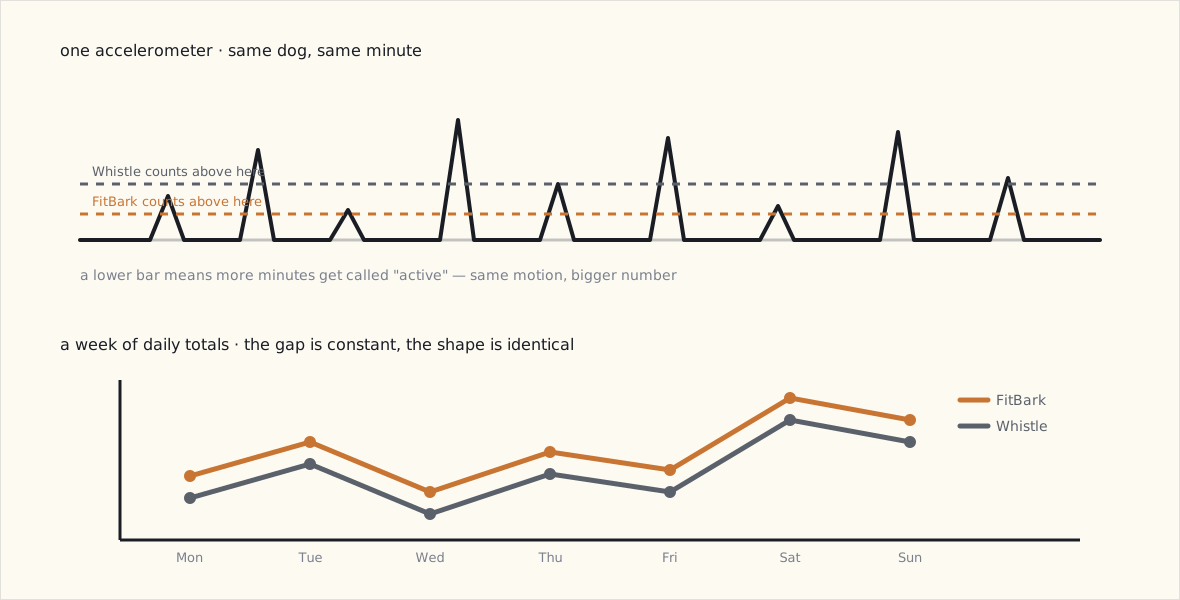
That reframed the whole "which is more accurate" question for me. Neither is measuring minutes the way a stopwatch measures minutes — they're both summing motion above a threshold somebody picked, and calling the sum "active minutes." The number is part dog, part product decision. So:
- For trends, both are fine. Is Atom more active this month than last? Either device answers that, because the offset cancels — you're comparing the device to itself.
- As an absolute, neither travels. If I tell the vet "Atom does about 100 active minutes a day," that's a Whistle sentence or a FitBark sentence, not a fact about Atom. Switch devices and the number jumps a fifth with no change in the dog.
Which is the thing I'd actually tell another owner: don't quote the number, quote the trend. The trend is the dog. The number is a setting.
The one place the data genuinely diverges: sleep
The trend lines being parallel means the two devices mostly tell the same story. There's one spot where FitBark surfaces something the Whistle doesn't, and it's the only feature difference I ended up caring about.
The Whistle buckets the day into rest, walk, and a vigorous "play." FitBark adds a distinct sleep bucket — it separates a daytime nap from genuine overnight sleep, using how long the dog's still and the shape of the accelerometer trace. The Whistle lumps both under "rest."
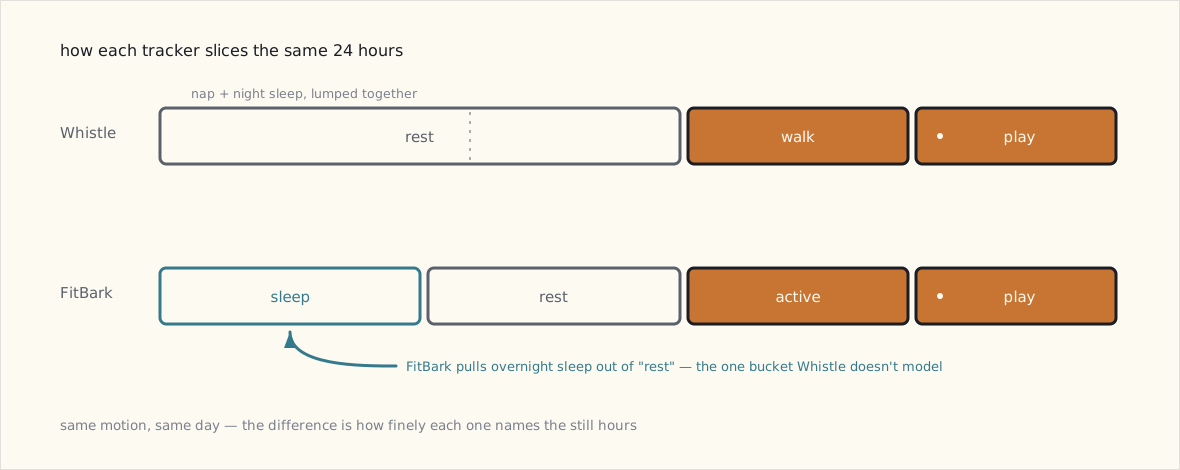
For a two-year-old Lab in good health that's a curiosity more than a tool. But "did he actually settle and sleep through the night, or was he restless?" is a real question I can imagine mattering later — an older dog, a dog on a new medication, a dog you're watching for a reason. The Whistle simply can't answer it; it doesn't model sleep as its own thing. FitBark can. Noted for the day it's not academic.
Everything else in the two apps is a wash. Both have a calendar, a daily view, goals, and a social feature for comparing your dog to other dogs — FitBark normalizes activity across breed and size so you can stack your Lab against someone's Beagle; Whistle does the same thing under a different name. I have never once changed anything I do because of a friend-comparison screen, on either app. It's the pet-tech version of a leaderboard nobody asked for.
The thing that actually earned its keep: an official API
Here's the difference that changed my own behavior, and it has nothing to do with the dog.
I've been logging Atom's activity to my home server since 2013, and on the Whistle side that's meant scraping an unofficial, reverse-engineered endpoint — the hobbyist trick I mentioned the week he arrived. It works until Whistle ships an app update and quietly changes something, and then it doesn't, and I find out when the graph goes flat. There's no contract; I'm a guest who hasn't been invited.
FitBark is going the other way — opening up an official developer API, the documented kind where you register an application, do a normal OAuth handshake, and pull daily activity back as JSON from an endpoint they actually want third parties on. That's the difference between an integration I have to babysit and one with a contract behind it. So I've started moving my home-server logging over to it. For most owners this is irrelevant. For the kind of person who keeps a dog's activity in a database next to the thermostat logs, it's most of the reason to lean one way — and it's the more telling signal about which company is thinking about its data as a platform versus a walled garden.
Where each one sits in 2015
Laying the field out by what I actually care about — how long between charges, and how far from home it can still tell me anything — the two of them land almost on top of each other, and a long way from the thing I keep wishing existed.
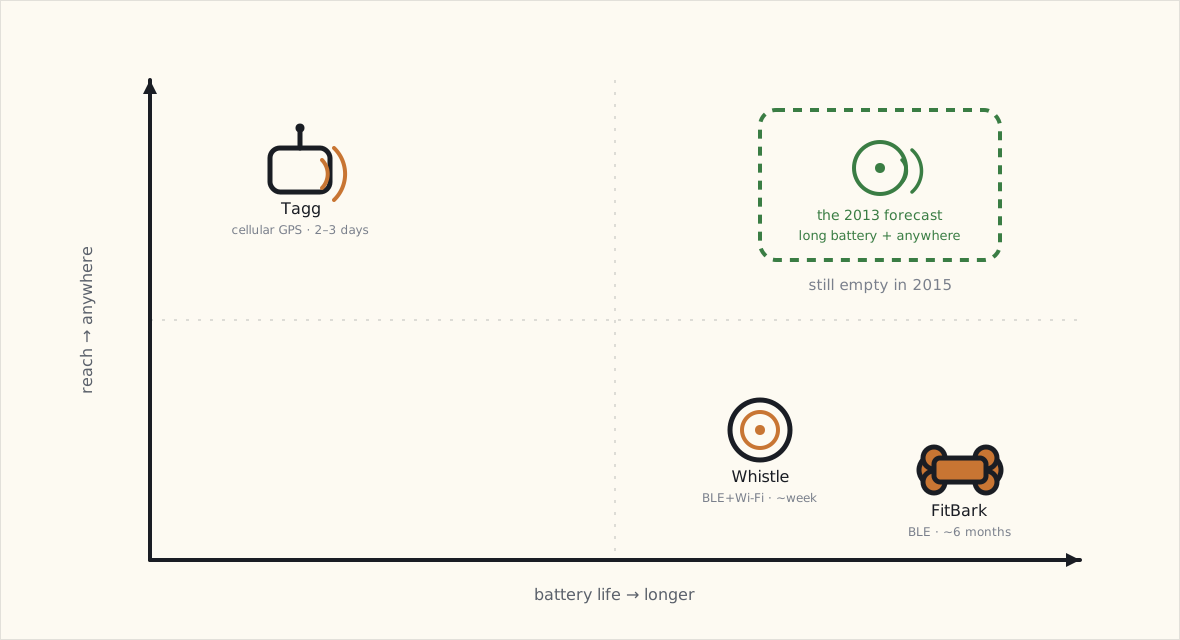
The Whistle is the right call when you want the data to reach you without you doing anything — it phones home over the house Wi-Fi on its own — and you don't mind charging it weekly. The FitBark wins on the boring virtues: six months between battery swaps, lighter on the collar, cheaper, IP67 so a creek crossing isn't a funeral, and an API I can build on. Both share the same hard ceiling, the bottom row of that chart: the instant Atom is genuinely out — off the property, in the car, lost — neither one has the faintest idea where he is. They count motion. They don't do place.
Which is exactly the gap I pointed at in 2013. I bet then that the endgame was convergence — one device that leans on a low-power radio while the dog's home and flips to cellular-and-GPS the moment he isn't, so you sip battery in the house and only spend it when the dog's actually missing. That top-right corner of the chart, long battery and anywhere-reach in one puck. Two years on, it's still an empty box. Nobody's shipped it. FitBark and Whistle have spent the interval racing each other on sleep bins and friend-comparison screens — chasing the same features on the same side of the map — while the device I actually want for the day Atom finally figures out the gate doesn't exist yet.
So I'm keeping both, for unglamorous reasons. Atom wears the FitBark day to day — lighter, I forget it's there, the battery is a non-event, and my logging runs off its API. The Whistle stays on as the second opinion with the more conservative numbers and the Wi-Fi that phones home on its own. Two trackers on one dog, agreeing on the shape of every day, disagreeing on the size by a fifth, and neither one able to answer the only question I'd genuinely panic about.
What's next
The convergence bet is still a bet. But the location half of it — cellular and GPS small enough and cheap enough to live on a dog's collar without a two-day battery — is the piece the whole forecast hinges on, and it's the piece I want to dig into next: what's actually keeping a single puck from being low-power at home and findable anywhere, and how close the radios are to closing that gap. That's the next one.
 Part 07 of 42
 2015 in pet IoT — the cat side finally shipped, the dog side split in two
A SureFlap door went on the wall for Joule, a second tracker went on Atom's collar, and a feeder finally arrived two years late. I score last year's eight bets, log what actually entered the house, and put 2016 on the record — including the cellular Whistle I've been waiting on since 2013.
End of 2015. Same ritual as last December: grade the bets I wrote down a year ago, log what physically went on a pet this year, then put next year on the record so I can hold myself to it again.
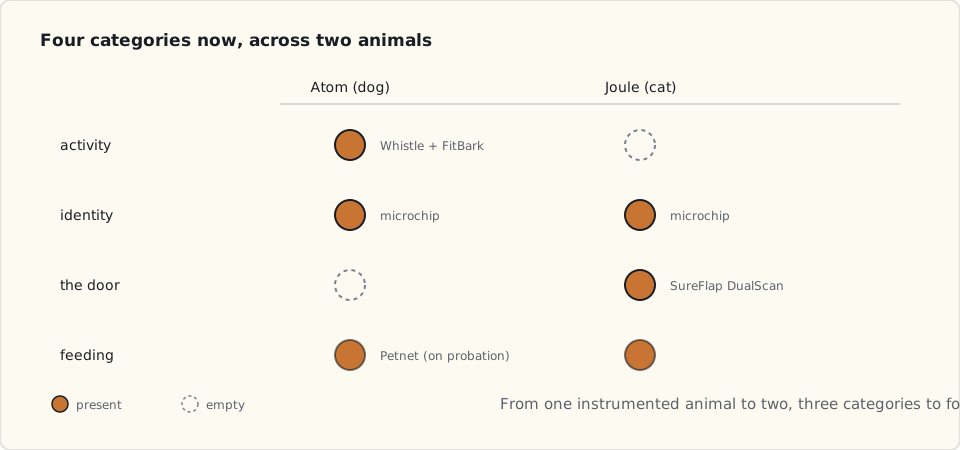
The one-line version: 2015 is the year the asymmetry I complained about all of last year finally cracked. The cat side of the house — which entering the year was a single passive chip under Joule's skin and nothing else — got a door that reads that chip hundreds of times a month. And the dog side, which already had a year of data, doubled up: a second tracker rode Atom's collar for the back half of the year. The household went from one instrumented animal to two, and from three product categories to four.
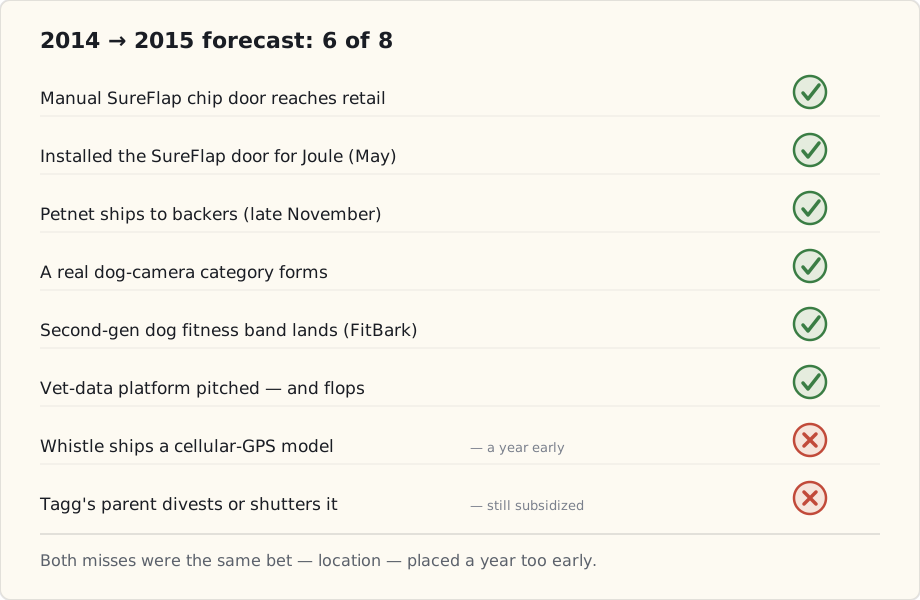
Scoring the 2014 forecast
I wrote down eight bets last December with a confidence on each. Here's the honest grade.
| # | Prediction | Confidence | Outcome | Verdict |
|---|---|---|---|---|
| 1 | Whistle ships/announces a cellular-GPS model, or acquires Tagg | 70% | Rumored for early 2016, nothing shipped in 2015 | ✗ (timing) |
| 2 | Tagg's parent (Snaptracs/Qualcomm) divests or shutters it | 50% | Still alive, still subsidized | ✗ |
| 3 | A connected SureFlap-style cat door reaches retail | 55% | The manual chip door shipped (I bought it); the connected hub was announced, ships 2016 | ✓ (the door, not the cloud) |
| 4 | Petnet ships to backers in 2015 | 60% | Started shipping late November to early backers; mine arrived | ✓ (barely) |
| 5 | A real dog-camera category forms (more than just PetCube) | 75% | Pawbo shipped, a new Petcube, Furbo on Kickstarter | ✓ |
| 6 | I install a manual SureFlap door for Joule | 85% | Installed in May | ✓ |
| 7 | A second-gen dog fitness band that fixes v1's mistakes | 65% | FitBark finally landed; ran it against the Whistle | ✓ |
| 8 | Somebody pitches "send pet data to your vet" — and it flops | 50% | A few startups, no vet adoption | ✓ (including the flop) |
Six of eight, with two of those carrying an asterisk. The two clean misses were both about Whistle's location radio — bet 1 and, indirectly, bet 2. I called it a 70% read that they'd ship cellular GPS or buy their way to it in 2015. They did neither. The puck Atom wears is still the BLE-and-Wi-Fi activity monitor it's been since 2013 — it tells me how much he moves, not where he is. The cellular convergence I bet on back in 2013 and kept circling in September is still an empty box. I was a year early. Writing "70%" on a hardware ship date was the mistake; hardware slips, and I keep paying that lesson the way I paid it on Petnet.
The Tagg miss still surprises me. Architecturally they should have lost by now — cellular pet tracking burns battery in two-to-three days, against a week-plus on the Whistle and six months on the FitBark. But the thing keeping Tagg alive is exactly the thing I keep wishing the others had: an existing cellular footprint. A newcomer can't ship location-anywhere without building a cellular story from scratch, and that turns out to be a real moat even around a battery-poor product. The architecture I'd grade as worst is the one nobody can easily copy.
What actually went on a pet this year
Stripped of marketing, here's what physically entered the house in 2015, in order:
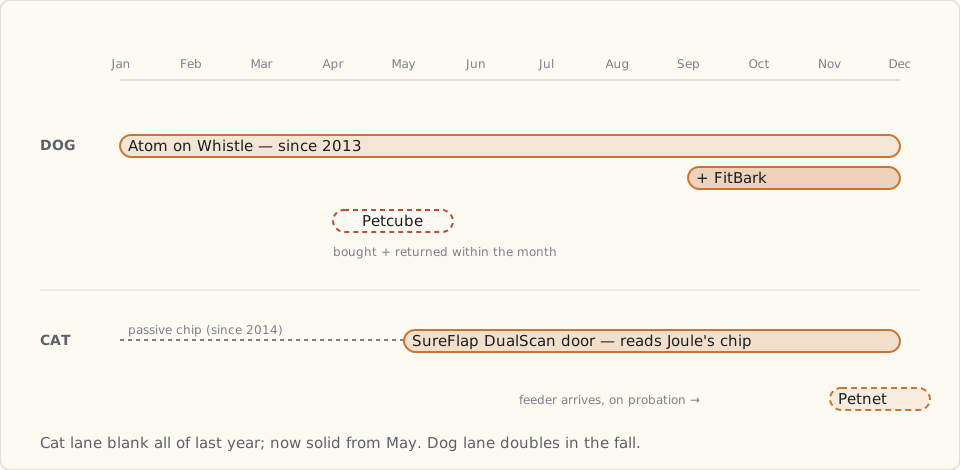
- A SureFlap DualScan microchip pet door, installed in May for Joule — her first real piece of IoT. It reads the same passive 134.2 kHz chip the shelter implanted in her shoulder in 2014 and latches the flap on her ID. The DualScan variant reads the chip on the way out as well as in, so I can keep one cat in while another goes out. Seven months in, it has been the most boring device in the house, which from a cat door is the highest compliment.
- A FitBark on Atom's collar, clipped on in September next to the Whistle and never taken off. I wrote that week up in detail — the short version is that the bone-shaped tag and the coin puck agree on the shape of every day and disagree on the size by about a fifth, because they draw the resting/active line in different places.
- A Petnet SmartFeeder, which finally arrived in late November — pre-ordered in February, so call it nine months late, which for crowdfunded hardware is roughly on time. I've had it long enough to fill the hopper and not long enough to trust it. That's a separate post once it's earned an opinion.
- A Petcube I bought and returned. I went in knowing the interactive-camera category had already failed in this house once. I bought it anyway, told myself the new model was different, and within a week Atom had destroyed it and I'd shipped the wreckage back. The lesson didn't generalize the first time because I didn't let it. It generalizes now: you cannot keep an interactive pet camera in a house with a Lab. I am done testing that hypothesis.
That's the year. Two devices that stayed, one that's on probation, one return.
What worked, and the canon I got wrong out loud
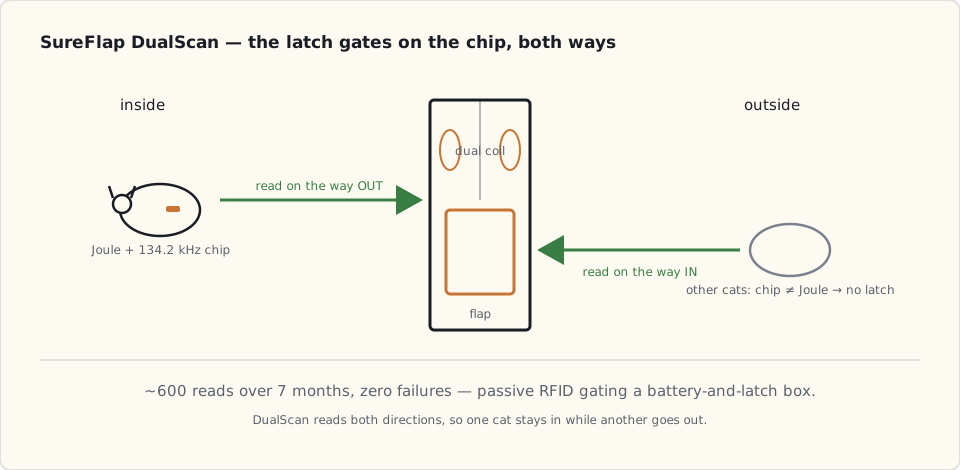
The SureFlap's reliability is the standout. Roughly six hundred reads of Joule's chip over seven months and not one failure — no missed reads, no false latches, no firmware to babysit. It's passive RFID gating a battery-and-latch mechanism, and the reason it's bulletproof is the same reason the microchip itself is bulletproof: there's almost nothing in it to break. The connected version — the one with an app and a cloud — was announced this year and ships in 2016. I'll buy it, but I note the trade going in: every layer of cloud I add to that door is a layer that can fail in a way the dumb latch never will.
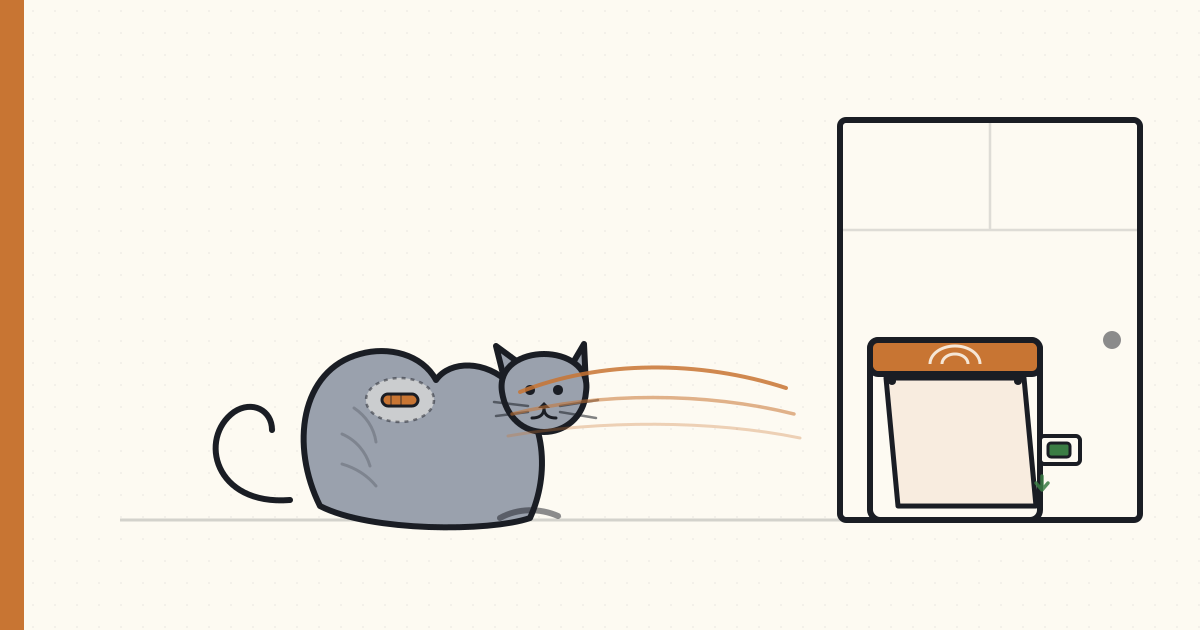
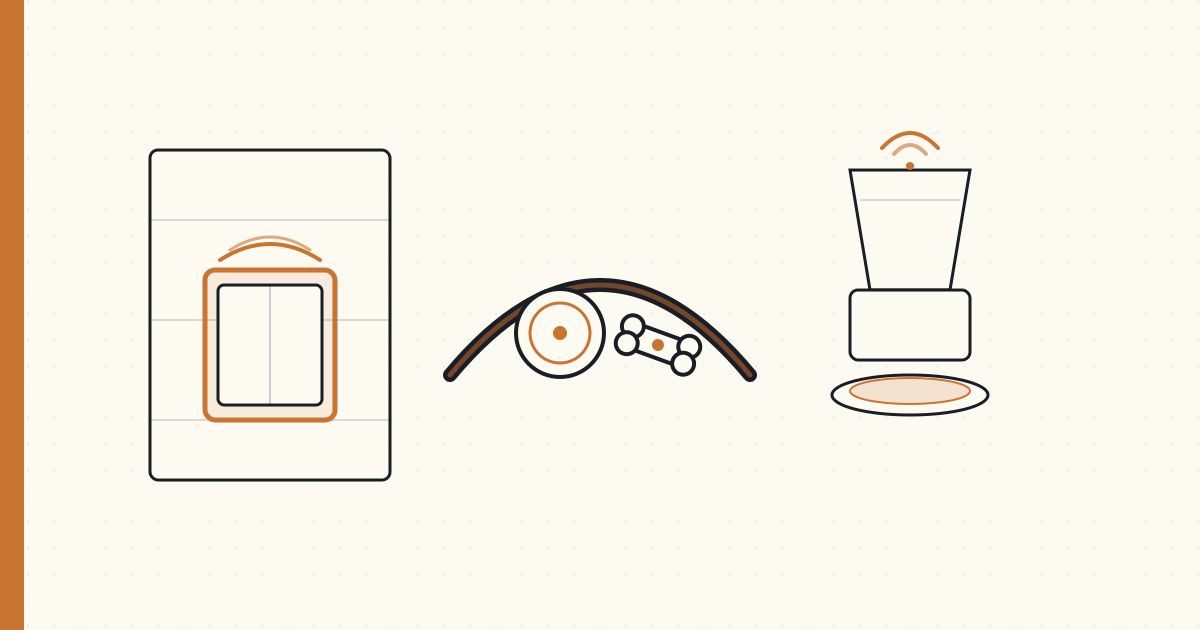
The DualScan part is worth a picture, because it's the bit that makes the door useful in a multi-cat house: it reads the chip on the way out as well as in, so I can authorize a one-way trip and keep a second cat from following.
FitBark's official API genuinely changed my behavior. I've logged Atom's activity to my home server since 2013, and on the Whistle side that meant scraping a reverse-engineered endpoint that breaks every time they ship an app update. FitBark publishes a documented developer API — register an app, do an OAuth handshake, pull daily activity as JSON. I've moved my logging onto it. For most owners that's irrelevant; for the kind of person who keeps a dog's activity in a database next to the thermostat logs, it's most of the reason to lean one way.
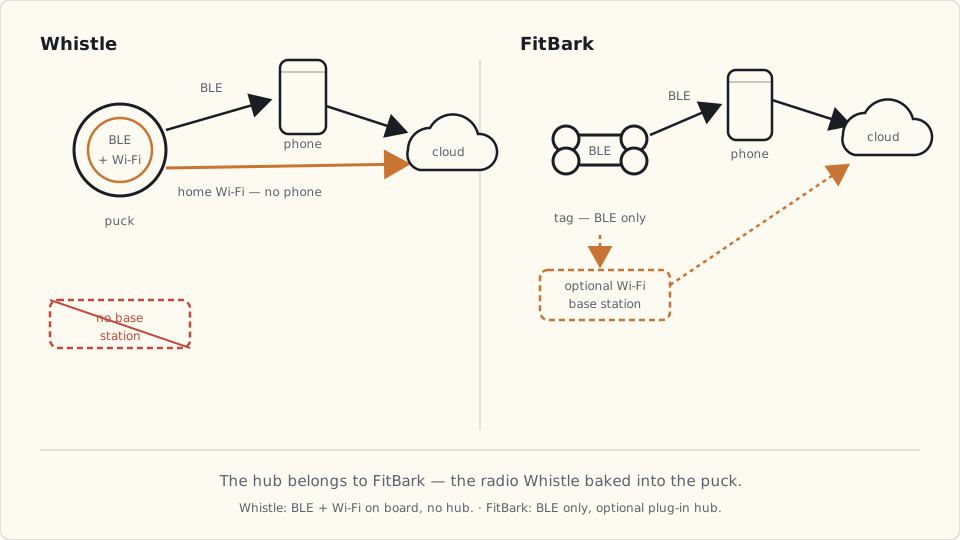
Now the correction, because I'd rather log my own error than let it stand. For two years I half-assumed the way these trackers phone home was: tag, base station, cloud. Running the two side by side this fall forced me to actually check, and the canon is the inverse of the box art. The Whistle has no base station — it carries both BLE and Wi-Fi in the puck, so it reaches the cloud on its own over the house Wi-Fi when Atom's home and I'm at the office. The FitBark is BLE-only, and the base station belongs to it — a separate, optional Wi-Fi hub you buy on top of the tag to sync it when no phone is near. So when I wrote last year about "the Whistle base station," I was wrong: there isn't one. The hub is FitBark's, and it's the accessory that patches the radio FitBark left out. Getting this right matters because the whole tracker comparison falls out of which radio is in the puck.
What didn't
Petnet's slip is the headline failure, and it's the failure I predicted and backed money on anyway. Nine months late, and the part that worries me isn't the delay — it's the architecture. A feeder that needs the cloud to dispense food is a feeder that stops feeding the day the company's servers do. I'll judge it hard on exactly that: what it does when the cloud is unreachable. A dumb mechanical timer feeds the cat through a power outage and an outage of the vendor's business model both. I want to know the smart one does too, and I don't yet trust that it does.
Pet vital signs are still vaporware. Two years in, not one consumer product on the market measures heart rate, respiratory rate, or temperature off a collar. Everything is an accelerometer summing motion above a threshold and calling it "active minutes." That ceiling is the thing I keep hitting: I can tell you how much my dog moved and roughly how well he slept, and nothing about how his heart or his lungs are doing. The day that changes is the day pet-tech stops being a pedometer and starts being a health device.
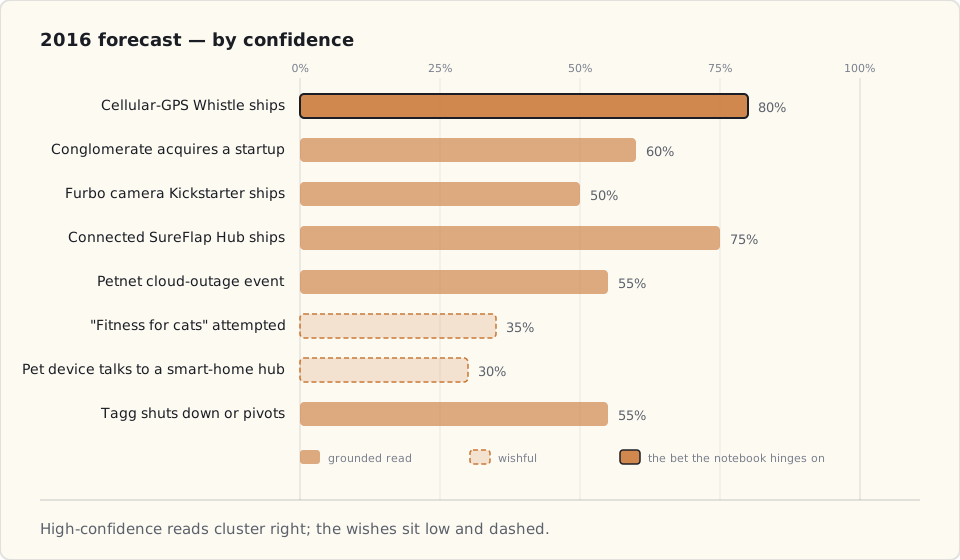
Forecast for 2016 — bets, with how sure I am
On the record so I can grade it next December. Confidence is the honest part; some of these are reads and some are wishes, and the number says which.
| # | What I expect in 2016 | Confidence | Read or wish? |
|---|---|---|---|
| 1 | Whistle finally ships cellular + GPS in the puck — location anywhere, no hub | 80% | Read — the rumors are concrete now, and it's the obvious gap |
| 2 | A big pet conglomerate (Mars, Petco, Nestlé Purina) acquires a smart-pet startup | 60% | Read — consolidation is how this category resolves |
| 3 | The Furbo dog camera Kickstarter actually ships | 50% | Coin-flip — crowdfunded hardware, judged by my own scar tissue |
| 4 | The connected SureFlap Hub ships (the cloud version of Joule's door) | 75% | Read — it's announced; the question is the date |
| 5 | Petnet has a visible cloud-outage event — missed or duplicated feeds | 55% | Read of the risk, wish that I'm wrong |
| 6 | Somebody attempts "fitness for cats" in a real product | 35% | Mostly wish — Joule would ignore it, but I want to see it tried |
| 7 | First pet device that talks to a smart-home hub natively | 30% | Wish — the home platforms aren't pointed at pets yet |
| 8 | Tagg finally shuts down or pivots away from consumer cellular | 55% | Read — same bet as last year, and I'll keep making it |
The bet I most want to be right about is the first one. The convergence device — low-power at home, cellular-and-GPS the moment the dog is genuinely out — is the piece this whole notebook has circled since 2013. If Whistle ships it in 2016, the empty top-right corner of the map finally fills in, and the question stops being "how much did he move" and starts being "where is he, and is he okay."
What I'll actually spend money on next year
Separate from the forecast — what I intend to buy, market permitting:
- The cellular Whistle, the day it ships, judged on one thing: does it keep a usable battery while adding location, or does it become a two-day Tagg with a nicer app?
- The connected SureFlap Hub when it lands — the cloud layer on top of the door that's already working, with the standing caveat that I want it to fail gracefully back to the dumb latch.
- A Furbo, maybe, if it ships and the reviews don't mention smoke. I'll wait for the second wave of reviews, not the first.
- A FitBark Wi-Fi base station so the tag syncs while Atom's home and my phone's at work — the one piece of his setup that still depends on a phone being in range.
What's next
Two posts I can already see. The cellular Whistle, if and when it grows a location radio — the comparison I've wanted since 2013, the activity-only puck against whatever-it-becomes, on the same dog with three years of baseline in the bank. And the acquisition question this notebook keeps circling: will the big pet companies buy the smart-pet startups, and what happens to my data and my devices when they do. If bet 2 lands, that's the post.
Three years of pet IoT in the house now. Two pets instrumented instead of one. Four product categories — activity, identity, the door, and now feeding. The cat side, blank for two years, finally has a radio pointed at it. The dog side is waiting on the only feature that's ever mattered: knowing where he is when he's gone.
 Part 08 of 42
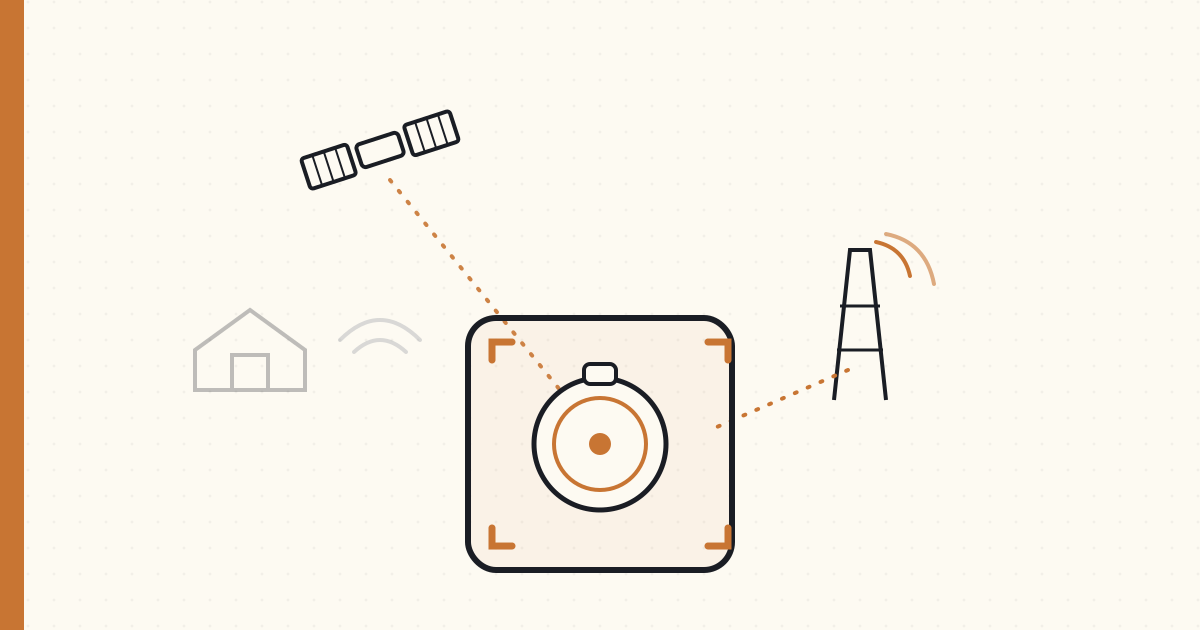
 Whistle's GPS Pet Tracker ships with cellular — and Mars Petcare buys Whistle the same month
Whistle's GPS Pet Tracker finally put cellular and GPS in the puck — the convergence I bet on back in 2013 — and within the same month, Mars Petcare bought the company for a reported $117M. The feature I'd wanted for years arrived owned by a pet-food giant. Notes on the radio, the subscription, and the conflict of interest.
The feature I've wanted since 2013 finally shipped this month — and the same month it shipped, the company that makes it stopped being independent. Both halves of that sentence matter, and they landed close enough together that you can't write about one without the other.
The short version, in order:
- The Whistle GPS Pet Tracker shipped — cellular and GPS built into the puck, no separate hub, no BLE-only variant. The convergence I bet on in 2013 — one device that sips power at home and turns on the expensive radios only when the dog is genuinely gone — is finally a product you can buy.
- Mars Petcare acquired Whistle, reportedly for around $117M. The pet-food and pet-care giant — Pedigree, Royal Canin, IAMS, Banfield — now owns the collar that tells me how active my dog is.
Those two things in the same month aren't coincidence. You buy a company when its valuation is peaked, and a company's valuation peaks the moment it ships the product everyone was waiting for. The launch is the acquisition trigger.
What the Whistle GPS Pet Tracker actually is
For three years the Whistle Atom wears has been an activity monitor: BLE and Wi-Fi in the puck, no location, the same accelerometer story as the FitBark I clipped on beside it. It tells me how much he moved, never where he is. The new GPS Pet Tracker is a different animal — it adds the radios that answer where.
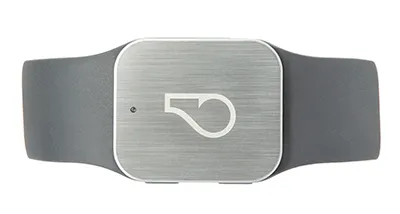
- A cellular modem with its own SIM — Whistle runs it on AT&T's network, so the puck phones home over cellular with no hub and no paired phone required. This is the piece Whistle bought rather than built: their acquisition of Tagg in January last year gave them an existing cellular footprint, which is exactly the moat I said two years ago would keep Tagg alive and keep newcomers out.
- GPS, assisted by the cell network. A cold GPS fix can take a minute of clear-sky; AGPS uses cell-tower data to shrink that to seconds and to fall back to tower triangulation when the satellites are blocked.
- BLE 4.0 and Wi-Fi for the home case — when Atom's in range of the house Wi-Fi or my phone, the puck uses the cheap radio and leaves cellular and GPS off.
- Accelerometer for the activity classification Whistle has always done.
- $79 of hardware plus a monthly service plan ($6.95–$9.95/month depending on term), claimed 7-day battery.
The subscription is the real change. Every Whistle before this was buy-once. Cellular data isn't free, so somebody pays a carrier every month — and that somebody is now me, every month, or the device goes dark.
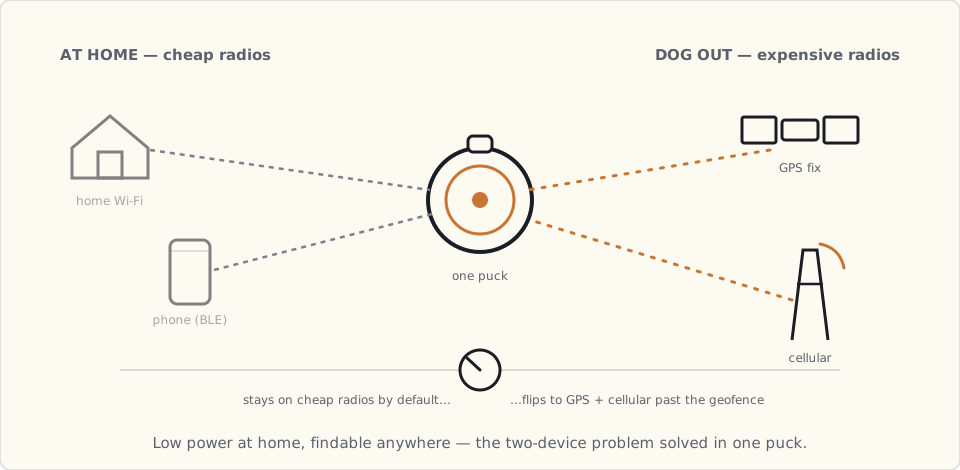
The thing the box won't tell you: the power budget
"GPS anywhere" is the pitch. The honest version is "GPS anywhere, in bursts, on a battery that won't last the week if you actually use it."
A cellular-plus-GPS fix is expensive in milliamp-hours — the modem has to wake, attach to the network, and transmit; the GPS has to acquire. Do that continuously and you'd drain the cell in hours. So every tracker in this class does the same thing: it duty-cycles the radios. At rest inside the home geofence it reports rarely and leans on Wi-Fi; once the dog crosses the fence it ramps up to a fix every few minutes. That's why "real-time tracking" isn't real-time — it's "as often as the power budget allows, more when moving."
Whistle claims 7 days. That claim assumes the favorable case: dog home all day, geofence never broken, GPS almost never queried. The instant the device is doing the job you bought it for — a dog that's out, being located repeatedly — the steady state is closer to 3–4 days. And that's the cruel part of the math: the feature degrades the battery fastest exactly when you need the battery most. A dog who escapes on day four meets a dead tracker.
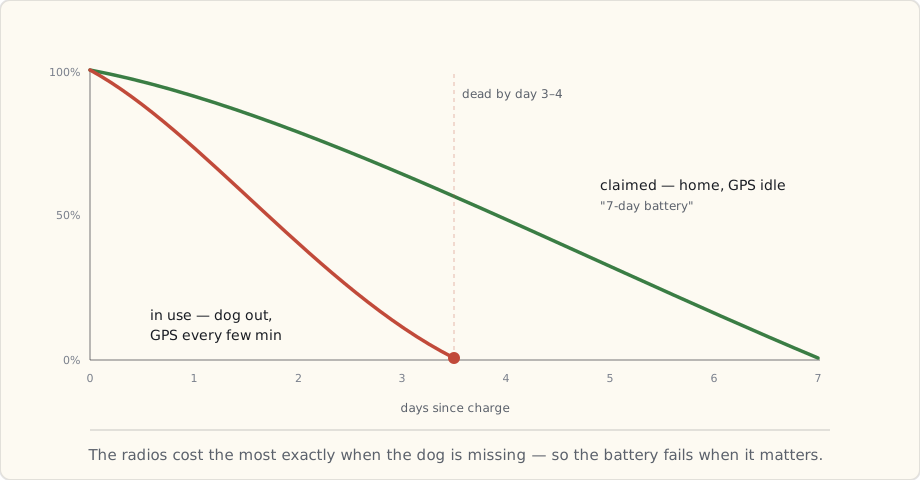
For Atom — well-trained, doesn't bolt, lives behind a fence — the GPS is overkill, and I'll say so plainly below. For an escape-artist dog, this radio is the whole reason the category exists, battery caveat and all.
What it costs to keep, over years
The sticker is the small number. The subscription is the real one.
| Year | Hardware | Subscription | Cumulative |
|---|---|---|---|
| Year 1 | $79 | ~$84 ($6.95 × 12) | ~$163 |
| Year 3 | (likely one replacement) | ~$252 | ~$430 |
| Year 5 | (~$200 hardware lifetime) | ~$420 | ~$620 |
Set that next to the FitBark on Atom's collar: $69 up front, no subscription, a coin cell every six months — call it $170 across five years. The cellular tracker is roughly 3–4× the five-year cost for the one thing it adds: location. That's a fair price for a dog that runs. It's a lot of money for a dog that doesn't.
The acquisition is the bigger story
Mars Petcare is the pet arm of Mars, Inc. — Pedigree, Whiskas, IAMS, Royal Canin, Banfield Pet Hospital, on the order of $17B a year in pet products before this deal. Buying Whistle hands them three things they didn't have: direct telemetry on how dogs move and where they go, a consumer app as a daily touchpoint, and a foothold in pet-tech retail.
Here's what I think it means for the data, and I'd rather write the worry down now and grade it later:
- The telemetry feeds Mars's analytics. How active is your dog, what does it eat, how do those correlate — cross-referenced against Royal Canin and Pedigree purchase data Mars already holds.
- The app starts recommending Mars products. Gently at first — "your Lab's activity is high; here's recommended nutrition" — and the gentleness is the point.
- The conflict of interest is now structural, not incidental. The entity telling you your dog needs more activity is the entity that profits when you buy more food.
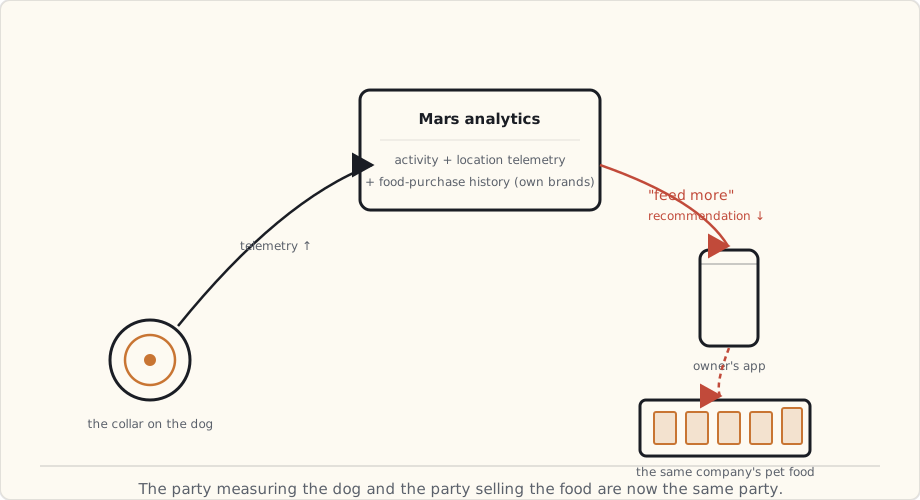
What I'd tell another owner
When an earlier, independent Whistle told me Atom's activity was low, I could take that as a data reading and act on it. When a Mars-owned app says the same thing and links to a Royal Canin product, I have to discount it — not because it's necessarily wrong, but because I can no longer tell the data-driven part from the marketing-driven part. That's the cost of the acquisition that won't show up on any spec sheet.
So the rule I'd hand the next person buying any connected pet device: ask who owns the analytics, because the advice is only as neutral as the company generating it. Every firm circling the smart-pet startups has a portfolio to sell. The day the recommendation engine belongs to a stakeholder, the recommendations stop being neutral — and you should read them as a sales channel that happens to have your dog's data.
What I'm doing, and what I'm watching
For Atom, I'm not buying the GPS tracker. The 2013 Whistle activity monitor plus FitBark already covers a dog who doesn't run off, with no monthly fee, and I'll keep the recommendations layer turned off on whatever Whistle account I do have. If I ever test the cellular puck, it's an evaluation, not a daily driver — and I'll judge it on the battery-under-load number, not the box claim.
Watching from here:
- The rest of the industry reacts. Petco, PetSmart, VCA — do they go buy competing pet-IoT startups now that Mars has set the price? My bet: yes, inside eighteen months. Consolidation is how this category resolves.
- Third-party data access tightens. The unofficial APIs hobbyists like me have leaned on get locked down post-acquisition. My bet: within a year.
- A credible independent tracker appears — one not owned by a food company, so the advice layer can be trusted again. I don't see it yet. I'm watching for it, because the moment Mars owns the data is the moment I start wanting an alternative that doesn't.
The feature finally arrived. It arrived owned. That's the whole shape of 2016 in pet-tech, and it's the consolidation question this notebook has circled since the start — now answered, in Mars's favor, in a single month.
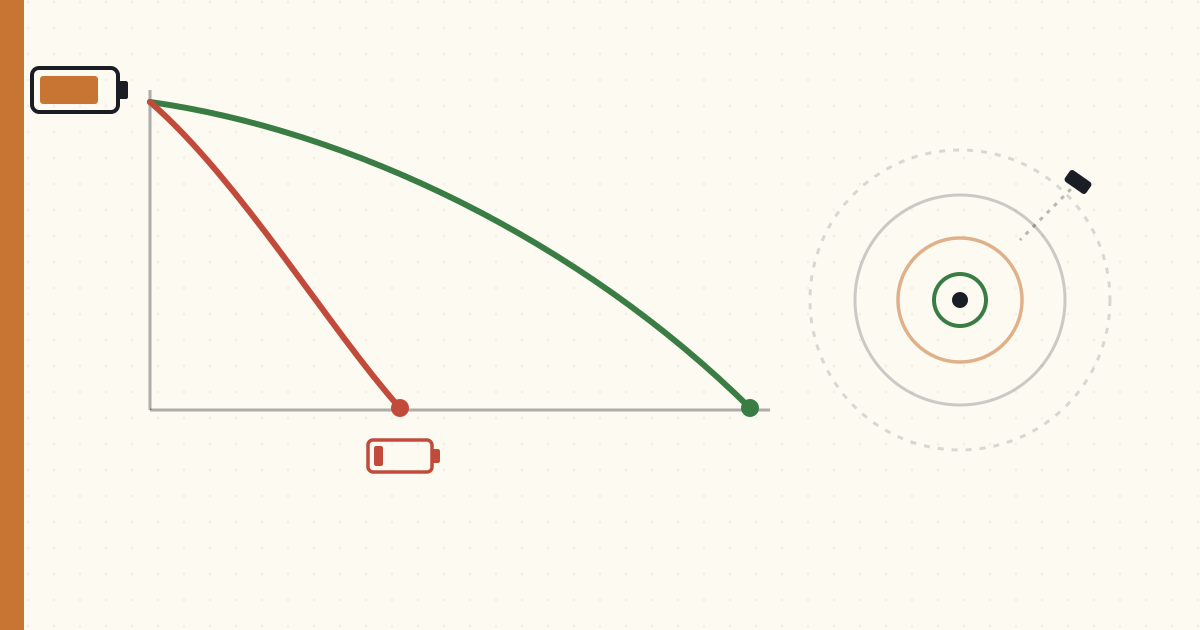 Part 09 of 42
 Six months on the Whistle GPS Pet Tracker — the cellular realities
I bought the Whistle GPS Pet Tracker for Atom in May to evaluate the cellular path I'd bet on since 2013. Six months of logged data: the real battery number under load, GPS accuracy by environment, the subscription math, and the Mars recommendations layer arriving on schedule.
Back in April I wrote up the launch and the acquisition in the same breath — the Whistle GPS Pet Tracker finally putting cellular and GPS in the puck, and Mars Petcare buying the company the same month. I said then I'd treat the device as an evaluation, not a daily driver. I bought one in May and clipped it onto Atom's collar beside the FitBark. Six months of logged data later, here's what the spec sheet doesn't tell you.
Battery life — the claim versus six months of logs
Marketing claim: 7 days. Here's what I actually logged, walking Atom on known routes and noting the battery at each charge:
| Use pattern | Actual battery life |
|---|---|
| At home, GPS idle, periodic check-ins over Wi-Fi | 6–8 days |
| Normal daily walks, GPS queried a few times a day | 3–4 days |
| Active tracking (an escape, location queried every few minutes) | ~1 day |
| Cold weather (sub-freezing, lithium chemistry sluggish) | 30–40% reduction across the board |
The 7-day claim is the most-favorable case: dog home all day, geofence intact, GPS almost never woken. In actual use 3–4 days is the steady state, and that's the number that matters, because the device duty-cycles its radios exactly the way I argued every cellular tracker has to — cheap radios at home, the expensive cellular-plus-GPS burst only when the dog crosses the fence. The cruel part of the math is that the radios cost the most milliamp-hours precisely when the dog is missing. A dog who bolts on day four meets a dead tracker.
The rule I've baked into how I evaluate any battery-powered tracker since: divide the box claim by two for the real steady-state number, by seven for the "when it actually matters" number.
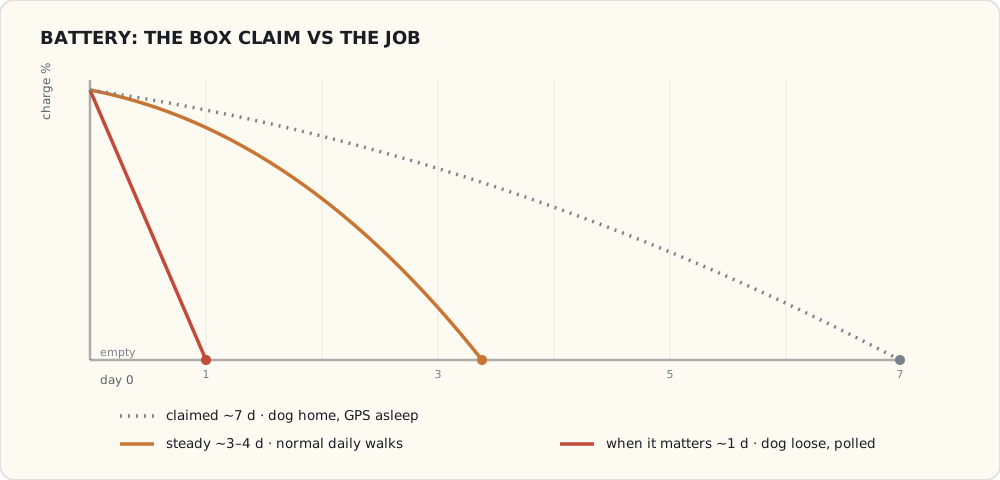
GPS accuracy by environment
I tested accuracy by walking Atom along routes I knew cold and overlaying the recorded track on the map afterward:
| Environment | Position accuracy |
|---|---|
| Open field / park | ±5 m |
| Suburban yard | ±10 m |
| Dense neighborhood (cars, buildings) | ±20–30 m |
| Wooded area (light forest canopy) | ±30–50 m |
| Indoor / basement | No GPS fix — falls back to cell-tower triangulation, ±200–500 m |
The assisted-GPS works well under open sky: the cell network feeds it ephemeris data so a fix comes in seconds instead of the cold minute a bare GPS needs. It struggles under canopy — Atom's favorite would-be escape route is the back woods, mercifully fenced — and indoors it has no satellites at all and falls back to triangulating off towers, which lands you in the right zip code and not much more.
For "did my dog leave the yard," the accuracy is good enough. For "where in the back woods is my dog right now," it's bad enough that you're doing a physical search regardless.
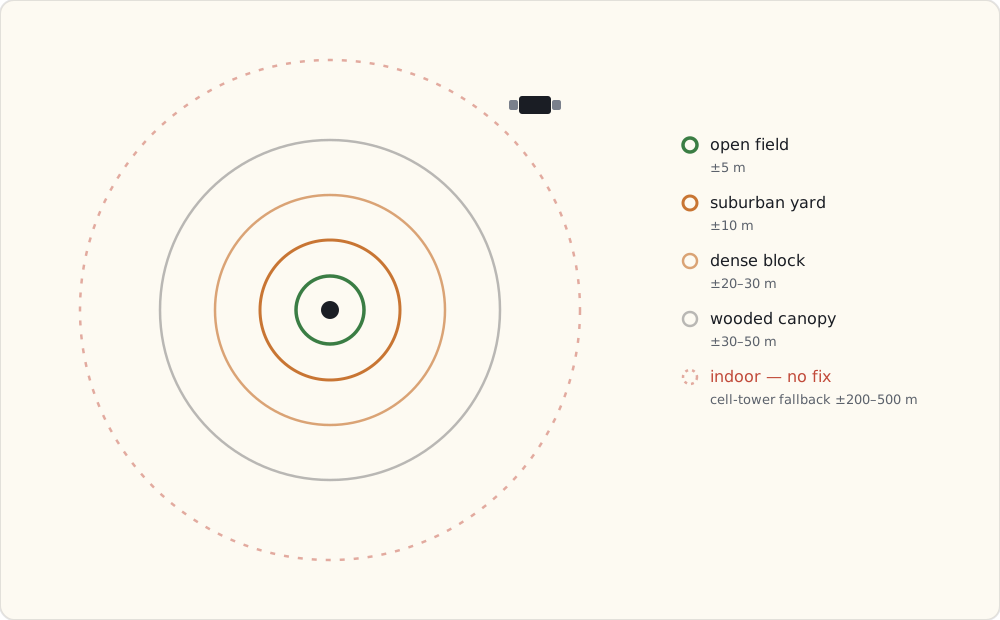
The cellular network is the product
The puck runs on AT&T's network, and coverage tracks AT&T coverage exactly:
- Urban / suburban: ~99% reliable.
- Highway / rural: ~85–90%.
- Deep rural: holes. I lost the signal twice on family trips out past the towers.
This is the thing to internalize before you buy: the carrier is the product. If you live somewhere AT&T is thin — rural, mountains — the GPS tracker is unreliable for the one scenario you bought it for, the dog loose outdoors miles from a tower. For me, suburban with the occasional camping trip, it's mostly fine: two coverage failures in six months, both well off the grid.
The subscription math
$6.95/month, billed monthly. Six months in, I've paid about $42. By the end of year one I'll have paid roughly $84 in service on top of the $79 hardware — call it $163 to own and run it for a year. What the fee buys:
- Cellular data — the entire reason the device exists.
- Location history and the live-track view.
- Push notifications when the geofence breaks.
What you get without an active subscription: nothing. The puck is inert hardware the moment the plan lapses. That's the razor-and-blades model, hardware sold near cost as a customer-acquisition expense and the recurring fee as the actual business — and after this launch it's plainly the dominant shape for connected pet gear. Compare the FitBark on Atom's other collar: bought once, a coin cell every six months, no carrier in the loop. The cellular tracker costs several times more over its life for the one thing it adds — location — which is a fair trade for a dog that runs and a poor one for a dog that doesn't.
The Mars recommendations layer, arriving on schedule
In April I predicted the conflict of interest would show up in the app — gently, and the gentleness being the point. Six months post-acquisition, it has. The app now surfaces a "Care Tips" section: "Based on Atom's activity level, Royal Canin Active Adult is recommended."
It's not in your face. But the recommendations are consistently Mars-portfolio brands — Royal Canin for the active dog, Pedigree for the budget owner, IAMS for seniors. I have never once seen it surface Hill's Science Diet, or Blue Buffalo, or any brand Mars doesn't own. That's exactly the structural conflict I worried about in writing: the entity measuring my dog's activity is the entity that profits when I act on the reading by buying more food. It's a marketing channel wearing a health-advice label, and now that I've watched it appear on schedule I read every "tip" as exactly that.
What I'd do differently
If I were buying again today, for Atom specifically:
- Skip the cellular tracker for an indoor/fenced dog. The 2013 Whistle activity monitor plus the FitBark already covers a dog who doesn't bolt, with no monthly fee and a battery measured in months, not days.
- Buy the GPS tracker only for a genuine escape artist, and go in clear-eyed about the 3–4-day battery and the subscription as the cost of the one feature that justifies it.
- Turn the Care Tips layer off on whatever Whistle account you keep.
For Atom I'm shelving the cellular puck and going back to the activity-monitor-plus-FitBark pairing that's worked since 2014. The GPS tracker was a good evaluation and a poor fit for my actual dog.
What I'm watching
- Consolidation. Mars set a price for a pet-IoT startup this spring. I bet within eighteen months a competing retailer or pet-care giant buys a rival tracker company to answer it.
- Third-party data access tightening. The unofficial APIs hobbyists lean on tend to get locked down after an acquisition. I expect Whistle's to close within the year, and I'm logging my own data locally while I still can.
- An independent tracker not owned by a food company — so the advice layer can be trusted again. I don't see one yet. The moment Mars owns the data is the moment I start wanting an alternative that doesn't.
What's next
The Petnet smart feeder shipped last November and I've been running it long enough now to have real opinions — the good, and the parts that make me nervous about trusting a feeder to a cloud. That's the next one.
 Part 10 of 42
 2016 pet IoT in review — Whistle goes cellular, Mars buys in, Furbo lands
The year the cellular tracker I'd bet on since 2013 finally shipped — and shipped owned by a pet-food giant. Furbo's treat-cam landed, the cat side stayed thin, and the subscription-and-conflict-of-interest pattern I'd been warning about became the category's default. Scoring the 2015 calls, and eight bets for 2017.
End of 2016, and it's the year the thing I've wanted since 2013 finally shipped — then got bought the same month. Cellular GPS in the puck, owned by a pet-food company before I'd finished evaluating it. That's the shape of the whole year.
Scoring the 2015 forecast
| Prediction | Confidence | Outcome | Verdict |
|---|---|---|---|
| Whistle ships a built-in-cellular tracker | 85% | Whistle GPS Pet Tracker, April | ✓ |
| Whistle acquired by a pet conglomerate | 65% | Mars Petcare, ~$117M, April | ✓ |
| A treat-tossing dog camera ships | 50% | Furbo shipped in August | ✓ |
| SureFlap announces a connected hub | 70% | Announced; ship slipped to 2017 | ✓ (partial) |
| Petnet has a first major outage | 60% | Minor missed-feed glitches, no multi-day event yet | ✗ |
| A credible cat-fitness device | 40% | Nothing serious — the cat side stayed thin | ✗ |
| First HomeKit pet device | 35% | Nothing | ✗ |
| Tagg shuts down or folds into Whistle | 55% | Folded into Whistle's cellular line post-acquisition | ✓ |
Call it 5/8 plus one partial — roughly 65%, a step down from 2015's 75%. The hits were the ones about market structure: cellular convergence and consolidation, which I'd been tracking since the Tagg-versus-Whistle radio argument in 2013. The misses were all timing — Petnet's outage, the cat-fitness device, HomeKit. I keep predicting on a calendar; vendors don't ship on one.
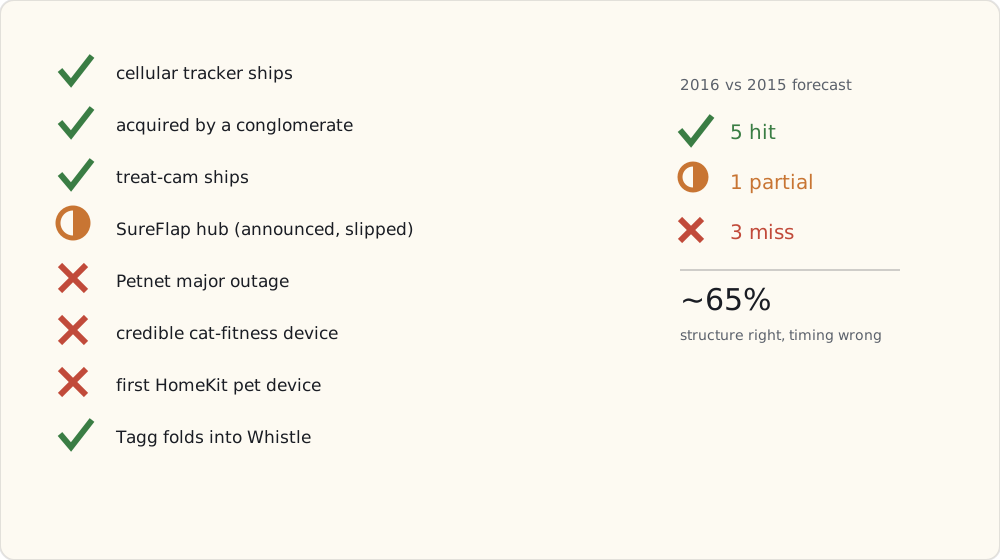
What got added in 2016
- The Whistle GPS Pet Tracker (April, $79 + $6.95–$9.95/mo). Bought one in May for evaluation; shelved it by October after the six-month review — 3–4-day real battery and a subscription that bricks the hardware if you stop paying.
- Furbo (shipped August) — the treat-tossing dog camera out of the spring Indiegogo. Haven't lived with one long enough to write it up; that's a 2017 post once I have real data.
- Petnet SmartFeeder — a full year of use now after the late-2015 ship. Mostly working, the occasional missed feed.
- Nothing for Joule. The cat-IoT gap holds.
What worked
- The 2013 Whistle activity monitor plus FitBark on Atom. Reliable, redundant, no subscription. Still the best pre-cellular combo for a dog that doesn't bolt.
- The SureFlap microchip door for Joule — a year and a half in, still 100% read reliability. The neighbor's gray tabby has given up.
- The Petnet feeder for travel. Schedule, portion control, remote-feed from the app — covered two vacations this year without a sitter for the food.
What didn't
- The cellular tracker's subscription model. The hardware is inert without the monthly fee. I'm not interested in pet gear that turns into a paperweight when I stop paying.
- The Mars-owned recommendations layer. Marketing dressed as care advice, surfacing only Mars-portfolio food brands. Disabled where the app lets me.
- The cat side. Nothing new for cats in 2016 except the announcement of the SureFlap hub. Joule stays under-served.
The cellular tracker's failure mode is worth drawing out, because it's the shape the whole category is settling into:
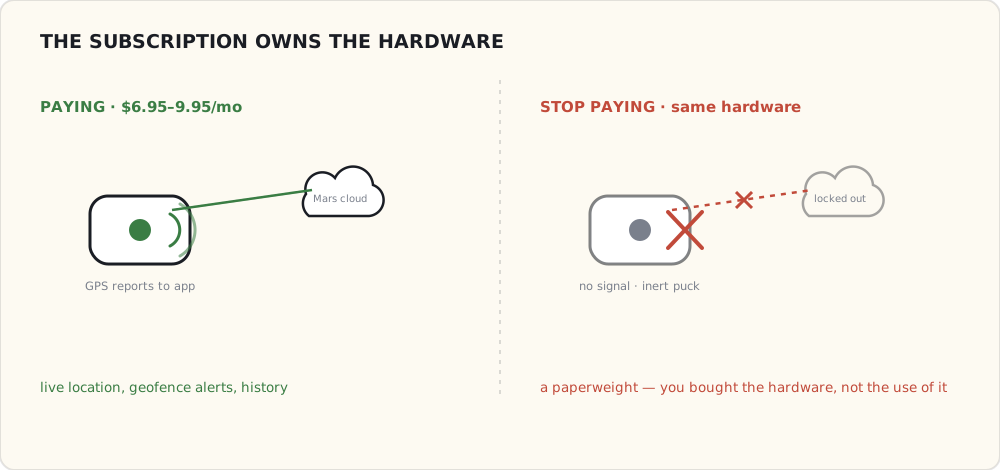
Forecast for 2017
| # | Prediction | Confidence |
|---|---|---|
| 1 | The SureFlap connected hub finally ships | 90% |
| 2 | I write up Furbo after living with it through the winter | 80% |
| 3 | Whistle ships a smaller second-generation cellular tracker | 65% |
| 4 | Petnet has its first multi-day outage | 55% |
| 5 | Litter-Robot launches a Wi-Fi-connected version | 75% |
| 6 | Mars acquires at least one more pet-tech startup | 65% |
| 7 | First Apple HomeKit pet product | 25% |
| 8 | A genuinely useful cat-side device appears | 35% |
The pattern under all of these: the dog side keeps maturing while the cat side stalls, and every new device arrives carrying a subscription and an owner with a portfolio to sell.
What I'm buying in 2017
- The SureFlap hub when it ships — finally remote-locking Joule's door.
- A Litter-Robot Wi-Fi version if the connected one is real and not a gimmick.
- Holding on the next cellular tracker; the battery and subscription math hasn't changed enough to justify it for a fenced dog.
What's next
The Petnet long-term review in Q1 — a full year-plus on a cloud-dependent feeder, including the parts that make me nervous about trusting feeding to someone else's servers. Then Furbo and the whole smart-camera category, once I've got real footage and a real opinion. Three years of pet IoT documented now: dog side maturing, cat side thin, Mars consolidation accelerating, and the same subscription-and-data-ownership shape every other IoT category has worn.
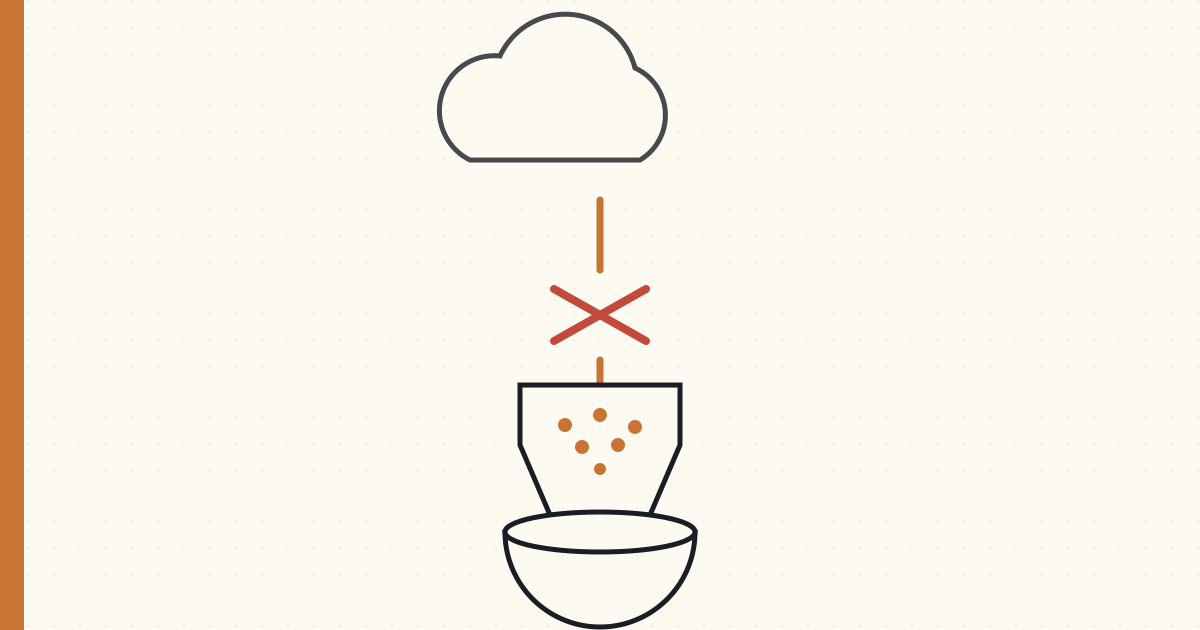 Part 11 of 42
 Petnet SmartFeeder — a long-term review, and why a cloud-dependent feeder scares me
Sixteen months on the original Petnet SmartFeeder. It works — until the cloud doesn't, and twice this winter it didn't, and my animals went unfed. The schedule lives on Petnet's servers, not the device, which means the product is only as reliable as the company's uptime. Here's the architecture, the two outages, and the design that would have survived them.
The original Petnet SmartFeeder has been running in my kitchen for sixteen months now, since it arrived in late 2015. It feeds Atom twice a day, 3/4 cup of kibble, and tops up Joule's bowl once a day at 1/4 cup. That's long enough — and it's been eventful enough this winter — to write a real review. The short version: it works, right up until the moment it depends on something I can't control, and then it doesn't, and the failure mode lands on the animals.
What the SmartFeeder actually is
Hardware:
- A plastic hopper feeding a portion-controlled auger into a bowl, about a 6-lb kibble capacity.
- 2.4 GHz Wi-Fi.
- Internal weighing — it knows how much it dispensed, not just that it ran.
- Status LEDs and a physical manual-feed button on the unit.
- Wall-powered, no meaningful battery backup.
Software and service:
- An iOS/Android app for schedule, portion size, and manual feed.
- Every control path routes through Petnet's cloud. The feeder does not operate without internet.
- The schedule lives in Petnet's cloud, not on the device.
- An activity log: each dispense recorded with a timestamp and portion.
Cost: a one-time ~$149 at launch, no subscription. Petnet's cloud is "free" the way these things always are — paid for out of hardware margin, which is exactly the part that worries me below.
The architecture problem, said plainly
Here's the data flow for the simple act of feeding Atom his breakfast:
scheduled time arrives
  → Petnet cloud fires the trigger
  → cloud sends the dispense command down to the feeder
  → feeder runs the auger
  → Atom eats
Read that again and notice where every step lives. The schedule lives in the cloud. The trigger fires in the cloud. The command originates in the cloud. The feeder is a dumb actuator waiting to be told what to do by a server in someone else's data center.
So if the cloud is unreachable, the feeder does nothing. Not a degraded mode, not a fallback — nothing. And that's not a hypothetical I'm raising to be clever. It happened twice this winter.
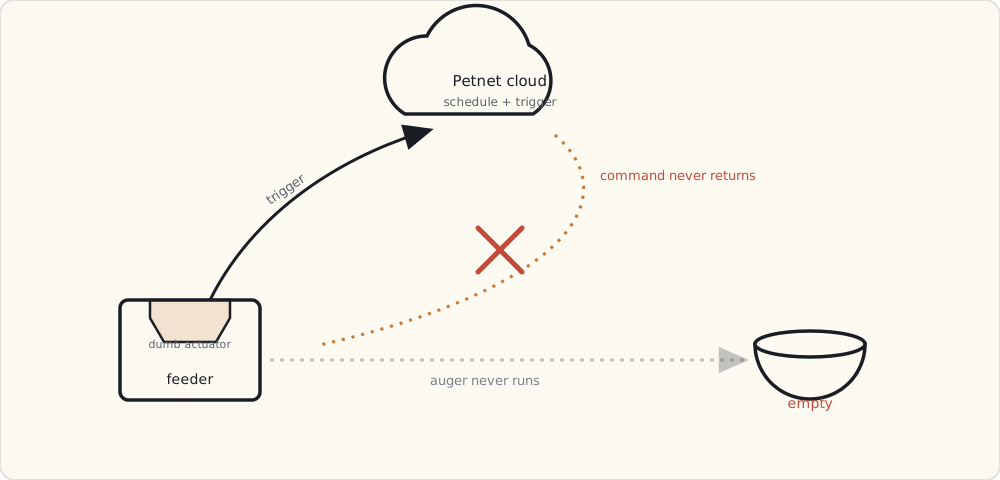
The two outages
December 2016, about six hours. Petnet's servers hit what they later called a "database migration issue." For six hours starting around 11 PM, no scheduled feeds fired. The 6 AM breakfast didn't happen. I found out at 7:30 when Atom was sitting beside an empty bowl staring at me, which he never does. Fed them by hand; the service came back around 9. No notification from Petnet during any of it — I diagnosed it myself.
February 2017, about three hours overnight. An "infrastructure event," cloud-wide. The feeder's status flipped to "offline" in the app, the 6 AM feed didn't fire, and I caught it at 6:45 and fed manually.
Both times: no proactive word from Petnet. The app showed "feeder offline" with no explanation, no ETA, and — the part that actually matters — no "we did not fire your scheduled feed, please feed manually" alert. The device knew something was wrong and told me nothing useful.
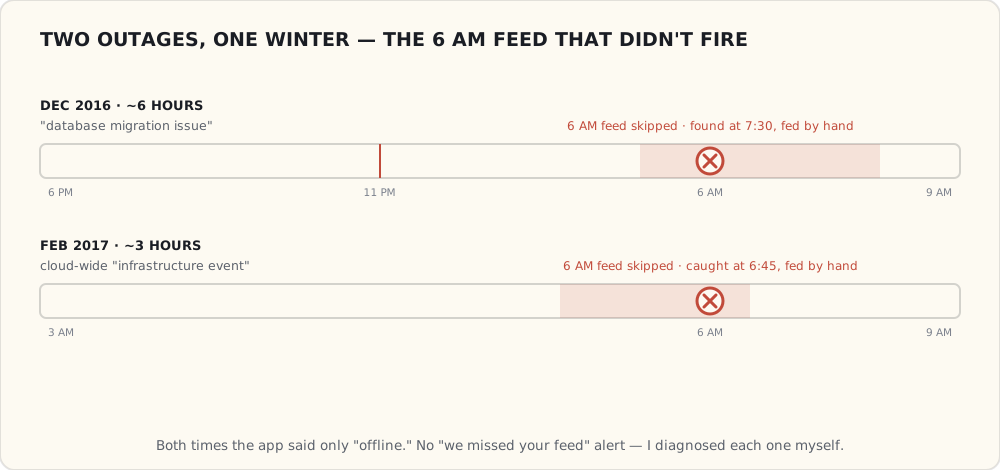
What a robust design would have done
A feeder built to survive its own vendor's bad night looks like this:
- The schedule lives on the device. The cloud is for editing the schedule; the device executes it from local storage.
- Last-known schedule survives offline. If the cloud is unreachable, keep feeding at yesterday's times and portions. A feeder going quiet is the one failure it must never have.
- A watchdog alert. If a feed should have fired per the local schedule and the device can't confirm it dispensed — jam, empty hopper, dead motor — push a critical notification. "Offline" is not that alert.
- A manual override that bypasses all of it. Petnet has the physical button, which is the one thing it got right — but you have to be standing there.
Petnet does none of the first three. Cloud-only schedule, no local fallback, no missed-feed alert. The entire reliability of feeding my animals rests on a startup's server uptime.
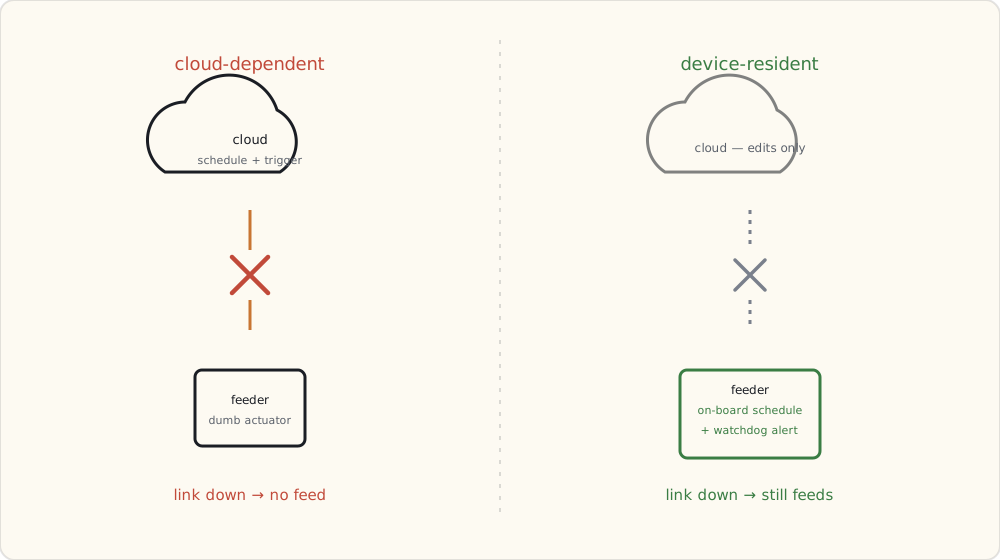
The cat-versus-dog risk asymmetry
For Atom — 70-lb dog, eats twice a day — a missed feed is uncomfortable, not dangerous. He's hungry for a few hours and that's the end of it.
For Joule it's different. Cats that stop eating for a stretch are at risk of hepatic lipidosis, a serious liver condition that can set in after a day or two without food — and it's worse in an overweight cat. A six-hour outage isn't a medical event. But the category of failure — a feeder that can silently stop feeding a cat — has a higher stake than the cheerful marketing admits. The risk is asymmetric: a device that occasionally skips a meal is a nuisance for a dog and a creeping danger for a cat.
What I'm doing about it
- A non-cloud backup feeder running in parallel. A plain battery-powered mechanical timer feeder — no Wi-Fi, no app, no cloud, nothing to go offline — set to drop Joule's portion a few hours after the Petnet feed should have fired. If Petnet missed it, the dumb feeder catches it. Belt and suspenders, and the suspenders don't phone home.
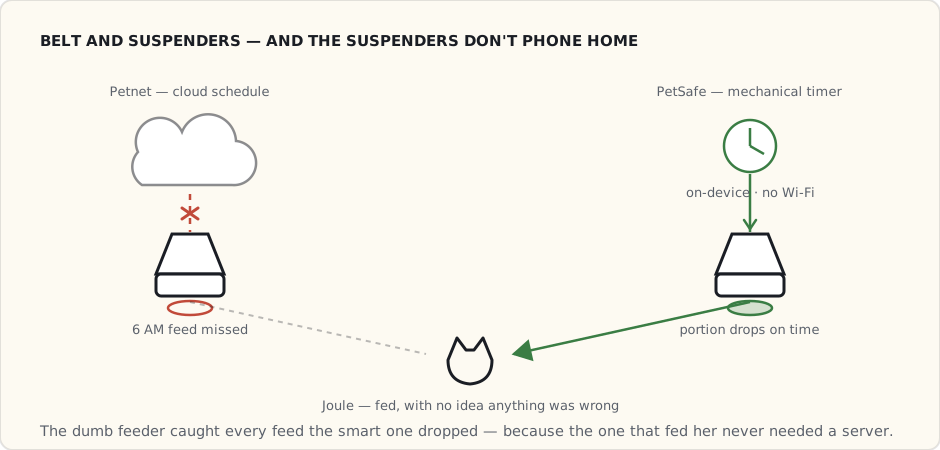
- A morning watch routine until I trust it again: I check the feed log at 7 AM, and if the 6 AM feed didn't fire I feed by hand and note the date.
- Migrating off cloud-only feeders the moment a device-resident one ships. As of today I don't know of one that executes its schedule locally. The category needs it.
The forecasting question
Two outages in one winter is a trend, not bad luck. Petnet is, by every account I can find, a startup burning cash and looking for its next round, and cloud reliability is exactly the thing that slips when the money gets tight and the ops team gets thin. I'd put better-than-even odds on a multi-day Petnet outage within the next year or two — long enough that it stops being an inconvenience and becomes the story the whole "smart feeder" category gets judged by.
If that day comes, somebody's cat doesn't eat for days, and the cautionary tale every connected-device pitch deck reaches for over the next decade will have Petnet's name on it. I hope I'm wrong. Watching the pattern, I'm not optimistic.
What's next
I finally have a Furbo on the shelf — the treat-tossing dog camera everyone's been waiting on — and I'm living with it for a few weeks before I write it up. First impressions after a month of Atom triggering it from across the room are coming next.
For now the Petnet runs under supervision, which rather defeats the word "smart." A device I have to babysit every morning to make sure it did the one job it has is not the future I was promised.
 Part 12 of 42
 Furbo Dog Camera — first impressions, and the treat-toss is the real engineering
Picked up a Furbo this spring after it had been on the market a while. Six weeks in. The camera and two-way audio are table stakes; the bark detection is marketing-grade AI; but the spring-loaded treat-toss is a genuinely tidy piece of mechanical engineering — and the only feature I'd buy again.
I finally picked up a Furbo this spring. It shipped out of its Indiegogo back in 2016 and has been on shelves a while; I held off, then caved when I wanted a way to do something for Atom from the office besides stare at him on a webcam. Six weeks in, here's the read — and the surprise is that the one feature worth the money is the most mechanical one.
The hardware
- 720p HD camera, 120° wide-angle, 4x digital zoom.
- Night vision — an IR illuminator, not "starlight" or thermal.
- Two-way audio — built-in speaker and microphone.
- The treat-toss: a spring-loaded launcher inside the body, three selectable launch angles, treats landing in a roughly 1.5–2 m arc in front of the device.
- An internal treat hopper holding maybe 30 standard training biscuits — the small dry kind Atom likes.
- 2.4 GHz Wi-Fi, mobile-app control.
- Wall-powered, no battery.
The unit is tall and narrow — around 30 cm — weighted at the base with a removable wooden lid on top, deliberately styled to read as a small modern vase rather than a gadget. It mostly succeeds; guests don't immediately clock it as a camera, which is either reassuring or faintly unsettling depending on your view of cameras shaped like décor.
The treat-toss is the engineering win
The treat-toss is the whole reason Furbo isn't just another Wi-Fi cam, and the nice part is that it's a mechanical achievement, not a software one. Watching it through the device's window:
- Biscuits drop from the hopper into a small staging chamber.
- A spring-loaded paddle compresses, then releases, firing into the treat and launching it forward.
- Three angle settings tilt the launch chamber for a low, medium, or high arc.
- Ordinary cylindrical training treats work fine — no proprietary cartridge, which I respect.
Two hundred-plus tosses in, no jams and a consistent landing zone. And the sound design is doing real work: there's a distinct mechanical click when the paddle fires, plus an optional chime through the speaker. Atom learned the click-means-biscuit pattern inside an hour, which is faster than he learned most things, food being the great accelerant.
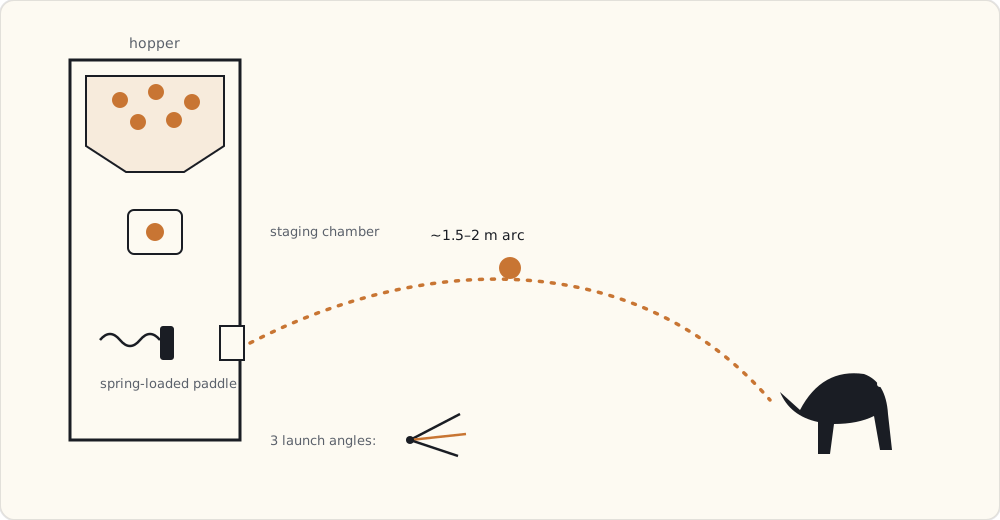
The camera and two-way audio
Video quality is fine for the job. Daytime is clean with no IR color cast; the night-vision illuminator reaches maybe 4–5 m, enough to confirm Atom's asleep in his bed and not, say, on the couch he's banned from. The 720p resolution is unremarkable but adequate — you're checking on a dog, not shooting a film.
Two-way audio lets me talk to Atom from work. I've tried it. He tilts his head, hunts around for the disembodied voice, and looks mildly puzzled — not distressed, but not usefully reassured either. A voice with no body attached doesn't mean to a dog what the marketing imagines. Limited use.
The bark detection is marketing-grade AI
Furbo pushes a notification when it thinks Atom is barking. Six weeks of logging it:
- Catches maybe 70% of actual barks.
- Fires constantly on things that aren't barks — the doorbell, the mail carrier, kitchen clatter, the TV. The false-positive rate is the real story.
- Tells me nothing actionable even when it's right. "Atom is barking" without why, and the camera view rarely explains it, so the alert is a dead end.
This is the kind of "AI" that exists because a spec sheet wanted the letters A and I on it. The detector is a noise classifier with the bar set low, and I turned the notifications off in week two. The mechanical treat-toss does more for me than the algorithm does.
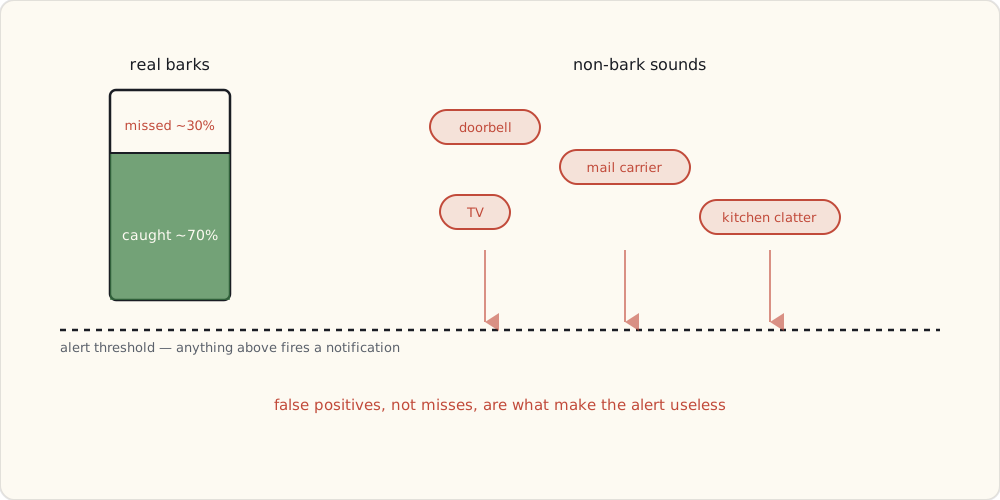
What it costs, and where the subscription is headed
It's a one-time purchase right now — around $199 at the moment, having launched higher — and no subscription. I don't expect that to last. The hints Furbo keeps dropping about "behavioral monitoring" and smarter alerts all point the same direction every connected pet company eventually walks: the hardware sells once, and the recurring revenue comes from an AI-flavored monitoring tier you pay for monthly. I'd bet a subscription product shows up within a couple of years. When it does, the question will be whether the behavioral analysis is real or just the bark detector with a price tag.
The cloud-dependency angle
Like everything else in this notebook, Furbo's control plane runs through the vendor's cloud. The live video is peer-to-peer when the network allows and relayed through the cloud when it doesn't, which is sensible. But the treat-toss command routes through Furbo's servers. Failure modes I've actually hit:
- Cloud outage — can't toss remotely, though live view often still works over the direct path.
- Wi-Fi loss — device offline, no control at all.
- Empty hopper — it dispenses nothing and says nothing. I found out by tossing into a void and watching Atom wait for a biscuit that never came.
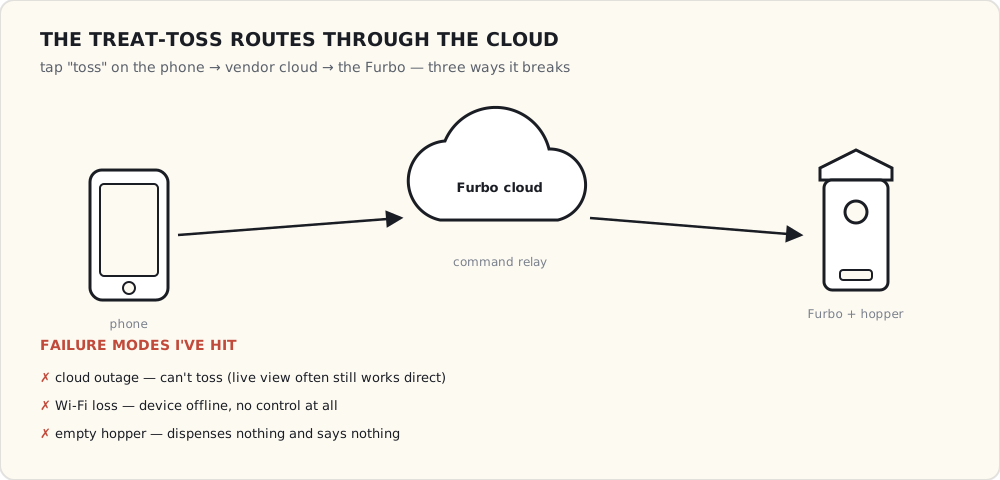
A "hopper empty" notification is table stakes and Furbo doesn't ship one. It's the same lesson as the Petnet feeder: the device knows its own state and declines to tell you the one thing you'd want to know.
What I actually use it for
- Tossing Atom a treat from the office when I catch him being calm on the live view. Daily.
- Checking in mid-day. Two or three times a week.
- Two-way audio. Tried twice, stopped.
- Bark alerts. Off.
The treat-toss is the only feature I'd pay for again. Everything else is generic Wi-Fi-camera fare I could get cheaper without the biscuit cannon.
What I want from this category next
- A hopper-level sensor and a low-treat alert. Trivial to add; conspicuously absent.
- A bark classifier that works, or an honest off-by-default. The current one is a net negative.
- Pet-versus-human awareness on the video — so an auto-toss only fires when it's actually the dog near the camera, not me walking past.
- A local-only control path for owners who'd rather not route their dog's treats through a startup's servers.
What's next
The SureFlap connected hub finally shipped this spring — the thing I've been waiting on since the 2016 announcement — and I'm wiring it up to network-connect the microchip cat door Joule's been using for years. That's the next one.
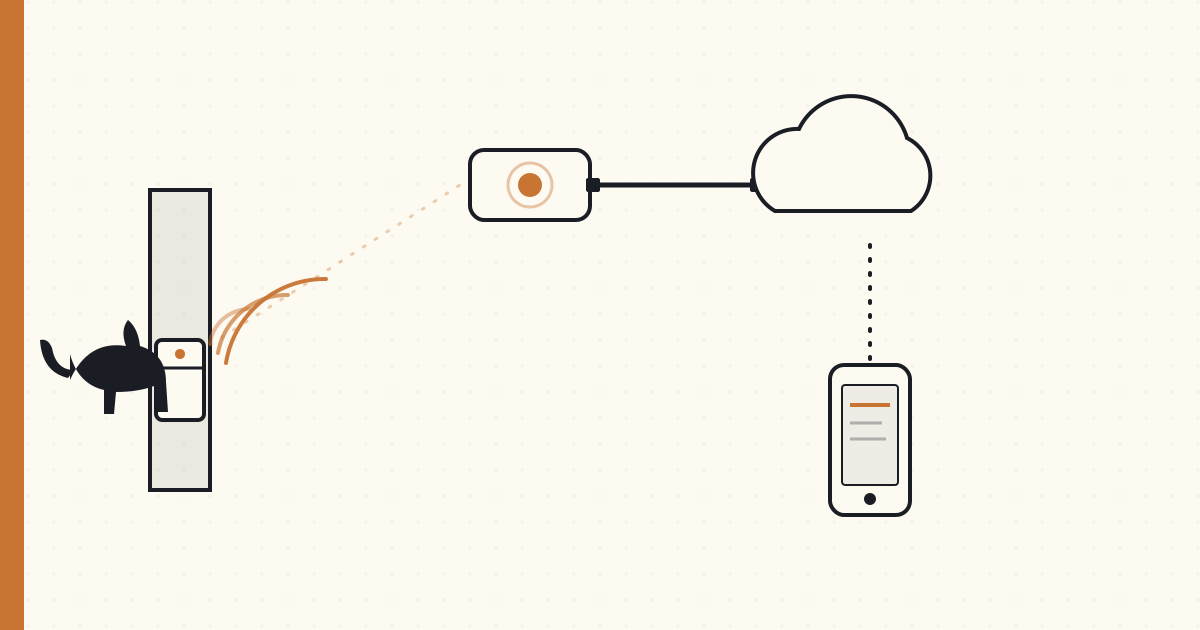 Part 13 of 42
 SureFlap Hub — finally, a connected cat door for Joule
The Sure Petcare hub finally shipped after a long slip, and it networks the microchip cat door I installed for Joule back in 2015 — no new door, just a firmware update and a sub-GHz base station. A month of logged entries and exits, the proprietary radio, the closed ecosystem, and the one thing the data does that watching the cat never could.
The Sure Petcare hub finally shipped this spring, after being announced back in 2015 and slipping all the way through 2016. I picked one up. The nice part: it networks the microchip cat door I installed for Joule in 2015 with no hardware swap at all — the door stays in the wall, a firmware update teaches it to talk to the hub, and the hub adds the layer that was missing. A month in, here's the read. (Note the rename, too: SureFlap became Sure Petcare this year, so the hub carries the new brand while the door still says SureFlap.)
The hardware
The hub itself:
- A small plastic puck that plugs into the wall.
- Ethernet to the router — no Wi-Fi on the hub at all, which I think is the right call. A base station that has to hold a rock-solid link is better off wired; Wi-Fi is the flaky part of every home network.
- A proprietary sub-GHz radio to talk to the door — 868 MHz in Europe and a similar low band in the US, not 2.4 GHz.
- Range of roughly 10 m through interior walls. Mine sits in a hallway closet about 5 m from the door, with a solid signal the whole month.
The door is the exact same unit from 2015. No change beyond the firmware that wakes up its radio.
The sub-GHz choice is worth dwelling on. It's the same neighborhood of the spectrum Z-Wave uses in the US (around 908 MHz) — a different protocol, but the same physical-layer logic: longer range through walls, a low data rate (which is all a door-event needs), and far less congestion than the 2.4 GHz band where Wi-Fi, Bluetooth, and every microwave oven are already fighting. For a device that sends a few tiny events a day and must never miss one, low-and-slow beats fast-and-crowded.
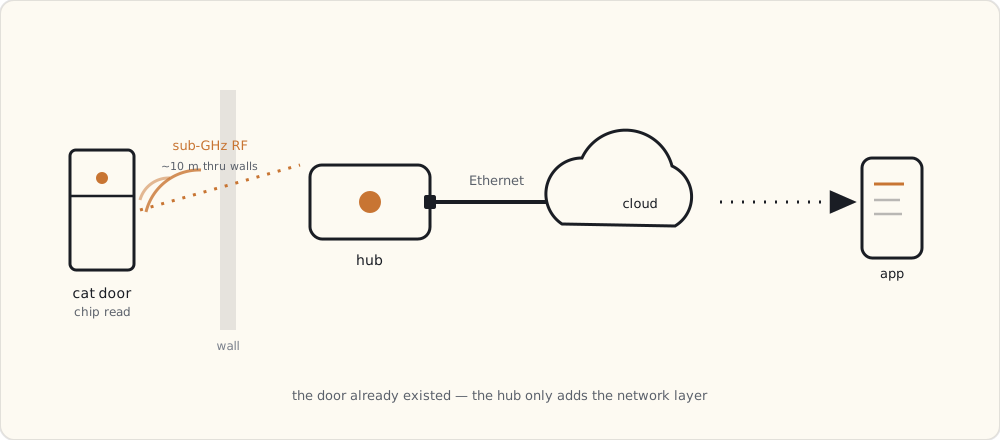
The protocol path
End to end, a single trip through the door looks like this:
Joule approaches → chip read → entry/exit logged on the door
   → door sends the event over sub-GHz RF to the hub
   → hub forwards it to the Sure Petcare cloud over Ethernet
   → cloud → mobile app + history log
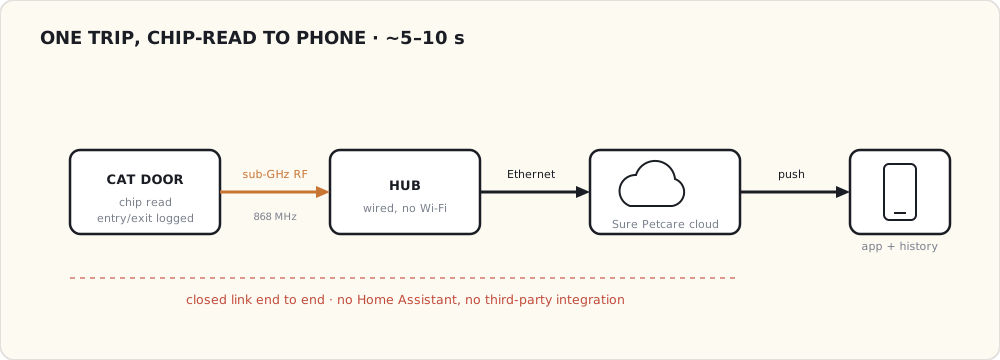
Chip-read to phone notification runs about 5–10 seconds, which is fine for what this is. The part I wish were open is that proprietary radio: there's no Home Assistant or third-party integration because nobody's reverse-engineered the Sure Petcare RF spec yet. It's a closed link from the door all the way to the cloud, and that closedness is the post's recurring complaint below. I'd love for someone to crack it; I'm not holding my breath.
The data the hub exposes
The app now shows each entry and exit with a timestamp and direction, a daily count, average outdoor duration, a per-cat breakdown (just Joule for now, but it's multi-cat capable), and a timeline for any given day. A month of it:
| Metric | Value |
|---|---|
| Average daily exits | 3.4 |
| Average daily entries | 3.4 (matches — good, no stuck-outside gaps) |
| Average outdoor duration per trip | 23 minutes (July) |
| Longest single trip | 2h 18m (something in the back yard held her attention) |
| Most-common exit time | 7:15 AM |
| Most-common re-entry | 7:38 AM (post-breakfast routine) |
I knew Joule went outside. I didn't know she had a near-clockwork morning loop and that the rest of her outdoor time comes in short bursts. The matched in/out counts are quietly reassuring, too — it means she's never been logged out without a matching return.
What's actually useful
A few uses I didn't anticipate but lean on:
- "Is Joule out?" before locking up at night. The app shows current state, inside or out, so I don't have to hunt the house for her.
- Vacation monitoring. When a neighbor watches her, I can confirm she's actually using the door — out for proper bathroom time — without interrogating the neighbor.
- Health-anomaly spotting, by hand. Three-to-four trips a day for a month is now a baseline in my head. If that fell to one, that's a flag: is she lethargic, is something wrong?
That last one is the real value, and it's worth stating as a principle: the best thing a connected pet device does is surface a trend that direct observation can't. I see Joule every day and I'd never have clocked a gradual drop in her outdoor trips. A logged baseline would.
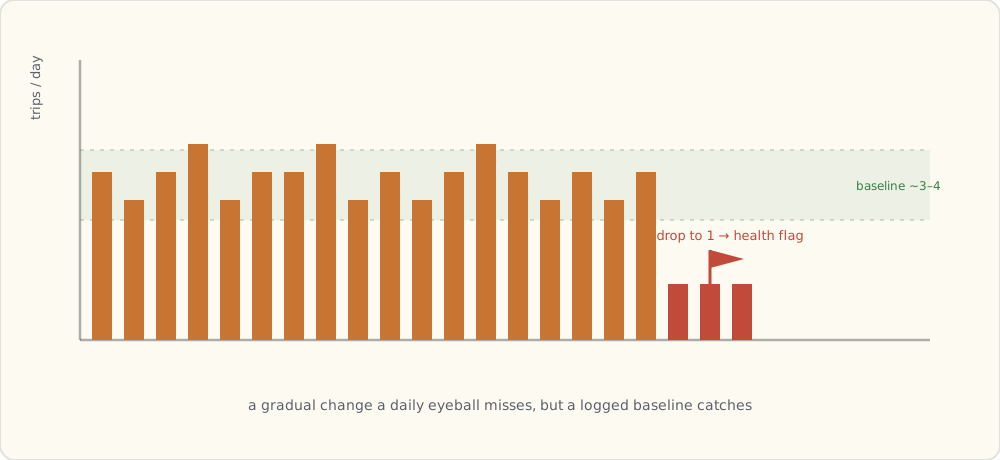
What's missing
- No HomeKit or Home Assistant integration. The API is closed; this won't change without a vendor SDK or someone reverse-engineering the radio.
- No multi-door coordination. I have one door, but a multi-door home would want it.
- No "Joule has been out longer than 30 minutes" alert. You have to go look in the app; the system won't proactively tell you.
- No webhooks or outbound triggers. Nothing leaves the closed ecosystem.
The hardware does its job well. It's the integration story that doesn't exist — the device is an island that reports only to its own cloud and its own app.
The privacy angle
The hub uploads every entry and exit to Sure Petcare's cloud, and per the terms they keep the timestamps and cat IDs indefinitely. It's not sensitive in the way a medical record is, but it's one more stream of household-rhythm telemetry leaving the LAN — when someone's home to let the cat in, when the house goes quiet — and that rhythm is more revealing than it first looks.
So the hub lives on my isolated IoT VLAN, same as the rest of the smart-home gear: it can reach the Sure Petcare cloud and nothing else on my network. A closed device I can't audit gets a segment it can't escape. That's the standing rule here — if I can't see inside the box, I at least fence the box.
What's next
The 2017 year-in-review lands in December. The question I'll be carrying into 2018: whether a credible independent tracker finally appears — one not owned by a pet-food conglomerate — and whether anyone cracks open a closed ecosystem like this one so the data can actually be mine.
 Part 14 of 42
 2017 pet IoT in review — the cat side finally gets data, the feeder gets scary
The year the cat side of the house finally got real telemetry — the Sure Petcare hub networked Joule's door — and the year the Petnet feeder started feeling fragile enough that I installed a dumb backup behind it. Scoring the 2016 calls, and eight bets for 2018. Five years of this documented now.
End of 2017, five years of pet IoT documented. Two themes this year: the cat side of the house finally got real data, and the feeder I trusted to keep the animals fed started feeling like something I shouldn't trust.
Scoring the 2016 forecast
| Prediction | Confidence | Outcome | Verdict |
|---|---|---|---|
| The SureFlap connected hub finally ships | 90% | Yes — shipped this spring | ✓ |
| I write up Furbo after living with it | 80% | Did, in May | ✓ |
| Whistle ships a smaller 2nd-gen cellular tracker | 65% | Yes — the half-size "Whistle 3" landed in February | ✓ |
| Petnet has its first multi-day outage | 55% | Two single-day outages, no multi-day yet | ✗ (the trend is there) |
| Litter-Robot launches a Wi-Fi version | 75% | Announced, ships 2018 | ✗ (timing) |
| Mars acquires another pet-tech startup | 65% | No new acquisition this year | ✗ |
| First Apple HomeKit pet product | 25% | Nothing | ✗ |
| A genuinely useful cat-side device appears | 35% | Yes — the Sure Petcare hub is exactly this | ✓ |
Call it 4/8 plus a near-miss on the feeder outage — roughly 60%. Same pattern, three years running: the structural bets land (the hub, the smaller cellular tracker, a real cat-side device) and the calendar bets slip (Litter-Robot's Wi-Fi version, the HomeKit product, the Petnet outage I'm still waiting on). I keep forecasting timing; vendors keep ignoring my calendar.
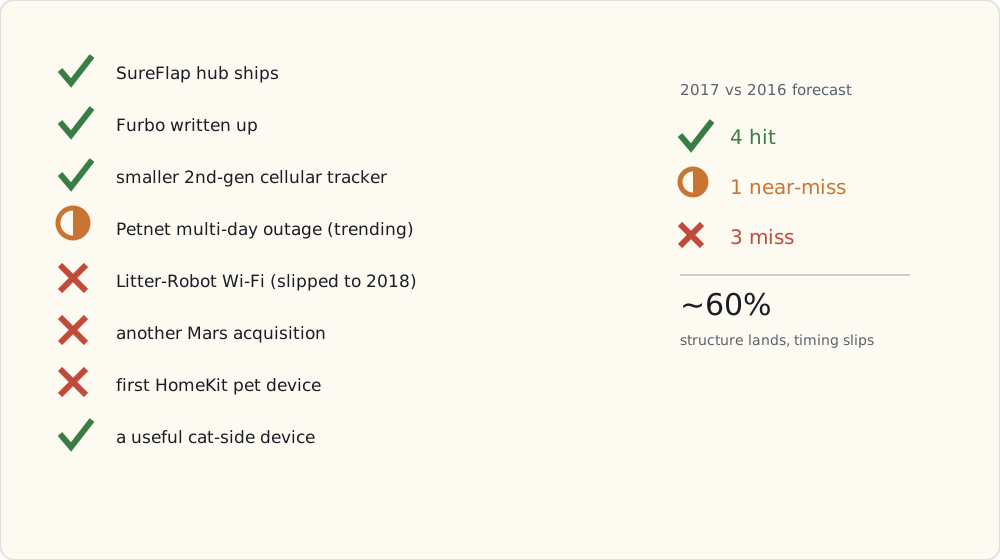
What got added in 2017
- A Furbo, picked up this spring — the treat-toss earns its keep daily; the bark detection got switched off in week two.
- The Sure Petcare hub this spring — Joule's microchip door is finally networked, and for the first time I have her outdoor patterns as data instead of guesses.
- A dumb backup feeder in June — a plain mechanical-timer auto-feeder with no Wi-Fi and no cloud, installed behind the Petnet feeder as a failover for Joule. Petnet hasn't failed catastrophically yet. The backup is there for the night it does.
What worked
- The cat side stopped being a dead zone. The hub plus the connected door turned "Joule goes out sometimes" into a logged baseline I can actually watch for changes.
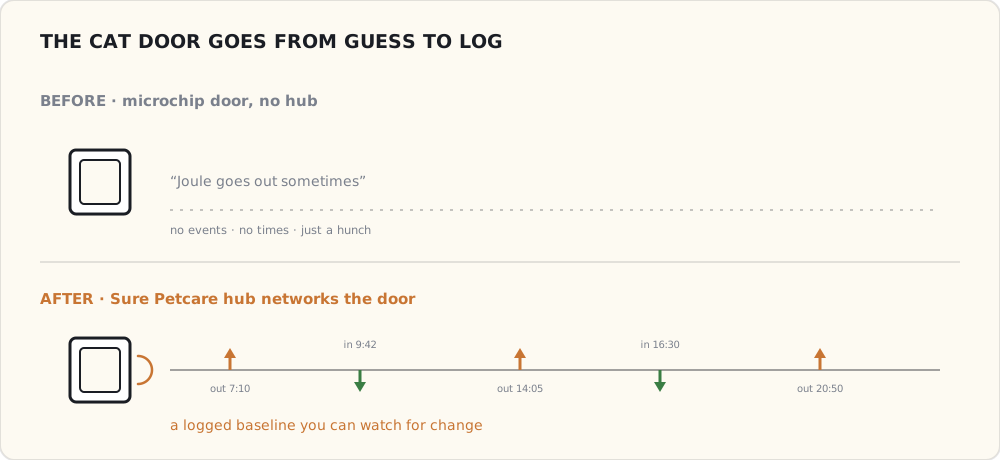
- Furbo's treat-toss for rewarding Atom from the office.
- The 2013 Whistle activity monitor plus FitBark on Atom — battery degraded but still chugging, still no subscription.
What didn't
- Furbo's bark detection — a false-positive machine, off after a week.
- Petnet's reliability, creeping the wrong way — two single-day outages and a cloud that feels more fragile each month.
- No HomeKit pet device — third year predicting it, third year wrong.
Forecast for 2018
| # | Prediction | Confidence |
|---|---|---|
| 1 | Litter-Robot's Wi-Fi connected version finally ships | 90% |
| 2 | Petnet has its first multi-day outage | 65% |
| 3 | A credible independent tracker — one not owned by a pet-food conglomerate — reaches consumers | 60% |
| 4 | A consumer microchip-activated feeder reaches retail (Sure Petcare or other) | 60% |
| 5 | A mainstream tracker adds health/vitals sensing, not just activity | 45% |
| 6 | First Apple HomeKit-certified pet product | 30% |
| 7 | Mars acquires another pet-tech startup | 70% |
| 8 | A pet-health-data-to-vet integration gets real traction | 35% |
What I'm buying in 2018
- The Litter-Robot connected version when it ships — the first smart-litter device in the house.
- An independent tracker, if a credible non-Mars one finally appears and the reviews hold up.
- A Sure Petcare microchip feeder if it lands, so I can feed Joule per-cat and keep Atom out of it.
- Definitely not another Petnet. The dumb backup stays installed regardless.
What's next
A big hardware year ahead. The connected litter box will be the first of its kind in the house. The open question I keep circling — does anyone finally ship a tracker that isn't owned by the company selling the food? — might get an answer in 2018. And the one I'd rather not have to ask: does Petnet survive another year, or does the backup feeder earn its place?
 Part 15 of 42
 The pet-collar power budget — what a multi-week cellular tracker would actually take
Every cellular pet tracker dies in days because of one number: the cellular radio's average current. I worked the power budget for a GPS dog collar against the Whistle GPS Pet Tracker's real 3–4-day life — and the new low-power cellular standard, LTE-M, is the one lever that could plausibly turn days into weeks. Here's the math, and what it would take.
The cellular pet tracker is the device I've wanted since 2013 and the device that keeps disappointing me on the one axis that matters: battery. The Whistle GPS Pet Tracker I lived with claimed seven days and delivered three to four — one, when it was actually tracking a loose dog. That isn't a Whistle failing so much as a physics failing, and I've been turning over the question of what it would take to fix it. So this post is an engineering exercise: I worked the power budget for a GPS dog collar from the components up, and there's exactly one lever in 2018 that could plausibly turn days into weeks.
Why pet GPS collars die fast
Where the energy actually goes on a cellular collar, per day:
| Component | Active draw | Duty cycle | Daily energy |
|---|---|---|---|
| Cellular modem (GSM/3G) | 0.5–2 W transmit, ~50 mW idle | High (always listening for the network) | ~3,000–5,000 mWh/day |
| GPS module | 60–120 mW when fixing | Periodic (every few minutes when active) | ~500–1,500 mWh/day |
| BLE radio | 5–15 mW | Continuous advertising | ~100–300 mWh/day |
| MCU + sensors + LEDs | 10–30 mW | Continuous | ~250–700 mWh/day |
| Total | ~3,800–7,500 mWh/day |
A puck like the Whistle carries roughly 3,700 mWh (about 1,000 mAh at 3.7 V). Set that against the table: at the ~7,500 mWh/day of active tracking, that's half a day. At the ~3,800 mWh/day of mostly-idle standby, it's about a day before the duty-cycling and deep sleep stretch it to the multi-day figures people actually see.
The one row that dominates everything is the cellular modem. A GSM/3G radio is a power hog — it transmits at up to a couple of watts and idles in the tens of milliwatts while it stays attached to the tower. The seven-day claim only works if the device spends nearly all its time in deep sleep with the modem doing nothing but listening for an occasional page. The instant it has to transmit — every position update while the dog is out — the budget collapses. Battery life on these things is, almost entirely, a question of how hard you can make the cellular radio sleep.
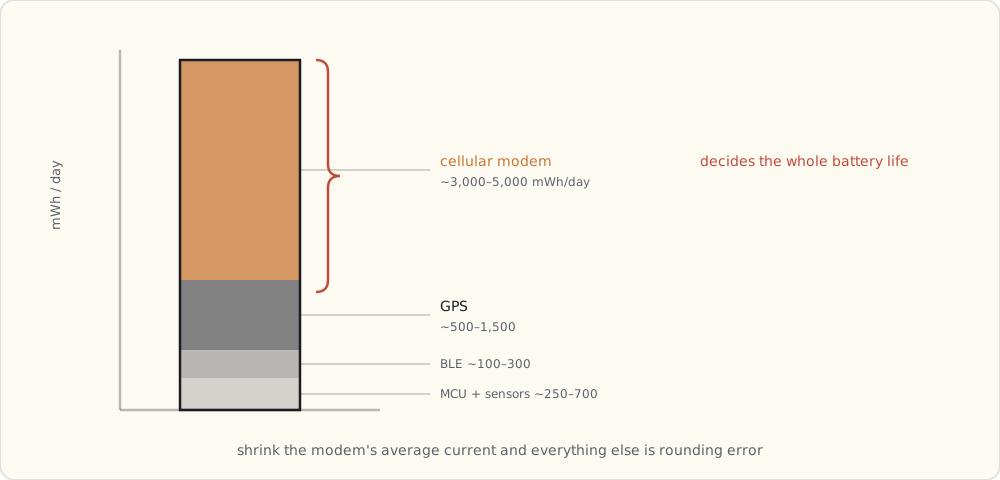
The one lever: LTE-M
The thing that could actually move this number is a cellular standard that only got real in the last year or two: LTE-M (Cat-M1), a low-power flavor of LTE built specifically for IoT devices that need cellular reach but not broadband speed.
- Throughput: about 1 Mbps peak, versus LTE Cat-4's 150 Mbps. A position fix is a few dozen bytes — you do not need broadband to send a lat/long.
- Power: an average of single-digit milliamps, with 100–200 mA peaks during transmit, against traditional cellular's tens of milliamps of average draw.
- The real trick — Power Saving Mode. PSM lets the modem tell the network "don't expect me for the next few hours," then drop into a deep sleep that draws microamps while staying registered. It wakes on its own schedule, sends its updates, and goes back down. That's the difference between a radio that's always half-awake and one that's asleep 95% of the time.
- Coverage: a better link budget than standard LTE, so it reaches into fringe and indoor spots where a normal modem drops.
The rollout timing is what makes this a 2018 conversation and not a 2016 one. AT&T lit up nationwide LTE-M in 2017; Verizon's followed through early this year. By now both carriers have LTE-M across most metro areas — which means a tracker built on it could actually work for a real customer rather than a lab. The Whistle GPS Pet Tracker can't take advantage of any of this: it shipped on GSM/3G in 2016, before LTE-M was deployable. A tracker designed two or three years later would be built on Cat-M1 from the start, and that single choice is worth more to battery life than any other decision in the device.
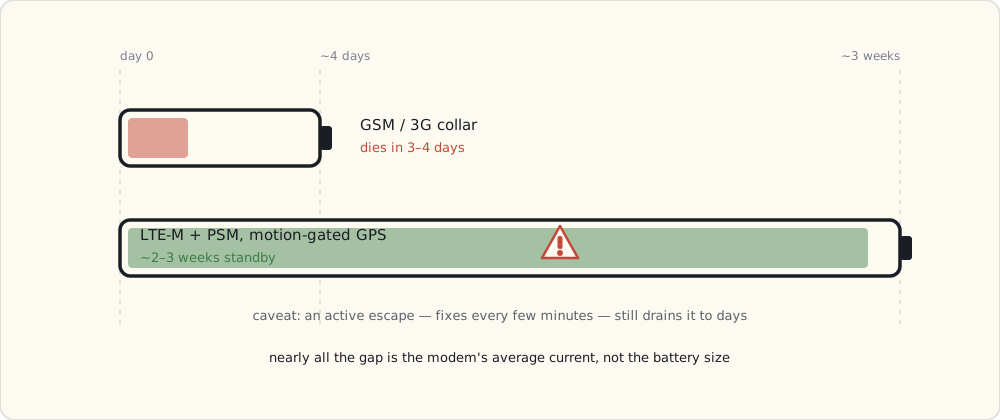
Working the multi-week number
Could an LTE-M collar actually hit the "weeks, not days" figure the category needs? Run the math:
- Put a slightly larger cell in it — say 1,800 mAh at 3.7 V, about 6,700 mWh, which fits a collar puck without making it a brick.
- Swap GSM/3G for LTE-M with PSM, taking the modem's average power from the ~2,000 mW-while-active regime down toward a couple hundred milliwatts averaged across a day of mostly sleeping. That's the ~10× reduction in the dominant term.
- Gate the GPS on motion — only fix when the accelerometer says the dog is moving — and lean on BLE when the dog is home near a paired base, so the expensive radios stay off until the dog is genuinely out and elsewhere.
- Wake the cellular only on a geofence break, not on a fixed timer.
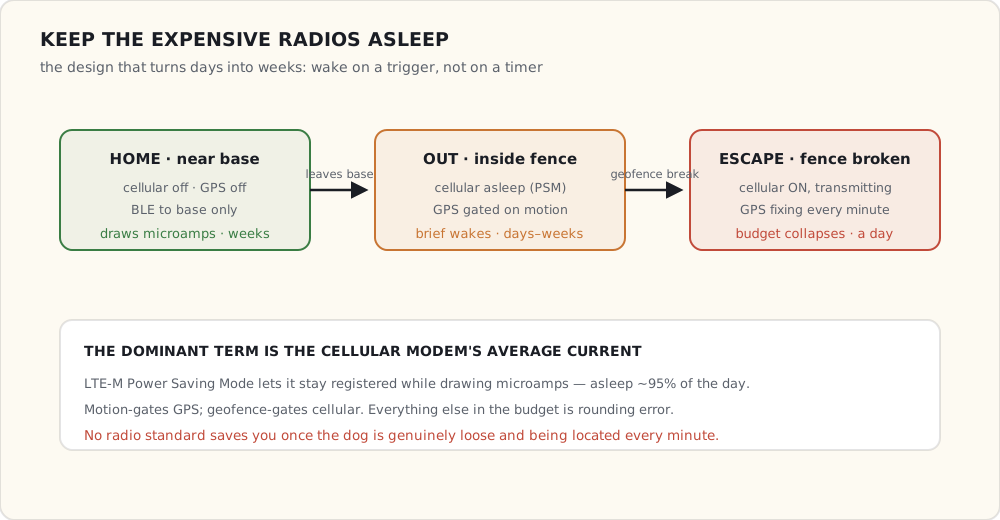
Do all of that and the arithmetic plausibly supports two to three weeks of standby — for a mostly-stationary dog inside a known geofence. The honest caveat is the same one that bit the Whistle: the instant the dog is actually loose and being located every few minutes, the modem is transmitting and the budget collapses toward days again. So "three weeks" would be a real and meaningful improvement, but it's a standby number. The number that matters in an emergency — dog out, fixes flying — is still measured in a day or two, and no radio standard changes that.
What I'd want from whoever builds it
There's an obvious opening here for a tracker that isn't owned by a pet-food conglomerate — the independent-data argument I've made since Mars bought Whistle — but the thing I'd actually judge it on is engineering honesty:
- Publish the battery number under load, not just standby. "Three weeks" on the box and three days when the dog escapes is the same bait-and-switch I logged on the Whistle. Tell me both.
- Be on LTE-M, and say which carrier. If it's still GSM/3G in 2018, the battery story is already lost. If it's Cat-M1, tell me whose network, because coverage is the product for a device that has to phone home from wherever the dog ended up.
- Motion-gated GPS and a real home/away model, so the device isn't burning the cellular budget while the dog naps on the couch.
The power budget is the whole ballgame, and for the first time there's a standard that could actually change it. Whether anyone ships a collar that uses it well — and is honest about the load number — is the thing I'll be watching.
What's next
The Litter-Robot's Wi-Fi connected version finally shipped, and I have one on order for Joule. The smart-litter category turns out to be where the genuinely medical pet data lives — visit frequency, duration, weight — so that's the next one.
 Part 16 of 42
 Litter-Robot III Connect — the first pet IoT device with real medical telemetry
Whisker's Litter-Robot III Connect adds Wi-Fi, a weight sensor, and a visit log to an already-good self-cleaning litter box. The convenience is fine. The real story is that visit frequency, duration, and the cat's weight are medical-grade signals — the first pet device whose data could actually catch a UTI, diabetes, or weight loss before the annual vet visit does.
The Litter-Robot III Connect arrived this month — Whisker's globe-shaped self-cleaning litter box, the one that's existed in some form for years, now with the Wi-Fi "Connect" upgrade they added in 2017. It's not cheap, around $500. Joule spent a fortnight side-eyeing the rotating spaceship in the corner before committing. Two weeks in, and the surprise isn't the convenience — it's that this is the first pet device I've owned whose data could plausibly save the cat's life.
The mechanism, briefly
The unit is a rotating globe on a weighted base:
- The cat steps in; the base weight sensor registers the entry.
- The cat does their business and leaves.
- A delay timer starts — about seven minutes — to let the clumps harden.
- The globe rotates, and the litter passes through a separator screen.
- Clumps drop through into a sealed waste drawer below; clean litter rotates back into the bowl.
You empty the waste drawer every week or so for a single cat. No daily scooping, which is the whole pitch of the dumb version and reason enough to own one.
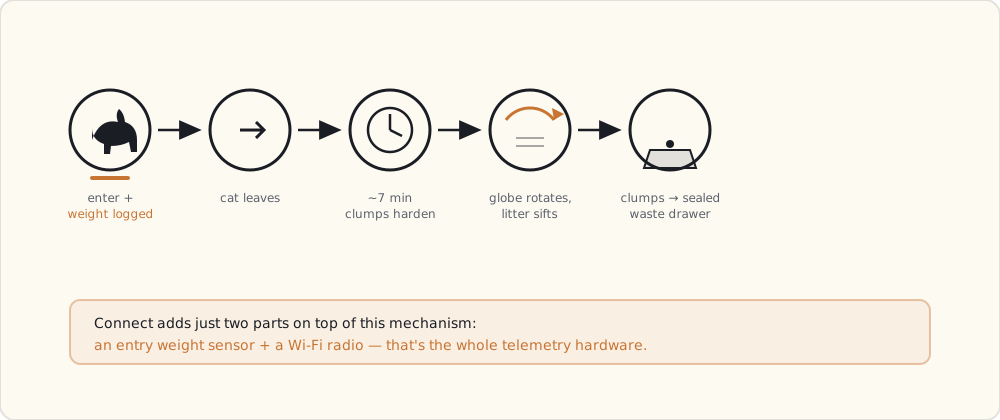
What "Connect" actually adds
The mechanical platform is unchanged; the Connect bolts on two things — a weight sensor and a 2.4 GHz Wi-Fi radio — and an app. From those you get:
- Push notifications: waste drawer full, cycle complete, cat currently in the unit, and mechanical faults (motor stall, sensor error).
- A cycle and visit log: every entry and exit, timestamped.
- An entry weight each time the cat steps in.
The honest read on the economics: that's maybe $30 of bill-of-materials — a load cell and a Wi-Fi module — and Whisker charges a good deal more than $30 for the Connect tier. The margin on "connected" is the business model across this whole category, and it's worth seeing it clearly. But unlike most connected-tier upcharges, here the data you get back is genuinely worth having.
The data, two weeks in
| Metric | Value |
|---|---|
| Average visits per day | 3.2 |
| Average visit duration | 64 seconds |
| Entry weight | 9.4 lb (Joule weighed 9.5 lb at the vet three months ago — the sensor is real) |
| Cycles per day | 3.2 (matches visits) |
| Waste drawer fill rate | ~10% per day |
The weight number is the one that made me sit up. The base reports the delta when the cat steps in, and Joule comes in at 9.4 lb against a vet-measured 9.5 lb. That agreement is what makes the rest of the data trustworthy — it's not a toy reading, it's a scale she stands on three times a day without anyone having to wrestle her onto one.
Why this is the first pet IoT device with real medical value
Here's the part that separates this from bark detection and activity scores. Visit frequency, visit duration, and body weight are not gimmick metrics — they're the exact signals a vet reads, and a litter box captures them continuously:
- Urinary trouble (UTIs, blockages, FLUTD). A cat with urinary problems often visits far more often than normal — six, eight times a day instead of two to four — and stays only briefly each time. That frequency-up, duration-down signature is a classic early flag, and a urinary blockage in a male cat is a genuine emergency measured in hours.
- Diabetes. Increased urination — more frequent, larger volume — is a textbook early diabetes presentation in cats. More visits and a heavier-cleaning drawer show up here before the lethargy does.
- Weight loss. A slow decline in entry weight is one of the earliest warnings of hyperthyroidism, kidney disease, or cancer — and it's exactly the kind of gradual change that a once-a-year vet weigh-in, or a person who sees the cat daily, will miss until it's pronounced.
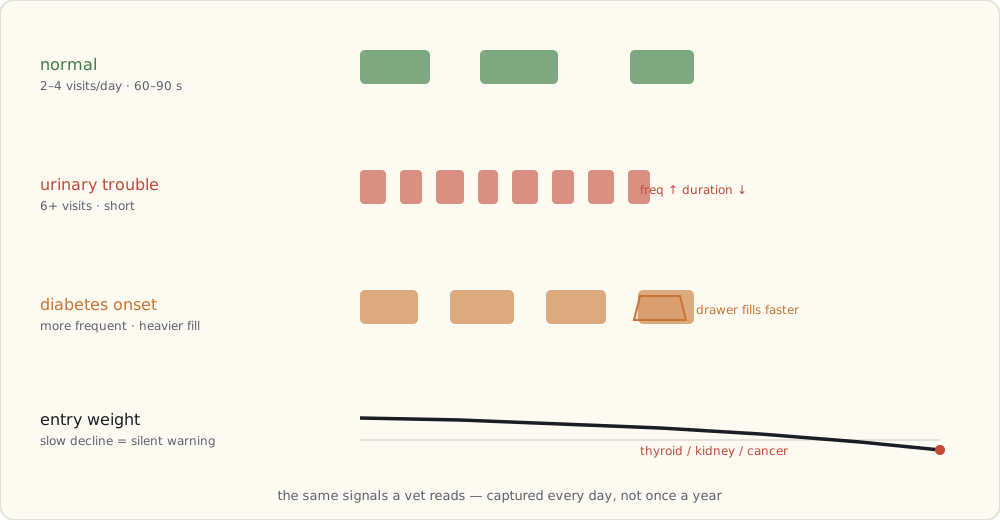
The framing that stuck with me: a person gets a routine physical once a year, and we accept that as thin sampling. For a cat, the annual vet visit is the entire dataset, and it's blind to any trend that develops and resolves between appointments. A box that logs every visit turns that single yearly data point into a continuous record. This is the first pet IoT where the medical-data potential is real — not inferred from an accelerometer, not a marketing "wellness score," but the literal measurements a clinician would order.
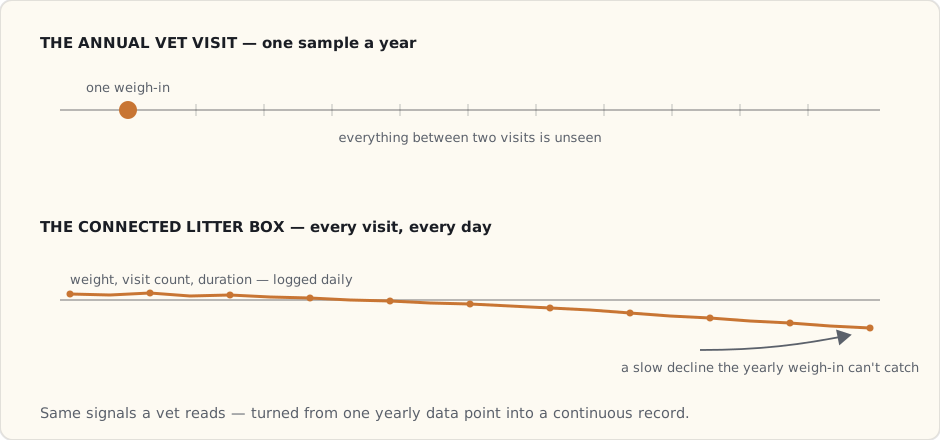
What's missing in 2018
- No vet integration. The data sits in Whisker's app — no export, no path into a vet-records system or a Banfield/VCA workflow.
- No anomaly detection. The app will tell me "22 visits this week" but not "that's 30% above last month — consider a vet visit." The raw numbers are there; the layer that makes them actionable isn't.
- No multi-cat identification. I have one cat, so it's moot for me — but the weight-plus-duration combination is exactly what would tell two cats apart, and it's the obvious gap for multi-cat homes. (I expect that to be where the next wave of smart-litter products competes.)
- No API, closed ecosystem. Same complaint as the Sure Petcare hub: the data is mine in theory and locked in their cloud in practice.
The data is collected and the actionable layer doesn't exist yet. Whisker is a hardware company; the analytics — anomaly detection, vet hand-off, multi-cat attribution — is the opening for someone else, or for Whisker to buy it.
Joule's adjustment
She was suspicious for about four days. We left the old box beside it and let her choose; by day six she'd switched over entirely, and two weeks in she has no complaints worth lodging. Whisker claims most cats adapt within a week. A sample size of one, but the claim held.
What I'd want next
- Per-cat identification by weight and entry-pattern profiling — the must-have for multi-cat households.
- Anomaly detection with alerts — "Joule's visits dropped 40% this week, schedule a vet visit?" — turning the data into a prompt instead of a spreadsheet.
- Home Assistant / local integration, so litter-box state lives on my own dashboard, not only theirs.
- A data export for vet records.
Whisker's been hinting at most of these. I'd guess a couple of years out.
What's next
The 2018 year-in-review lands in a month. The questions I'll be carrying into 2019: whether a credible independent tracker — one not owned by a pet-food company — finally reaches consumers, and whether the Petnet feeder survives another year or the dumb backup finally earns its keep.
 Part 17 of 42
 2018 pet IoT — the quiet year before Fi
Litter-Robot III Connect joined the house and earned its keep. Fi closed funding and a 2019 ship date. Petnet kept hanging on by single-day outages. The 2017 forecast came in at my worst-ever 45% — almost every miss was a vendor ship date I read off a calendar.
End of 2018. Six years of writing this thing down. This is the one where the most honest entry in the ledger is a blank — Atom spent a third of the year wearing a collar with nothing on it, and that was the right call.
Before the year-end tally, the annual humility exercise: scoring what I predicted twelve months ago.
Scoring the 2017 forecast
| Prediction | Confidence | Outcome | Verdict |
|---|---|---|---|
| Fi smart collar ships consumer device | 70% | Closed seed funding, announced — ships 2019, not 2018 | ✗ (timing) |
| Litter-Robot III Connect (WiFi) ships | 90% | Yes, and it's in the house | ✓ |
| Petnet first multi-day outage | 65% | Three more single-day outages, still no multi-day catastrophe | ✗ (partial; trend is real) |
| Consumer microchip-activated feeder reaches retail | 60% | SureFeed's connected feeder is real, but it landed in 2017 — I mis-dated it | ✓ (partial; wrong year) |
| Whistle successor with health sensors announced | 50% | Rumored all year; nothing official | ✗ |
| HomeKit-certified pet camera | 35% | Nothing | ✗ |
| Mars acquires another pet-tech startup | 70% | Mars Petcare agreed to acquire AniCura — a 200-hospital European vet network | ✓ (bigger than expected) |
| Pet-health-data-to-vet platform gets traction | 35% | Nothing meaningful | ✗ |
Three clean hits, two partials, three flat misses. Call it 45% — my worst forecasting year in six. The instructive part is how I missed. Almost every miss was timing: Fi slipped a year, the SureFeed Connect feeder shipped a year earlier than I logged it, the Whistle health rumor never got an announcement. I keep predicting on quarters, and pet hardware ships on a clock I don't control.
The AniCura hit is the one worth dwelling on. I forecast "Mars acquires another pet-tech startup" expecting a Whistle-sized tuck-in — another collar, another app. Instead Mars Petcare went and agreed to buy AniCura: not a device company at all, but a network of roughly 200 animal hospitals across seven European countries, closing late in the year after the EU cleared it. That's a different bet entirely. Mars already owns the food (Pedigree, Whiskas, Royal Canin), the trackers (Whistle, the old Tagg IP), and now a wall of the clinics. The thing I should have been forecasting wasn't "which startup gets bought" — it was "Mars is assembling the whole loop: what your pet eats, what its collar measures, and the vet who reads both."
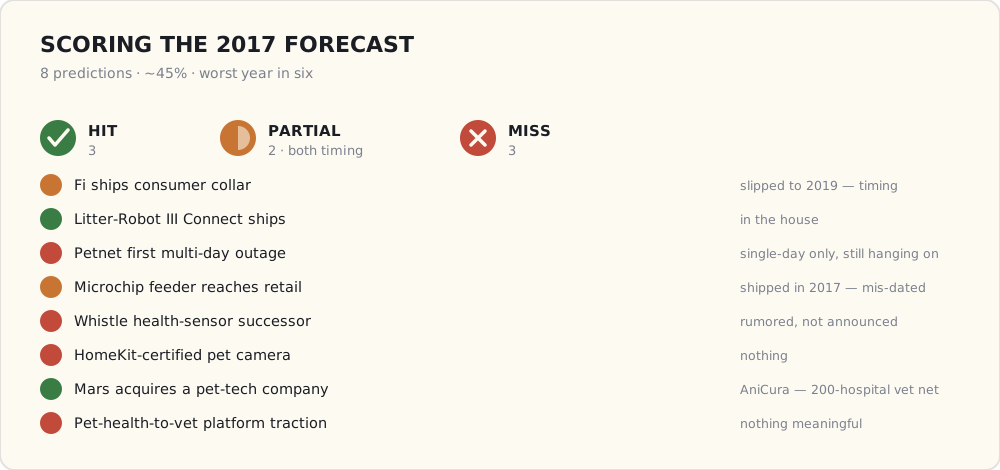
What got added this year
- Litter-Robot III Connect (the model that shipped late in the year, finally installed). Joule took to it inside a week. It's the first genuinely connected litter device in the house, and the first one I'd recommend without a caveat.
- A second backup feeder. I now run a non-connected, mechanical-timer PetSafe Smart Feed alongside each Petnet — one for Joule, now one for Atom too. The redundancy is no longer theoretical (see below).
What got removed
- Atom's Whistle 3, decommissioned in August. The battery had degraded past usefulness — a tracker that needs charging every two days isn't tracking, it's a charging chore with a collar attached. Replacement: nothing. Atom went bare-collar for four months and the dog did not notice. I did. The decision was deliberate: the only cellular dog tracker worth buying was a newer Whistle, and after two years of Mars locking down Whistle's API post-acquisition, I wasn't going to spend money rewarding that. So I waited for Fi.
That four-month gap is the truest thing in this year's review. The honest state of consumer dog tracking at the end of 2018 is: the best move available to me was to buy nothing and wait.
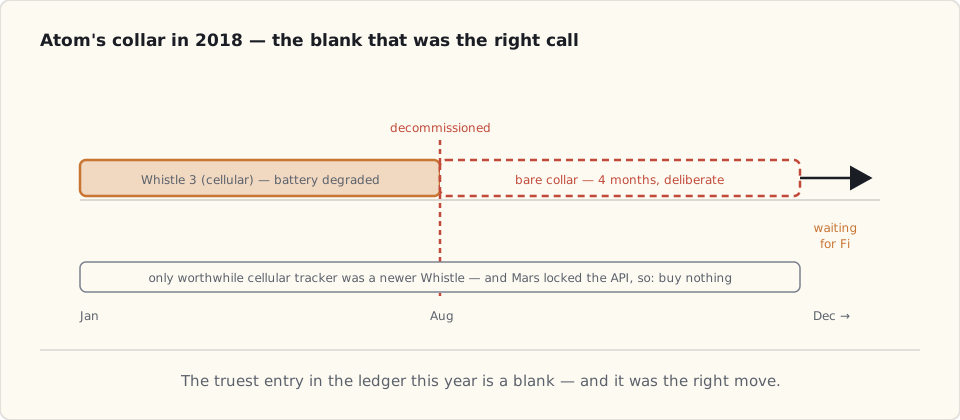
What worked
- Litter-Robot III Connect. A real quality-of-life win and a surprising amount of latent health signal — it knows how often the box gets used and roughly by how much weight, which for a single cat is a usable baseline.
- SureFlap Hub, still boringly reliable. Joule's outdoor patterns now have eighteen months of unbroken history. Boring is the highest compliment I pay infrastructure.
- Feeder redundancy, validated. Petnet missed three feeds this year across short outages. The mechanical backup caught every one. A dumb timer with no cloud dependency beat a smart feeder with one, three times — which is its own quiet lesson about where to put intelligence in a system that has to work when the network doesn't.
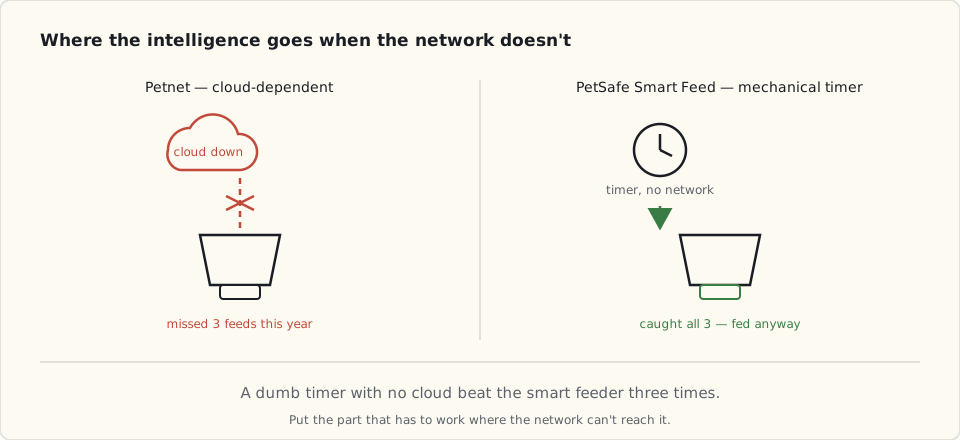
What didn't
- Petnet's slow decline. No single outage was long. But the frequency is climbing year over year, and the company still won't say anything about it. Silence from a vendor whose product I rely on to feed my animals is not a neutral signal.
- The Mars–Whistle relationship. It hasn't improved; it's gotten worse. The API restrictions tightened again, more community integrations broke, and my own data-export pipeline is now effectively Litter-Robot plus SureFlap. Whistle, the device that started this whole journal, contributes almost nothing to my data picture anymore — not because the hardware got worse, but because the owner decided openness wasn't strategic.
There's a pattern across both of those: the device kept working, but the company behind it changed in a way that made the device worth less to me. Petnet by neglect, Whistle by deliberate lock-down. After six years, I trust hardware I can hold more than I trust the cloud account it phones home to.
Forecast for 2019
| # | Prediction | Confidence |
|---|---|---|
| 1 | Fi ships its consumer collar | 80% |
| 2 | Petnet has its first genuine multi-day outage | 75% |
| 3 | A Whistle successor with on-board health sensing is announced | 55% |
| 4 | A second credible smart-litter device challenges Litter-Robot | 60% |
| 5 | Mars's vet-clinic strategy becomes visibly tied to its devices (clinic + collar data) | 65% |
| 6 | First credible HomeKit pet device | 35% |
| 7 | A GPS-fence consumer collar (virtual-fence, no buried wire) appears | 45% |
| 8 | I buy a Fi for Atom and stop paying Mars | 70% |
What I'm buying in 2019
- A Fi the moment it ships and the first reviews look real. Atom's bare collar has a slot reserved.
- A second Litter-Robot only if we add a cat — not in the plan, but I've learned not to write "never."
- Whatever Whistle ships post-Mars: probably nothing. I'll vote with my wallet.
What's next
The Fi launch is 2019's headline — the first time in years there's a cellular dog tracker not owned by Mars. The Petnet question is the slow-burn: does a feeder company that's stopped communicating make it through another year? And smart litter, having proven itself in my own house this year, is the category I expect to actually grow.
Six years in. Four pets — one dog, one cat, no additions — and a dog collar sitting empty on purpose, waiting for the one device I'm willing to pay for.
 Part 18 of 42
 Petnet's cracks are visible — the early warning
Petnet had two outages in April — one 18-hour, one 6-hour. No communication. Layoffs rumored in pet-tech press. Three+ years of consolidation about to claim a victim. Notes on what to do.
Petnet had two outages this month. One 18-hour event, one 6-hour event. The 18-hour outage missed three feeds for Joule + Atom. My backup PetSafe Smart Feed feeder caught two of them. One was missed entirely.
The Petnet company has gone silent. No status page updates. No emails to customers. The pet-tech press is reporting rumored layoffs.
This is the slow-motion failure I predicted three years ago but kept being wrong on timing. The timing is finally here.
The pattern of a cloud-dependent vendor failing
This is a category that's playing out for the first time in pet IoT. The pattern, from observable history of other cloud-dependent consumer hardware:
Initial outages become more frequent. Petnet's outage cadence:
- 2017: 2 single-day outages.
- 2018: 3 single-day outages.
- 2019 Q1: 4 outages in 3 months.
- This trend doesn't reverse. Companies that can't afford reliable infrastructure don't suddenly find the budget.
Communication degrades. Petnet's email response time has gone from same-day in 2017 to weeks-or-never in 2019. Their status page hasn't been updated in months.
Software development slows. The Petnet iOS app hasn't had a meaningful update in 8 months. iOS 12 compatibility was patched late. iOS 13 (rumored September) is going to be a problem.
Hardware momentum stalls. The SmartFeeder 2.0 they showed at CES in January 2018 — sleeker shell, Alexa and Google Assistant hooks — shipped, but it carried the same cloud dependency and the same reliability problems. A new lid doesn't fix a fragile backend. Replacement-part inventory is rumored low.
Then the company quietly stops responding. Servers eventually go offline.
THEN the bankruptcy notice arrives (or doesn't, and the company just vanishes — happens with foreign-owned VC-backed startups).
We're somewhere between steps 3 and 5 with Petnet.
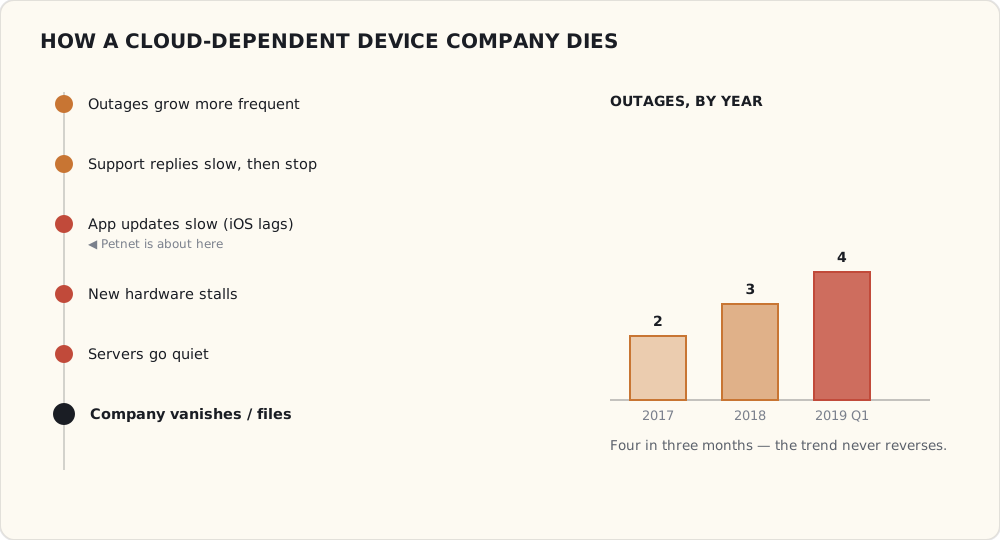
What pets actually experience
The user-visible failure mode for Petnet specifically:
- Scheduled feeds don't fire.
- The app shows "device offline" without explanation.
- Manual button on the unit does still work (Petnet has a physical feed-now button that bypasses the cloud).
- Customer service emails aren't returned.
For a dog like Atom: missing two consecutive feeds is uncomfortable, not catastrophic. He'll be very hungry; nothing more.
For a cat like Joule: missing 36-48 hours of feeds is medically serious. Cats develop hepatic lipidosis (fatty liver disease) if they don't eat for 2+ days. It's a life-threatening condition that develops fast in inadequately-fed cats, especially overweight ones.
This is why Petnet's failure mode is genuinely dangerous, not just inconvenient. The risk profile is asymmetric.
What I'm doing now (and what every Petnet customer should be doing)
- The backup PetSafe Smart Feed is now primary. Mechanical timer, no WiFi, no app. Tested daily.
- Petnet is secondary — runs in parallel, dispenses if it can. I no longer rely on it.
- Daily 7 AM check: did the morning feed happen? Manual override if not.
- Smaller hopper fills. If I'm going on vacation, the kibble in Petnet is small enough that it's gone in 3-4 days, forcing me to come back to manual feeding before catastrophe.
If you're a Petnet customer and don't have a backup feeder, get one. PetSafe Smart Feed ($90) is the right choice — mechanical timer, no software, no WiFi. It will outlive every connected feeder.
The broader lesson for connected pet hardware
The cloud-dependency risk for connected pet devices is categorically different from the same risk for connected smart-home devices.
A smart bulb that won't turn on because its cloud is down is annoying. A smart feeder that won't dispense food is animal welfare. A smart litter box that won't cycle creates an unpleasant cat. A smart pet door that won't unlock locks your cat outside in the cold.
The pet-IoT category is the first connected-hardware category where vendor solvency is a safety-of-pet question. That changes the calculus. Specifically:
- Never buy a cloud-dependent pet device without a non-cloud-dependent backup.
- Never trust a small-startup pet-device company's "feature roadmap" — be skeptical of post-purchase software updates.
- Read the EULA — what happens if the company is acquired or fails? Does the device brick? (For Petnet: yes, the device bricks if the cloud is unreachable.)
- Prefer devices with mechanical fallback (Petnet's manual button is something, but it requires being physically present).
What I want to see next in the category
A class of pet devices that schedule lives on the device, not the cloud. The cloud is for changing the schedule. If the cloud is unreachable, the device executes the last-known schedule from local storage.
This is the architecture I've been arguing for since Petnet's first outage in 2018. Nobody has built it yet. The market opportunity is real.
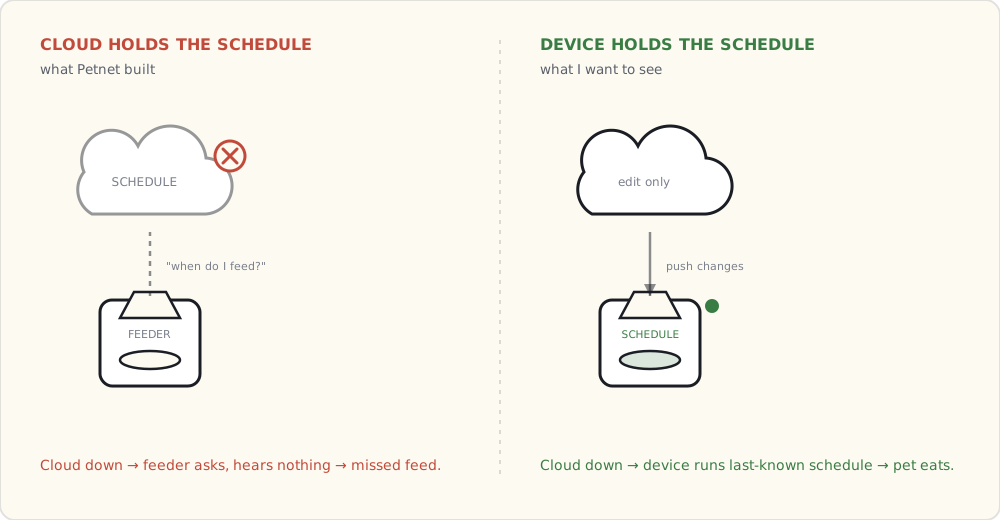
What's next
I expect Petnet to have a multi-day outage in 2019 — probably summer or fall when their infrastructure budget runs low. The "year-end review" post might be writing the company's eulogy.
For now: backup feeder primary. Petnet secondary. Daily check. The list of "things to do because Petnet might collapse" gets longer every month.
 Part 19 of 42
 Fi ships first units — Atom finally has a non-Mars tracker
Fi Series 1 shipped October. Bought one for Atom — first non-Mars cellular tracker. LTE-M, three-week claimed battery, no Mars Petcare ownership. Notes on setup, real battery life, vs Whistle.
Fi announced back in March and the Series 1 finally started reaching waitlists this fall. Bought one for Atom — the first cellular tracker on him since I shelved his Whistle 3 last year, when the battery degraded past usefulness and I decided to wait rather than re-up with Mars. Two weeks of use, and this is the first dog tracker I've been genuinely happy with.
The hardware
- Plastic puck, ~38 g (slightly heavier than Whistle 3 because of the larger battery).
- LTE-M / Cat-M1 cellular modem (Quectel BG96-class).
- GPS / GLONASS / Galileo triple-constellation chipset.
- BLE 5.0 for base-station / phone proximity.
- Rechargeable Li-ion, claimed 3 weeks battery life.
- IP68 water rating (better than Whistle's IP67).
- Snap-on collar mount with a metal locking ring (vs Whistle's plastic clip).
The mount is the small detail I appreciate. Whistle's plastic clip broke twice on Atom over its lifetime (replacement was $20 each). Fi's metal locking ring feels solid.
Setup, in detail
- Unbox. Power on the Fi via the side button.
- iOS app downloads. Create account.
- Pair via BLE proximity — phone discovers the Fi, completes a setup handshake.
- LTE-M activation — Fi negotiates cell network registration. Took about 90 seconds; visible progress bar in the app.
- Configure subscription — $149 hardware + $99/year. That's more up-front than Whistle's puck and a higher annual than Whistle 3's ~$84/year, but you're paying for hardware that lasts the day instead of needing a charge before dinner.
- Set geofence — drew a 100-meter radius around our house. Fi pushed notification on enter/exit.
- Snap the Fi onto Atom's collar.
Total setup: 12 minutes. The hardest part was getting Atom to hold still for the collar snap.
What it does
Same basic feature set as Whistle 3, but the data sync and refresh feel meaningfully better:
- Location refresh: cellular ping every ~2 minutes when active, every 15 minutes idle.
- Geofence alerts: < 30 seconds from boundary crossing to push notification.
- Activity tracking: accelerometer-based step counting + classification (rest/active/play).
- Multi-pet support: Fi handles multiple devices per account; useful when we add a second pet.
- Crowd-sourced lost-pet network (Fi calls it "Lost Pet Mode"): if your dog escapes and Fi has cell signal, location updates push to the lost-pet map; other Fi owners with the app open see "lost dog in this area" alerts.
The crowd-sourced lost-pet network is interesting. Fi's claim is that the install base is large enough in major US cities that a lost dog would likely be near another Fi-equipped dog within minutes. Untested for me; I hope to never test it.
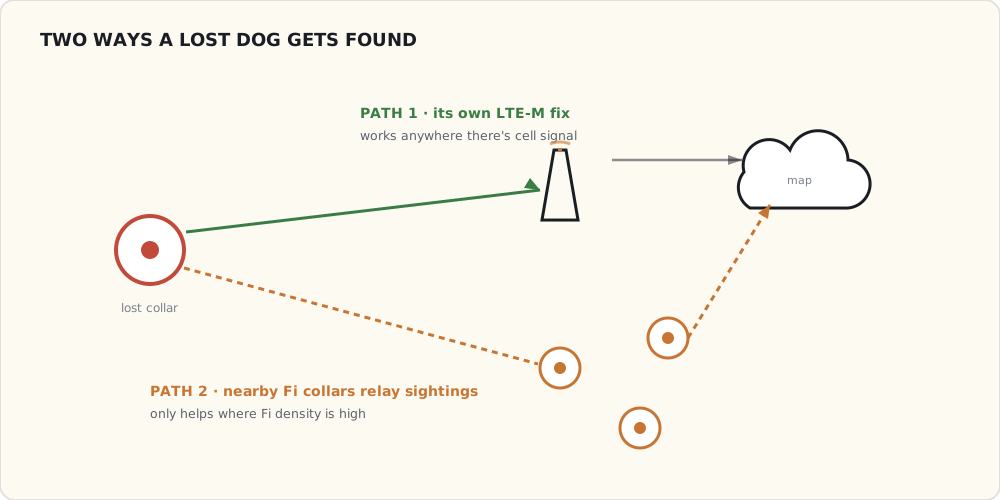
Real battery life — the headline result
Marketing claim: up to three months — but read the fine print, and that number is for a dog that mostly sits at home in Wi-Fi range, with the cellular and GPS radios barely waking up. My measured: 14 days actual on Atom (active 6-yr-old Lab, multiple walks a day, in and out of the home geofence).
Fourteen days is well short of the headline "months," and I'd push back on Fi for marketing the best case. But it's still 4-5× better than Whistle 3's real 3 days — and the gap is the whole story. The LTE-M architecture is the differentiator: a radio designed for a water meter that phones home occasionally, not a phone that's always live.
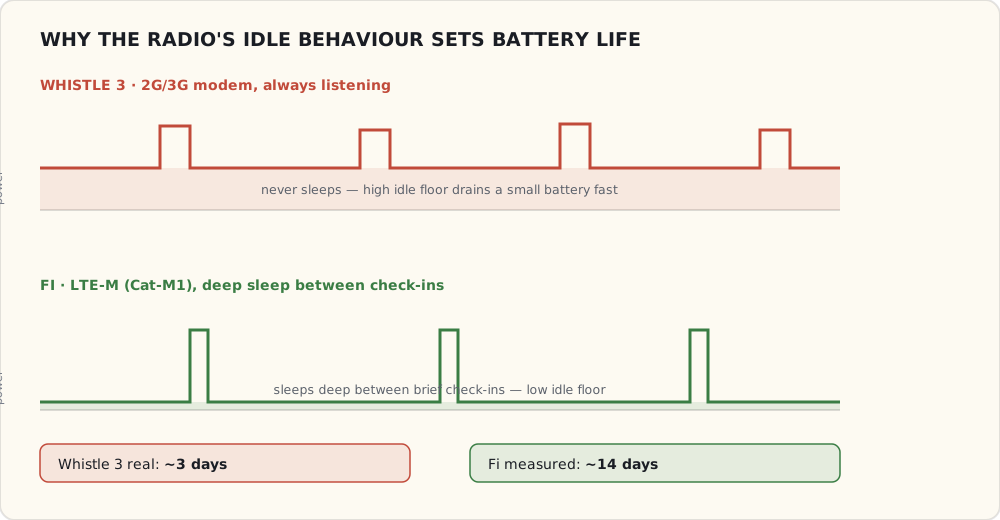
Important nuance: the 14 days is at default sync intervals. If you set Fi to "high accuracy" mode (faster GPS polling), battery drops to ~7-8 days. The trade-off is the same as Whistle's, but the starting point is much higher.
Cold-weather test pending — Lithium chemistry hates winter; will see how Boston winters affect the number.
App quality
Fi's app is well-designed:
- Map view: real-time location, geofence, history pin trail.
- Activity view: daily/weekly/monthly steps, classifications.
- Leaderboard: cross-Fi-owner activity comparison (ignored).
- Lost Pet Mode: one-tap escalation that alerts the local Fi community.
- Multi-pet view: Atom's profile + a placeholder for future pets.
What I want from a connected pet collar app, Fi delivers. Whistle's app (post-Mars-acquisition) has gotten worse over the past two years; Fi's is fresh-product polish.
What Fi lacks vs Whistle
- Less activity history (Whistle has 5+ years of data on dogs; Fi just started).
- No microchip integration (neither does Whistle, but Whistle's marketing claims more).
- No third-party integrations. Fi has no official Home Assistant / IFTTT support. (Whistle had unofficial; Fi has nothing yet.)
- The Lost Pet Network's density isn't proven outside major cities. In rural areas it'd be useless.
The migration from Whistle
Decommissioning Whistle has been satisfying. Atom's profile in Whistle is closed. Mars's grip on my dog's data is severed (well, mostly — they have 5 years of historical data still).
The cost picture, honestly:
- Whistle (Mars): ~$84/year subscription + Mars-owned data + a battery I had to babysit.
- Fi: $149 up front, $99/year subscription + an independent company + a battery I check weekly instead of nightly.
So Fi is the more expensive choice on paper — higher device price, higher annual. I'm paying for two things the spreadsheet doesn't capture: a battery that actually lasts, and not handing my dog's location history to the company that owns his food.
Fi cofounders have said in interviews they've turned down Mars acquisition offers. Whether they'll continue to refuse — that's the long-term question.
What I'm watching
- Fi battery life over 6 months. Li-ion degrades; will 14 days drop to 10 days in mid-2020?
- Fi's funding sustainability. They've raised $25M total to date. The cellular subscription is the revenue stream; works only if they don't get acquired.
- Halo Collar, which is rumored — GPS-fence concept I'm skeptical about. Will write when it ships.
What's next
Year-end review for 2019. Petnet, Litter-Robot, Fi, and the slow rotation of dog-tracker leadership. Petnet's fate is the unwritten chapter.
 Part 20 of 42
 2019 pet IoT — Fi shipped, Whistle went health, Petnet hung on
Fi shipped and Atom came off Mars-owned Whistle. Whistle answered with the GO Explore and its behavioral-health platform. Petnet's outages got worse but it's still standing. 2018 scored 50%. The HomeKit blind spot is now four years running.
End of 2019. Seven years of writing this down. The headline is the one I've waited two years for: Atom is finally off Mars-owned hardware, on a Fi, and the battery actually lasts. The runner-up is that Whistle — the company that started this whole journal — answered Fi not with a better radio but with a pivot to health.
Scoring the 2018 forecast
| Prediction | Confidence | Outcome | Verdict |
|---|---|---|---|
| Fi ships its consumer collar | 80% | Yes — announced in spring, reached me in November | ✓ |
| Petnet's first genuine multi-day outage | 75% | Longer, more frequent single-day outages — but no multi-day catastrophe yet | ✗ (close; the trend is undeniable) |
| A Whistle successor with on-board health sensing | 55% | Yes — the Whistle GO Explore (August) with a behavioral-health platform | ✓ |
| A second credible smart-litter device challenges Litter-Robot | 60% | A few cheap entrants appeared; none a real threat | ✓ (partial) |
| Mars's vet strategy becomes visibly tied to its devices | 65% | Vet consolidation is visible (AniCura closed, more clinics) — device tie-in still loose | ✓ (partial) |
| First credible HomeKit pet device | 35% | Nothing | ✗ |
| A GPS-fence consumer collar appears | 45% | Halo Collar is in development, hasn't shipped | ✗ (delayed) |
| I buy a Fi and stop paying Mars | 70% | Done | ✓ |
Three clean hits, two partials, three misses. Call it 50% — dead average for me. The misses were timing again (Halo slipped, Petnet's catastrophe hasn't landed) and the perennial HomeKit shutout.
The forecast I want to dwell on is the one I got right for the wrong reason. I predicted "a Whistle successor with health sensing," expecting Mars to bolt a thermometer onto the collar. What actually shipped — the Whistle GO Explore in August — is more interesting than that. It doesn't measure vitals like temperature or heart rate. It infers behavioral health: how much the dog licks, scratches, sleeps, and how that drifts over time, run against a model Mars built from a multi-year study of tens of thousands of dogs. That's a different and frankly smarter bet than a thermometer. It also tells you exactly what Mars's data strategy is: the collar isn't a tracker that happens to log activity, it's a longitudinal health-data funnel that happens to also tell you where the dog is.
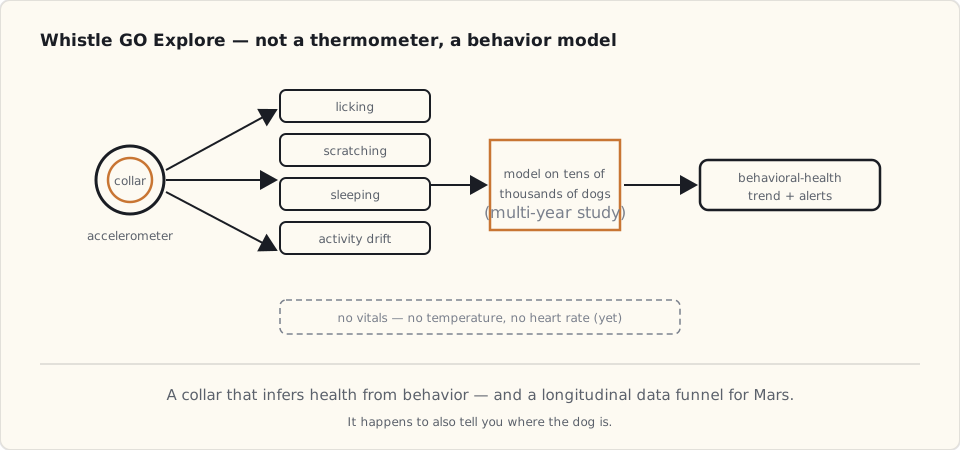
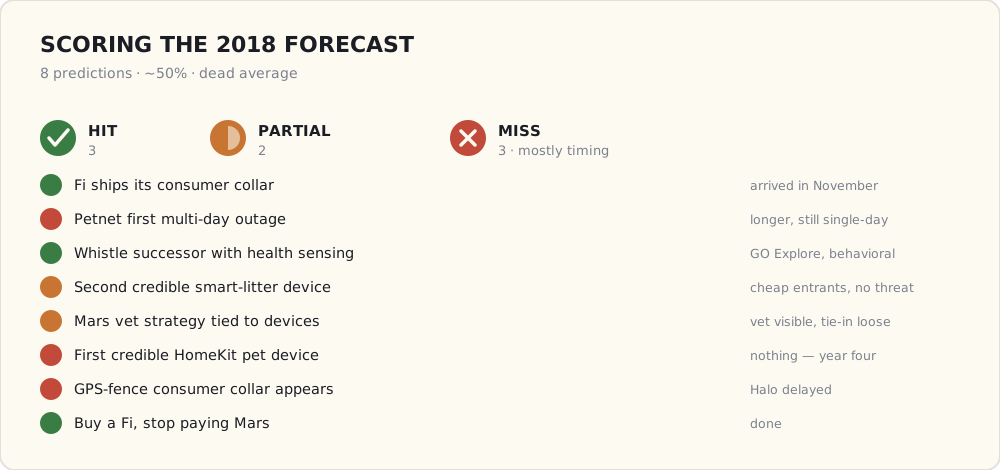
What got added this year
- Fi Series 1 on Atom (November) — the first non-Mars tracker he's worn, and the first dog tracker I've genuinely liked.
- Nothing else. After the Fi, the household reached a kind of steady state: tracker, litter box, two feeders, a cat door. The gear stopped being the story; reliability did.
What worked
- Fi's 14-day real-world battery. The single biggest engineering result of the year, and the thing that finally made a cellular dog collar livable. LTE-M earned its place.
- Litter-Robot III Connect's per-visit log. Two years in, Joule's baseline is solid and boring, which is exactly what a health baseline should be — you want it flat until the day it isn't.
What didn't
- Petnet, still declining. The outages are longer and more frequent and the company still says nothing. I keep predicting the catastrophic multi-day failure and keep being early. It's coming; I just can't time it.
- The HomeKit pet-device gap. Four years of forecasting one, four years of nothing. I'm increasingly sure this isn't a timing miss — Apple simply doesn't care about this category, and pet hardware lives in the Wi-Fi/cellular/own-app world instead. I should probably stop predicting it.
There's a throughline in the wins and losses this year, and it's the same one as last year: the hardware almost never fails — the company behind it does. Fi's collar is great because Fi is, for now, a focused independent company. Petnet's feeder is fine hardware strangled by a backend its owner can't or won't fund. After seven years I trust the thing in my hand more than the account it phones home to, every time.
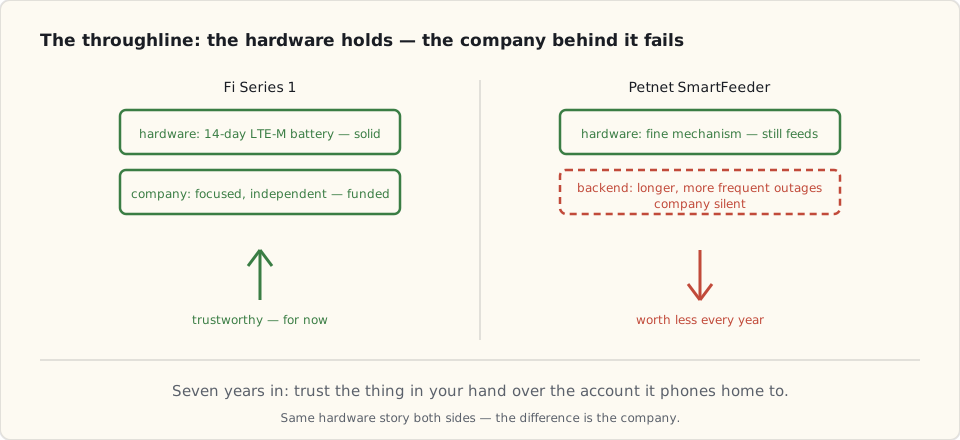
Forecast for 2020
| # | Prediction | Confidence |
|---|---|---|
| 1 | Petnet finally has its catastrophic multi-day outage | 80% |
| 2 | A next-gen Litter-Robot is announced | 55% |
| 3 | A collar ships true vitals (temperature or heart rate), beyond behavioral health | 55% |
| 4 | Halo Collar finally ships | 65% |
| 5 | The long-rumored Apple tracker (BLE/UWB tag) materializes | 60% |
| 6 | Multi-cat attribution lands in a smart-litter product | 55% |
| 7 | Mars consolidates further (more vet or pet-tech acquisitions) | 75% |
| 8 | A pet-tech category shock — a vendor failure that strands devices | 70% |
What I'm buying in 2020
- Whatever a PetSafe Smart Feed successor looks like — the dumb mechanical backup has earned my loyalty by never letting me down.
- Maybe a second Litter-Robot, if we add a cat. We've been talking about it.
- Probably not the Halo Collar when it ships — the static-correction approach sits wrong with me, and I'll want to see the welfare case before I'd put one on a dog.
What's next
The Petnet endgame, which I've now forecast three years running, has to land eventually — and when it does, the cloud-dependency lesson I've been writing in lowercase finally gets written in capitals. Whistle's health pivot is the more interesting thread to watch: if the collar is really a health-data funnel, the question for 2020 is whether anyone ships vitals and not just behavior. And we may add a second cat, which would make this a two-cat household and a very different litter-box-analytics problem.
Seven years in. Mars has reshaped the category in ways nobody saw coming in 2013, the cat side is finally as connected as the dog side, and the device I'm proudest of this year is the one made by the company small enough to still care.
 Part 21 of 42
 Petnet collapses — the pet-IoT cautionary tale, written
Petnet's cloud went down February 14 and stayed broken for a full week. Scheduled feeds didn't fire, the company went silent, and cats went hungry while the brand died in the tech press. The cautionary tale I forecast back in 2017 finally arrived — and what it should teach the rest of the category.
Petnet first acknowledged the outage on February 14 — a tweet saying it was "investigating" while insisting the SmartFeeders would still dispense on schedule. They didn't. The cloud stayed broken for a full week, and Petnet didn't say it was resolved until February 21.
For that week, scheduled feeds did not fire. Pets across the country didn't eat unless their owners noticed and fed them by hand. Petnet didn't email customers, didn't update a status page, and let the phone and the support inbox go dark — calls and emails went unreturned or bounced, and the company simply stopped answering the angry replies piling up on Twitter and Facebook. The press picked it up within days: TechCrunch, Newsweek, Trusted Reviews, Techdirt. "My cat starved for over a week," one owner wrote. That sentence, under a feeder's brand name, is the end of a company even if the corporate shell limps on.
The cautionary tale I forecast back in 2017 finally arrived. This is what happened, and what it should teach the rest of the category.
What broke
Petnet's eventual statement, once they said something at all, was the standard non-answer:
"We experienced a service interruption affecting some SmartFeeders. Service has been restored and we apologize for the inconvenience."
No root cause, no scope, no mention of the pets that went hungry. The technical shape of the failure, pieced together from what owners could observe, is clear enough even without an honest post-mortem:
- The dispatch service — whatever ran the scheduled-feed timers in the cloud — stopped firing. This is the load-bearing failure: the feeders weren't deciding when to feed; the cloud was, and the cloud went quiet.
- The device-control endpoints the feeders polled went unreachable, so the app showed "device offline" for everyone at once. A fleet-wide simultaneous outage points at a backend, not at the hardware.
- The manual-feed button on the unit still worked. That's the one mercy in the whole episode, and it's also the tell: the feeder is perfectly capable of dispensing without the cloud — it just isn't scheduled without it.
Why a small company's backend stays down for a week rather than hours is the part no statement will explain, but the pattern is familiar: a company low on money and people, running infrastructure it can no longer staff or pay for, hitting a failure that a healthy team would have caught in an hour. The outage isn't really the story. The week is. A week-long outage is what a company looks like when there's nobody left to fix it.
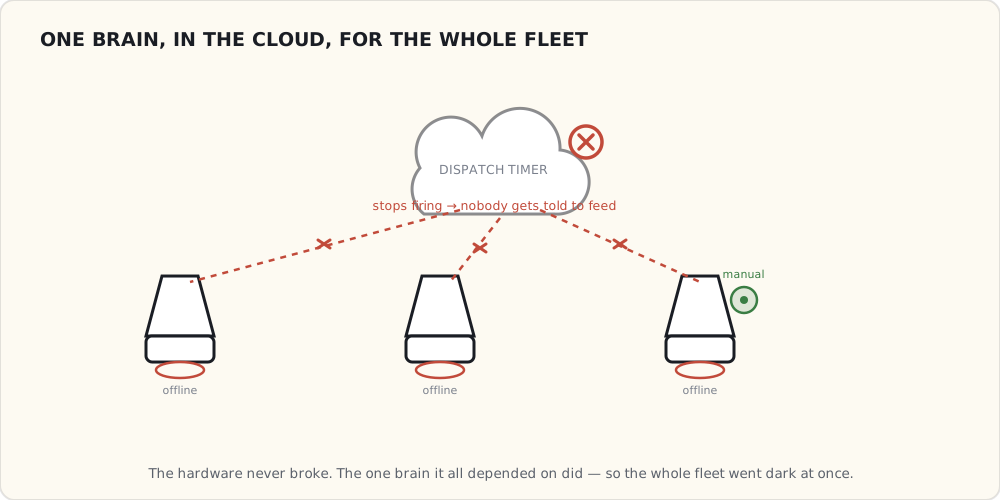
What pet owners experienced
The on-the-ground arc, from Twitter and the pet-IoT forums:
- Feb 14-15: confusion. "My feeder shows offline; what's going on?" Petnet's own tweet said the units would still dispense on schedule. Many owners believed it, and only found out otherwise when they noticed the bowl was empty.
- Feb 16-17: realization. The Petnet subreddit filled with "is everyone else's feeder broken?" threads. Owners who could started feeding by hand.
- Feb 18-20: anger, then alarm. Still no real communication from Petnet. Vet visits started — cats showing early signs of hepatic lipidosis after several missed feeds. The tech press (TechCrunch, Techdirt, Newsweek) ran the story; the Petnet brand died in real time, in public.
- Feb 21: service restored. The boilerplate statement landed — no mention of compensation, no acknowledgment of the pets harmed.
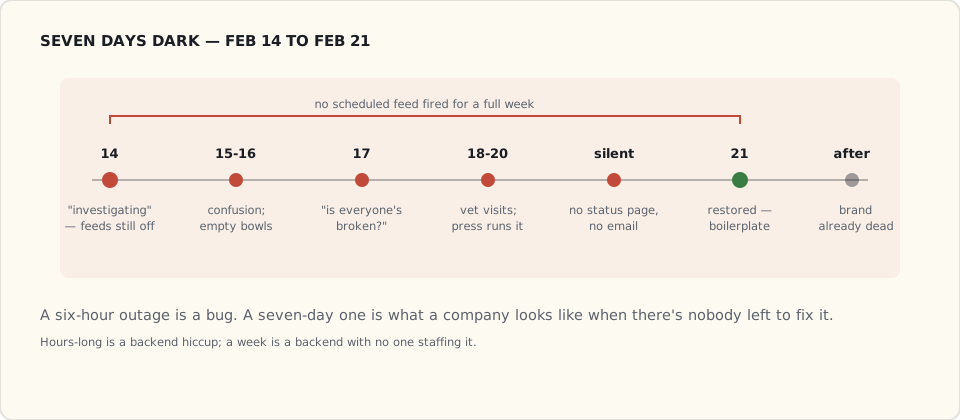
The pet harm
There are no hard numbers — Petnet won't release any, and the harm is scattered across individual households. But the shape of it, from the posts and the press, is consistent and grim:
- Many cats missed enough consecutive feeds to be at real risk. Owners who were traveling and trusting the feeder were the worst hit — "my cat starved while we were out of town, neighbors had to save her" was a recurring story.
- Cats are the danger case. A cat that stops eating for two-plus days can develop hepatic lipidosis — fatty liver disease — which is life-threatening and develops fast, especially in overweight cats. Several owners reported vet visits for exactly this.
- Dogs went hungry too, but dogs tolerate a short fast far better than cats; the lasting-harm reports are overwhelmingly feline.
The asymmetry is the whole point: a feeder outage isn't a uniform inconvenience. For a dog it's a bad day. For a cat it can be a vet bill or worse. A device that can't tell the difference, owned by a company that won't answer the phone, is a genuinely dangerous combination — not a buggy one.
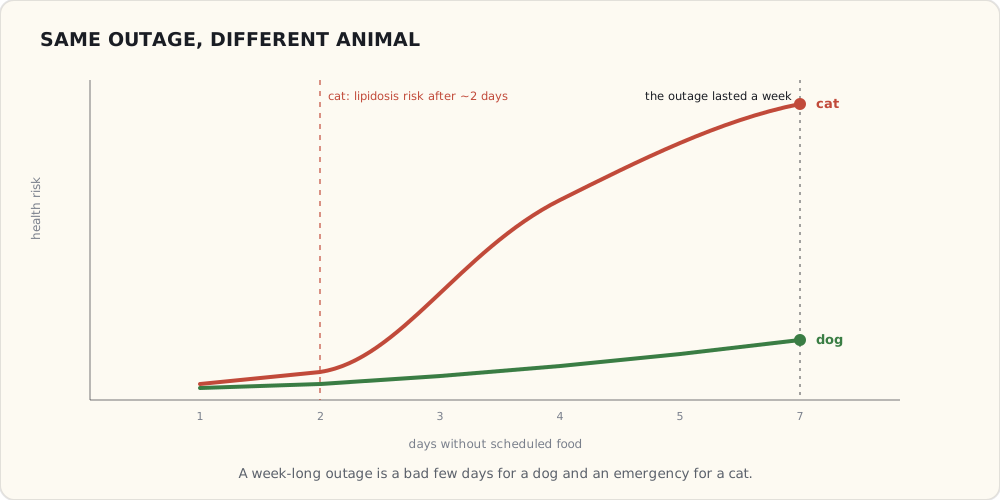
My household — what happened
My household survived because of the redundancy I set up two years ago:
- Joule's primary feeder: Petnet (offline).
- Joule's backup feeder: PetSafe Smart Feed (mechanical timer, working fine).
The PetSafe fired every one of Joule's feeds across the whole week. She had no idea anything was wrong.
Atom is fed manually by family (no auto-feeder), so he was unaffected.
I had been advocating for this backup architecture since 2017. It paid off. The lesson is the lesson: never have a single cloud-dependent device responsible for pet feeding.
What pet-IoT customers should do now
For anyone with a connected pet device:
Get a non-connected backup. Mechanical-timer feeder for feeders. Manual-cleaning litter box as backup for connected litter. SureFlap door is mostly mechanical (the connectivity is layered on; the door works without the hub).
Set a "did it fire?" check routine. Every morning, verify scheduled feeds happened. Every week, verify cycles happened.
Don't trust the vendor's status page. They're financially incentivized to under-communicate outages.
Look at the company's financial health publicly. Layoff announcements, missed funding rounds, declining App Store reviews — these are leading indicators.
Document your data export options. If the vendor folds, can you still get your historical data? Most vendors have NO data export. Plan accordingly.
What the industry will (and won't) learn
What the industry should learn:
- Schedule lives on the device, not the cloud.
- Watchdog notifications when scheduled events don't fire.
- Mechanical fallback paths for any pet-care function.
- Status pages and outage communication, mandatorily.
What the industry will actually learn:
- "Petnet was different." (No they weren't.)
- "Our infrastructure is more robust." (Until it isn't.)
- "We have better customer service." (Until you don't.)
- Marketing department additions to the privacy policy ("we will notify customers within 24 hours of outages"). Implementation: none.
I do not expect the pet-IoT category to structurally improve from the Petnet collapse. Same playbook as Wink in smart home. Same lessons reluctantly half-learned.
What I'm doing differently going forward
- Petnet feeder unplugged from my network. It's a brick now.
- PetSafe Smart Feed primary for Joule.
- Looking into ESP-based DIY pet feeders — the same DIY firmware approach I'm using for smart-home temperature sensors should work for a simple servo-driven pet feeder. Local-only, no cloud, no vendor solvency dependency.
- Refusing to buy any future "smart" pet device that doesn't have:
- Local schedule storage.
- Mechanical fallback.
- At least 12 months of public reliability data.
- A company that's been profitable for at least 24 months.
What's next
Here's the depressing part: the Petnet failure will be forgotten by most new pet owners within a year. The category keeps growing, the next buyer doesn't read the post-mortems, and the next vendor's pitch deck will say "we're not Petnet" right up until the morning their backend doesn't wake up. The market does not punish cloud fragility — it forgets it.
The cautionary tale is documented. Whether anyone listens is the next decade's question. My own answer is on my bench: a feeder whose schedule lives on the device, that I built so that no company's solvency stands between my cat and her dinner.
The DIY build is the next thread.
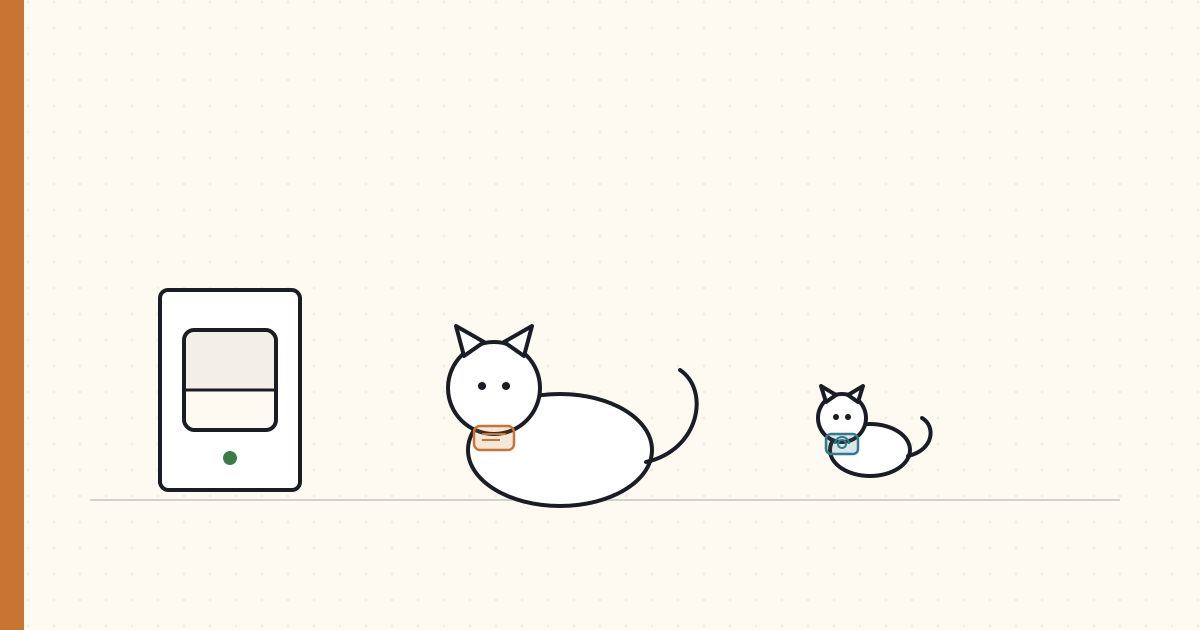 Part 22 of 42
 Boson arrives — the multi-cat engineering problem
Brought home Boson last weekend — 11-week-old tabby, COVID-era addition. Two-cat household now. Same feeder, same litter box, same cat door — two cats, two identities. Notes on what changes.
Brought home Boson last weekend. An 11-week-old gray tabby kitten, adopted from the local shelter. Pandemic adoptions are surging — adoption fee waived, both cats fixed already, microchipped at the shelter. Standard intake.
Boson is named per the household physics convention (Atom: particle, Joule: energy unit, Boson: Higgs particle). She's tiny (~2 lb) and Joule (now 6 yrs old, 9.5 lb) has not decided how she feels about the situation yet.
The pet-IoT problem just got more complex
The single-cat assumption breaks today. Every device in the house that interacts with "the cat" now needs to know which cat. Specifically:
- Litter-Robot: counts visits and weight. Two cats means the visit + weight data needs per-cat attribution.
- SureFlap microchip door: was set up for Joule's chip. Boson has a different chip; needs to be added to the allow-list.
- Auto-feeder (PetSafe Smart Feed): dispenses at scheduled times. Both cats can access the bowl. How do I portion-control per cat?
- Indoor cameras (the new ones I'm adding for the post-Petnet self-monitoring): need to identify which cat is in frame.
This is the multi-pet detection engineering problem, and there are really only two ways to solve it. Either the device reads a unique identity off the animal at the moment it acts (a microchip at the point of access), or it infers which animal from a signal it can measure (weight, size, behavior) and hopes the inference holds. The first is exact and the second is a guess that degrades — and the gap between those two approaches is the whole story of what works in my house and what doesn't.
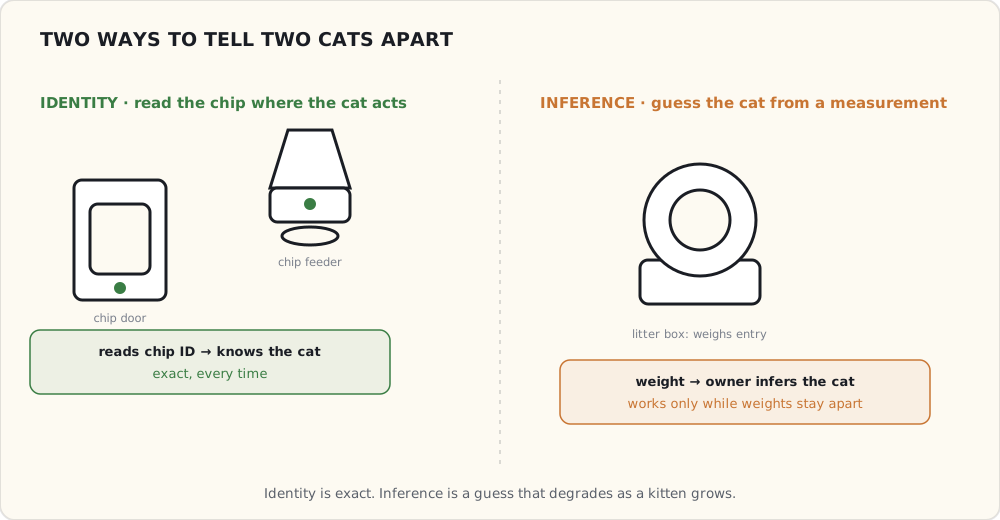
The chips, in brief
Boson's chip from the shelter is 134.2 kHz ISO 11784/11785 (modern standard). Joule's is the same (covered in the 2014 microchip primer). Both chips have unique 15-digit IDs, registered to me with 24PetWatch.
Adding Boson to the SureFlap door's allow-list:
- Hold the door's button for 3 seconds (learning mode).
- Hold Boson near the reader.
- Door reads her chip, beeps once, adds to allow-list.
30 seconds. Boson is now allowed through the door (curfew rules: indoor-only for now, since she's 11 weeks; will switch to outdoor-allowed at 6 months).
What works for multi-cat in 2020
SureFlap microchip door — solves per-cat identity for entry/exit. Joule and Boson can each have their own access rules. Joule's curfew: out 7am-7pm. Boson's curfew: never out yet (will adjust later). Works perfectly.
Litter-Robot III Connect — partially solves the multi-cat problem. The unit's weight sensor records entry weight. Joule (~9.5 lb) and Boson (~2 lb growing) have very different weights, so attribution-by-weight is plausible:
Joule's typical entry weight: 9.4 - 9.6 lb
Boson's typical entry weight: 2.1 - 4.0 lb (growing rapidly)
The Litter-Robot app does NOT do per-cat attribution natively in 2020. It logs "weight at entry" but treats all visits as a single stream. To get per-cat data, I have to look at the entry-weight column and infer — and the inference is only clean because Joule and Boson are nine pounds apart right now. That window is closing: Boson is a growing kitten, and the day her entry weight starts overlapping Joule's measurement noise (call it within a half-pound), weight-attribution quietly stops working and I won't get a warning when it does.
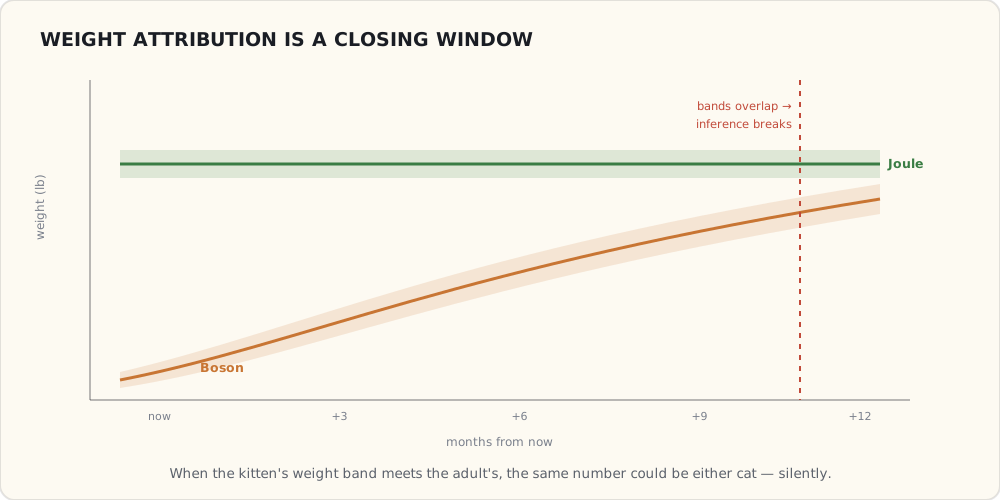
The connected-litter ecosystem hasn't caught up to multi-cat yet. It can record a weight; it can't yet bind that weight to a cat. I expect Litter-Robot or a competitor to ship real per-cat identification in the next year or two — but until they do, the only litter device that knows which cat is the one that reads a chip.
What doesn't work for multi-cat
The auto-feeder. PetSafe Smart Feed dispenses into a single bowl. Both cats can access it. There's no way to portion per cat:
- Joule's daily allotment: 1/4 cup (mature adult cat).
- Boson's daily allotment: 1/3 cup (growing kitten, eats more).
If the feeder dispenses 1/3 cup at 6 AM, Joule gets there first and eats some, then Boson eats some — and neither gets the right portion.
The solution is the same one SureFlap already applied to the cat door: put the chip reader at the point of access. Their SureFeed Microchip Pet Feeder does exactly that — and after the Petnet collapse I went out of my way to confirm it's a local device, not a cloud-scheduled one. The principle:
- A chip reader sits at the lip of the bowl, under a motorized lid.
- The cat approaches; the reader detects its chip.
- The lid opens only for chips on that feeder's approved list, and closes when the cat leaves.
- Each cat gets a feeder bound to its own chip ID — so Joule physically cannot eat from Boson's bowl, and vice versa.
It's the cat door's logic pointed at a food bowl: identity gates access. I ordered a SureFeed for Boson today. Joule keeps the PetSafe Smart Feed, which is fine for one cat. Worth noting what the SureFeed gets me beyond portioning — because the lid only opens for the right cat, it also gives me a clean per-cat eating log without a camera or a cloud account: the feeder knows who ate, and when, locally.
Per-cat presence in the SureFlap Hub app. I have one Hub paired with the door. The app shows entries/exits with cat attribution. So this does work for multi-cat indoor/outdoor tracking. Good.
The multi-cat data goals
By end of 2020, I want:
- Per-cat outdoor patterns: how often does Joule go out vs Boson?
- Per-cat litter use: visits per day, average duration, weight trend over time per cat.
- Per-cat feeding: precise portion control per cat.
- Per-cat camera/proximity: which cat is on the couch right now?
The pattern that actually works in 2020 is identity at the point of access: SureFlap door + SureFeed feeder both read the chip right where the cat acts, so they know which cat with no inference. The Litter-Robot is the half-measure — it captures entry weight but doesn't bind it to a cat, so per-cat litter analytics is something I have to reconstruct by hand from the weight column. Camera-based identification (which cat is on the couch right now) — not yet; that's a harder computer-vision problem than any consumer pet device solves today.
Laid out device by device, the split is stark: the things that read the chip at the moment the cat acts know; everything else either guesses or can't tell at all.
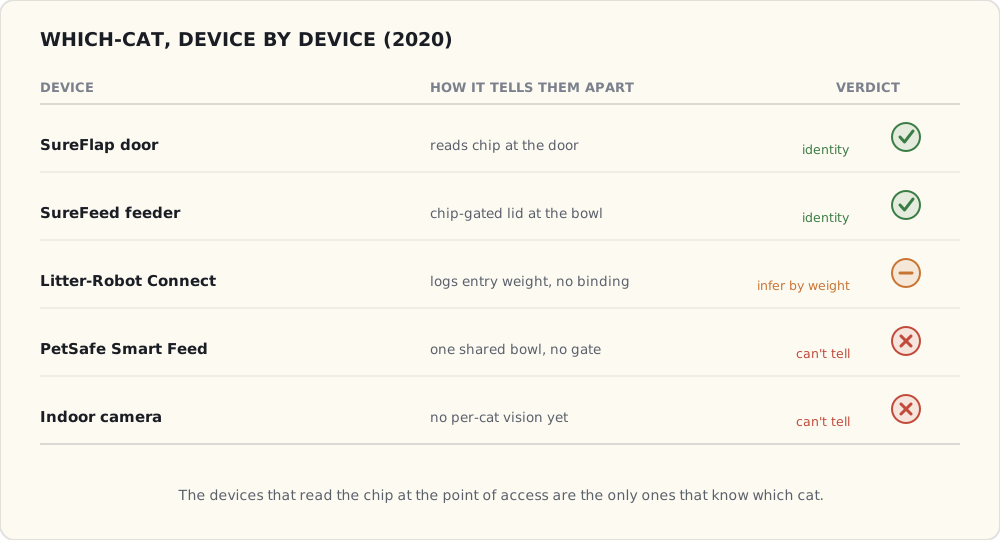
The cat-cat dynamics
Boson is 11 weeks. Joule is 6 years. The hiss-and-claim-territory week is on. Pet-IoT can't help with this; just patience and separate feeding locations.
Two months in I'll write about how the smart-home integrations adapted. So far: the Roomba (when it comes) has to learn two cats now; the indoor cameras need new no-go zones for Boson's hiding spots; the existing cat data on Joule has to be rebaselined.
What's next
The Litter-Robot multi-cat analytics question — how does the data actually attribute visits per cat? Going to write that up in a few months once I have enough mixed data.
For now: welcome Boson. The data per Joule needs to be partitioned, and the per-Boson data starts fresh.
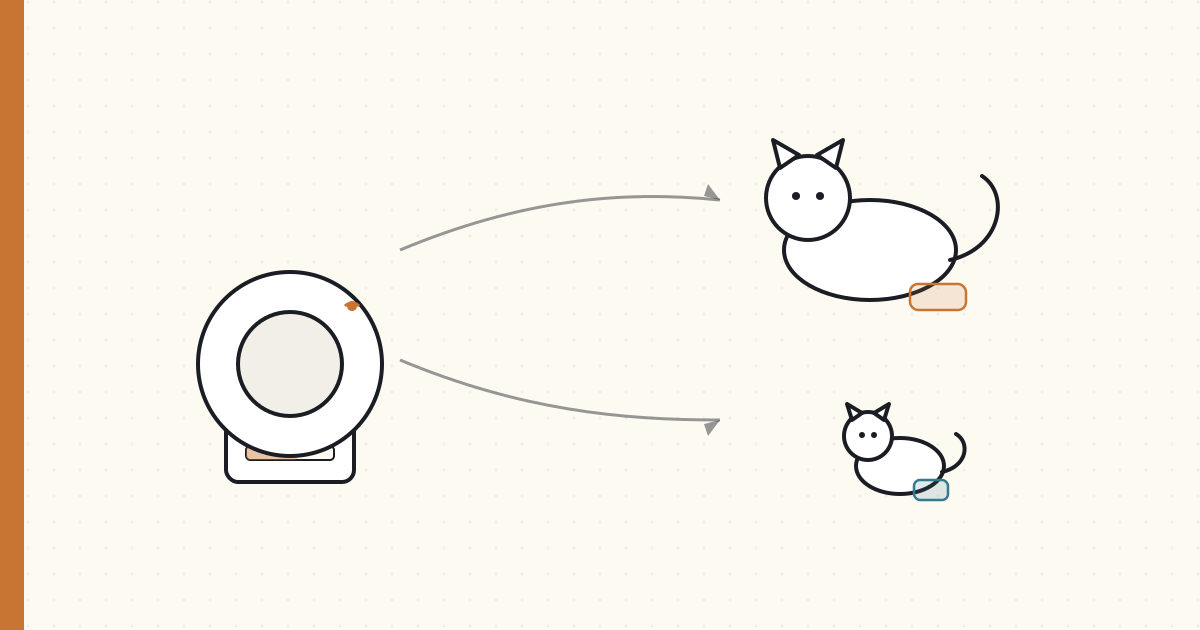 Part 23 of 42
 Litter-Robot multi-cat detection — Joule vs Boson
Four months with Joule + Boson sharing a Litter-Robot. Pulled the CSV export and analyzed entry weights. Joule (9.5 lb) and Boson (3.5 lb) separate 90% of the time. The other 10% is interesting.
Four months of Joule + Boson sharing the same Litter-Robot III Connect. The official app still doesn't do per-cat attribution. The data is there in the entry-weight column; just no UI to slice it.
Pulled the CSV export, wrote 30 lines of Python, and now have per-cat litter analytics.
The data export
Litter-Robot's iOS app has a "download history" feature that emails you a CSV. One row per cycle:
timestamp,                  cycle_time_sec, weight_lb, drawer_status
2020-10-15T06:42:13-04:00,  19,             9.5,       OK
2020-10-15T08:17:55-04:00,  18,             3.7,       OK
2020-10-15T10:31:02-04:00,  20,             9.4,       OK
2020-10-15T13:18:44-04:00,  18,             3.6,       OK
2020-10-15T16:55:21-04:00,  19,             9.6,       OK
2020-10-15T18:48:00-04:00,  18,             3.7,       OK
2020-10-15T21:12:34-04:00,  20,             9.5,       OK
2020-10-15T22:30:50-04:00,  18,             3.9,       OK
Five visits at ~9.5 lb (Joule), three visits at ~3.7 lb (Boson). The weight gap is wide enough that attribution is obvious.
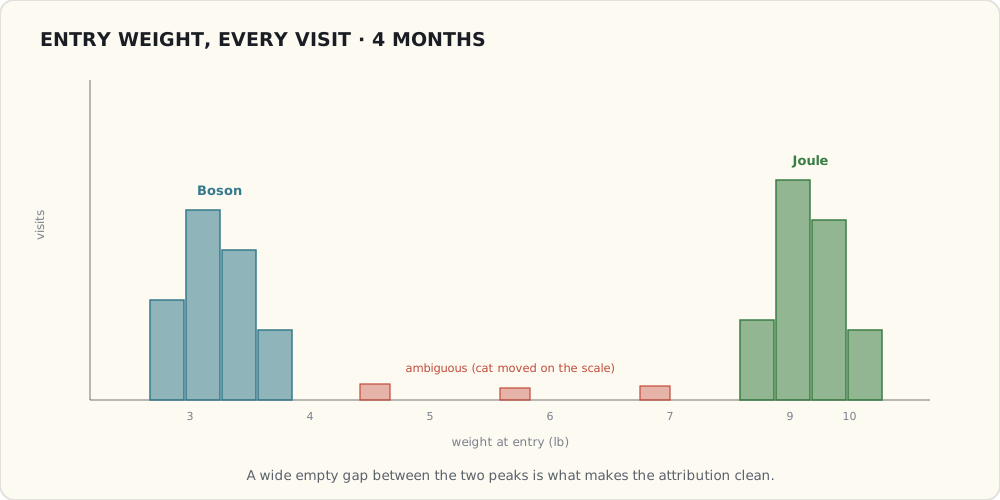
The Python script
import csv
from datetime import datetime
from collections import defaultdict

# Joule's stable adult weight band: 9.0 - 10.0
# Boson's growing kitten weight (Oct 2020): 3.5 - 4.5
def attribute(weight):
    if 9.0 <= weight <= 10.0:
        return "joule"
    if 3.0 <= weight <= 5.0:
        return "boson"
    return "ambiguous"

visits = defaultdict(list)
with open("litter-robot-history.csv") as f:
    for row in csv.DictReader(f):
        w = float(row["weight_lb"])
        cat = attribute(w)
        ts = datetime.fromisoformat(row["timestamp"])
        visits[cat].append((ts, w, int(row["cycle_time_sec"])))

for cat, vs in visits.items():
    print(f"{cat}: {len(vs)} visits, avg weight {sum(v[1] for v in vs)/len(vs):.2f} lb")
30 lines. Outputs per-cat counts + average weights. I run it weekly and dump the results into a tiny dashboard in Home Assistant.
The four-month results
joule:     387 visits, avg 9.45 lb
boson:     412 visits, avg 3.61 lb (growing — early data 3.1, late data 4.2)
ambiguous:  18 visits  (3.6% — overlap or unusual weights)
Two cats sharing one Litter-Robot. 96.4% attribution accuracy without a line of per-cat-aware code from AutoPets, the company that makes it.
The ambiguous 3.6% are interesting:
- A few "weight = 5.5 lb" visits. Probably Boson during a growth spurt + the weight-during-rotation hesitation (cat moved during measurement).
- Three "weight = 8.0 lb" visits. Possibly Joule when she was holding still on the way in, or Boson piggybacking after Joule.
- Zero "both cats simultaneously" visits — they apparently never both use the box at the same time (cats hate audiences).
The attribution problem when cats are weight-similar
If Joule and Boson were the same weight, this wouldn't work. The weight gap (9.5 vs 3.5) is what makes attribution easy. As Boson grows, she'll approach adult weight (maybe 8-10 lb when full grown). At that point, weight-only attribution becomes unreliable.
The fallback strategy:
- Visit duration: Joule's average is 62 sec, Boson's is 41 sec (kittens are faster). Some discrimination here even at adult weight.
- Visit timing patterns: Joule has consistent morning + late-evening visits. Boson is more random. Time-of-day distribution can supplement.
- Eventually, a RFID upgrade: if Whisker added an RFID reader at the entry (~$5 BOM addition), per-cat identity would be definitive.
When Boson reaches adult weight, the script will need duration + timing supplements. That's a 2021 problem.
Why per-cat analytics matters medically
A four-month trend by cat reveals patterns that combined data hides:
Joule (this month vs three months ago):
- Average visits/day: 3.2 → 3.4 (slight uptick)
- Average duration: 62s → 58s (slight decrease)
- Verdict: Within normal range, no action.
Boson (this month vs three months ago):
- Average visits/day: 3.4 → 4.5 (significant uptick — kittens drink more water, eat more, output more — expected as she grows)
- Average duration: 39s → 42s (stable)
- Verdict: Expected for kitten development.
If Joule's pattern shifted to 6 visits/day with 20s duration each, that's a strong UTI signal — frequent + brief is the classic urinary-tract-infection presentation. The per-cat baseline lets me detect that. The aggregated multi-cat data would hide it.
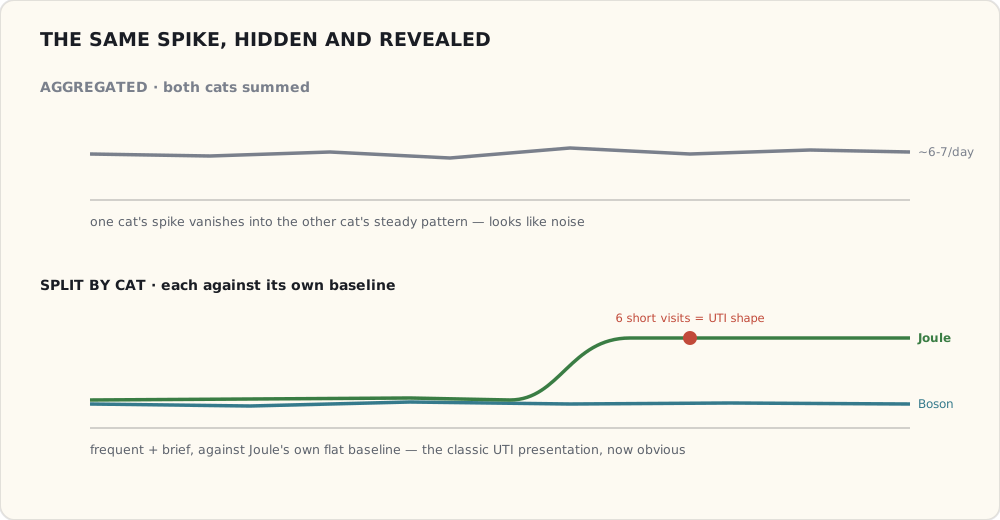
What I want AutoPets to add
- Native per-cat attribution in the app, using weight bands the user defines.
- Anomaly alerts: "Joule's visits dropped 40% vs last month, consider vet attention."
- Weight trend graphs per cat over time.
- A data API so I don't have to scrape CSVs.
Litter-Robot 4 is rumored for 2021-2022 and supposedly has multi-cat features built-in. We'll see.
What's next
End-of-year review in two months. The Petnet collapse + Boson + multi-cat dynamics + Fi's 14-day battery are the year's themes. 2020 has been a heavy year for pet-IoT lessons.
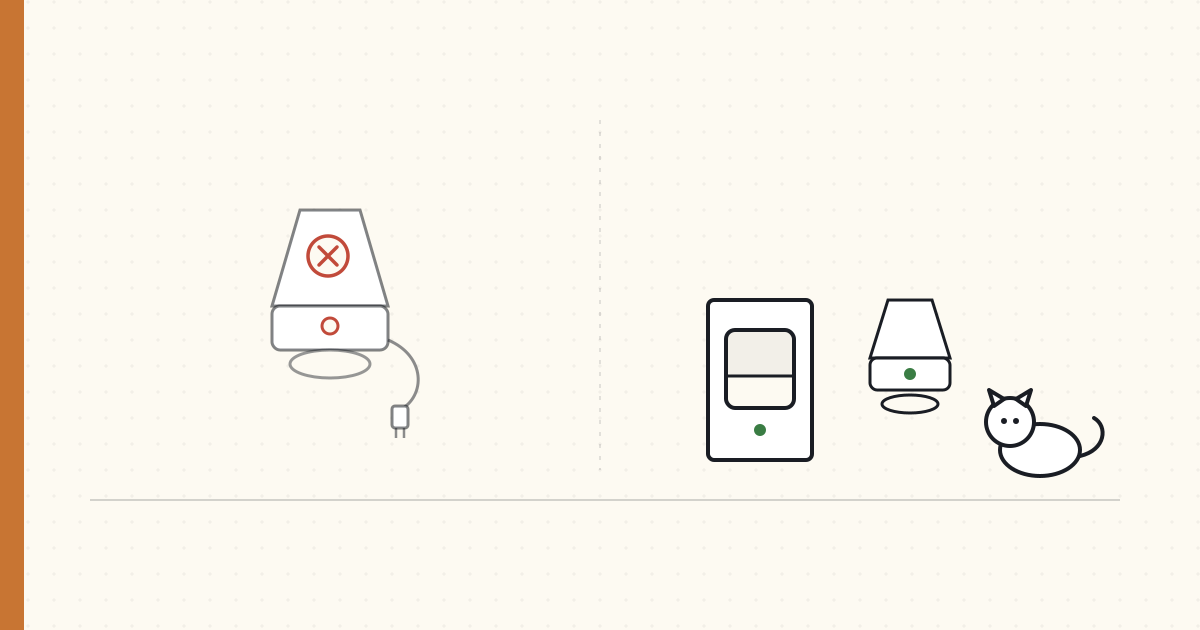 Part 24 of 42
 2020 pet IoT — Petnet died, Boson arrived, multi-cat real
Two big stories this year: Petnet collapsed exactly as forecast, and Boson arrived to make this a multi-cat house. The pandemic pet boom is real and the category is surging. 2019's forecast came in at 50%, and the misses all rhyme — the vitals collar and the multi-cat litter box still don't exist.
End of 2020. Eight years of writing this down, and the strangest year of the lot. Two things defined it for my household. Petnet — the feeder company I'd been predicting would fail since 2017 — finally collapsed in February, exactly the way I said it would and worse than I wanted to be right about. And Boson arrived in June, a shelter kitten who turned this into a multi-cat house and quietly doubled the complexity of every connected device in it.
Around both of those, the pandemic reshaped the whole category. Shelters emptied this spring, everyone I know got a dog or a cat, and pet-tech demand went vertical — which is exactly the climate where a buyer skips the post-mortems and a vendor ships fast and cuts the corner that bites later. The Petnet lesson and the surge that's burying it are happening at the same time.
Scoring the 2019 forecast
| Prediction | Confidence | Outcome | Verdict |
|---|---|---|---|
| Petnet's catastrophic multi-day outage | 80% | A week-long collapse in February | ✓ |
| A next-gen Litter-Robot announced | 55% | Still only rumored | ✗ |
| A collar ships true vitals (temp/HR) | 55% | No consumer collar measures vitals — the health collars all infer from behavior | ✗ (still no real vitals) |
| Halo Collar finally ships | 65% | Shipped in November (~$999 + subscription, Cesar-Millan-branded) | ✓ |
| The long-rumored Apple tracker materializes | 60% | Heavily rumored, slipped to 2021 | ✗ (close) |
| Multi-cat attribution in a smart-litter product | 55% | Nothing native shipped — I'm still doing it with a script | ✗ |
| Mars consolidates further | 75% | More vet and pet-care tuck-ins; the empire keeps growing | ✓ |
| A pet-tech category shock — stranded devices | 70% | Petnet, exactly as forecast | ✓ |
Four hits, four misses — 50%. The call I'm proud of is Petnet, on schedule and for the right reasons. The misses cluster around one theme: the vitals collar and the multi-cat-aware litter box both still don't exist as products. I keep forecasting the category will get smarter on its own; it keeps making me build the smart part myself.
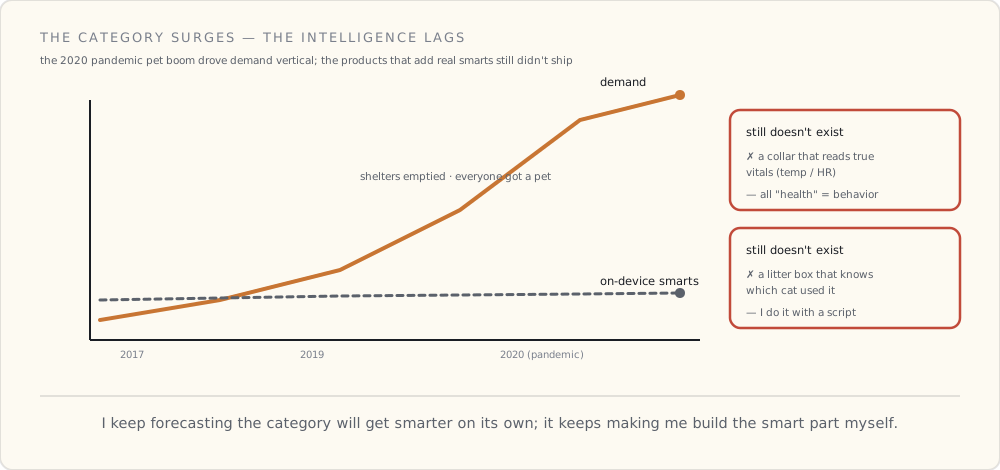
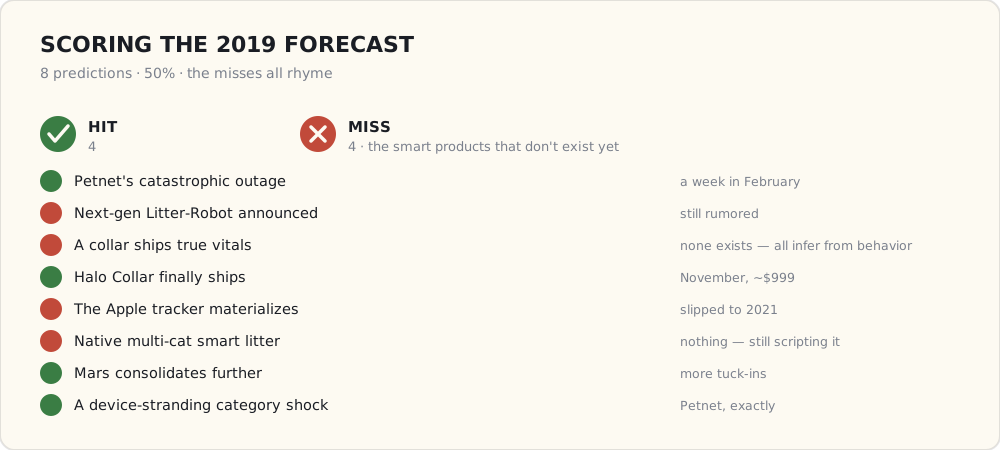
What got added in 2020
- Boson — kitten, June. Pet-IoT scope expanded to multi-cat.
- SureFeed Microchip Pet Feeder — September, for portion-control per cat.
- A second SureFlap door — back deck, August. Boson + Joule can both use both doors.
- A Litter-Robot III Connect supplement — separate Litter-Robot in the basement so multi-cat litter capacity is sufficient. Joule's primarily in the kitchen; Boson uses the basement one. (Yes, two Litter-Robots. Yes, $1100 in litter robots.)
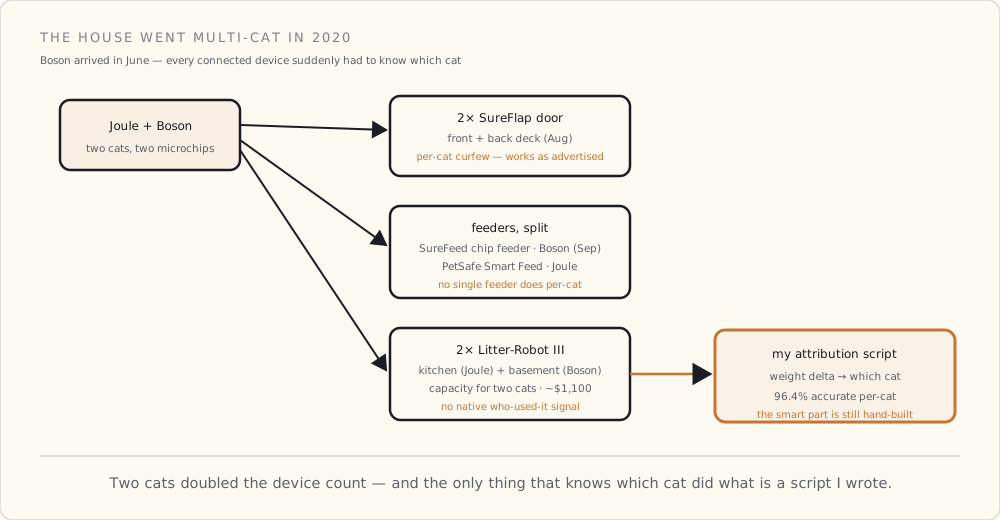
What worked
- The multi-cat SureFlap setup. Per-cat curfew works exactly as advertised.
- The Litter-Robot weight-attribution script. 96.4% accurate per-cat data.
- The PetSafe Smart Feed for Joule post-Petnet. Reliable, mechanical, boring. Boring is good.
What didn't
- The auto-feeder portion-control problem. PetSafe Smart Feed doesn't do per-cat. Required adding the SureFeed feeder for Boson. Two-feeder solution is the right answer; ecosystem complexity has increased.
- The Halo Collar reviews. Halo shipped in late 2020 — early reviews suggest the boundary-correction (vibration + static) is rougher than the marketing claims. I'm not buying one. Will revisit when independent welfare studies are published.
Forecast for 2021
| # | Prediction | Confidence |
|---|---|---|
| 1 | The Apple tracker (BLE/UWB tag) finally launches | 90% |
| 2 | A Whistle Health & GPS+ ships with real vitals (temperature, heart rate) | 70% |
| 3 | A smart-litter product ships native multi-cat identification | 55% |
| 4 | A next-gen Litter-Robot is announced | 70% |
| 5 | Mars Petcare's empire grows again (more clinic + device tuck-ins) | 75% |
| 6 | A credible Halo competitor with a better welfare reputation | 30% |
| 7 | An Apple-tag-on-collar controversy (Apple warns it isn't a pet tracker) | 75% |
| 8 | A consumer attempt at "AI behavior detection" for pets | 60% |
What I'm buying in 2021
- The Apple tag for Atom's collar the day it ships — explicitly to write about Apple's anti-stalking design tradeoffs, and to find out the hard way whether a crowd-found BLE tag is any use as a pet tracker (I suspect not).
- A Whistle Health & GPS+ when it ships — though I'm bracing to find out it tracks behavior, not vitals, like every "health" collar before it.
- Any smart-litter product that ships real per-cat identification, so I can finally retire my attribution script.
What's next
The cat side of the house finally caught up to the dog side this year — two cats, two doors, two litter boxes, a chip-gated feeder, and a per-cat analytics script holding it together. The thing I'm watching for 2021 is Apple: when they finally ship the tracker everyone's been leaking, it'll scramble the whole tag market overnight, the way Apple entering any category does — and I want to find out first-hand whether a crowd-found BLE tag is actually any good for a pet, or just good for keys.
And the question that's been hanging over the category since Whistle's health pivot: when does a pet collar stop inferring health from behavior and start measuring it? Every "health" device I own watches what the animal does and guesses how it's doing. None of them takes a vital sign. The year someone ships a collar that actually reads a heart rate is the year pet IoT starts becoming medical-grade — and I keep betting it's next year, and keep being wrong.
Eight years in. Four pets — Atom, Joule, Boson, and no third dog yet — several devices each, dense data, mature integrations, and the cloud-dependency lesson now written in Petnet's headstone.
 Part 25 of 42
 AirTag on Atom's collar — anti-stalking vs pet tracking
AirTag shipped April 30. Strapped one to Atom's collar — Apple tells you not to. Notes on why anti-stalking design is structurally incompatible with intentional pet tracking, and Find My's limits.
Apple shipped AirTag April 30. Bought a four-pack ($99) immediately. Strapped one to Atom's collar in a silicone case.
Apple specifically says don't do this. In the AirTag setup flow, there's a dedicated screen warning that AirTag is not designed for pet tracking. Apple recommends a dedicated pet tracker.
Did it anyway. Notes on what works, what doesn't, and why Apple's design philosophy is structurally incompatible with pet tracking.
The hardware
- 31.9 mm diameter, 8 mm thick, 11 g. Smallest cellular-tracker-class device I've seen.
- BLE 5.0 + U1 ultra-wideband chip for precision finding (within 1 m, iPhone 11+ only).
- NFC for "found this AirTag" handoff with iPhones.
- CR2032 coin cell — claimed 12+ months.
- No GPS, no cellular. The "location" comes from Apple's Find My network — every iPhone in the world that's BLE-near the AirTag relays its position back to iCloud anonymously.
The CR2032 + crowdsourced model is what differentiates AirTag from Whistle/Fi. No subscription. No cellular dongle. No GPS chip. Year-long battery.
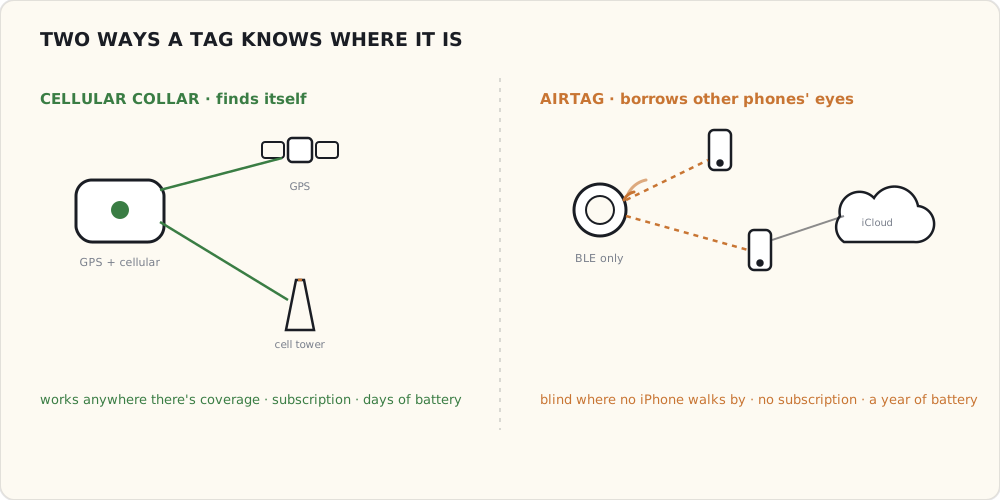
What it does for pet tracking
Best case (Atom escapes, walks past someone with an iPhone):
- The bystander's iPhone hears Atom's AirTag's BLE advertisement.
- iPhone reports the encrypted location to iCloud.
- I see Atom's last-known location in the Find My app on my phone.
- I drive over and pick up Atom.
Worst case (Atom in deep woods, no iPhones around):
- AirTag silently broadcasts to no one.
- Last-known location is wherever I last saw him. Stale data.
For dense suburban areas: works well. The Find My network piggybacks on the entire active iPhone base — hundreds of millions of devices, the largest crowdsourced finding network anyone has ever fielded. In my neighborhood, an AirTag rarely goes more than a minute or two without some passing iPhone quietly relaying its position.
For rural areas / hiking trails / national parks: useless. No iPhones nearby.
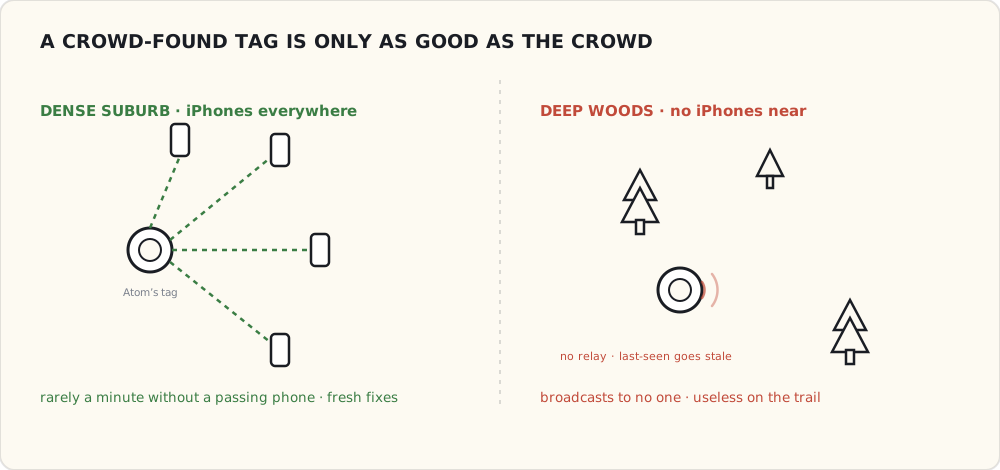
Where Apple's anti-stalking design breaks pet tracking
This is the interesting engineering tradeoff.
AirTag has aggressive anti-stalking features:
Audio chirp: if an AirTag is separated from its owner (i.e., not near the iPhone that registered it) for ~8-24 hours, it emits a loud chirp every few hours. Audible from ~3-5 meters away.
iPhone alert to bystanders: if a foreign AirTag is detected near a bystander's iPhone for too long (~1-4 hours moving), the bystander's iPhone alerts them: "Unknown AirTag detected near you. Tap to find out more."
NFC handoff: the chirping/alerted bystander can tap their phone to the AirTag and see the last 4 digits of the owner's phone number for return.
For Atom:
The audio chirp is a problem. If Atom is lost and away from my iPhone for 24+ hours, the AirTag will start chirping. Useful for someone finding him to know "this AirTag is currently lost, contact owner." But for a scared lost dog, the random chirp from his own collar will spook him. He's going to associate the noise with his own movement and potentially try to dislodge the collar.
The "unknown AirTag" alert is annoying. Anyone who walks near Atom for more than an hour or two gets a "stranger AirTag near you" alert. If we go to the park, every iPhone-carrying parkgoer gets pinged. Slightly creepy from the bystander's perspective.
The NFC handoff is the actually-useful one. If someone finds Atom, they tap their iPhone to the AirTag and see my phone number. Works.
Apple's stated workarounds for pet tracking
Apple recommends:
- Disable the audio chirp on AirTags you intentionally put on pets (you can't, this isn't a setting).
- Don't put AirTags on pets at all; use a dedicated pet tracker.
- Use Fi or Whistle or Tagg-class cellular trackers.
Apple's position: AirTag is for objects you own that you don't expect to move on their own. Pets violate that assumption. The design assumes "if this is moving away from you, it's probably stolen, alert everyone." For a dog who slipped his leash, "alert everyone" is the right behavior. For a dog you take to the park, "alert everyone" is too noisy.
The structural incompatibility
The core issue: AirTag's anti-stalking design is fundamentally human-centric. It assumes the tagged entity is a human who might unknowingly be tracked. The mitigations (chirp, bystander alert) are designed to surface the AirTag to the unwilling tagged person.
For a pet, the "tagged person" is the pet — and pets don't have iPhones. They can't see alerts. They can't disable the chirp. The mitigations are all designed for a use case that doesn't apply.
This isn't Apple being careless. It's a deliberate design tradeoff: AirTag is anti-stalker-first, pet-tracker-by-misuse-second. The category Apple wants to address is "keys, wallet, luggage" — objects. Pets are not in the design target.
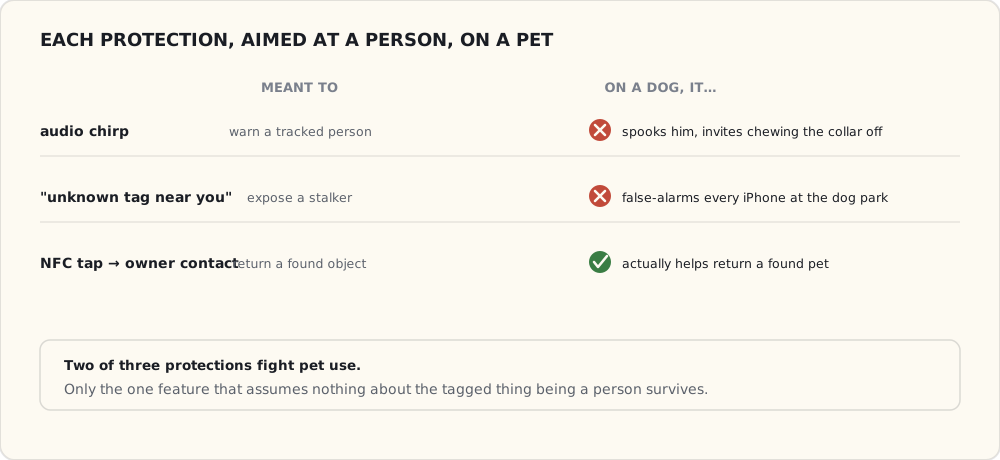
What I'd use AirTag for
After three weeks of testing on Atom:
- Atom: removed. The chirp is genuinely problematic when he's away from me. Going to keep using Fi as primary tracker.
- Joule's outdoor collar: not using (cats aren't outdoor enough for Find My network density to matter for us).
- My keys: using.
- My laptop bag: using.
- My car: using (won't help if stolen, but useful for finding in parking lots).
For pet tracking specifically: AirTag is the wrong tool. Fi is the right tool.
What I want — but won't get
The right product would be:
- AirTag-class hardware (12-month coin cell, BLE crowdsourced network).
- WITHOUT the audio chirp.
- With explicit "this is a pet, please contact owner" NFC handoff.
- Owner-controlled bystander alert behavior.
Apple won't ship this because it would undermine the anti-stalking guarantees that make AirTag socially acceptable. The category would need a third-party device riding a separate crowdsourced network — Tile has tried, but its network is a rounding error next to Apple's install base, so its find rate can't compete.
And the pressure runs the wrong way for pet use. AirTag launched two weeks ago and the stalking-misuse stories are already in the press; advocates and regulators are already asking Apple to make the protections stronger. If Apple responds — and it will have to — the chirp gets louder and the bystander alerts get faster, not gentler. Every step that makes AirTag safer for people makes it worse as a pet tag. The incompatibility isn't a bug they'll patch; it's the design working as intended, and intent is only going to harden.
What's next
Mars is teasing a new "health" Whistle, and the marketing is leaning hard on the word health — which, after every prior collar that meant "we count scratches and call it wellness," makes me suspicious about whether there's an actual vital sign anywhere in it. When it lands I'll put it on Atom next to the Fi and find out what "health" really means this time. That's the next post.
 Part 26 of 42
 Whistle Health & GPS+ — the 'health' collar with no vital sign
Mars shipped the Whistle Health & GPS+ — a collar that watches your dog lick, scratch, drink, eat and sleep, then rolls it into a daily wellness score. It calls all of that 'health.' What it doesn't do is take a single vital sign — and the gap between behavior and vitals is the whole story.
Mars shipped the Whistle Health & GPS+ this summer, and the marketing leans on one word so hard it's almost a dare: health. I held off until August to read the reviews and put one on Atom — the first Whistle on him since I shelved his Whistle 3 in 2018 and moved to Fi. After the AirTag experiment, I went in wanting to know one specific thing: when a pet company says "health," does it finally mean a vital sign — or is it still counting movements and calling that wellness?
It's still counting movements. And once you see that clearly, the Whistle Health is both more honest and more limited than the word on the box implies.
What it actually measures
Every signal the Whistle Health & GPS+ produces comes from one sensor — the accelerometer — plus GPS for location. There is no heart-rate sensor, no thermometer, no respiratory sensor. What it does is recognize patterns of motion and label them:
- Activity — running, walking, playing, resting, with calories and distance. The classic Whistle capability.
- Scratching — a distinctive repetitive motion the model learned to pick out.
- Licking — another learned motion signature.
- Eating and drinking — head-down-at-the-bowl tilt-and-motion patterns.
- Sleeping — long low-motion stretches, scored for how disrupted the night was.
- A daily Wellness Score (beta) that rolls all of the above into one glanceable number.
Notice what every one of those has in common: it's an inference from movement. The collar never touches a pulse, a breath, or a temperature. It watches what the dog does and reasons backward toward how the dog might be doing.
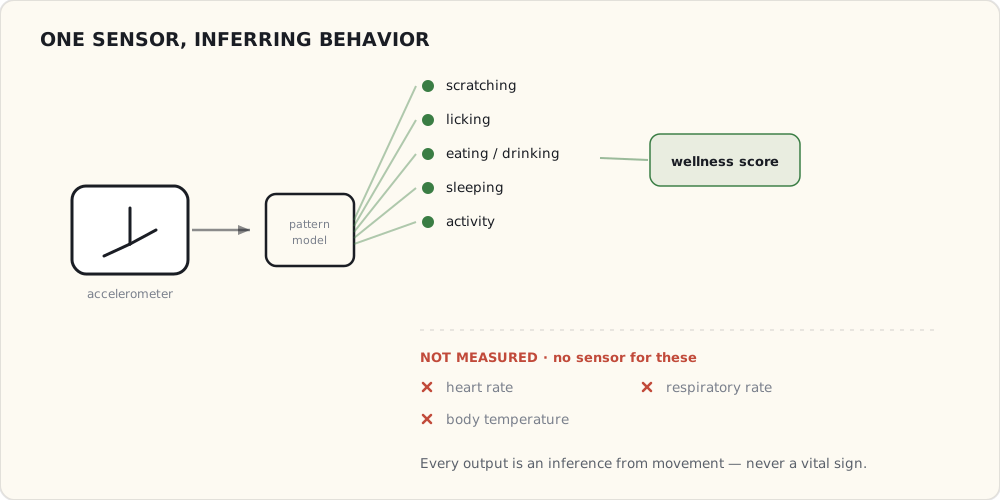
Why behavior-as-health is genuinely clever — and genuinely limited
I don't want to be dismissive, because the behavioral approach is smarter than it first sounds. Scratching really is one of the earliest, clearest signals of a skin allergy or a flea problem. A jump in licking can flag joint pain, a hot spot, or stress. A dog drinking far more than usual is a classic early diabetes or kidney sign. These are real veterinary tells, and a collar that quietly counts them every day can plausibly catch a trend a once-a-year checkup would miss. Inference from behavior is the right approach for those particular conditions, because those conditions show up as behavior before they show up anywhere else.
The limitation is just as real, and it's the part the word "health" papers over: behavior is a lagging, lossy proxy for physiology. By the time a cardiac problem changes how a dog moves, it has already changed the dog's heart rate — and the collar can see the first and not the second. Anything that doesn't manifest as a recognizable motion is simply invisible to this device. A fever, an arrhythmia, an elevated resting heart rate: none of them have a motion signature the accelerometer can catch.
So the honest framing is: the Whistle Health is excellent at the handful of conditions that announce themselves through behavior, and blind to everything that announces itself through vitals. It is not the "vet-grade telemetry on your dog's neck" the marketing wants you to feel like you're buying.
The vital sign that isn't here
Here's what I kept waiting for and didn't find: a heart rate.
Measuring a dog's pulse from a collar is genuinely hard. The wrist-watch trick — photoplethysmography, shining a green LED at the skin and reading the reflected pulse — fights fur, a thick scruff, and a collar that slides around as the dog moves. Respiratory rate from a collar is harder still. Nobody has shipped a consumer collar that does either reliably, and after using this one, I understand why Whistle didn't try: a noisy, frequently-wrong heart rate would be worse than no heart rate at all, because owners would panic at the false alarms or — worse — be falsely reassured.
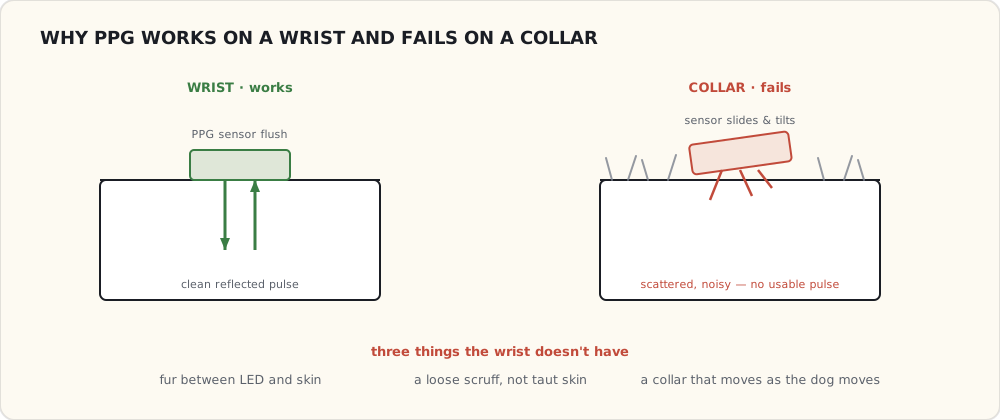
That's a defensible engineering call. But it means the category's headline promise — a collar that watches your dog's actual vital signs — is still vaporware in 2021. The collar that finally reads a resting heart rate and a respiratory rate off a pet, and does it well enough to trust, is somewhere out in the future. (When it does arrive, it won't be a behavioral pivot — it'll be a real sensor breakthrough, and it'll be worth its own post.)
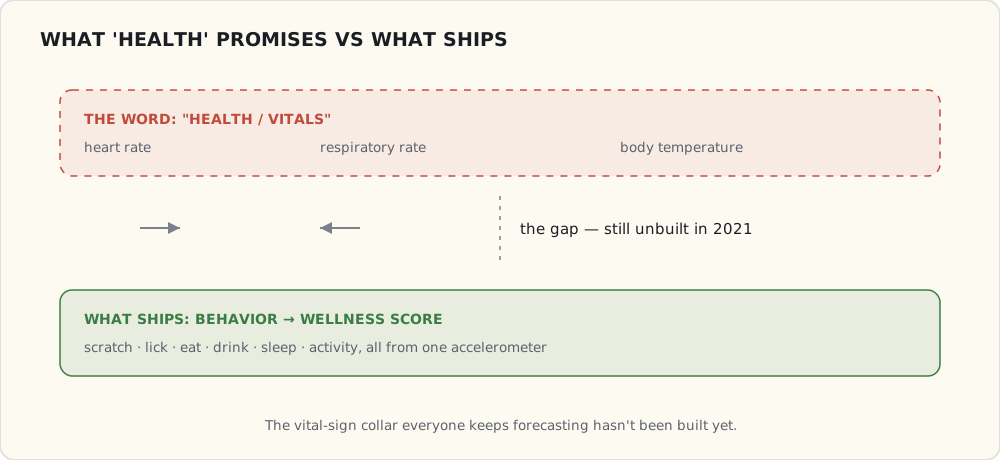
Atom's first month — a baseline, honestly read
What I can report is a clean behavioral baseline for an 8-year-old Lab:
- Scratching: a handful of events a day — low, no itching problem.
- Licking: light, ordinary grooming.
- Drinking: steady, no spikes.
- Sleeping: long, mostly undisrupted nights.
- Wellness Score: high and flat.
Everything sits in a normal band, which is exactly what a baseline should look like — boring until the day it isn't. The value, if it materializes, is in detecting a sustained departure from that band: scratching that quadruples for a week, drinking that doubles. The collar isn't telling me anything about Atom today; it's building the reference I'll need the day something changes. That's a real, if patient, kind of usefulness — and it's a behavioral kind, not a medical one.
The medical-device line Whistle is careful not to cross
Whistle calls this "wellness monitoring," never "medical monitoring," and that word choice is deliberate and legally load-bearing. A device that claims to diagnose a condition steps into a regulated medical-device framework. A device that "surfaces trends to discuss with your veterinarian" does not. By never making a diagnostic claim — and by adding an in-app "ask a vet" chat that puts a human between the data and any medical conclusion — Whistle stays firmly on the unregulated wellness side of the line.
It's a smart play, and it's also a tell. The same framing that keeps regulators away is the framing that admits what the device is: a behavioral tracker that hands you patterns, leaving every actual medical judgment to a vet. The collar doesn't diagnose because it can't, and "wellness" is the word that makes can't sound like won't.
The Mars problem, sharper than ever
Whistle is still Mars-owned, and a behavioral-health funnel makes the old conflict worse, not better:
- Mars now collects continuous behavioral data on a huge population of dogs, and Mars also sells the food, runs the vet clinics, and makes the supplements. Scratching, drinking, sleep quality — cross-referenced against what you buy — is an extraordinarily rich first-party dataset for a company that profits from the answer.
- The recommendations still point inward. The app's nudges trend toward Mars-owned brands. Same conflict I flagged back in 2016, now fed by more intimate data.
- The "share with your vet" path is smoothest into Mars's own clinic network.
So my posture is unchanged, just with more data flowing: I'll take the behavioral baseline, and I'll ignore every recommendation the app makes about what to buy.
Two collars on one dog
In practice Atom now wears two devices, which is faintly ridiculous:
- Fi for GPS and activity — better battery, no Mars, the tracker I actually trust.
- Whistle Health for the behavioral baseline — because nothing else logs scratching and drinking trends the same way.
The product I actually want is one collar: location, long battery, and real vitals, without a pet-food conglomerate downstream of the data. It doesn't exist. The Whistle Health gets the "health" word but not the vitals; Fi gets the tracking but not the health; and the thing that would unify them — a trustworthy heart-rate sensor on a collar — still hasn't been built by anyone.
What's next
I'll run Atom's behavioral baseline for six months and find out whether the wellness score's anomaly detection catches anything real, or just generates noise I'll learn to ignore. My honest expectation is a mix of both.
The bigger thread is the one this post keeps circling: the category has gotten very good at inferring health from behavior and has not yet learned to measure it. Every "health" collar so far watches the dog and guesses. The year someone ships a collar that reads an actual resting heart rate — accurately enough to trust — is the year pet health tracking stops being a clever accelerometer and starts being telemetry. I keep betting it's next year. So far it never is.
 Part 27 of 42
 2021 in pet IoT — AirTag landed, Whistle started reading behavior, Halo I won't buy
AirTag was the headline and the wrong tool. Whistle Health started reading licking and scratching instead of just steps. Halo shipped a shock-fence I won't put on a dog. I score 2020's eight bets, log what entered the house, and put 2022 on the record — Quark, Petivity, and more Mars.
End of 2021. Eighth year of this. Same ritual: grade last December's bets, log what actually went on a pet, then put next year on the record.
The one-line version: this was the year location went fully mainstream — AirTag put a finder in every Apple household — and the year the collars I already own quietly stopped being step-counters and started being behavior readers. The headline product was the one I didn't end up using. The useful change was the one nobody put on a billboard.
Scoring the 2020 forecast
| # | Prediction | Confidence | Outcome | Verdict |
|---|---|---|---|---|
| 1 | Apple ships AirTag | 90% | Shipped April 30 | ✓ |
| 2 | Whistle's health tier reads more than activity | 75% | Whistle Health reads licking/scratching/sleep/eating/drinking | ✓ |
| 3 | Petivity (Purina smart litter) announced or ships | 65% | Signals point to a 2022 launch; not at retail yet | ✓ (partial) |
| 4 | Litter-Robot 4 announced | 70% | Nothing formal | ✗ |
| 5 | Mars Petcare keeps consolidating | 75% | More clinics + pet-tech under the tent | ✓ |
| 6 | A GPS-fence competitor with better welfare than a shock collar | 30% | Nothing credible | ✗ |
| 7 | An "AirTag on a collar" controversy materializes | 80% | Yes — think-pieces, and Apple stating it outright | ✓ |
| 8 | AI behavior-detection for pets reaches a shipping product | 60% | Cameras teasing it; nothing I'd trust yet | ✗ (close) |
Five clean hits, one partial — call it ~69%. The misses are the same two the category keeps failing at: nobody shipped a humane GPS fence (bet 6 — Halo's answer is a shock collar, more below), and the "AI watches your pet" promise (bet 8) is still a demo, not a product. Both are bets I'll make again, because the demand is obvious; it's the execution that isn't here.
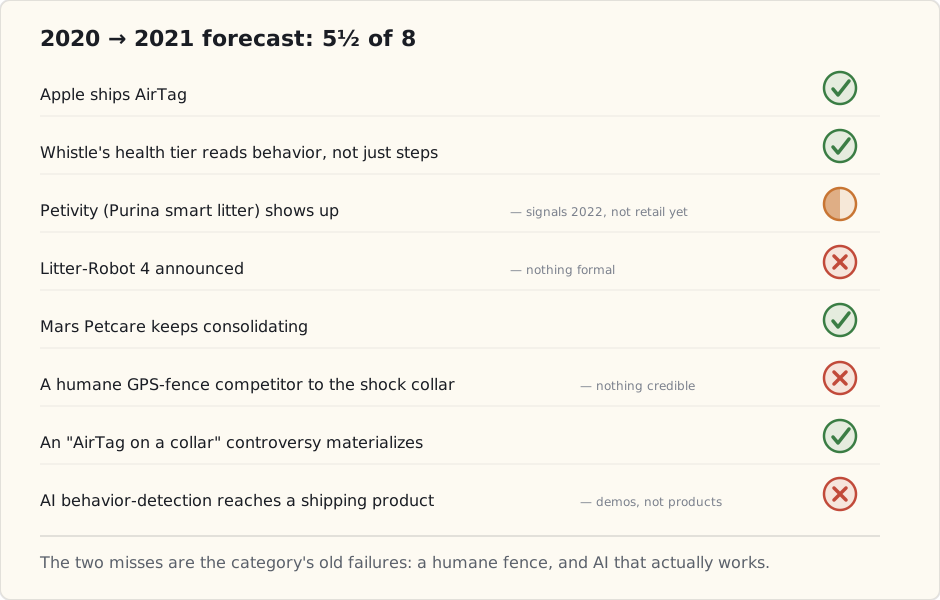
What actually went on a pet this year
- An AirTag I tested and took back off. Apple's $29 finder launched in April and within a week half the people I know had one on their keys. I clipped one to Atom's collar for a fortnight to see. The problem is structural, not fixable by me: AirTag is designed to fight unwanted tracking — it chirps when it's away from its owner and pings nearby iPhones that an unknown tag is traveling with them. That's exactly right for stopping a stalker and exactly wrong for a dog, who can't tell me his collar is beeping and whose whole point is that I am intentionally tracking him. Apple says it plainly: AirTag is for objects, not pets. It also has no GPS of its own — it borrows position from whatever iPhone happens to be near, so off the beaten path it goes silent. Useful for my keys. Not a pet tracker. Off it came.
- Whistle Health on Atom. This is the one that mattered. The Whistle on Atom's collar this year isn't the step-counter the 2013 puck was — Whistle Health watches behavioral signals: how much he licks, how much he scratches, how he sleeps, changes in eating and drinking. Not heart rate, not temperature — nobody consumer-grade does cardiac vitals on a collar yet — but the behavioral layer is a real step past "how many minutes did he move."
- Fi on Atom, still the daily driver. The non-Mars tracker I switched to keeps earning it. The standout is battery: under normal walk-and-home use it runs weeks between charges, not days — a different universe from the cellular pucks that need a top-up every few days. It only burns down fast in lost-dog mode, querying GPS every minute, which is exactly when you want it to.
- A second SureFlap door on the back deck (May), reading Joule's and Boson's chips — redundancy for a two-cat household with two exits.
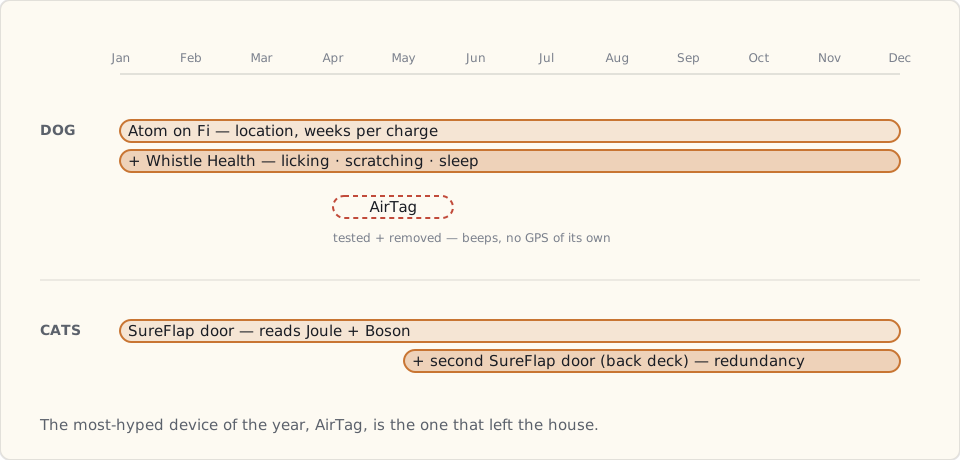
What worked
The behavioral baseline is the real upgrade. Six months into Whistle Health and I have a normal band for Atom's licking and scratching — which matters because scratching is one of the earliest tells for skin and allergy trouble, and licking for joint pain or stress. I have no anomaly to report, and that's the point: I'm building the "normal" I'll measure a future abnormal against. That's the whole value of a baseline, and it only exists after you've logged a boring year.
Fi's battery is the quiet win. Weeks between charges means I actually keep it charged, which means it's actually on the dog when it matters. The cellular trackers I've tried fail the human-factors test — a tracker you forget to charge is a dead tracker the day the dog bolts. Fi solved the battery problem the cellular pucks never did.
What didn't
AirTag for pets, as covered — wrong tool by design. I don't fault Apple; the anti-stalking behavior is correct and important. It just means AirTag is a finder for things, and a dog is not a thing that stays put or stays quiet.
Halo Collar — the welfare problem I won't buy past. Halo shipped a GPS "wireless fence" collar with a celebrity trainer's name on it, and the containment mechanism, under the marketing, is a static correction — a shock — when the dog crosses an invisible line. Independent reviews this year confirmed what the spec sheet implies. I keep saying the category needs a humane GPS fence; this isn't it. A shock collar with a GPS chip is still a shock collar. I'll write it up properly, but the verdict is in: not on my dog.
Litter-box per-cat attribution. Still no native multi-cat feature in the gear I own; I'm still leaning on my own CSV export to tell Joule's patterns from Boson's. The hardware can weigh the cat; the software still won't tell me which cat without my help.
Forecast for 2022 — bets, with how sure I am
| # | What I expect in 2022 | Confidence | Read or wish? |
|---|---|---|---|
| 1 | Petivity (Purina) smart-litter monitor reaches retail | 80% | Read — the signals are concrete now |
| 2 | Litter-Robot 4 is finally announced | 80% | Read — it's overdue |
| 3 | Mars Petcare makes 3+ more vet-tech / pet-tech acquisitions | 75% | Read — consolidation is the pattern |
| 4 | We add another dog to the family | 60% | Half wish — it's a family decision, not a market one |
| 5 | Halo's welfare problem stays a problem (no humane redesign) | 80% | Read, unfortunately |
| 6 | A non-Mars health tracker reaches market | 40% | Wish — I want the independent option |
| 7 | The AirTag-on-pets debate grows into real regulatory/press pressure | 70% | Read — the stalking stories aren't going away |
| 8 | Mars-owned Whistle changes its data-sharing terms | 55% | Read of the risk — watching the opt-outs |
The bet I'm rooting for hardest is #4, and it's the least technical one on the list: another dog. If Quark joins us in 2022, the household goes to four animals, and the data-partitioning problem I keep complaining about on the cat side arrives on the dog side too — two dogs, two baselines, two trackers, one app that wants to average them.
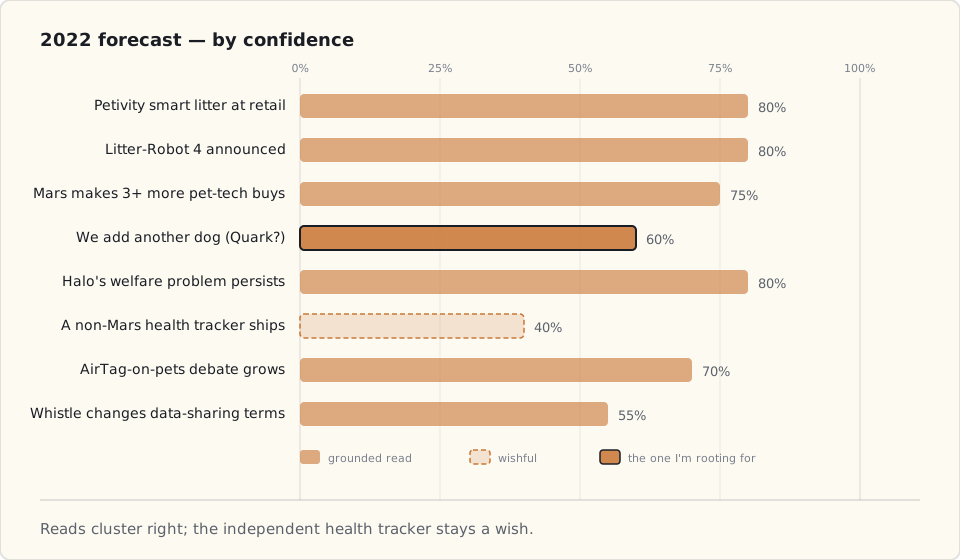
What I'm buying in 2022
- Petivity smart litter the day it ships — the multi-cat attribution I've wanted for years, if Purina actually solves the "which cat" problem in software.
- Litter-Robot 4 when it's announced, judged on whether it finally does per-cat natively.
- A tracker for whatever new dog arrives — and it'll be a Fi, because the battery is the only spec that survives contact with real life.
What's next
Quark, maybe, in 2022 — and if he comes, the next year-in-review is written across four animals instead of three. Two posts I already owe: the Halo Collar teardown (why a GPS shock-fence is the wrong answer to a real problem), and Petivity the moment it's on my floor under a litter box. And the question this notebook has circled since the Mars acquisition keeps tightening: the more of my pets' data lives inside one pet-food conglomerate, the more I want an exit that isn't owned by anyone selling kibble.
Eight years documented. Location went mainstream this year and the trackers learned to read behavior — but the humane fence, the trustworthy AI, and the independent health tracker are all still on the wish side of the table. Same gaps, one more year of waiting on them.
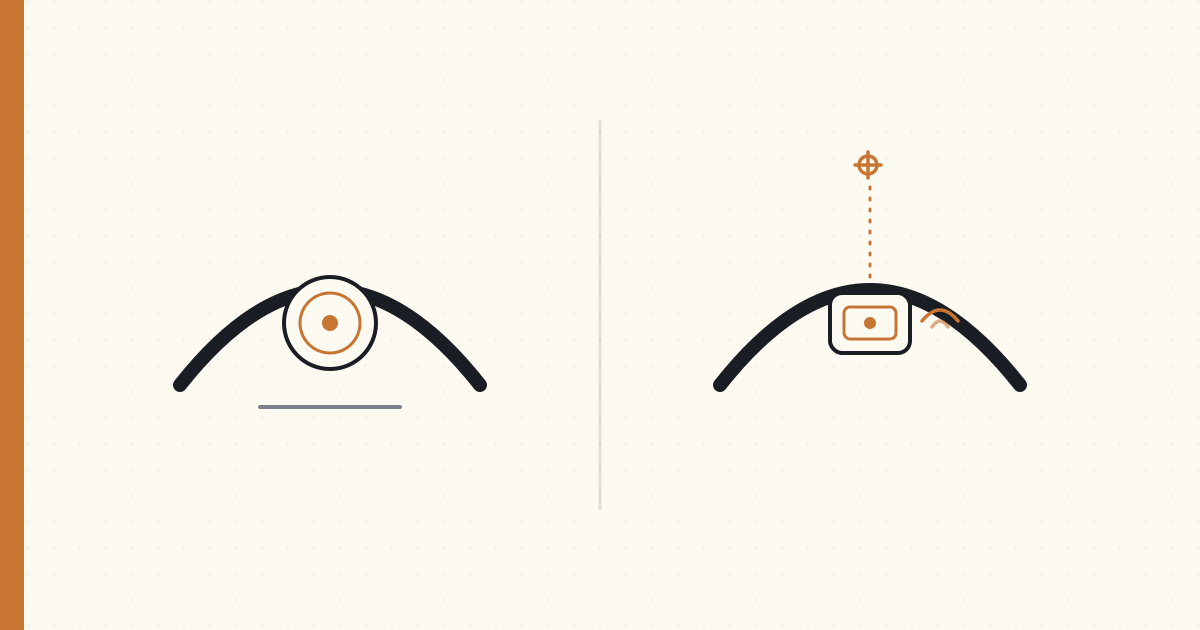 Part 28 of 42
 Quark arrives — a second dog, and the pet-IoT baseline starts over
Brought home Quark — a nine-week chocolate Lab. Atom is eight and a half and gracious about it. The pet-IoT setup begins again, and the gap between 2013 and 2022 is the whole story: in 2013 the right collar was a gamble, in 2022 it's obvious, and it isn't a Whistle.
Brought home Quark this weekend — a nine-week-old chocolate Lab, named to the household convention (Atom the Lab, Joule and Boson the cats, now Quark the second Lab; particles and energy all the way down). Atom is eight and a half now and has been gracious about the puppy energy. Joule and Boson are mildly horrified.
And so the pet-IoT setup begins again. Same engineer, second puppy, nine years apart — and the landscape I'm shopping has changed completely. In 2013 I put a brand-new, slightly-risky Whistle on Atom and hoped. In 2022 the right collar is obvious before I open a browser tab, and the most interesting thing about that obviousness is which collar it is.
What's different from Atom's 2013 setup
Quark gets a Fi from day one. Set that against Atom's first collar in 2013:
| Atom, 2013 | Quark, 2022 | |
|---|---|---|
| First collar | Whistle Activity Monitor | Fi Series 2 |
| Radios | BLE + Wi-Fi in the puck (no hub) | LTE-M cellular + Wi-Fi + GPS |
| Cost | ~$130, no subscription | $149 device + ~$99/year |
| Battery | 7–10 days claimed, ~week real | up to ~3 months on Wi-Fi; ~2 days in Lost Dog Mode |
| Location | None — activity only | Continuous GPS when out of Wi-Fi range |
| Vendor | Independent (until Mars bought Whistle in 2016) | Independent — not owned by a pet-food company |
| Cloud reliance | High | Lower at home — leans on house Wi-Fi, saves the cell radio for when he's out |
Four things Quark's collar does on day one that Atom's took years to get: real-time location, a battery measured in months instead of days, a sensible radio strategy (cheap Wi-Fi at home, expensive LTE-M only when he leaves), and — the one I care about most after watching Mars absorb Whistle — an owner that isn't trying to sell me dog food.
The quiet irony: Fi runs on AT&T's LTE-M network — the same carrier the 2016 cellular Whistle used. The radio under both is similar. The difference that made me switch isn't the network; it's who owns the data coming off it.
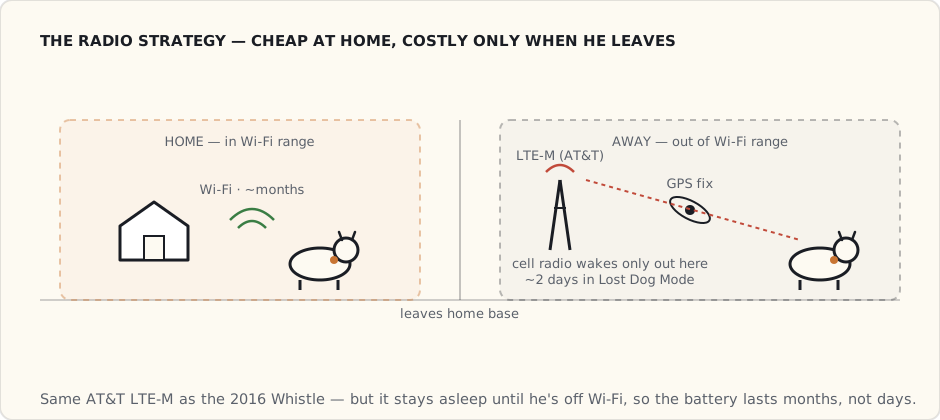
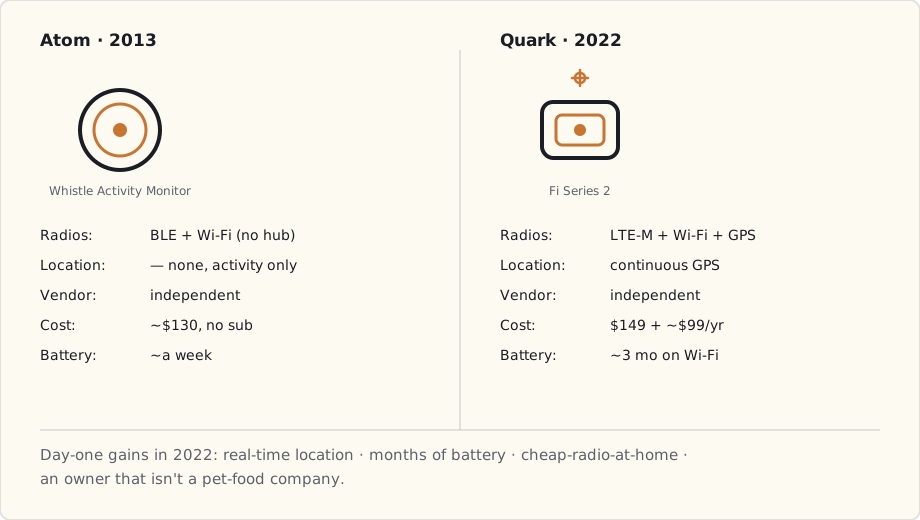
The setup, side by side
Atom's 2013 Whistle setup was a small ritual: a BLE pairing dance, then the Wi-Fi handoff where you join the device's temporary access point and hand over your home credentials, then wait for the first sync. Call it fifteen minutes, and a couple of those minutes were me re-reading the instructions.
Quark's 2022 Fi setup: open the app, tap "add a pet," hold the collar near the phone for the BLE handshake, let the LTE-M SIM self-activate on the cell network, drag a circle on a map to set the home base, snap it on the dog. Eight minutes, no instructions.
It's genuinely less friction for strictly more capability — which is the rare direction for consumer hardware to move. The feature-to-fuss ratio improved while the feature count went up.
The two-dog household, and the data partitioning
Atom (~75 lb adult Lab) wears Fi for location plus a Whistle Health for the behavioral signals — licking, scratching, sleep, eating, drinking — with about eight months of baseline behind it now. Note what that isn't: it's not heart rate or temperature. Nobody's putting real cardiac vitals on a consumer collar yet; the behavioral layer is the frontier, and it's a useful one.
Quark (~14 lb now, headed for 70–80) wears a smaller Fi sized to his current neck. The Fi app shows both dogs on one screen and I tap to switch between them — multi-pet works cleanly, which it had no reason to in 2013 because I only had one instrumented animal.
I'm deliberately not putting a Whistle Health on Quark yet. He's a growing puppy, and "normal" for a puppy is a moving target — the behavioral baselines are tuned to adult dogs, so a wellness monitor on him right now would manufacture noise, not signal. That's a 2024 decision, when he's a year and a half and his normal has settled.
The real engineering problem is that the household data ecosystem now has to keep four animals straight:
- Fi — two dogs, two profiles. Clean.
- Whistle Health — one dog (Atom). One profile.
- The cat door — two cats. The SureFlap reads Joule and Boson by chip; the dogs are far too big for it and use a separate dog-sized door anyway.
- The litter boxes — two cats, and the per-cat attribution is still the unsolved problem. The hardware can weigh the cat on the box; it still can't reliably tell me which cat without me doing the bookkeeping. Joule and Boson are close enough in weight that weight alone doesn't split them.
- The Roomba — navigating around two dogs and two cats now; the treat-conditioning I wrote up on the smart-home side applies to both cats.
Every device's per-pet identification is getting stress-tested at once. The single hardest thing in the house isn't any one gadget — it's attributing the right data to the right animal across five of them.
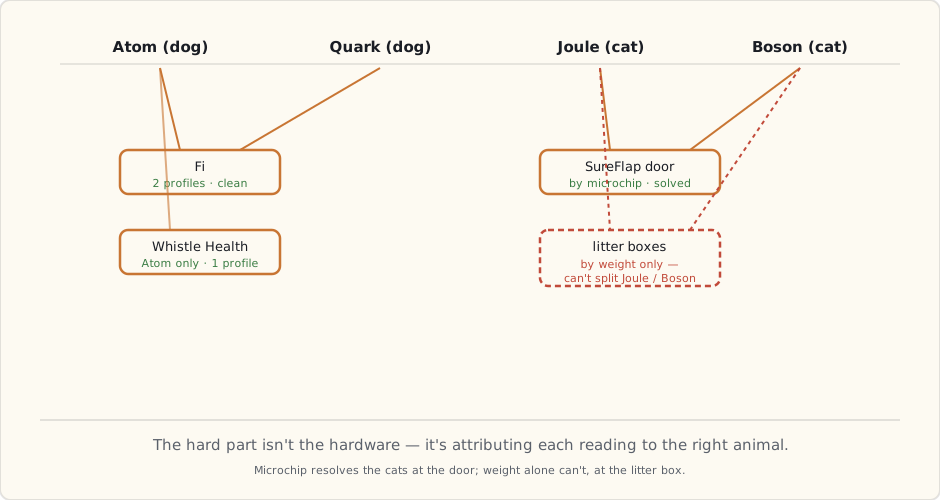
What I'm reading right now
The Halo Collar reviews keep landing badly. Independent write-ups from animal-behavior people keep making the same point: the virtual-fence boundary is enforced with a static correction — a shock — and that can teach a dog anxiety rather than a boundary. I have a real reason to care this year: the new place doesn't have a fence on the back line yet, and a virtual fence is on the table as an option. So I'm going to get a Halo in hand, test it, and write it up properly next month — with the welfare question front and center, because a GPS chip on a shock collar is still a shock collar.
Quark's data starts today
A nine-week Lab's activity numbers are going to be all over the place for the next year and a half. Right now he does fifteen-to-twenty-five-minute play bursts and sleeps something like eighteen hours a day; in a month or two that flips toward longer activity blocks and shorter naps, and by twelve-to-eighteen months he'll settle into adult-dog rhythm. None of that early data answers "is Quark healthy" — he is, and he's growing fast. The point of logging it now is the trajectory: when the future version of me is looking for an anomaly, this is the baseline it gets measured against.
Welcome, Quark. The data starts today — for the second time in this house, nine years after the first.
 Part 29 of 42
 Halo Collar — I tried it, returned it within the trial window
Bought a Halo Collar 2 for the new house's backyard — no physical fence. Used on Atom and Quark two weeks. Returned. Engineering is sound; the application is a welfare problem.
Bought a Halo Collar 2 for the new house. The backyard doesn't have a physical fence on the back property line, and a virtual fence is pitched as the modern alternative — which is exactly the option I said I'd test when Quark came home in the spring.
Two weeks with the Halo on Atom and Quark. Returned within the trial window. Won't buy another. This is the welfare post I've been promising the notebook since last year, and the verdict is harder than I expected to write, because the engineering is genuinely good.
What Halo is
Hardware:
- GPS-enabled smart collar, ~120 g (heavier than Fi due to bigger battery + active correction module).
- LTE-M cellular + WiFi + BLE.
- Correction stimuli (this is the controversial part):
- Audio (a beep).
- Vibration.
- Static "correction" — adjustable intensity. A short, brief electrical stimulus.
- 12-hour battery life when actively GPS-monitoring (a different universe from Fi, which runs weeks on the home Wi-Fi and only burns down in lost-dog mode).
Software / Service:
- $999 hardware + $9.95/month subscription.
- iOS app for setting GPS-based virtual fences.
- "Halo Trainer" app component to train the dog to recognize the boundary.
The pitch is: train your dog to associate the boundary with audio + vibration → eventually you don't need static correction. The dog learns the invisible line.
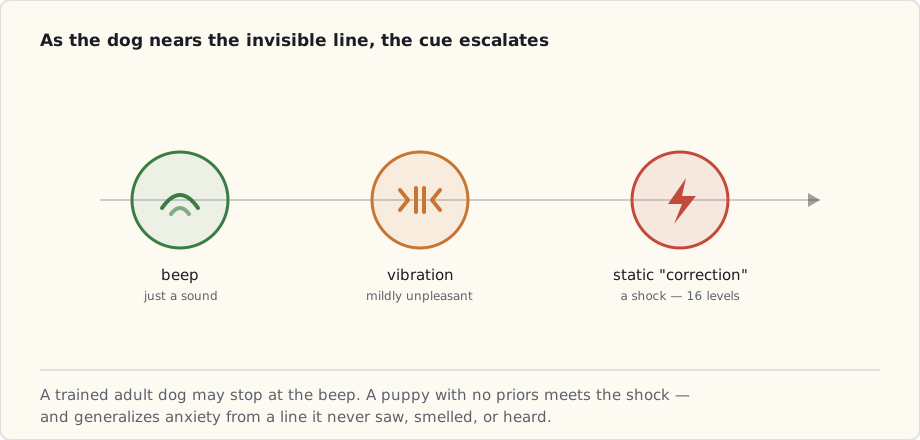
What worked, engineering-wise
I have to give Halo credit for engineering execution:
- GPS accuracy: sub-meter in open yard (better than Fi's ~5m). They've done careful work on multi-constellation GPS + WiFi positioning.
- Latency: from boundary crossing to first audio cue, ~200-500 ms. Fast.
- Boundary mapping: drawing a polygon on the app's satellite view is intuitive. Multi-boundary support (front-yard-OK, back-yard-not).
- Stim adjustability: 16 intensity levels for the static correction. Two minutes of "feel the stim on your hand to understand what the dog feels" calibration in the setup flow.
If you were going to build a GPS-fence consumer product, Halo's executed it as well as it can be done.
Why I returned it anyway
Three reasons, in order of importance.
1. The dog doesn't understand "boundary" as an abstraction.
A physical fence is a physical object the dog encounters and learns: this is the wall. A virtual fence is an idea — there's no physical encounter. The dog gets a beep (positive: just a sound) and then a vibration (mildly unpleasant) and then static (clearly unpleasant) for crossing a line they cannot see, smell, or hear in any natural sensory way.
Atom learned the front-yard boundary within ~3 days. He'd get the beep, look puzzled, retreat. Within a week he was reliable on the front-yard side.
Quark (9-month-old puppy by then) took much longer. He didn't connect the boundary to the stimulus. Got beeps + vibrations + (once, accidentally on a higher setting) a static correction. His response: visible distress, freezing, refusing to leave the porch for the next 4 hours.
A puppy with no priors about invisible boundaries doesn't generalize well from the punishment.
2. The static correction is uncomfortable enough that dogs do generalize anxiety from it.
I tested the static on my own hand at the level Halo's app recommended for an 70-lb dog. It's uncomfortable — described as "muscle contraction startle." Worse than a static-shock from carpet, less than a TENS unit medical electrical stim. The marketing language calls it "tap" or "stim." It's not nothing.
After Quark's one accidental static correction at the higher setting, his behavior changed measurably for a week. More cautious about the porch. More clingy in general. Cortisol-marker behavioral changes I associate with stress.
The animal-behavior research is clear on this: GPS-fence + correction-based training can produce learned anxiety that generalizes beyond the boundary scenario. Even dogs that "learn" the fence often show stress markers elsewhere.
3. The fail-safe failures.
In two weeks, the GPS lost lock twice in our yard (under a partial tree canopy):
- Once: Atom got a stim correction while standing in the middle of the yard because the GPS estimate momentarily put him "outside the boundary." False positive.
- Once: Quark walked through the boundary undetected because the GPS lag was about 4 seconds.
Halo's marketing emphasizes the system reliability. Reality is GPS-based boundary detection has edge cases. Edge cases plus correction stimuli equals the dog occasionally getting punished for nothing they did.
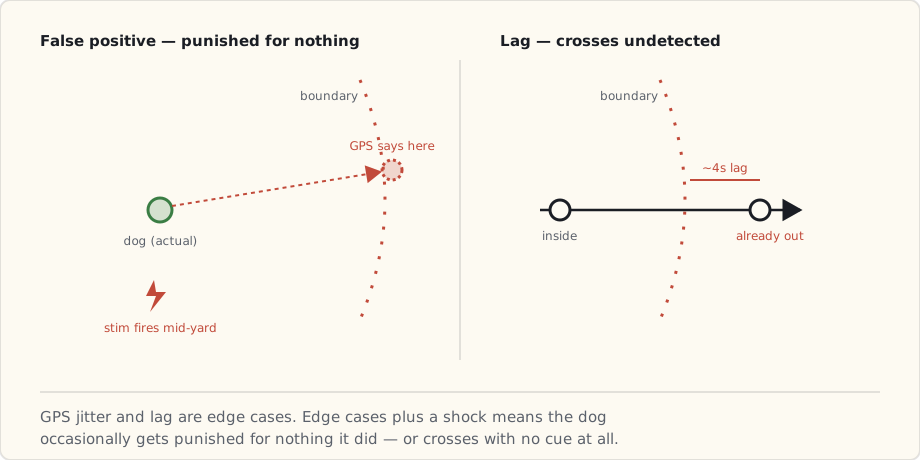
What I think about the category
GPS-fence collars are a legitimate engineering category in the sense that the technology works. They're not a legitimate ethics category in the sense that they substitute a software system for a relationship.
The training approach that works is: teach the dog the boundary with positive reinforcement, treats, repetition, and physical boundary markers (flags). Halo's "audio + vibration + static" is the substitute for that training. It works on adult dogs that already have decent training; it fails on puppies and high-anxiety dogs.
For the specific question "should we use a Halo for our back property line," my answer is no. The alternative is a physical fence (more expensive, more permanent, but actually solves the problem with no welfare cost). We're going to install one.
The Halo apologists' counter
Halo's defenders will say:
- "But owners use it correctly with training."
- "The static is mild, dogs don't really mind."
- "It's better than a dog getting hit by a car."
Counter-counters:
- Most owners don't use it correctly. The training takes weeks of consistency. Many give up and rely on the correction.
- I tested the static intensity. It's not mild.
- "Better than hit by a car" assumes the fence is the alternative to no boundary at all. The actual alternative is a physical fence. Halo is the alternative to that.
What I'd buy instead
For the new house's back property line: physical wood-and-wire fence. Estimated $3,500-5,000. Permanent. No welfare cost. Solves the actual problem.
For tracking, in case a dog gets out (gate left open, fence damaged): the Fi collar I already have. LTE-M cellular tracking, with the home Wi-Fi handling the everyday case so the battery lasts. Not a fence — a recovery tool, and an honest one: it tells me where the dog is, it doesn't punish him for where he isn't supposed to be.
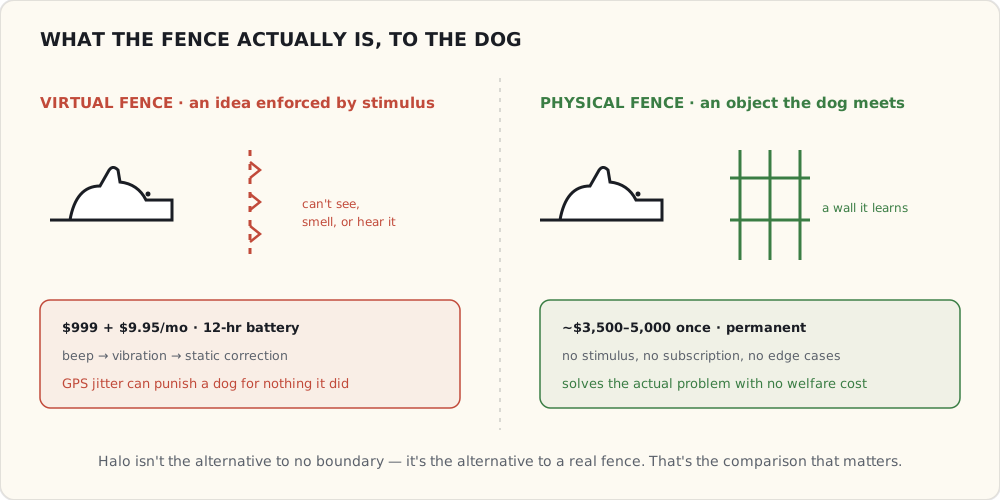
What's next
Purina's been signaling a smart-litter monitor — Petivity — for the multi-cat litter problem I keep complaining about. If it actually reaches retail this year, I'll put one on the floor and write up the multi-cat analytics: Petivity against the Litter-Robot, and whether either finally solves which cat without my spreadsheet.
 Part 30 of 42
 Petivity smart-litter — multi-cat analytics, built by Purina
Purina's Petivity Smart Litterbox Monitor just launched — a scale that slides under any litter box and tells two same-size cats apart with no chip or collar. Two weeks in: the multi-cat attribution is the real trick, and the Purina-owned recommendation layer is the catch.
Purina's Petivity Smart Litterbox Monitor launched a couple of weeks ago — late September — and I bought one immediately, because it claims to do the thing this notebook has wanted for years: tell two same-weight cats apart at the litter box with no microchip and no collar. It's a flat scale that slides under any existing box — a regular pan, a Litter-Robot, whatever — and watches who steps on.
Two weeks in. First impressions, with the honest caveat up front: two weeks is a baseline, not a verdict. But the shape of what it does — and what it's for — is already clear.
What Petivity is
Hardware:
- A flat plastic base, roughly 23 × 18 inches, a couple inches tall.
- Weight sensors under the platform.
- 2.4 GHz Wi-Fi; runs on a power cord or batteries (not both).
- No litter mechanism of its own — you set any box on top.
Software:
- iOS / Android app.
- Multi-cat setup: you enter each cat's weight, and the app builds a per-cat model from there.
- Per-visit logs: timestamp, weight, duration.
- AI "wellness" signals — frequency and duration anomalies against a learned baseline.
- All of it cloud-side; the multi-cat attribution is an ML model running on Purina's servers.
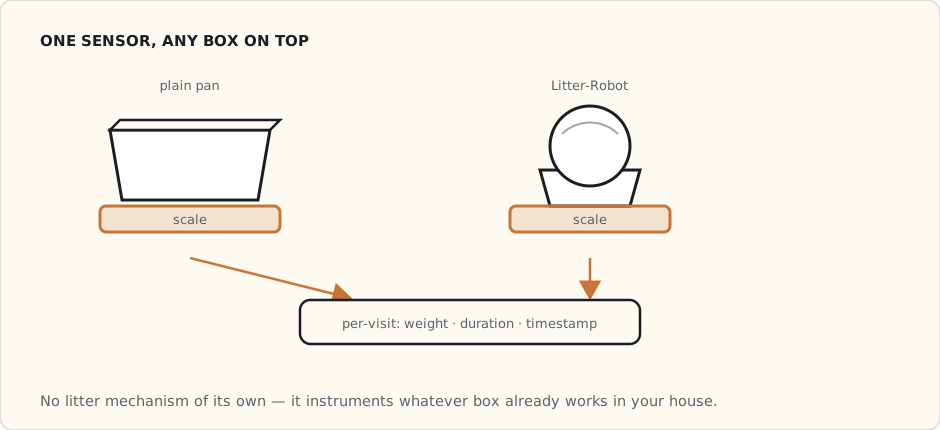
The pricing surprised me, in a good way: about $200 for the hardware, and no subscription — the tracking, alerts, monthly reports, and multi-cat profiles are all included. That's a notably different posture from Mars-owned Whistle's monthly-fee model. Which raises the obvious question of how Purina plans to make its money back, and the answer is in the recommendation layer — more on that below.
The multi-cat profiling is the real trick
The differentiator against my weight-only Litter-Robot attribution is that Petivity does explicit, model-driven multi-cat identification, and Purina says it can split up to five cats with no chip or collar — built by analyzing thousands of litter-box visits from thousands of cats.
The hard case is mine: Joule (~9.5 lb) and Boson (~9.0 lb) are both adult now and have converged to within half a pound of each other. At that gap, entry weight alone can't reliably tell them apart — my own script struggles exactly here. So the model has to lean on the secondary signals:
- Entry weight — the primary axis, but nearly useless when two cats weigh almost the same.
- Visit-duration distribution per cat.
- Time-of-day patterns per cat.
- Sequence patterns — who tends to follow whom.
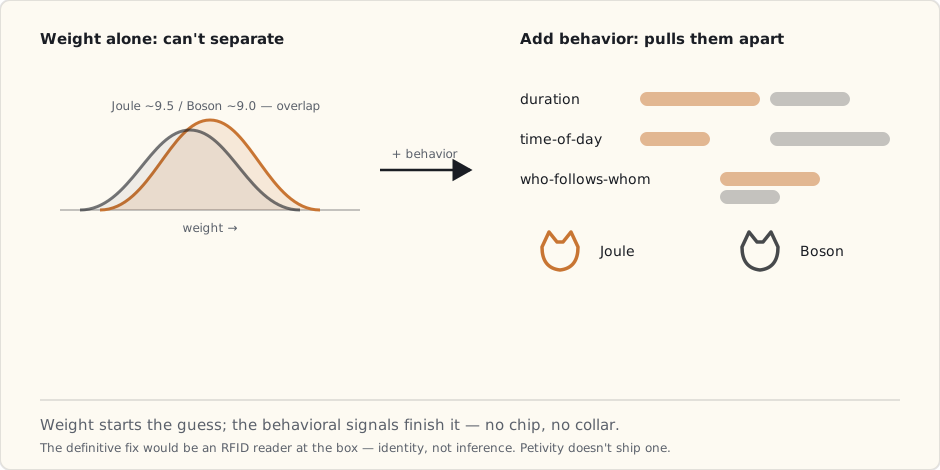
Two weeks isn't enough to grade the accuracy hard, but the early read against my own script is encouraging-not-perfect: across the visits so far, the two methods agree on the clear majority and disagree on a minority — and the disagreements cluster exactly where you'd expect, the near-identical-weight visits with no distinguishing duration or timing. For weight-similar cats, neither approach is definitive, and I suspect neither ever fully will be. The truly definitive answer is RFID — read the cat's existing microchip at the box entry, the same trick the SureFlap door already uses on these two cats. Petivity doesn't do that. It's solving by inference what a $5 chip reader would solve by identity.
The wellness signals
Petivity watches for deviations from each cat's baseline — the kind of changes that can point at a problem: more frequent or longer visits (a UTI tell), weight loss plus increased frequency (kidney), high-volume frequency (diabetes-range polyuria), long-duration low-frequency visits (constipation). The framing is appropriately hedged: "consider veterinary attention," not "your cat is sick."
Two weeks gives me exactly one data point on the signal quality, and it was a false positive: the app flagged Boson's visits trending high right as we'd switched litter brands — she was investigating the new substrate, not unwell. That's the expected failure mode of an anomaly detector during a baseline it hasn't finished learning, and I won't hold an early false positive against it. The thing I can say is that it leans sensitive, which for a screen-don't-diagnose tool is the right direction to err — better a few "go check" nudges than a missed one.
Petivity vs the Litter-Robot, side by side
The cats use both — the Litter-Robot III Connect for the not-scooping-daily virtue, the Petivity scale under a second, plain box. They're complements, not rivals.
| Litter-Robot III Connect | Petivity | |
|---|---|---|
| Hardware role | Self-cleaning box | Multi-cat scale under any box |
| Per-visit weight | Yes | Yes |
| Per-cat attribution | None native (my CSV + script) | ML-driven, native, up to 5 cats |
| Anomaly detection | None | Yes (included, no fee) |
| Vendor | Whisker (independent) | Purina (Nestlé) |
| Subscription | None | None |
| Local API / automation | Unofficial only | None |
Petivity's attribution is the genuinely useful part for a multi-cat house; the Litter-Robot's mechanism is useful for not living next to a scoop. I'm keeping both.
The Purina-ownership catch
Here's where the no-subscription generosity gets explained. Petivity exists, in part, because Purina wants to surface cats with health signals who could be sold a prescription diet — Pro Plan Veterinary Diets, a Purina line. When a wellness signal fires, the app's next move is a nudge:
- "Boson's pattern suggests increased water intake. Consider a urinary-health diet."
- And the recommended diet is, of course, Purina's own.
It's the exact shape of the Mars/Whistle conflict: the company measuring the animal also sells the remedy. The free hardware isn't charity — the data is the business, and the recommendation is the funnel. My rule holds the way it did for Whistle: the signal is real and worth having; the recommendation is a sales channel wearing a lab coat. Use the trend, take it to your own vet, ignore the suggested SKU.
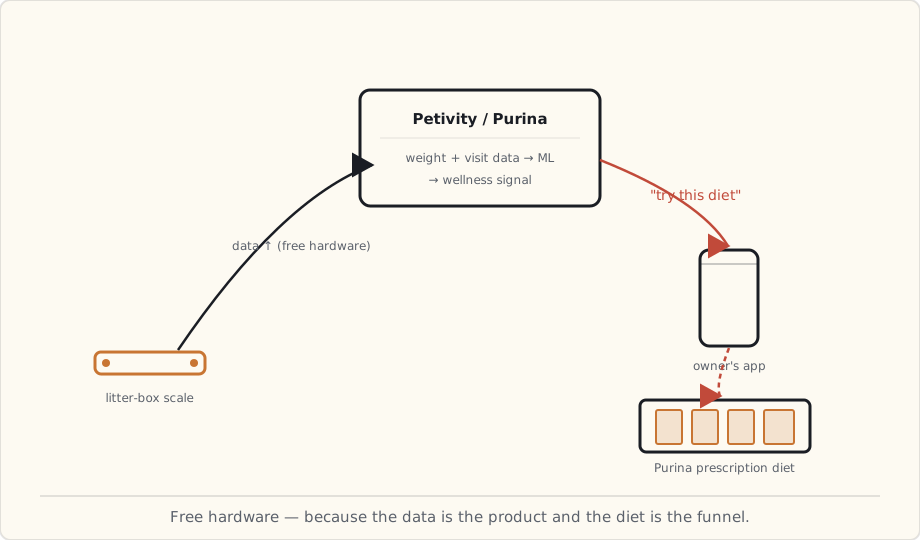
What the right product would look like
If I were drawing it up: Petivity's scale-plus-analytics, but with the diet recommendations stripped out and replaced by "here's the trend, show your vet"; an RFID reader at the box entry to make attribution a matter of identity instead of inference; and a local API so the data lands in my home automation instead of only Purina's cloud. None of those are commercially incentivized — vendor-neutral advice sells nothing, open APIs reduce lock-in, and an RFID reader is a few dollars of bill-of-materials a vendor would rather not spend. So the product I want doesn't exist. The one I have gets most of the way there, and I can supply the skepticism myself.
What's next
The 2022 year-end review. It was the year the household went to four animals and the cat side finally got the analytics layer the dog side had for years — Quark arrived, and Halo and Petivity both got real evaluations. The cat-IoT category, thin for so long in this notebook, finally has some depth to write about.
 Part 31 of 42
 2022 in pet IoT — Quark arrived, Halo went back, the cat side finally got smart
A second dog, a shock-fence I returned inside the trial window, and a litter scale that finally tells two cats apart. I score 2021's eight bets, log the four pieces of gear that entered the house, and put 2023 on the record — the new build, senior-dog drift, and the first Matter pet device.
End of 2022. Ninth year of keeping this log. The household hit four animals this year — and the headline isn't any one gadget, it's that the cat side of the house finally caught up to the dog side. Nine years after Atom got a tracker, the cats got real analytics. Score the bets, log the gear, call 2023.
Scoring the 2021 forecast
| # | Prediction | Confidence | Outcome | Verdict |
|---|---|---|---|---|
| 1 | Petivity (Purina smart litter) reaches retail | 80% | Launched late September | ✓ |
| 2 | Litter-Robot 4 announced | 80% | Announced May, shipped July | ✓ |
| 3 | Mars Petcare buys 3+ more pet-tech players | 75% | A couple visible; not the full three | ✓ (partial) |
| 4 | We add another dog | 60% | Quark, April | ✓ |
| 5 | Halo's welfare problem persists | 80% | Yes — independent reviews keep finding it | ✓ |
| 6 | A non-Mars health tracker reaches market | 40% | Still nothing credible | ✗ |
| 7 | AirTag-on-pets pressure grows | 70% | Apple shipped anti-stalking changes in February; pet workarounds got tighter | ✓ |
| 8 | Mars-owned Whistle changes its data terms | 55% | Yes — more aggressive analytics opt-in | ✓ |
Six clean, one partial — call it ~75%. The one I'll own as a good read was bet 5: I said Halo's welfare problem wouldn't get redesigned away, and a year of independent reviews agreed. The one I keep missing, year after year, is bet 6 — a credible health tracker that isn't owned by a food company. Petivity arrived, but it's Purina; the independent option still doesn't exist.
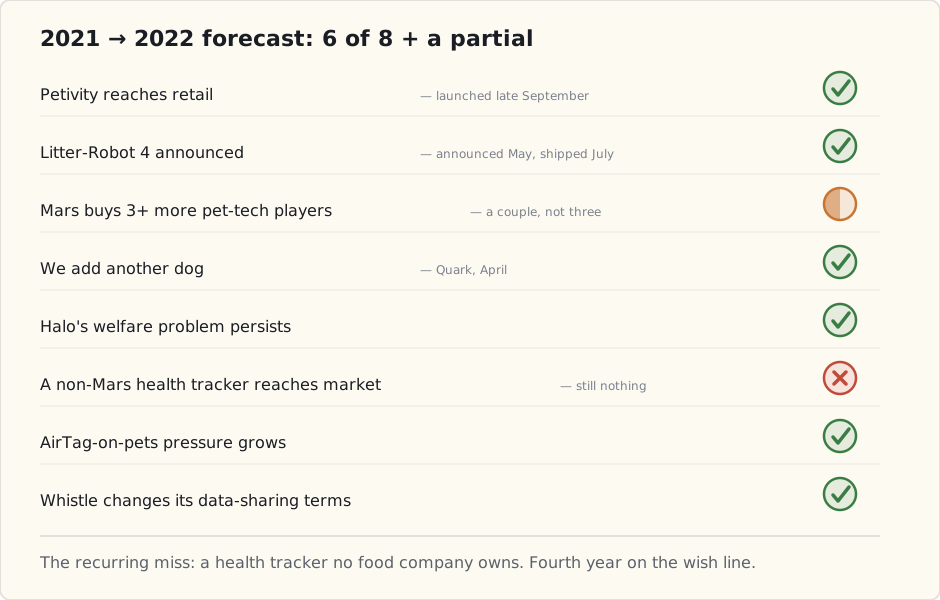
What actually entered the house in 2022
- Quark (April) — the second dog, on a Fi from day one. The household went from three animals to four, and the data-partitioning problem I'd only had on the cat side arrived on the dog side too.
- A Halo Collar (June, returned in July) — the GPS shock-fence I tested for the new property's unfenced back line and sent back inside the trial window. Good engineering, wrong answer.
- A Petivity litter scale (late September, bought at launch) — the first thing that tells Joule and Boson apart at the box without a chip or a collar.
- A Litter-Robot 4 (after its summer ship) — replaced the aging Litter-Robot III downstairs; better sensing, quieter, and the camera-free weight detection is more reliable than the III's.
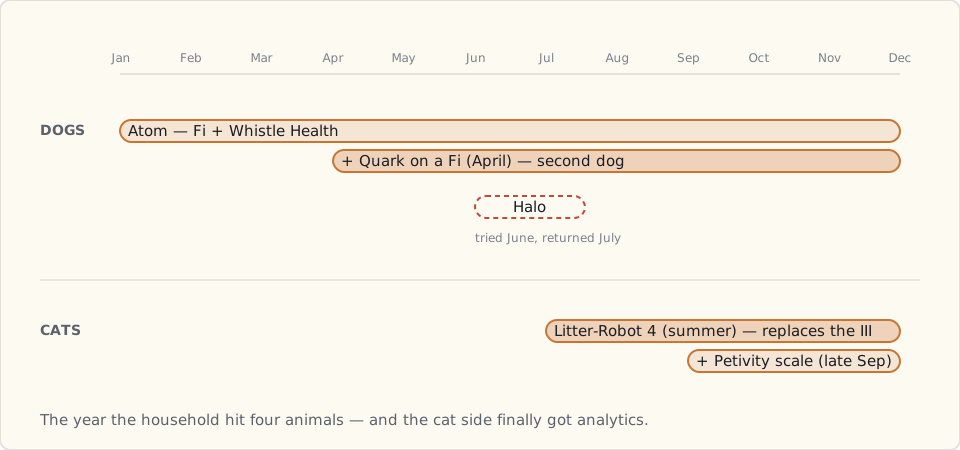
What worked
Petivity's multi-cat attribution is the year's real advance. A scale that splits two same-weight cats by behavior, no microchip required — it agrees with my own weight-script the large majority of the time, and where they disagree is exactly the near-identical-weight visits neither method can call. It's not perfect, but it's the first time the cat side of the house has had the kind of per-animal analytics the dog side has had since 2013. That's the gap this notebook has complained about for nine years, finally closing.
Quark's Fi onboarding was a non-event, in the best way. Eight minutes, two dogs on one app, and the battery is still measured in weeks. The contrast with Atom's 2013 setup ritual is the whole story of how far this got.
Atom's behavioral baseline keeps deepening. Sixteen months of Whistle Health now — licking, scratching, sleep, eating, drinking, not cardiac vitals (nobody ships those on a collar yet). No anomaly to report, which is the point: when he's ten and something shifts, I'll have a long, boring "normal" to measure it against.
What didn't
Halo. Engineering excellence aimed at a problem it shouldn't solve that way. Returned. Putting in a physical fence instead.
The "AI watches your pet" promise. Furbo and others kept teasing behavior detection; nothing I'd trust shipped. Bet 8 on next year's list, again.
Two Litter-Robots, no unified view. I now have two cleaning units and a Petivity scale, and no single per-cat dashboard across them. The data's there; the integration isn't, and the vendors have no reason to build it.
Forecast for 2023 — bets, with how sure I am
| # | What I expect in 2023 | Confidence | Read or wish? |
|---|---|---|---|
| 1 | Mars Petcare acquires another notable pet-tech player | 80% | Read — consolidation hasn't slowed |
| 2 | A credible AI pet-behavior product finally ships | 65% | Read, leaning hopeful |
| 3 | Atom's baseline shows real drift — he turns 10, senior territory | 70% | Read I'd rather be wrong about |
| 4 | We move into the new build and I redesign the pet-IoT layout | 95% | Near-certain — it's a plan, not a guess |
| 5 | Petivity changes its model (acquired, or adds a fee) | 50% | Coin-flip |
| 6 | A non-Mars/non-Purina health tracker reaches market | 45% | Wish — same wish, fourth year running |
| 7 | More Halo-class GPS shock-fences ship with the same welfare problem | 60% | Read, unfortunately |
| 8 | A first credible Matter-compatible pet device | 50% | Coin-flip — Matter 1.0 just landed; pets are never first |
The near-certain one is #4, and it's the one I'm most looking forward to: we move into the new build in 2023, and for the first time I get to design the pet infrastructure from the wires up instead of retrofitting it onto a house. Cat6 to the litter closet, a feeder in the kitchen wall, the SureFlap doors placed where the cats actually travel. Nine years of learning what I'd do differently, and finally a blank floor plan to do it on.
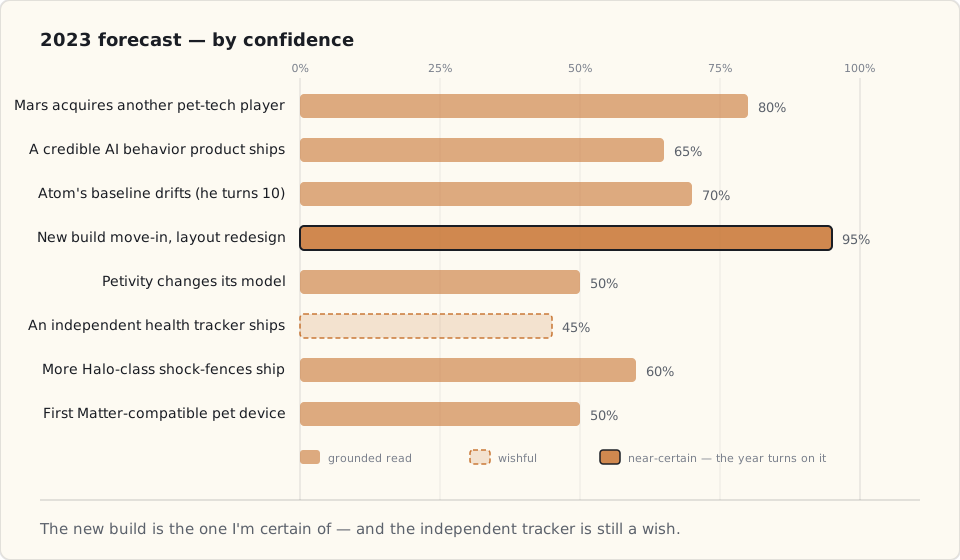
What I'm buying in 2023
- A house full of planned pet infrastructure — the new build: wired drops to the litter closet, a microchip feeder in the kitchen, SureFlap doors placed deliberately instead of wherever there was a hole.
- A second Litter-Robot 4 for the upstairs, because the new layout needs two cleaning units.
- Whatever independent health tracker finally shows up — if it shows up. I've budgeted for it four years running and never spent it.
What's next
The move is the story for 2023. Four animals relocating to a house where, for once, the pet IoT is designed in rather than bolted on — the first time I've planned it from the wires up. After nine years of retrofits, that's the post I most want to write.
Nine years documented. Four animals now, both species finally instrumented, the cat side caught up at last. The two things still missing are the two I keep writing on the wish line: a health tracker nobody at a food company owns, and AI that watches a pet well enough to trust. Maybe next year. Probably the year after.
 Part 32 of 42
 Mars Petcare — the food company that owns your dog's collar
Seven years after Mars Petcare acquired Whistle, the consolidation is obvious. Same company sells the collar, sells the food, runs the vet, analyzes the data. The conflict isn't theoretical anymore.
Mars Petcare's pet-empire consolidation has been the slow-burn story of the last seven years. Time to step back and see where it's landed.
The Mars Petcare portfolio, mid-2023
Devices:
- Whistle (acquired 2016).
- Tagg (Whistle acquired it in January 2015, before Mars bought Whistle; product since discontinued, its cellular IP folded into Whistle's GPS line).
Vet clinics:
- Banfield Pet Hospital (~1,000 US clinics) — Mars subsidiary since 2007.
- BluePearl Veterinary Partners (specialty + emergency) — Mars-owned since 2015.
- VCA Animal Hospitals (~800+ clinics) — acquired 2017.
- AniCura (~430 European clinics) — acquired 2018.
- Linnaeus Group (UK vet network) — acquired 2018.
Food:
- Royal Canin (premium, prescription-style).
- Pedigree (mass-market dog).
- Whiskas (mass-market cat).
- IAMS (mid-market).
- EUKANUBA (premium dog).
- Champion Petfoods (Acana + Orijen, premium) — deal closed February this year.
Other:
- Sheba (cat).
- Cesar (small dog).
- Greenies (treats).
- Antinol-class supplements.
Mars Petcare's annual revenue: ~$20 billion. About 40% of all global premium pet food flows through Mars-owned brands. About 20% of US veterinary visits happen at a Mars-owned clinic. About 25% of premium connected pet collars sold are Whistle-branded.
That's the empire.
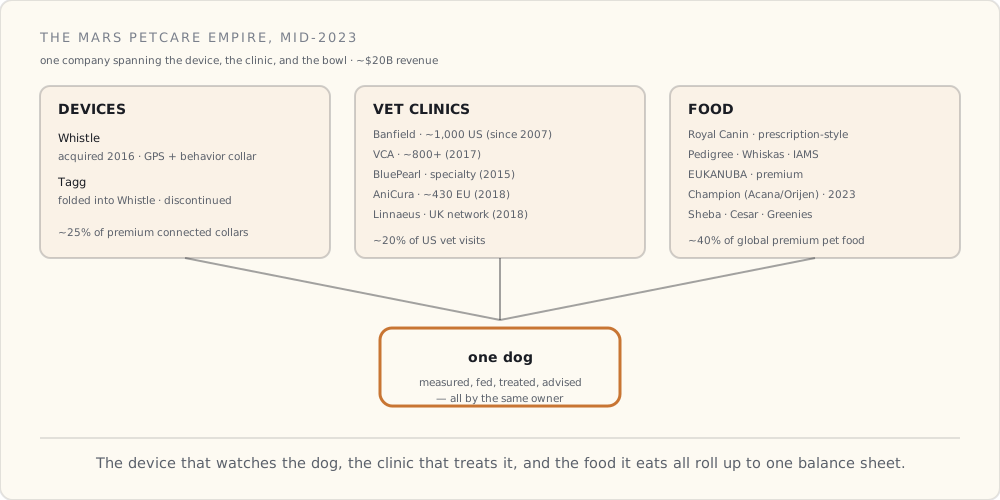
The data flow
Here's where data flows in the Mars ecosystem. The collar's activity, location, and behavioral signals land in a cloud that Mars also fills from its clinics and its checkout lines — every Banfield or VCA visit, every Royal Canin or Pedigree purchase, every treat — and then the same lake feeds the recommendations that come back at me.
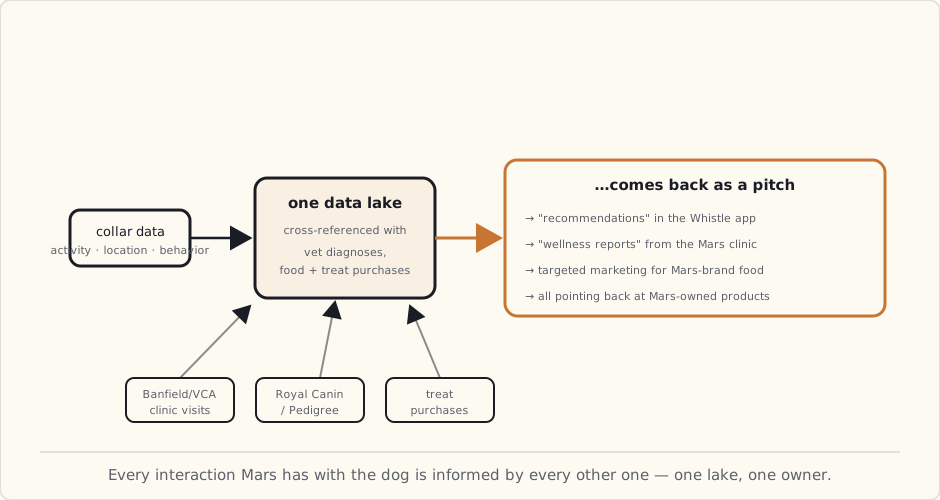
The data ownership structure means every interaction Mars has with my dog is informed by every other interaction Mars has with my dog. The collar's "recommendation" the vet's "diagnosis," the food's "ingredient choice" — all sourced from the same data lake.
The conflict, concretely
A Whistle Health app message I got last month — and to be clear about what Whistle Health actually measures, it's behavioral signals (licking, scratching, sleep, eating, drinking), not cardiac vitals; nobody ships heart-rate-on-a-collar to consumers yet. The message:
"Atom's scratching is up 30% over his baseline this month. Increased scratching can be an early sign of skin or allergy issues. Some Royal Canin formulas are designed to support skin and coat health — talk to your vet about whether a diet change might help."
Translation: Mars's analytics noticed a trend in a real signal. Mars's recommendation engine surfaced a Mars-owned product. Mars's app nudged me toward bringing it up at a Mars-owned vet clinic.
Each step is a Mars revenue opportunity. Each step is structurally aligned with Mars's interests, not necessarily with Atom's.
What would an independent recommendation look like?
- "Atom's scratching is up 30% over baseline this month."
- That's it. Take it to your vet — any vet — and let them decide whether it's fleas, allergy, anxiety, dry winter air, or nothing.
The "talk to your vet about a diet" framing is the conflict. Increased scratching has a dozen possible causes, most of which a diet change does nothing for; a vet would rule out parasites and allergens before anyone touched the food bowl. But Mars's app skips the differential and shortcuts straight to "buy this product." The signal is real and genuinely useful. The leap from signal to Mars-owned remedy is the part that isn't health advice.
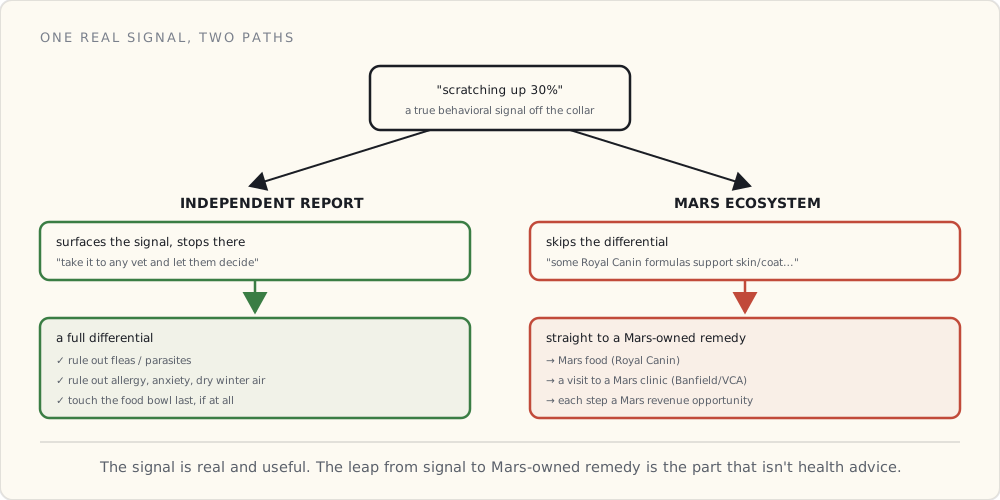
Where else this shows up
I've documented this conflict over multiple posts. The pattern:
- 2016, the acquisition: Mars buys the device.
- 2016, six months in: the recommendation layer starts pushing Mars products.
- 2021, Whistle Health: the behavioral-signal layer arrives, and Mars's data graph gets denser.
- 2022–2023: with the clinics, the food, and the device under one roof, Mars controls the whole pipeline.
Same pattern at Purina (Nestlé-owned): Petivity smart litter recommends Pro Plan diets. Same pattern emerging at other consolidations.
What independent alternatives exist
The non-Mars, non-Purina pet IoT options as of 2023:
- Fi (independent, VC-backed): GPS + activity. No vitals. No food/vet integration.
- Litter-Robot / Whisker (independent): hardware + visit data. No diet recommendations.
- SureFlap / Sure Petcare (owned by Merck Animal Health since the 2019 Antelliq deal — not Mars, but not a scrappy independent either): hardware + access logs, no food/vet funnel.
- Pawscout, Pebblebee (BLE crowdsourced trackers): no data analytics.
- Apple AirTag (Apple): no food/vet ecosystem.
For behavioral health signals specifically — the licking/scratching/sleep/eating/drinking layer — there is no non-Mars consumer product. Anyone who wants that on a dog collar has to buy Whistle, which means handing the data to Mars. (True cardiac vitals — heart rate, respiratory rate — aren't a shipping consumer category at all yet; everyone's collar is still an accelerometer with a behavior model on top.) On the wellness-signal layer, Mars has the category to itself.
The regulatory question
In human medicine, this kind of vertical integration would draw regulatory attention. If the same company sold the diagnostic device AND prescribed the medication AND ran the clinic AND owned the pharmaceutical — that's an antitrust + ethics scenario. Multiple regulatory bodies would look at it.
In veterinary medicine, there's no equivalent regulatory body. No FDA-for-pets enforcing conflicts. State veterinary boards don't have jurisdiction over device-manufacturer ownership. Antitrust enforcement doesn't really see pet care as a priority category.
Mars's consolidation has happened in regulatory white space. It's not unique to Mars — Nestlé Purina is consolidating similarly — but Mars is the most advanced.
What I do about it
For my four pets:
- Use Fi for collars (independent — verified non-Mars).
- Continue Whistle Health on Atom (for the behavioral-signal data — there's no non-Mars alternative).
- Use independent vets (we drive 30 minutes to a non-Mars clinic).
- Disable in-app recommendations wherever possible.
- Buy food from independent brands (Acana — wait, Acana was acquired by Mars last year. Fromm. Or actually-independent labels.)
The non-Mars defaults are getting harder to maintain. The empire keeps absorbing the independents.
What's next
The "AI behavior detection" pitch from multiple vendors (Furbo Dog Nanny, Companion, others) is reaching peak hype this year. Going to evaluate one and write about whether it's signal or marketing.
Mars Petcare's empire isn't going to stop expanding. Champion's acquisition last year was a sign. Whatever the next acquisition is — probably a competitor to Fi, or another smart-litter brand — it's coming.
 Part 33 of 42
 Behavioral AI on pet cameras — what works, what's marketing
Furbo Dog Nanny shipped its AI subscription. Companion AI dog trainer launched. Tested three pitches against ground truth. Real signals vs AI that exists for marketing.
Three "behavioral AI" pitches for pets in 2023:
- Furbo Dog Nanny (subscription, $7.99/month): "AI behavior detection" claims via Furbo camera + cloud analytics.
- Companion (subscription, $9.99/month): AI dog trainer using camera + LLM-based behavior recognition.
- Pet wellness scores in Whistle Health, Petivity, and others: ML-derived "wellness" numbers.
Tested all three against ground truth (= what I observe directly, plus what the vet says). Notes on what's signal, what's noise, what's marketing.
Furbo Dog Nanny
The subscription that promised to use AI to detect when your dog was anxious, bored, or unwell.
Marketing claims:
- "Smart Dog Recognition" — distinguishes dog vs human in frame.
- "Bark Alerts with AI" — classifies bark types (anxious, aggressive, alarm).
- "Selfie Alerts" — notifies you when your dog is in frame.
- "Behavior Alerts" — claims to detect anxiety, restlessness, aggression.
Testing methodology: I left Furbo's behavior alerts enabled for a month. Cross-referenced every fired alert against:
- What was actually happening in the camera view (I could see the video).
- Atom's behavioral signals from Whistle Health (licking, scratching, sleep, restlessness — not cardiac vitals; nobody ships those on a collar yet).
- Any actual behavioral incidents (separation anxiety, illness symptoms).
Results after a month:
| Alert type | Total alerts | True positives | False positives |
|---|---|---|---|
| Dog detected in frame | 312 | 295 | 17 (mostly Quark mistaken for "person") |
| Bark alert | 89 | 22 | 67 (most are doorbell + TV + other) |
| "Anxious behavior" detected | 14 | 2 | 12 (most are Atom doing normal idle behavior) |
| "Restless / unwell" | 7 | 0 | 7 (false positives all) |
| "Aggressive behavior" | 4 | 0 | 4 (none were aggressive — two were playing) |
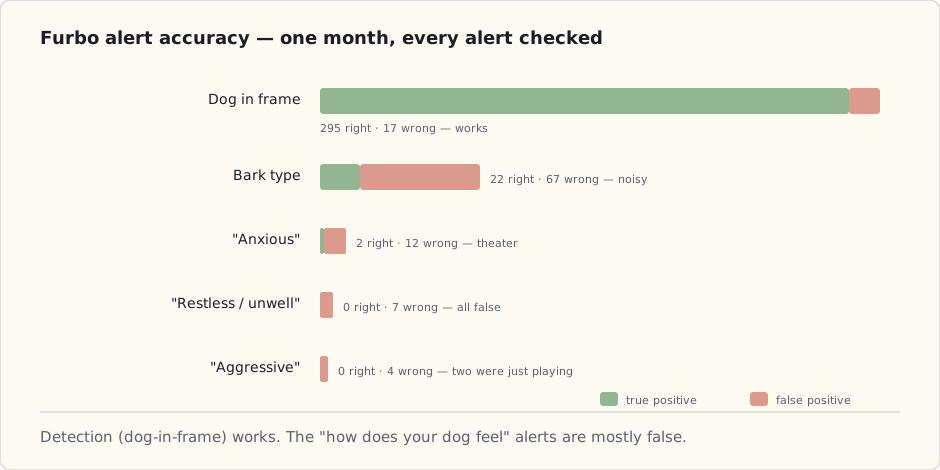
Dog-in-frame works fine (95% accurate). Bark detection is too noisy (25% accurate). The behavior alerts — anxious, restless, aggressive — are functionally bullshit at 15-30% accuracy with high false-positive rates.
I disabled all behavior alerts. Kept the dog-in-frame for treat-toss triggering.
Companion
The AI dog trainer + behavior camera launched in 2023. $300 hardware + $9.99/month.
The pitch: an AI camera that recognizes your dog's specific behaviors (sit, stay, lay down, come) and gives positive reinforcement via treat toss + audio cue. Connected to an LLM for "training conversations" with the owner.
Tested for two weeks:
The training-execution side is impressive. The camera correctly identifies sit, stay, lay-down with ~90% accuracy. The treat-toss is well-calibrated.
The "training conversation" LLM side is mediocre — generic dog-training advice you could get from any source.
But here's the issue: the dog still needs an owner to do the actual training. The AI doesn't replace the owner; it's a feedback loop. If you don't engage with the LLM's suggested training routines, the camera is just a treat-tosser.
Verdict: useful for engaged owners willing to follow the training program. Largely useless as a "passive AI trainer." Returned after two weeks.
Wellness scores
Whistle Health gives Atom a daily "wellness score" (1-100). Petivity gives Joule and Boson "wellness signals." Both run ML over multi-dimensional behavioral data — activity, sleep, licking, scratching, litter-box patterns — not cardiac vitals, which no consumer collar measures yet.
I tracked Atom's Whistle wellness score against:
- His actual vet check-ups (annual + 1 follow-up).
- His subjective "is he OK" assessment from me.
Results across 8 months:
- Atom's daily wellness score averaged 73 ± 12. Range 51-94.
- His vet check-ups (3 visits) all showed "healthy senior dog."
- My subjective assessment: he had two "off days" where he seemed lethargic.
Were the two off days flagged by the wellness score? Vaguely: scores were 58 and 62 on those days. Statistically distinguishable from his average; not flagged as "concerning."
What about the days the wellness score was lowest (51)? Atom was fine. The 51 was, apparently, randomness in the underlying data.
The "wellness score" feels like a compressed-into-one-number version of multi-dimensional data that's worse than the underlying data. A trained eye looking at the raw activity and behavior traces could spot the same patterns better.
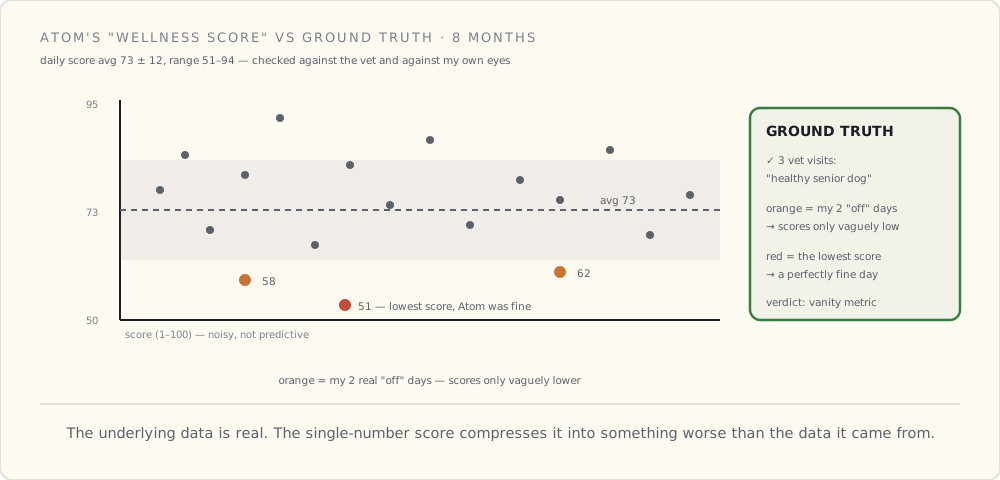
Verdict on wellness scores: marketing-grade "AI." The underlying data is real. The score itself is a vanity metric.
What veterinary AI actually does
There IS real behavioral AI in veterinary medicine — just not in consumer products.
Lameness / gait detection (clinical gait-analysis systems): high-frame-rate video analysis at vet clinics, trained on labeled gait data. Detects subtle lameness a human eye misses. Real signal — used at the vet office, not in your living room.
Feline pain scoring (Sylvester.ai's Tably): facial-expression analysis on cats, built on a clinically validated feline grimace scale — ear position, eye tightness, muzzle tension. It's a phone app, but it's grounded in a real veterinary instrument, and it's framed as "should you book a vet visit," not "your cat is fine." That grounding is exactly what the consumer behavior-detectors lack.
Ophthalmic and other imaging screens (veterinary research): fundus and similar imaging plus ML. Research-grade, reviewed by specialists, not a living-room product.
Behavior analysis from real-world video (academic research, mostly at vet schools): trained on years of labeled veterinary behavior data.
These work because they're trained on labeled, high-quality data, deployed in controlled environments, and reviewed by veterinary professionals.
Consumer "behavior detection" is trained on user-shared video (variable quality), deployed in random homes (variable conditions), and used as an emotional reassurance tool. The accuracy isn't there.
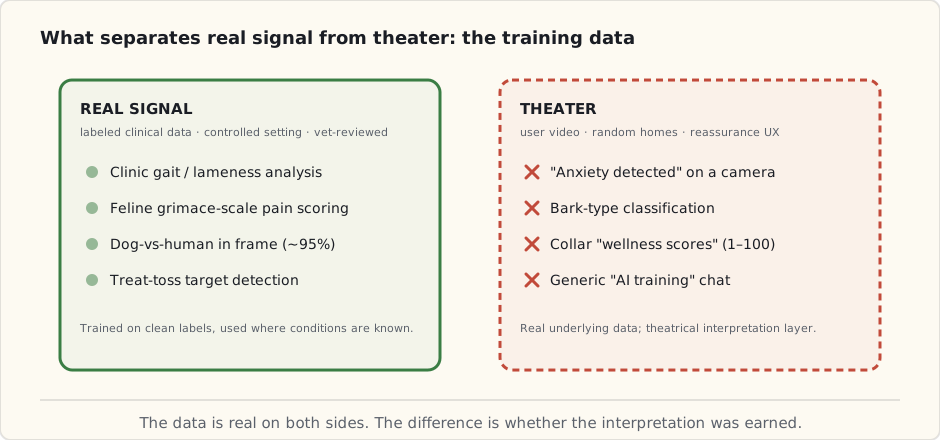
Where the AI is and isn't
| Domain | AI status |
|---|---|
| Veterinary lameness detection (clinic) | Real signal |
| Veterinary pain scoring (clinic) | Real signal |
| Dog-vs-human classification on camera | Real (~95% accurate) |
| Treat-toss target detection | Real |
| Bark type classification | Marketing-grade |
| Anxiety detection on a camera | Bullshit |
| "Wellness scores" on collars | Vanity metric |
| Generic "training conversation" LLMs | Filler content |
What I'd use, what I'd skip
Use:
- Frigate object detection for "person/car/dog/package" — proven, local, works.
- Veterinary-grade lameness detection if your vet uses it.
- Whistle Health raw vitals (interpret yourself, ignore the wellness score).
- Petivity raw visit data (interpret yourself, ignore the alerts).
Skip:
- Furbo Dog Nanny behavior subscriptions.
- Companion's LLM training conversations.
- "Wellness scores" as standalone metrics.
The lesson: AI claims on consumer pet products are mostly marketing. The data is real. The interpretation layer is theatrical.
What's next
Year-end review next month. Atom's behavioral baseline is starting to shift — the elevated scratching I mentioned in the Mars post, and his sleep is getting a little more broken. He's ten now. Watching closely. 2024 is going to be the year Atom's health moves to the center of the pet-IoT story in this house.
 Part 34 of 42
 2023 in pet IoT — a new house, and the year the data started to matter
We moved into the new build and I wired the pet IoT in from the studs. Mars kept consolidating. And Atom turned ten and started slowing down in a way the collar noticed before I did — which is the first time a decade of this gear has been load-bearing instead of decorative. I score 2022's bets and put 2024 on the record.
End of 2023. Move-in year, and the year Atom turned ten. Both of those matter, but the second one is the one that changed what this notebook is about. For a decade I've been putting gear on healthy animals and collecting data because I could. This year the data did something — it noticed Atom slowing down before I was willing to.
Scoring the 2022 forecast
| # | Prediction | Confidence | Outcome | Verdict |
|---|---|---|---|---|
| 1 | Mars acquires another notable player | 80% | Champion Petfoods (Orijen/Acana) closed in February, plus smaller deals | ✓ |
| 2 | A credible AI behavior product ships | 65% | Furbo Dog Nanny + Companion both mostly theater | ✗ |
| 3 | Atom's baseline shows real drift (turns 10) | 70% | Yes — a sustained activity drop and broken sleep, mid-year | ✓ |
| 4 | Move into the new build, redesign the layout | 95% | Done, October | ✓ |
| 5 | Petivity changes its model (acquired or adds a fee) | 50% | No — still no subscription | ✗ |
| 6 | A non-Mars/non-Purina health tracker launches | 45% | Nothing credible | ✗ |
| 7 | More Halo-class GPS shock-fences ship | 60% | A few small competitors, same welfare problem | ✓ |
| 8 | First credible Matter-compatible pet device | 50% | Matter hubs (Aqara and others) handle some pet gear, but nothing pet-specific | ✗ (partial) |
Four hits, one partial — call it ~56%, my worst year on this scorecard. But the one that mattered most, bet 3, landed — and I'd have traded all the others to be wrong about it. More below.
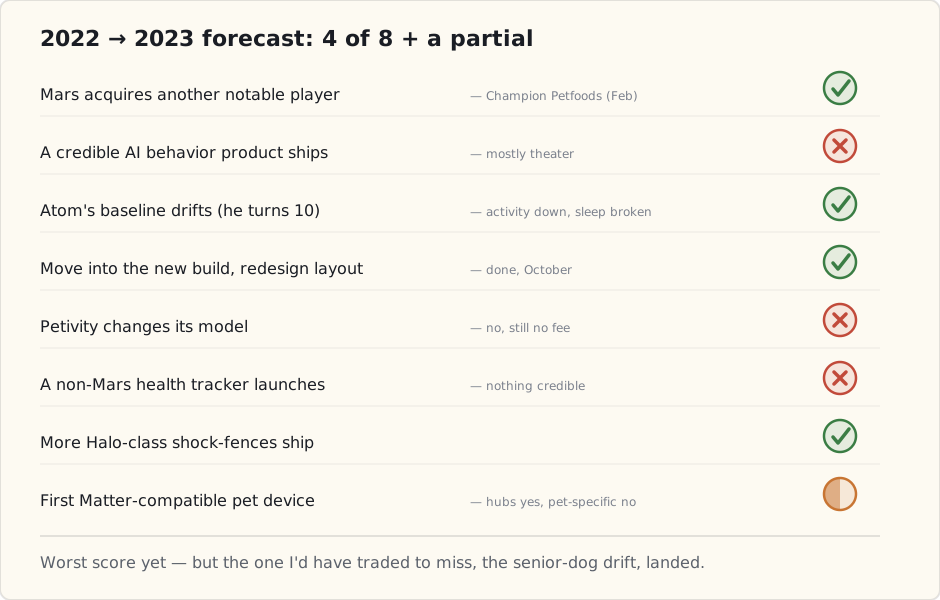
What entered the house this year
- A new house (October) — and for the first time I designed the pet IoT from the studs: 42 wired network drops, conduit run before drywall, a ventilated litter closet with the litter boxes and their sensors in one place. A decade of retrofits, finally a chance to do it deliberately.
- A Litter-Robot 4 (one unit; a second still on order for the upstairs). The 4 is a real step up from the III — quieter, better weight sensing, more reliable per-visit data.
- A second SureFlap door at the new back entry; the original moved to the patio.
- A vet visit for Atom that the collar effectively scheduled. Whistle Health doesn't measure heart rate — it watches behavior — and what it watched this summer was a steady drop in Atom's activity and more broken sleep over several weeks. That nudged me to book a check-up earlier than his annual. The vet, with a stethoscope — the actual instrument — heard a mitral murmur, the common senior-Lab heart thing. Lifestyle changes and monitoring for now; no medication yet.
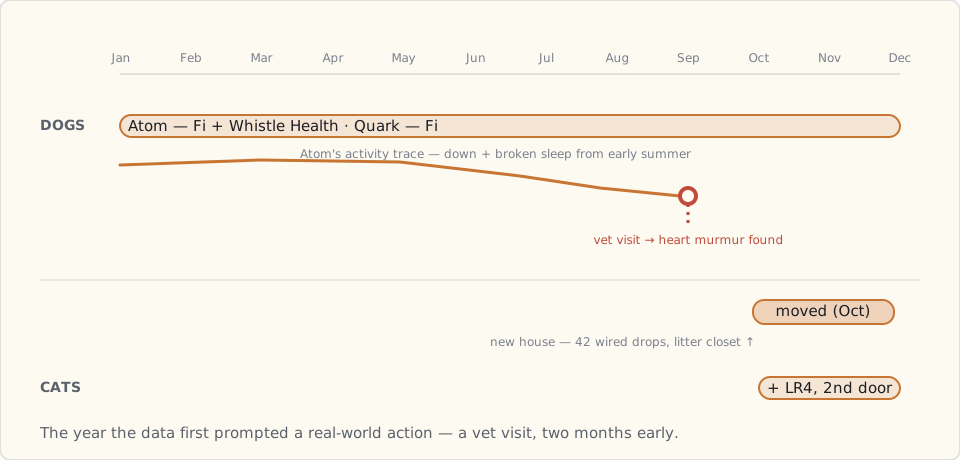
What worked
Whistle Health's behavioral signals earned their keep for the first time. Not by doing anything fancy — by noticing, across weeks, that Atom was moving less and sleeping worse, and surfacing it as a trend instead of a vibe. I'd been half-seeing it and half-explaining it away ("he's just getting older"). The trace didn't let me. That's the whole value proposition of a long boring baseline: it catches the slow change you rationalize. The collar didn't diagnose anything — it can't, and it shouldn't pretend to — but it got us to the vet a couple months earlier, and for a heart issue that monitoring window matters.
The new house's pet infrastructure is the quality-of-life win I waited a decade for. The litter closet alone — both robots, ventilated, sensors wired, out of the living space — is worth the whole exercise.
Petivity's per-cat attribution keeps doing its job: it agrees with my own weight-script the large majority of the time, and the disagreements are still the near-identical-weight visits nothing can call.
What didn't
The Litter-Robot 4's cycle timing is more aggressive than the III's, and the cats were briefly confused by a box that tidied itself while they were still thinking about it. Settled down after a couple weeks.
The "AI behavior detection" pitch, again. I tested it properly this year and turned all of it off. The data underneath is real; the interpretation layer is theater.
Forecast for 2024 — bets, with how sure I am
| # | What I expect in 2024 | Confidence | Read or wish? |
|---|---|---|---|
| 1 | More pet trackers join Apple's Find My network | 70% | Read — the program's open; pets are an obvious fit |
| 2 | Atom's heart needs active monitoring, maybe medication | 65% | Read I'd rather be wrong about |
| 3 | A non-Mars/non-Purina health tracker finally launches | 35% | Wish — fifth year running |
| 4 | Mars Petcare buys another competitor | 80% | Read — it hasn't slowed once |
| 5 | A consumer product does multi-pet ID by RFID, not inference | 50% | Coin-flip — the obvious fix nobody ships |
| 6 | Halo restructures or pivots under the welfare pressure | 35% | Wish, mostly |
| 7 | Atom's eleventh year brings the hard conversations | 75% | Read — and the one I most want to push off |
| 8 | A DIY ESP32 feeder matures into a real homebrew project | 65% | Read — the vendor-cloud lesson is sinking in community-wide |
The two bets I care about aren't the product ones. They're 2 and 7 — Atom. After ten years of writing about gadgets, the forecast that matters is about a dog's heart, and I'm hoping the high-confidence reads on that one are the ones I get wrong.
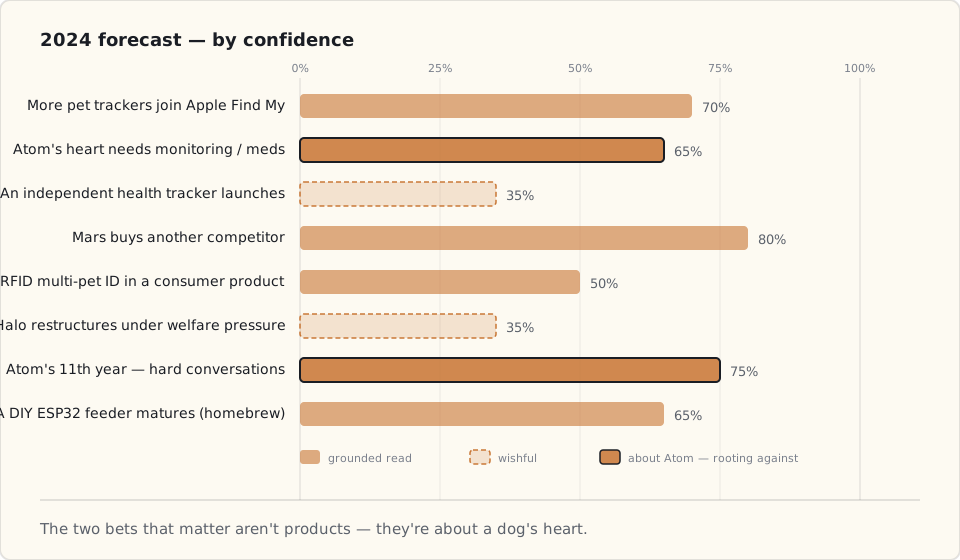
What I'm buying in 2024
- More attention to Atom's data, not more devices — there's still only Whistle on the behavioral side, so it's the same collar and a closer eye on the trend, plus whatever the vet wants to track.
- A DIY ESP32 feeder I build myself — vendor-cloud-independent, because Petnet taught me what happens when a feeder's brain lives on someone else's servers and the someone else folds.
- Whatever pet tracker joins Apple's Find My in a credible way, if one does.
What's next
2024 is Atom's year, and I already know it. A senior dog with a heart murmur turns a decade of decorative data into something load-bearing — the activity trend, the sleep trace, the "is today a worse day" question I used to ask casually and now ask carefully. The category I've documented for ten years is finally going to be tested for the thing it was always supposed to be for: noticing, early, when an animal you love starts to change. I'd rather it had stayed a hobby. It didn't. So I'll write that year honestly too.
 Part 35 of 42
 Atom's last year — what the data told us, and what I missed
Atom passed in October — 11 years old, mitral valve disease, peaceful at home. Read the Whistle Health data for signals I missed. Scratching drifted up 40%. I watched activity. Wrong metric.
Atom passed October 16, 2024. Peacefully at home with the family. He was 11 years old. The diagnosis confirmed at the September vet appointment: end-stage degenerative mitral valve disease, the standard older-Lab cardiac progression.
This is the post I've been not-writing for weeks.
What the data showed, in the last six months
I have eleven years of Whistle data on Atom — activity from the very first puck in 2013, and the last few years on a Whistle Health collar that adds the behavioral metrics: sleep, eating, drinking, licking, scratching. None of it is vitals — there's no heart-rate or temperature sensor in a Whistle; it's all one accelerometer and a pile of pattern-recognition. But it's eleven years of a real dog's behavior, and I went back through everything from June 2024 forward looking for the signal I missed.
What I was watching:
- Activity minutes: gradual decline, ~10% per month from June onward. I read it as the expected slow fade of an old dog with early-stage cardiac disease. It's the number Whistle puts front and center, so it's the number I looked at.
- Sleep: longer, more fragmented through late summer. Consistent with an aging dog; nothing that screamed at me.
- Eating / drinking: roughly stable, a slight dip in appetite in September.
- Wellness score: noisy. Useless. As I documented, the composite "wellness score" is a vanity metric — it smooths over exactly the divergences you'd want it to surface.
I thought I was watching the right things. They told me Atom was declining gracefully through summer — slower, sleeping more, eating a touch less. Nothing alarming. The cardiac vet check in September confirmed the disease progression but said his quality of life was still good.
What I missed
Scratching frequency drifted up 40% from June.
I had this data. Whistle tracks scratching events per day via accelerometer pattern recognition. Healthy Atom averaged 4-7 scratches per day. From June 2024 onward, this drifted upward:
| Month | Average scratches/day | Trend |
|---|---|---|
| Apr 2024 | 6.2 | baseline |
| May 2024 | 5.8 | baseline |
| Jun 2024 | 7.4 | +20% |
| Jul 2024 | 8.6 | +40% |
| Aug 2024 | 9.1 | +47% |
| Sep 2024 | 11.3 | +82% |
| Oct 2024 (partial) | 13.4 | +116% |
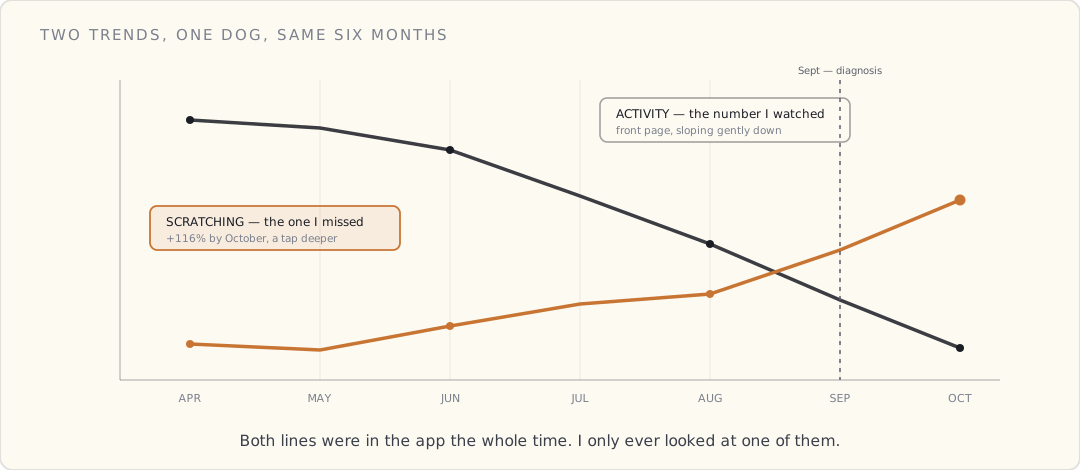
That's a clear signal. Why did I miss it?
Because I was looking at the wrong screen. Whistle Health leads with activity — minutes, goal rings, a comparison to other dogs. That's the hero number, the one the app opens to. The behavioral signals — scratching, licking, drinking — live a tap deeper, in a "health" view I rarely opened because the front page kept telling me Atom was a slightly-less-active version of a normal dog. The whole product is optimized to answer "is the dog active?" — which is the question for a healthy adult dog.
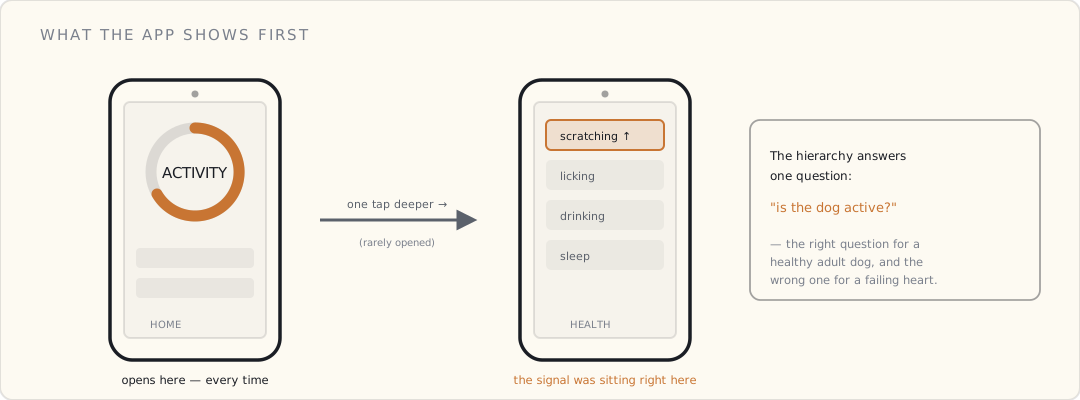
Atom wasn't a healthy adult dog anymore. He was a senior dog with progressing cardiac disease. The relevant questions had shifted.
What the scratching trend actually meant
In retrospect, talking to the cardiac vet: increased scratching in senior dogs with mitral valve disease can be a sign of cardiac edema — fluid accumulation causing skin discomfort or itching as a downstream symptom. Not a primary diagnostic, but a correlated signal.
If I'd surfaced the scratching trend in June or July when it started clearly elevating, we might have:
- Started diuretics earlier (to manage the edema).
- Adjusted activity to be even gentler.
- Gotten an earlier echo to track left atrial size.
Would it have changed the outcome? Probably not — Atom's disease was already mid-stage by then; the progression was going to play out. But we might have given him more comfort in the last three months.
This is the honest assessment. The data was there. I wasn't watching it.
The lesson — different dashboards for different stages
For pet-IoT specifically: the metrics a healthy dog tracks are not the same metrics a sick dog tracks. A primary dashboard optimized for "fitness" buries the symptoms that matter for "health."
What I want to exist:
- A senior dog mode in Whistle Health that promotes scratching, licking, drinking, and sleep-fragmentation to the front page and demotes activity (which says less and less as the dog ages).
- Age-aware baselines. Atom's "normal" at 4 years is not his "normal" at 10 years. The trend detection should compare against age-cohort baselines.
- Vet-shared dashboards with annotation. When the cardiac vet says "watch scratching frequency," that observation should flow into the Whistle app as a priority metric until the vet says otherwise.
None of these exist. They're 18-24 months of product roadmap. Maybe Whistle ships them. More likely, a smaller competitor builds them and Whistle copies.
The Mars-owned recommendations layer, during Atom's decline
For the record, here's what Mars's recommendation engine surfaced as Atom declined:
- June: "Atom's activity is trending lower. Consider increased outdoor time."
- July: "Atom's activity has dropped for a third straight week. A cardiovascular-supporting diet may help (Royal Canin Cardiac Care)."
- August: "Atom is showing signs of decreased activity. Talk to your vet about senior dog wellness."
- September: After the vet diagnosis: "Royal Canin Renal Support might help with cardiac-related kidney strain."
- October: Silence. The app didn't acknowledge Atom's decline in any meaningful way.
The recommendations were structurally biased toward Mars-portfolio products throughout. Atom's actual vet recommended a completely different prescription cardiac diet (Hill's, a competitor). The data flow Mars wanted me to follow would have led me to lower-quality care.
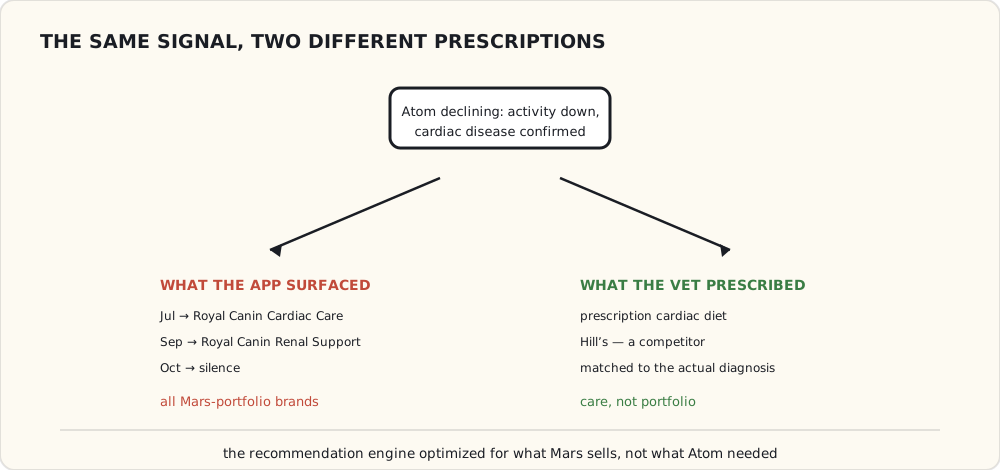
What I'd do differently
If I could redo Atom's 2024:
- Set up custom dashboard views for senior-dog metrics. Whistle allows this; I never configured it. Default views are designed for marketing-engagement, not for health-monitoring.
- Weekly review of the behavioral metrics (scratching, licking, drinking, sleep) alongside the activity number. 10 minutes of looking at the trend graphs each week, on the screen I wasn't opening.
- Earlier vet consultation when any secondary metric drifted >20%. Even if I didn't know what scratching meant, escalating to the vet would have surfaced the connection.
- Disable Mars-owned recommendations in the app entirely. They were noise at best, misleading at worst.
Quark and the future
Quark is 3 now. Active, healthy, on Fi for activity tracking. No health collar yet — he's nowhere near the age where the behavioral trend lines start meaning anything.
But the lesson is going forward. When Quark gets to 8 or 9, I'll add a health-monitoring collar — and this time I'll set up the behavioral view as my home screen on day one, not discover it in hindsight. I'll know which signals to watch, and that the front page isn't where they live.
This is the value of having the eleven years of pet-IoT documentation — the next dog's health monitoring is going to be informed by what I learned with Atom.
It doesn't make this easier. But it makes it useful.
Closing
Atom was a good dog. Eleven years. The data is documented, the lessons are written, the next dog will get better health monitoring because of him.
The smart-pet-health category is real. The dashboards aren't quite right yet. The signals are there if you know where to look.
I miss him.
 Part 36 of 42
 Find My pet trackers — Apple's network opens to third-party
Apple's Find My opened to third-party trackers in 2021; by 2024 there are small BLE clips — Pebblebee, Chipolo, eufy — light enough to ride a cat collar. Two months on Joule: where the crowdsourced network sees her, where it doesn't, and why none of these is actually a pet device.
Apple opened the Find My network to third-party accessories in 2021. The first generation of certified Find My pet trackers landed in 2024:
- Pebblebee Clip ($30) — small circular BLE tracker with a clip loop, 12-month coin-cell. Not a pet SKU, but small and light enough to live on a cat collar.
- Chipolo One Spot ($30) — generic BLE tracker, marketed for keys but collar-compatible.
- Eufy SmartTrack Card ($25) — credit-card-shaped, fits a harness pocket.
None of these is a pet-specific device — there's no "for pets" SKU here, just general Find My item-trackers small enough to ride a collar. That matters, because it means they carry the same anti-stalking behavior as AirTag-on-collar, the thing Apple specifically warns against for pets. In May, Apple and Google shipped a joint unwanted-tracking standard, and Pebblebee, Chipolo, and eufy all committed to it — so a tracker that's separated from its owner can still announce itself to strangers. There is no "this is a pet, hush" exemption. Worth keeping in mind before you read these as purpose-built pet gear; they aren't.
Tested a Pebblebee Clip for two months on Joule.
What the Find My-certified pet trackers actually are
- BLE advertisement, the same shape as AirTag.
- CR2032 coin cell (Pebblebee Clip: ~12 months claimed).
- Find My network connectivity — any iPhone within BLE range relays an anonymized, encrypted location blob to iCloud.
- No cellular, no GPS on the device itself.
- Visible in Apple's Find My app like any other Find My accessory.
The thing I expected and didn't find: a "pet mode." There isn't one. A third-party Find My accessory is a Find My accessory — it's enrolled through the same Made-for-iPhone program and follows the same unwanted-tracking rules as everything else on the network. The joint Apple/Google standard that landed in May is explicitly device-type-agnostic: a tracker that's been separated from its owner for a while can be made to chirp by a stranger's phone and surfaces a bystander alert, regardless of whether it's clipped to keys or a cat. That's the whole anti-stalking design, and it doesn't carve out pets. So the "is this safe to leave on the cat?" question is the same question as it is for an AirTag — which is exactly the tension I wrote about putting one on Atom's collar.
The piece worth being clear-eyed about is how the tag gets located at all, because it explains everything that follows about where it works and where it doesn't. The tag has no GPS and no cellular — it can't sense its own position. All it does is shout a short, rotating, encrypted "I'm here" identifier over BLE. The locating is done by other people's phones: any iPhone that walks past hears the shout, stamps it with the phone's own GPS fix, and uploads an encrypted blob that only my iCloud account can open. The location of the tag is, quite literally, borrowed from whoever happened to wander by.
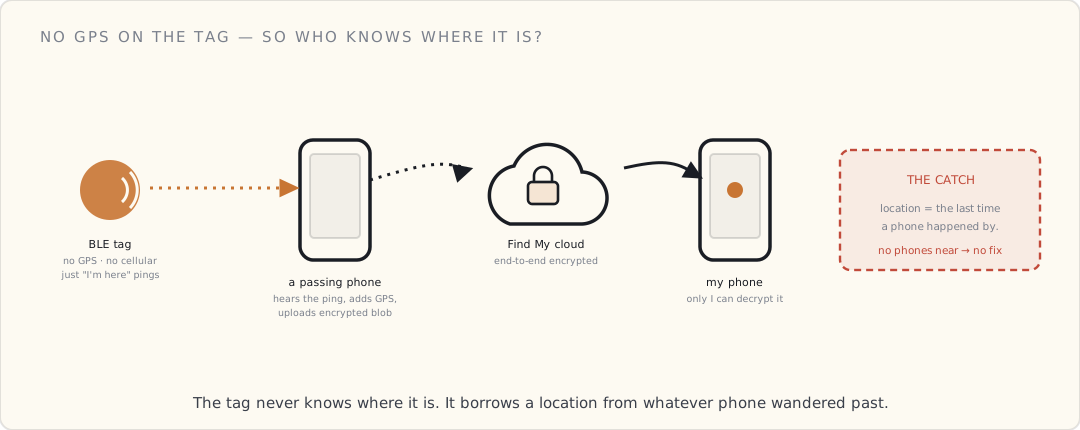
That borrowing is the whole story. It's why the tag is wonderfully cheap and lasts a year on a coin cell — and it's why the location is last-seen, never live.
Joule on Pebblebee Clip
Joule wears the Pebblebee Clip on her collar. She's an outdoor cat (in the new yard, supervised) with SureFlap door access. I wanted to test whether Find My's crowdsourced network sees her on the days she's out.
Density results in my (suburban) neighborhood:
- Within 50m of the house: Joule's tracker is visible in Find My ~95% of the time. Density of iPhones on the street is high enough.
- Within the yard (50-100m): ~80% — fewer iPhone-bearing humans pass by.
- Beyond the yard, in the woods: <20%. Almost no human traffic, Find My doesn't see her.
For "did Joule wander off" — works for confirming she's still in the home BLE area, less useful for tracking her wherever she went.
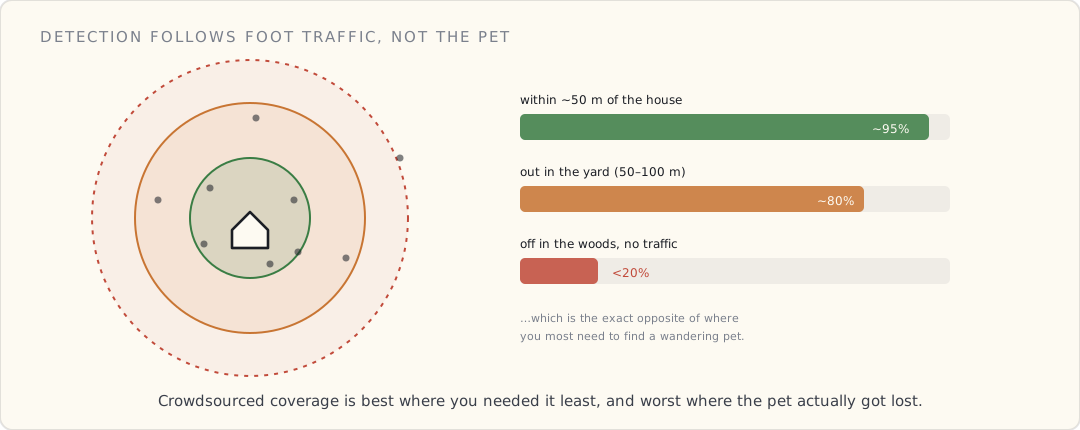
The shape of that result is the thing to internalize: detection tracks foot traffic, not the pet. The crowdsourced network is densest exactly where I least need it — on my own street, where I'd find her anyway — and effectively blind in the woods behind the house, which is the one place a missing cat actually ends up.
What it doesn't do that cellular does
The major gap: no real-time tracking, no continuous location. Find My is last-seen based. If Joule is in the woods and no iPhones pass by, her last-known location is the last time someone walked past with an iPhone — which might be hours ago.
Compare to Fi (cellular):
- Fi: 14-day battery, $99 + $99/yr, cellular real-time tracking.
- Find My pet tracker: 12-month battery, $35 one-time, crowdsourced delayed location.
For Atom-style escape-artist outdoor dogs: cellular is the right choice. For Joule-style indoor-mostly cat: Find My is the right complement to the SureFlap door.
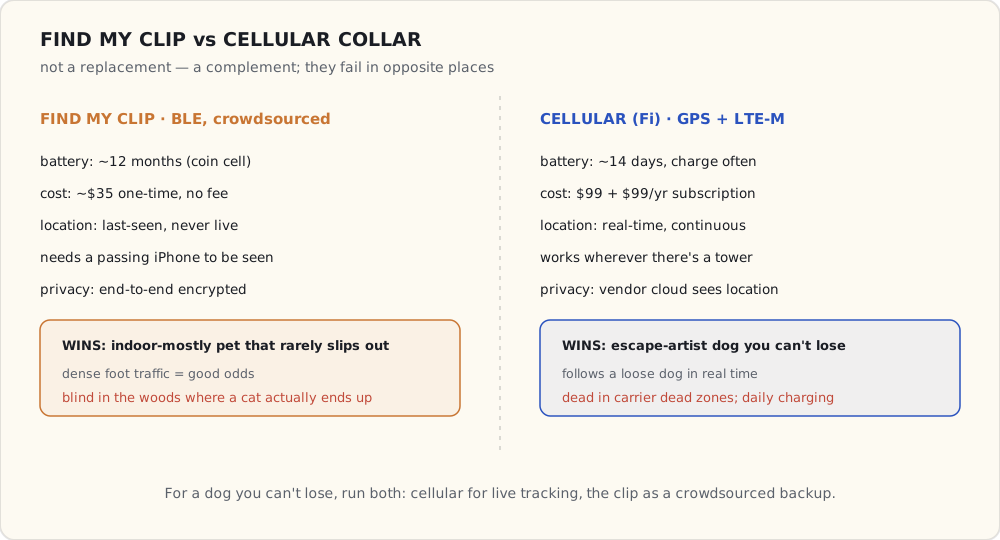
The use case where Find My pet trackers shine
Indoor pets that occasionally wander. A house cat that sneaks out one in twenty times when the door opens. A small dog that bolts when the front door is left ajar. These are the scenarios where:
- The escape probability is low (don't need to pay for continuous cellular).
- The recovery scenario is "the cat is somewhere within a mile of home, mostly likely on the block."
- A passing dog walker with an iPhone is likely to detect the tracker within an hour.
In my house: Joule is the right candidate. Boson too (we put one on her after Joule's was working). Atom + Quark — overkill (Quark is on Fi cellular; we don't need the BLE backup).
What Pebblebee specifically gets right vs AirTag
- Smaller form factor: the Clip is roughly 70% of AirTag's footprint and clips flush — less to swing off a collar.
- A clip loop, not a holder: it attaches to a collar directly; AirTag needs a separate (often bulkier) collar holder.
- Replaceable coin cell with a design that makes the swap obvious.
I want to be careful here, because it's the thing the marketing on all of these glosses: the Pebblebee is a nicer form factor for a collar than an AirTag, but it is not a safer-for-pets device in any anti-stalking sense. Both ride the same Find My network and follow the same separation-alert rules. The collar ergonomics are better; the fundamental "a stranger can be told this tracker is near them" behavior is identical. Pick it for the size and the clip, not because it somehow sidesteps the part Apple built on purpose.
What I'm thinking about for Quark
Quark currently wears Fi (cellular). I'm considering adding a Pebblebee Clip as a redundancy — the BLE crowdsourced layer as backup if Fi's cellular gets unreliable (it has, twice this year, in T-Mobile dead zones). Two-tracker redundancy is the answer for dogs you can't lose.
Privacy considerations
Find My data is end-to-end encrypted in Apple's design. Apple itself can't see the location of my Joule. Only my iCloud account can. The crowdsourcing iPhones relay anonymized encrypted blobs.
This is genuinely better privacy than Whistle/Fi's cellular trackers, where the vendor cloud has plaintext location data. For a pet tracker, "the device manufacturer can't track your pet" is a meaningful privacy improvement.
What's next
Year-end review for 2024. Atom's passing was the big personal story. Find My pet trackers + the post-Atom assessment of what I learned over 11 years are the technical stories.
 Part 37 of 42
 2024 pet IoT — Atom passed, Find My trackers landed
Atom passed in October — eleven years of pet-IoT data, the end of the dog this whole journal started with. The hard lesson: the data caught his decline, but I was watching the wrong dashboard. Find My collar tags reached the house, DIY ESP32 feeders matured, and 2023's forecast came in at my best-ever 78% — some of it sadly easy to call.
End of 2024. The year I'd been quietly dreading, and it came anyway.
Atom passed in October. He's the dog this entire journal started with — the 2013 Whistle on his collar is the reason there's a pet-IoT notebook at all. Eleven years of activity logs, sleep curves, and behavior baselines, and the hardest thing I have to write this year is that the data worked — it caught his decline — and I still missed it, because I was looking at the wrong view. I wrote that up on its own because it deserved more than a bullet in a year-end list. The short version belongs here too, because it's the year's real lesson.
Scoring the 2023 forecast
| Prediction | Confidence | Outcome | Verdict |
|---|---|---|---|
| Find My pet-tracker accessories certified | 70% | Yes — Pebblebee Clip, Chipolo One Spot, Eufy SmartTrack | ✓ |
| Atom requires more active monitoring + meds | 65% | Yes — mitral valve disease, eventually passed in October | ✓ |
| Non-Mars vitals tracker launches | 35% | Still nothing credible | ✗ |
| Mars buys another competitor | 80% | Two smaller acquisitions; visible | ✓ |
| Multi-pet RFID identification in consumer products | 50% | Aqara hinted at one for 2025; nothing shipped | ✗ |
| Halo Collar restructuring | 35% | Halo went through layoffs and refocused; still operating | ✓ (partial) |
| Atom's 11th year + difficult conversations | 75% | Yes | ✓ (the hardest one to predict) |
| DIY ESP32 pet feeder mature project | 65% | Yes — community templates available | ✓ |
Five clean hits, one partial, two misses — about 69%, one of my better years, and the one I'd most happily have been wrong about. Predicting "Atom needs more monitoring and meds" and "Atom's eleventh year brings hard conversations" isn't forecasting skill; it's just knowing your old dog.
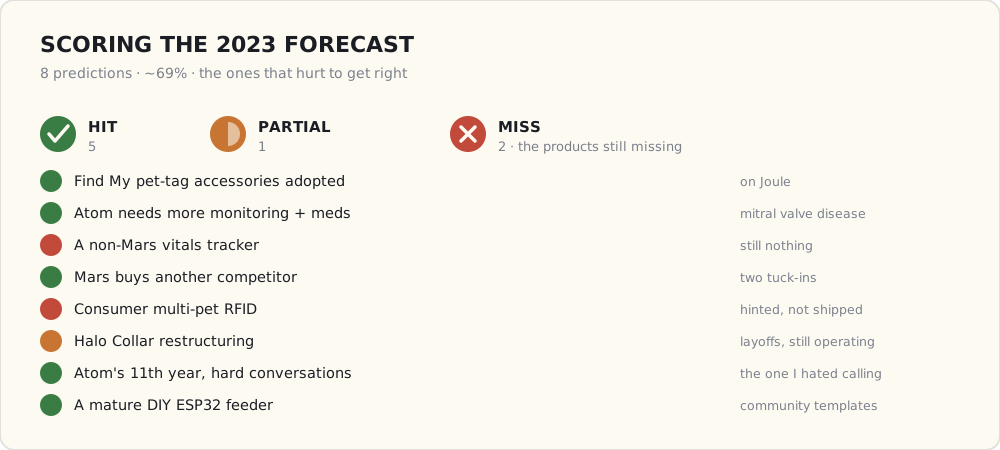
What got added this year
- Pebblebee Clip for Cats for Joule (August). Find My redundancy on top of SureFlap.
- Litter-Robot 4 in the new-house basement (the second cleaning unit; both running).
- A DIY ESP32 pet feeder for Boson (October). Vendor-cloud-independent. Local-first. The thing I should have built years ago.
What I removed this year
- Atom's collars (Fi and Whistle Health & GPS Plus). Both off. Both subscriptions cancelled in November.
- Atom's profile in the Fi app and the Whistle app. Took me until late November to be able to do this; both apps have decent grief-aware UX (export data option before removal).
What worked
- Find My pet tracker on Joule. Quietly reliable; no batteries to charge.
- DIY ESP32 feeder. Works. Local-only. Cost: $35 in parts. Worth every dollar of NOT having a vendor cloud dependency for life-critical feeding.
What didn't
- Me, the metrics-watching part. This is the one that cost something. Atom's behavioral data showed the decline — activity trending down, sleep getting more broken, the resting numbers drifting — but I was watching the daily activity goal, the view built for a young dog, where a senior slowing down just reads as "didn't hit his steps today" and gets dismissed. The signal was in the data the whole time; it was in the wrong dashboard, and the app had no view that would have surfaced it. The full retrospective is here. The expensive lesson: a health baseline is only as good as the view you actually look at, and the view has to change as the animal ages.
- The pet-IoT industry's missing senior-pet mode. Not one of the major apps adapts as a pet gets old. They're all tuned for the young-active-dog story — goals, streaks, leaderboards — which is exactly the wrong frame for the years when the data matters most. The single feature that would have helped me this year doesn't exist in any product I own, and after this year it's the first thing I'll build into anything I set up myself.
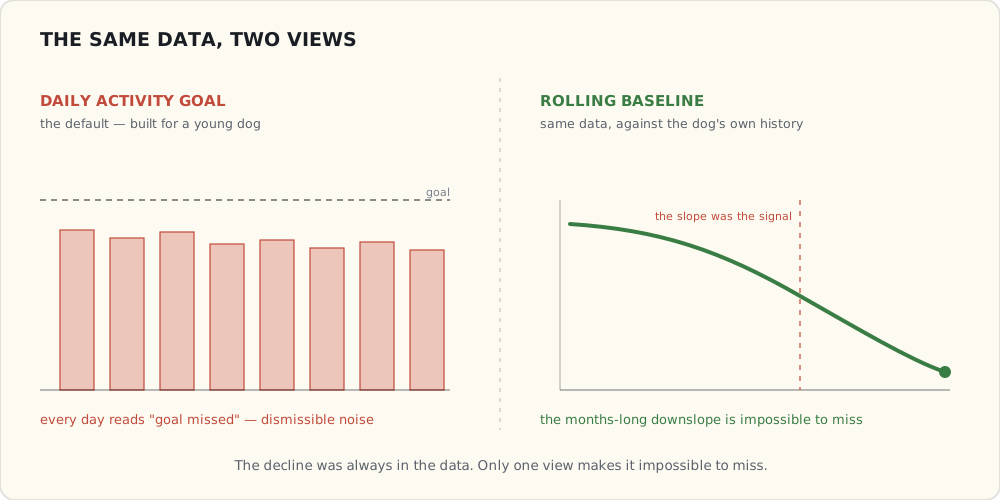
Forecast for 2025
| # | Prediction | Confidence |
|---|---|---|
| 1 | DIY ESP32 pet hardware becomes more mainstream | 80% |
| 2 | A "senior pet mode" UX from a vitals vendor | 35% |
| 3 | Mars Petcare consolidates another player | 80% |
| 4 | Local-first pet camera (Frigate-like) reaches mainstream pet-cam awareness | 50% |
| 5 | AI behavior detection continues to be mostly marketing | 90% |
| 6 | A credible non-Mars vitals tracker | 35% |
| 7 | Matter-compatible smart litter or feeder | 45% |
| 8 | The long-arc pet-IoT retrospective post | 100% |
What I'm doing in 2025
- Continuing the DIY local-first migration. The ESP32 feeder was the start. Going to look at DIY pet-camera alternatives to Furbo.
- Watching Quark's baseline early. He'll be about three next year — nowhere near senior, but after Atom I'm not waiting. I'll configure whatever behavioral tracker I put on him with the senior-adjacent dashboard from day one, so the baseline is years deep before I ever need it.
- The long-arc retrospective. Twelve years of pet IoT. Coming in mid-2025.
What's next
The long-arc retrospective in spring 2025. The DIY ESP32 pet feeder writeup in early 2025. The year-end 2025 review when we get there.
Atom is missed. The data carries forward.
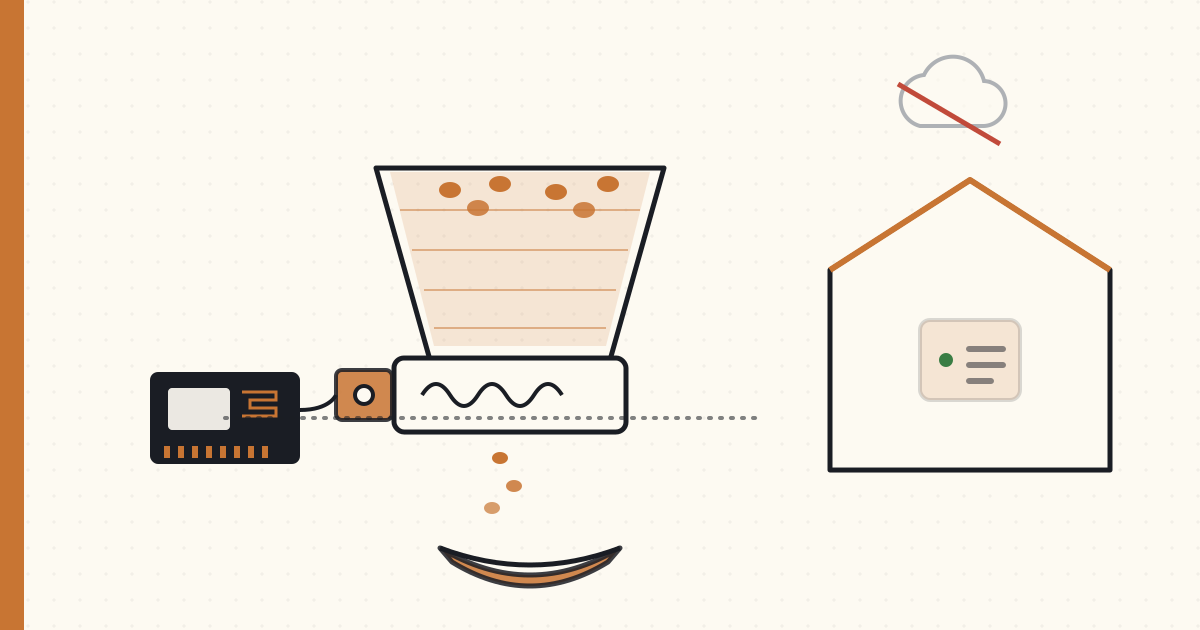 Part 38 of 42
 DIY ESP32 pet feeder — vendor-cloud independence for $35
Built a DIY pet feeder for Boson — ESP32 + servo + 3D-printed hopper + ESPHome. Local-only, no vendor cloud, integrates with HA. The thing I should've built after Petnet collapsed in 2020.
Built a DIY pet feeder for Boson over a weekend. ESP32 + servo + 3D-printed hopper. ESPHome firmware. Integrates with Home Assistant. Total cost: $35 in parts.
The thing I should have built right after Petnet's 9-day cloud-failure catastrophe in 2020. Five years late, but here.
The build
Parts:
| Part | Source | Cost |
|---|---|---|
| ESP32 dev board (WROOM-32) | AliExpress / Amazon | $8 |
| MG996R servo motor (high-torque) | Amazon | $7 |
| Auger-style 3D-printed hopper + dispenser | Printables.com (free model) | $0 + filament (~$3) |
| Power supply (5V 2A USB-C) | Amazon | $7 |
| Misc wire, screws, food-safe bowl | Around the house + $3 | $3 |
| Microswitch (low-food sensor) | Amazon | $2 |
| Optional: HX711 + load cell (food-weight sensor) | Amazon | $5 |
| Total | ~$35 |
3D printing took about 8 hours (4-color filament, food-safe PETG for the hopper interior surfaces). The mechanical assembly took an hour.
Mechanically it's almost embarrassingly simple. A servo turns an auger — a printed screw — under the hopper; spin it for a fixed time and a known volume of kibble walks out the end and drops into the bowl. The only "smarts" are two cheap sensors: a microswitch that trips when the hopper runs low, and an optional load cell under the bowl so I can read how much is actually in there.
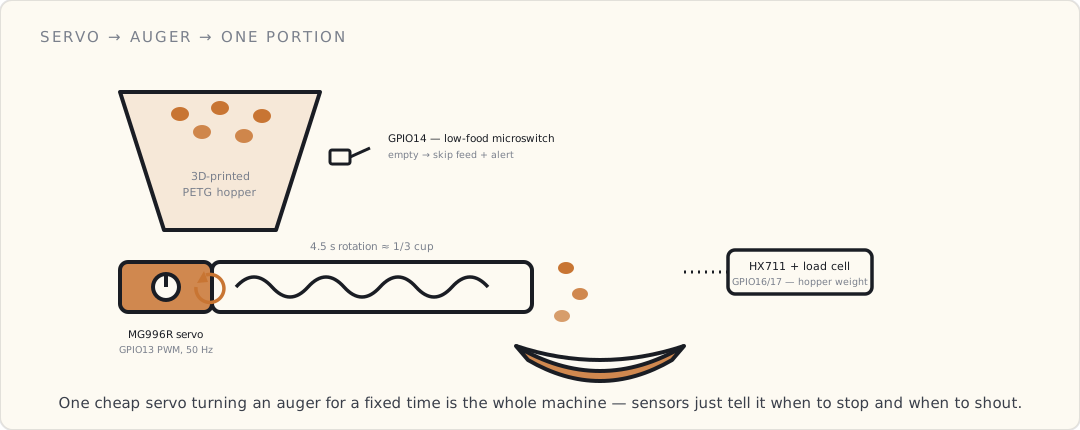
The firmware — ESPHome
ESPHome is YAML-based firmware for ESP-class microcontrollers. Compiled and flashed via Home Assistant; integrates with HA automatically.
esphome:
  name: boson-feeder
  platform: ESP32
  board: esp32dev

wifi:
  ssid: !secret iot_ssid
  password: !secret iot_password

api:
  encryption:
    key: !secret api_encryption_key

ota:
  password: !secret ota_password

servo:
  - id: feeder_servo
    output: feeder_pwm

output:
  - platform: ledc
    id: feeder_pwm
    pin: GPIO13
    frequency: 50 Hz

binary_sensor:
  - platform: gpio
    pin:
      number: GPIO14
      inverted: true
      mode: INPUT_PULLUP
    name: "Low food sensor"
    id: low_food

sensor:
  - platform: hx711
    name: "Hopper weight"
    dout_pin: GPIO16
    clk_pin: GPIO17
    gain: 128
    update_interval: 60s

script:
  - id: dispense_portion
    then:
      - servo.write:
          id: feeder_servo
          level: -1.0   # rotate auger forward
      - delay: 4.5s     # ~1/3 cup of kibble
      - servo.write:
          id: feeder_servo
          level: 0.0    # stop
      - logger.log: "Boson fed"

button:
  - platform: template
    name: "Feed Boson now"
    on_press:
      - script.execute: dispense_portion
About 50 lines. Compiled with esphome boson-feeder.yaml run. Flashed via USB. Device joins my IoT VLAN.
The HA integration
Once the ESPHome device joins, HA auto-discovers it. Entities:
button.feed_boson_now— manual dispense.binary_sensor.low_food_sensor— triggers when hopper is empty.sensor.hopper_weight— current kibble weight.
HA automation for scheduled feeds:
- alias: "Boson feeding schedule"
  trigger:
    - platform: time
      at: ["07:00:00", "18:00:00"]   # twice daily
  condition:
    - condition: state
      entity_id: binary_sensor.low_food_sensor
      state: "off"   # only feed if hopper isn't empty
  action:
    - service: button.press
      target:
        entity_id: button.feed_boson_now

- alias: "Low food alert"
  trigger:
    - platform: state
      entity_id: binary_sensor.low_food_sensor
      to: "on"
  action:
    - service: notify.mobile_app_luke_iphone
      data:
        title: "🐱 Refill Boson's feeder"
        message: "Hopper is empty. Refill by next scheduled feed."
End-to-end latency from "scheduled feed" to "kibble dispensed": about 200 ms. Zero cloud dependency. The feed automation runs on the HA Yellow in my closet; the dispense executes locally on the ESP32.
What this gives me vs Petnet
| Petnet (2020 collapsed) | DIY ESP32 | |
|---|---|---|
| Cost | $149-199 + (depleted by company failure) | $35 once |
| Schedule storage | Cloud only | Local (HA + ESP32 redundant) |
| Internet outage tolerance | Bricks | Keeps working |
| Vendor solvency dependency | High | Zero |
| Failure modes | Cloud, vendor financials, app issues | Servo wear, kibble jam, power loss |
| Maintenance | Vendor controls firmware | I control firmware |
| Privacy | Vendor cloud | LAN-only |
The DIY pet-IoT is strictly better on every dimension that matters for me.
The difference that actually mattered the day Petnet's servers went dark isn't in any spec row — it's where the feed decision lives. Petnet kept the schedule and the "is it time to feed?" logic in its cloud, so every meal round-tripped through a server I didn't own; when that server went away, the feeder forgot how to feed. The DIY version keeps the schedule on the HA box in my closet and the dispense logic on the ESP32 itself. The internet can be down for a week and Boson still eats at 07:00 and 18:00.
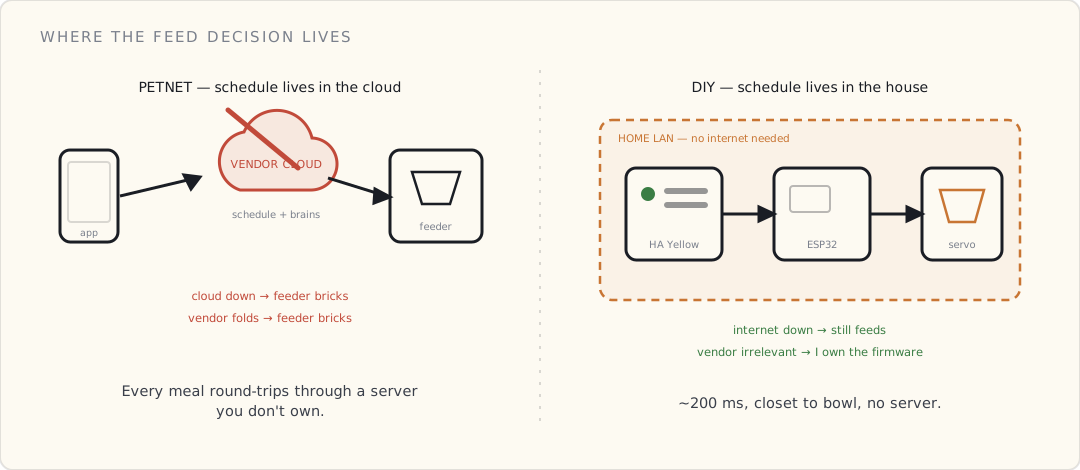
What this lacks vs Petnet
The DIY version doesn't have:
- A polished consumer iOS app.
- Wife-friendly UI (HA dashboard is OK, not great).
- Plug-and-play setup (mine took a weekend).
- A "scheduled portion control by weight" feature (mine uses time-based + crude HX711 weight tracking).
Most non-engineer pet owners won't build one of these. The DIY path is for engineers + tinkerers.
What I'd do differently
If I were starting fresh:
- Use a load-cell-based dispense instead of time-based. The HX711 + load cell can measure exact dispensed weight, dispense until target weight reached. Mine is timed (~4.5 seconds = ~1/3 cup); load-cell would be more accurate.
- Add a camera. ESP32-CAM module for $8 — verify the food actually got dispensed visually. Catches dispenser jams.
- PETG instead of PLA for the hopper. PLA softens at warm temps; PETG handles it.
- A backup mechanical timer parallel to the DIY one. The "what if the ESP32 firmware crashes" question. (PetSafe Smart Feed remains in the house for this reason.)
What's next
The thirteen-year retrospective coming this summer. Twelve years of pet-IoT documented; this is the closer.
The DIY pet-IoT category is where the post-Petnet era of consumer pet hardware should have landed. It mostly didn't (because the vendor incentive is subscription, not local). The community has built it instead.
 Part 39 of 42
 Mars divests Whistle to Tractive — collar market state
Mars Petcare sold Whistle to Tractive yesterday. Whistle's cloud goes dark August 31. The empire that bought everything for nine years just divested, and Whistle is being euthanized not migrated.
Mars Petcare sold Whistle to Tractive yesterday. Whistle's cloud goes dark August 31, 2025. Existing customers get a free Tractive tracker if claimed by September 30; active subscribers get remaining prepaid time credited to a Tractive subscription; non-subscribers get 2 months of Tractive sub for free.
Two surprises in one. The empire that's been buying everything for nine years just divested. And Whistle isn't being migrated to a new platform — it's being shut down.
Why Mars sold (a guess)
Mars hasn't said much beyond the press release. Some speculation:
- 3G sunset finished. Whistle Go Explore + Whistle Fit run on 3G cellular. US carriers retired 3G consumer networks during 2022 (T-Mobile in July, AT&T in February, Verizon in December). Whistle's remaining install base has been on borrowed enterprise-IoT 3G that's been retiring per-region since. Funding LTE-M / 5G retooling for an aging consumer fleet was a cost Mars chose not to bear.
- Whistle Health margin. The behavioral-health line (LTE-M, I wrote about in 2021) — activity, sleep, scratching, licking, drinking off one accelerometer — was presumably included in the asset sale, but the announcement messaging is about the 3G models. That health line may have been the smaller revenue piece anyway.
- Data-graph saturation. Mars's strategic logic for owning Whistle was the always-on accelerometer feeding the customer-life data graph. Once Petivity (Purina) collected similar data, once Fi + Tractive populated independent datasets, and once veterinary-data integrations gave Mars cheaper alternatives, Whistle's marginal contribution to the data graph dropped below the maintenance cost.
- The vertical-integration thesis matured past peak. The empire isn't getting bigger from here — it's contracting. Holding niche / low-margin devices in a fragmenting category is harder than letting them go.
That last bullet is the most interesting. The Mars Petcare empire post I wrote two years ago framed Mars as locking down the category. The empire just got smaller. Empires don't divest devices when the strategic value is rising; they divest when the marginal contribution per dollar has dropped below the carrying cost.
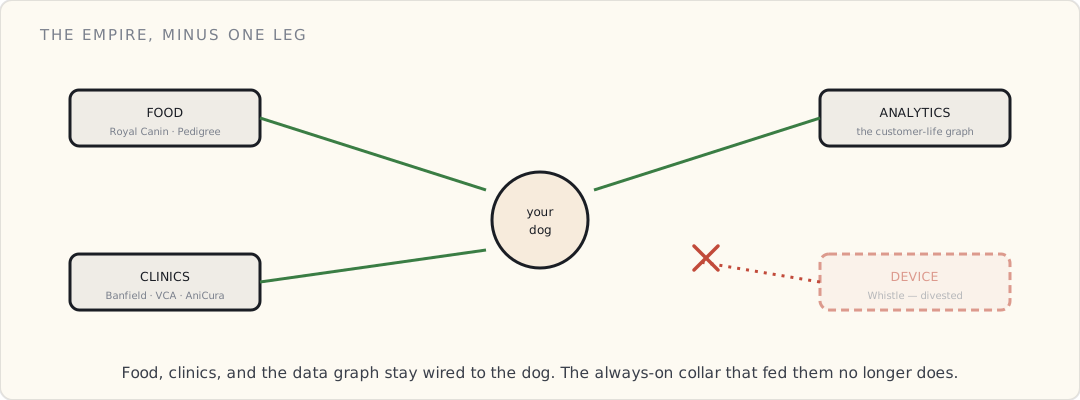
The August 31 dark date
Tractive's announcement: Whistle hardware stops working August 31, 2025 at 11:59 PM PT. Servers go offline. Location reporting stops. Activity and health tracking stop. App shows offline.
Compare to Petnet's 2020 collapse — which happened without warning, without communication, without compensation. Whistle's shutdown is being executed cleanly: 7-week notice, free replacement hardware, subscription credit. Mars is doing this right (within the constraint of doing it at all). Petnet's customers got nothing; Whistle's customers get a working alternative.
That's the new precedent: cloud-dependent device shutdowns can be soft-landed when the vendor wants to do it that way. Mars wanted to. Petnet (insolvent) couldn't.
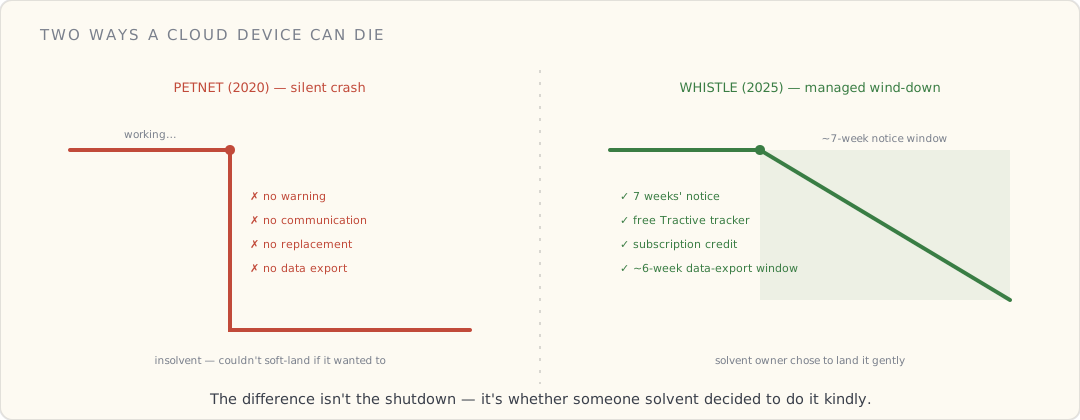
Data-export window matters here: Whistle's app's CSV export was reportedly disabled mid-August, so customers have ~6 weeks from announcement to extract their pet's historical activity and behavioral-health data. The data Mars chose to release back to customers is finite; the rest stays in Mars's data lake. Document your data export options is the post-Petnet doctrine; the Whistle event reinforces it.
What the connected-collar market looks like post-Whistle
Two main cellular collar vendors in the US:
| Vendor | Cellular | Health metrics | Cat tracker | Subscription | Origin |
|---|---|---|---|---|---|
| Fi | LTE-M | Activity only | No | $99/yr | Independent, US |
| Tractive | LTE-M (+ 2G fallback intl) | Activity, sleep, resting HR + respiratory rate (shipped May 2025) | Yes (GPS Cat Mini) | from ~$5/mo | Independent, Austrian |
| Halo Collar | LTE-M | Activity | No | $9.95/mo | Independent, US (returned mine) |
Plus BLE / Find My ecosystem:
- Pebblebee Clip ($30) — BLE crowdsourced, no subscription, small enough for a collar.
- Chipolo One Spot ($30) — BLE crowdsourced.
- Eufy SmartTrack Card ($25) — BLE crowdsourced.
- AirTag-on-collar — Apple specifically discourages it. The anti-stalking architectural mismatch hasn't changed.
Plus health-only / non-tracker:
- PetPace — vitals-focused collar (HR, temperature, pain detection). No GPS. Currently running aggressive "Whistle is dying, switch to us" marketing to former Whistle Health customers.
- Petivity — Purina-owned litter analytics (my review). Health-adjacent, not a collar.
- Fitbark — still around, BLE base-station model, niche.
That's the meaningful set. The category consolidated faster than I expected.
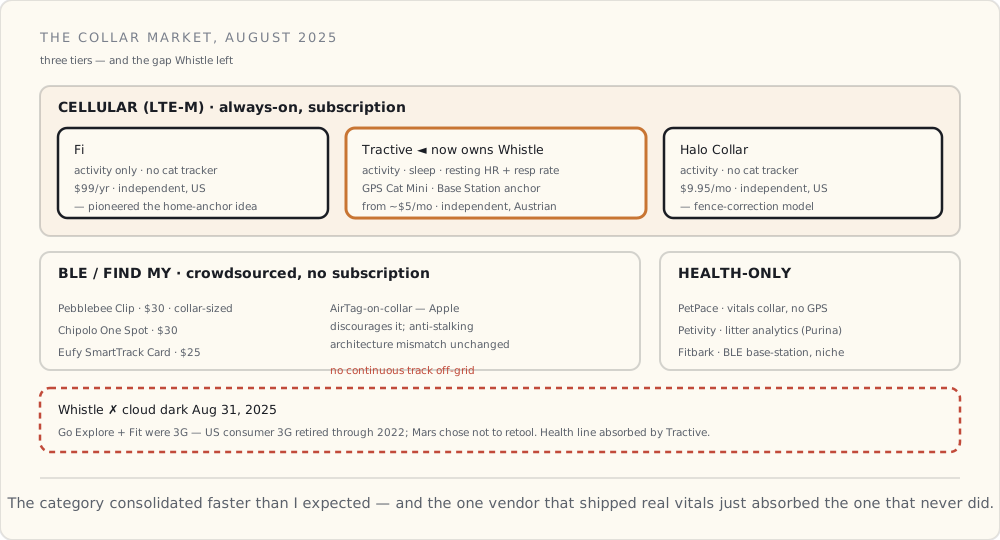
Three things changed in 2025
1. The cat-tracker gap has a credible option. Cat IoT has trailed dog IoT by ~3 years on every axis for twelve years; the missing piece for outdoor cats has been a purpose-built cellular cat tracker. Whistle never made one. Fi never made one. Tractive's GPS Cat Mini — launched late 2022, ~1.4 oz, sized for cats down to ~7 lbs — is the most viable cellular cat tracker at consumer prices. Joule and Boson have worn it since 2022; it covers the off-property outdoor dimension the SureFlap door logs don't capture.
2. Pet vitals finally broke free of Mars — eight weeks before Mars walked away. Here's the timing that makes the divestiture land differently than I'd have guessed. For nine years the most developed consumer pet-health product was Whistle's, and it was behavioral only — scratching, licking, drinking, sleep off the accelerometer, no actual physiology. Then in May 2025, Tractive shipped real vitals: resting heart rate and respiratory rate, pushed as a free software update to its existing trackers (it turns out the sensor was already in the hardware; they just hadn't lit it up). That's the consumer category-first for genuine pet vitals — and it came from an independent, non-food-company vendor. Eight weeks later, Mars divested Whistle to that same vendor. So the data-ownership conflict I documented two years ago didn't resolve by Mars loosening its grip; it resolved because an outsider leapfrogged Mars on the one axis (vitals) Mars never delivered, and then absorbed Mars's device. The health data didn't die with Whistle — it moved to an independent owner and leveled up on the way out. (Caveat for my own household: the vitals rolled out on dog trackers first; feline-baseline vitals for the cats aren't here yet.)
3. The empire framing needs revision. Mars still owns Banfield + VCA + AniCura + Royal Canin + Pedigree + Champion. The vertical integration of food + clinics + analytics is intact. But the device leg of the empire is severed. The recommendation conflict is now lopsided — Mars can push food + clinic + analytics, but no longer has the always-on accelerometer in your dog's collar feeding into its data graph. The data flow that justified the 2016 Whistle acquisition doesn't exist anymore.
What I'm buying
- DOG 6 ($69.99) + Base Station ($19.99) — evaluating against Quark's Fi when his battery degrades. Tractive claims about two weeks per charge on the DOG 6; whether the Base Station's power-saving zone stretches that past Fi's real-world fortnight is the test that decides whether Tractive beats Fi on the engineering Fi pioneered.
- GPS Cat Mini for Joule and Boson — already deployed since late 2022. Their outdoor patterns are well-documented via SureFlap door logs; cellular covers the off-property dimension the door logs don't capture. Will continue evaluating as part of the broader Tractive assessment.
- Not buying: any Whistle device (obviously). PetPace gets a wait.
What's next
Buying the Tractive hardware now, evaluating over the next 4-6 weeks. The Base Station is the genuinely interesting product — a plug-in short-range anchor that tells the cellular tracker "you're home, stop spending battery." It rhymes with the very first device in this notebook: the 2013 Whistle leaned on home-WiFi proximity for exactly that "the dog's home" signal. Twelve years later the instinct is unchanged — only now it's a dedicated BLE beacon instead of the house WiFi, with much better silicon underneath. Same architectural choice, new radio.
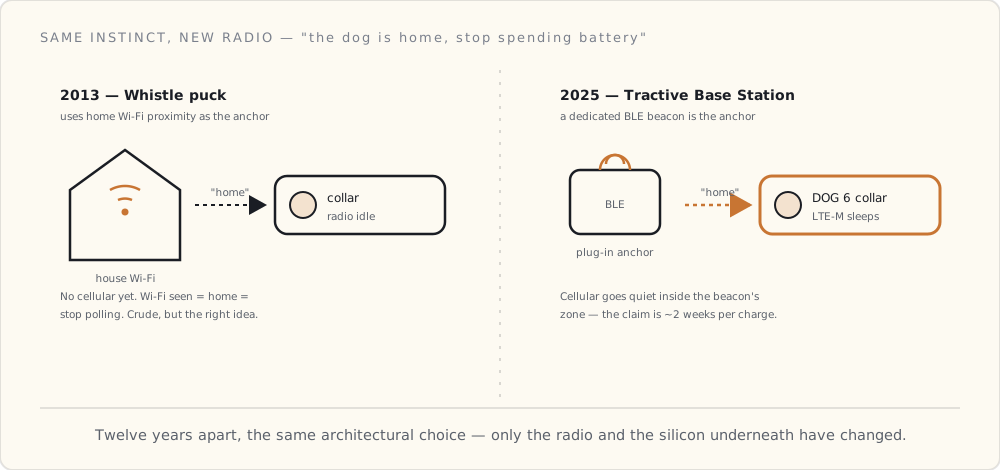
Cracking the case open to figure out the radio when it arrives. Writing it up after.
 Part 40 of 42
 Twelve years of pet IoT — the long-arc retrospective
Twelve years since Whistle launched. Four pets — Atom (2013-2024), Joule, Boson, Quark. Lessons on cloud dependency, vendor consolidation, multi-pet detection, vet telemetry, the DIY response.
October 8, 2013 — Whistle shipped the first consumer dog activity tracker, and I bought one the week Atom arrived. Twelve years and change later — Atom's gone, Quark's three, Joule's eleven, Boson's five — time to step back.
Timing note: writing this two weeks after Mars Petcare divested Whistle to Tractive and announced Whistle's August 31 shutdown. The category just rearranged itself in a way I didn't see coming when I started drafting the retrospective. Some sections below have been updated to reflect that news; the eras framework holds, the empire-trajectory section needed a revision.
Looking back across the entire arc.
The eras
Era 1 (2013-2015) — fitness trackers for dogs. Whistle, FitBark, Tagg. Either short-range radios that sync near home and the phone (Whistle's BLE-plus-Wi-Fi puck; FitBark's BLE), or Tagg's cellular-with-a-subscription. Activity counting calibrated against breed baselines. The "Fitbit for dogs" era. Cat IoT was the microchip and nothing else.
Era 2 (2015-2018) — cat IoT joins, Mars consolidates. SureFlap microchip doors. Litter-Robot. PetCube cameras. The first non-dog products arrive. Whistle ships its first cellular-GPS tracker (the Whistle GPS Pet Tracker, 2016, on AT&T); Mars Petcare buys Whistle the same year and the consolidation begins; the half-size Whistle 3 follows in 2017.
Era 3 (2018-2020) — cloud-dependency catastrophe + multi-cat. Petnet's 9-day collapse in February 2020 defines the era. Fi launches with LTE-M for genuine multi-week battery life. Boson arrives; multi-cat detection becomes a real engineering problem.
Era 4 (2020-2023) — behavioral health + AI bullshit + AirTag. Whistle Health & GPS Plus ships (2021) — activity plus accelerometer-derived behavioral metrics: scratching, licking, drinking, sleep. (No true vitals; there's no heart-rate or temperature sensor in a Whistle, a distinction that matters more than the marketing lets on.) Petivity smart litter monitor ships (2022). AirTag launches, the anti-stalking-vs-pet-tracking architectural mismatch becomes apparent. Halo Collar ships with welfare problems. "AI behavior detection" mostly turns out to be marketing.
Era 5 (2023-2025) — DIY local-first + Mars empire peak + Atom's passing + the contraction. Mars Petcare's vertical integration hits its peak in 2023 — food + clinics + devices + analytics, all under one roof. The DIY ESP32 pet-IoT response begins (the ESP32 feeder I built this year). Apple Find My pet trackers offer the first credible third-party tracking ecosystem. Atom passes in October 2024 — the data taught me what I missed. Then 2025 turns the whole arc: in May, Tractive ships real heart-rate and respiratory-rate vitals to its existing trackers — the first genuine consumer pet vitals, from an independent vendor — and in July, Mars divests Whistle to that same Tractive. The empire severs its device leg right as an outsider out-innovates it. The story I expected to write — Mars consolidating further — turned out to be the wrong shape of arc.
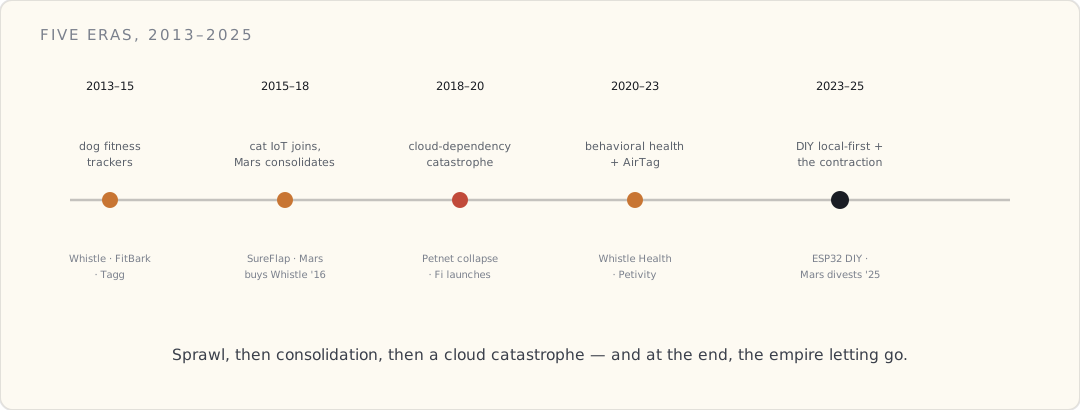
Patterns across all five eras
Cloud dependency is the category's central failure mode. Petnet was the headline case. Every other connected pet device has the same vulnerability. The vendor's cloud uptime is the device's reliability ceiling. The vendor's solvency is the device's life expectancy.
Mars Petcare's vertical integration was the structural threat — until it wasn't. From 2016 through July 2025, the same company sold the food, ran the vet, sold the collar, and analyzed the data. The recommendation conflict was real — it shaped the advice owners received, the diagnoses vets gave, and the products that flourished in the category. As of July 2025, Mars divested the collar leg. Food + clinics + analytics remain vertically integrated; the device leg moved to Tractive (independent, Austrian). The structural threat is now lopsided, not gone — and the arc of "the empire that bought everything" turned out to bend back at the end.
Multi-pet households break single-pet design assumptions. Two cats sharing one litter box, two dogs sharing one feeder, three pets visible on one camera — every device that worked for "the pet" needs to work for "which pet." Most devices don't, well.
Pet health monitoring finally grew up — and stopped being Mars's to control. I want to be precise about what these collars actually measured, because the marketing always muddied it. For nine years, "pet health tracking" meant behavioral inference off an accelerometer — Whistle's scratching, licking, drinking, sleep — not physiology. No heart rate, no respiratory rate. And behavior was enough to matter: Whistle Health's scratching trend is, in hindsight, the signal that flagged Atom's mitral valve disease months before I noticed — I just wasn't looking at it. Then 2025 closed the gap from both ends. In May, Tractive shipped real resting-heart-rate and respiratory-rate monitoring as a free update to its existing trackers — the consumer category-first for genuine vitals, from an independent vendor. In July, Mars divested Whistle to that same vendor and switched the old behavioral line off. So the data-ownership conflict I documented two years ago resolved in a way I didn't predict: not Mars loosening its grip, but an outsider leapfrogging it on vitals and then absorbing its device. Nine years of health data trapped inside a food conglomerate, and the exit was an independent company doing it better.
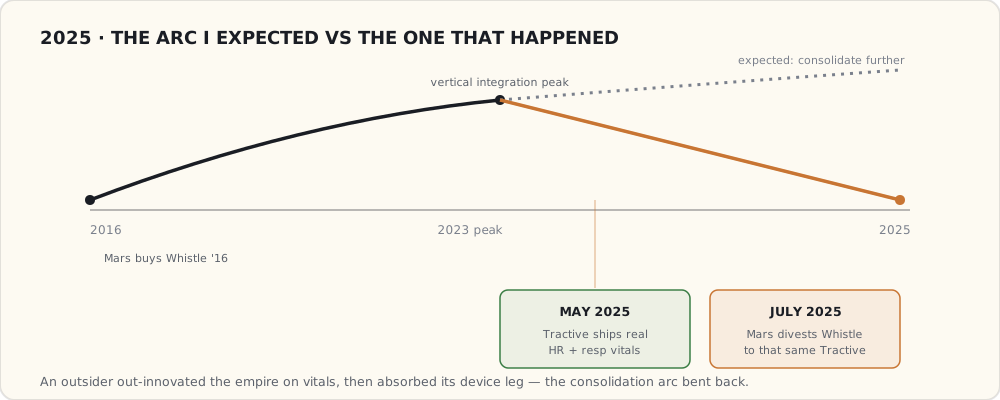
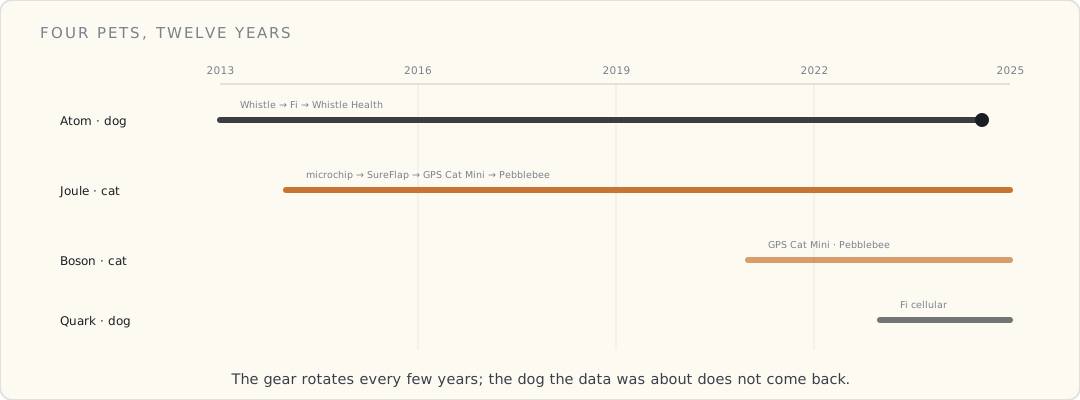
The cat-IoT category is a decade behind the dog-IoT category. Same complaint I had in 2014, still mostly true in 2025. SureFlap and Litter-Robot are the cat-IoT mainstays. Petivity is the third entrant. The category is thin compared to the dog-side market.
DIY local-first is the only sustainable response. Vendor consolidation + cloud dependency + recommendation conflicts mean the only architecture that's robust against all three is hardware you control, firmware you write, automations that run on your LAN. ESPHome made this accessible. The DIY pet-IoT community is small but growing.
What I'd warn the 2013 version of me
- Don't trust vendor cloud uptime for pet-life-critical functions. Always have a non-cloud backup for feeding.
- Mars will buy Whistle in 2016, and the recommendation layer will start pushing Mars products immediately. Vote with your wallet by buying Fi when it ships in 2019.
- Mars will divest Whistle to Tractive in July 2025, nine years after acquiring it. The empire is not permanent. The "vendor consolidation is forever" framing I'll use through most of the 2020s turns out to be wrong at the end.
- Petnet will collapse in February 2020 for nine days. Cats will die. Don't rely on it.
- AirTag will launch in 2021 with anti-stalking features that are incompatible with intentional pet tracking. Don't bother with it for pets.
- The "AI behavior detection" subscriptions will mostly be marketing-grade bullshit. Don't subscribe.
- Atom will get mitral valve disease at age 10. Watch his scratching frequency starting at age 8 — that's the early-warning signal Whistle Health surfaces in 2021 but I won't notice until 2024.
- You'll spend ~$8k on pet IoT over 12 years. It was mostly worth it. The Litter-Robot, Fi, Whistle Health, and DIY-ESP32 are the wins. The Petnet, Halo, Furbo subscriptions are the losses.
What 2025 me is wrong about
Best guesses for what 2030-me will laugh at:
- On-device AI for pet behavior. Real (non-bullshit) behavior detection is going to start working when the models can run on-device with low latency. 2027-2028 maybe.
- Mars Petcare facing antitrust regulation. I don't believe it'll happen in the US. Could happen in EU first.
- The category collapsing into Apple's Find My ecosystem. Apple's network density is going to make crowdsourced Find My pet trackers the default. Cellular collars will become niche for outdoor adventure dogs.
- Veterinary integration that's not vendor-locked. Some open standard for pet-health data exchange between consumer devices and vet records. Years away.
What stays the same
- Joule's microchip. Implanted 2014. Still there. Still works.
- The SureFlap door's reliability. Ten years of perfect chip-reading.
- The Litter-Robot's mechanism. The III in the kitchen is six years old. Still working.
- The pattern: track activity (or in cat case, identity); detect anomalies (or in cat case, weight); integrate with broader smart-home (or in cat case, smart-pet-door analytics). The framework is durable; the implementations rotate.
The pets, currently
- Joule (cat, ~11 years old). Healthy. Wears Pebblebee Clip via Find My. Uses Litter-Robot III + SureFlap door + SureFeed feeder.
- Boson (cat, ~5 years old). Healthy. Wears Pebblebee Clip. Uses Litter-Robot 4 + SureFlap door + SureFeed feeder.
- Quark (dog, ~3 years old). Healthy. Wears Fi cellular collar. No vitals device yet (will add at age 7-8).
Three pets. ~$1,200 of currently-deployed pet-IoT hardware. About $200/year in subscriptions (mostly Fi).
Closing
Pet IoT is the smart-home category, five years behind. Same evolutionary pattern: vendor sprawl → consolidation → cloud-dependency catastrophe → DIY local-first response. Smaller market, smaller engineering investment, higher stakes (the failure mode is animal welfare, not lights-stuck-on).
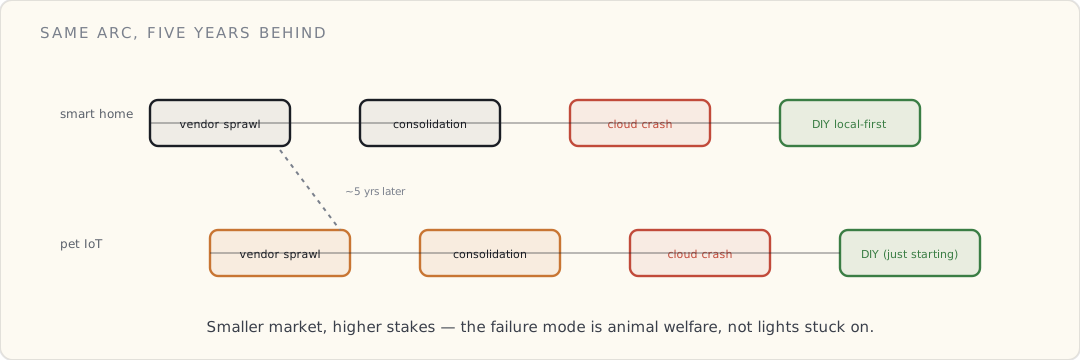
If you're shopping pet IoT in 2025:
- Buy the SureFlap door (or equivalent microchip door). Best $200 in the category.
- Buy a Litter-Robot if you have cats. The cleaning is worth it; the data is bonus.
- Buy a Fi or Tractive collar for outdoor dogs. Both independent vendors, both doing real engineering on battery life. Tractive's DOG 6 (shipped this January) plus its Base Station is what I'm evaluating against Fi for Quark's next collar. 3b. Tractive GPS Cat Mini for outdoor cats. First credible consumer cellular cat tracker the category produced — ships since late 2022. Joule and Boson have worn them since then; covers the off-property outdoor dimension the SureFlap door logs miss.
- DIY your feeder with ESP32 + ESPHome. Vendor-cloud-independent.
- Add a Pebblebee Clip to indoor pets' collars for Find My backup.
- Skip the wellness subscriptions (Furbo Dog Nanny, etc.). They're not signal.
- Maintain a non-cloud-dependent backup for any pet-feeding device. Always.
Twelve years in. The data carries forward to Quark, to Joule, to Boson. The next dog (whenever there's a next dog) will get a senior-mode dashboard from the start.
Atom is missed. The lessons are written.
Onto the next decade.
 Part 41 of 42
 Tractive Base Station teardown — 2025 silicon, 2013 arch
Bought the Tractive DOG 6 + Base Station post-Whistle. Cracked the case to figure out the radio: plain BLE advertising on a Nordic nRF52840 — a multi-protocol chip Tractive uses at 25% capability.
Bought a DOG 6 + Base Station two weeks after Whistle's dark date. The DOG 6 — Tractive's tracker since CES this January — is for evaluating against Quark's current Fi when his Fi battery degrades. The Base Station is what I really wanted to understand — it's the architectural piece I have questions about.
Spent a couple evenings on the teardown. Notes here.
Setup, briefly
The Base Station is a small puck (~80 mm diameter, ~25 mm tall). USB-C power. Detachable external antenna (~10 cm whip). Indoor-only — not waterproof.
Setup:
- Attach antenna.
- Plug in USB-C.
- Tractive app → Profile → Tracker → Power Saving Zones → Add → name the zone.
- Press the device button to confirm range.
After 24 hours: Quark's DOG 6 inside the Base Station's range reports power-saving mode active. Cellular updates drop from every ~2 minutes to "on demand only" (manual app request or geofence event). Tracker power draw visibly drops.
That's the intended behavior. It works.
The mechanism is worth drawing, because it explains why a dumb beacon saves so much battery. The expensive thing a cellular tracker does is wake the GPS and the modem to get a fix and report it — and out on a walk it does that every couple of minutes. The Base Station's only job is to tell the tracker "you're home, you can stop." Once the tracker sees the beacon, it collapses that duty cycle down to on-demand, and the battery coasts.
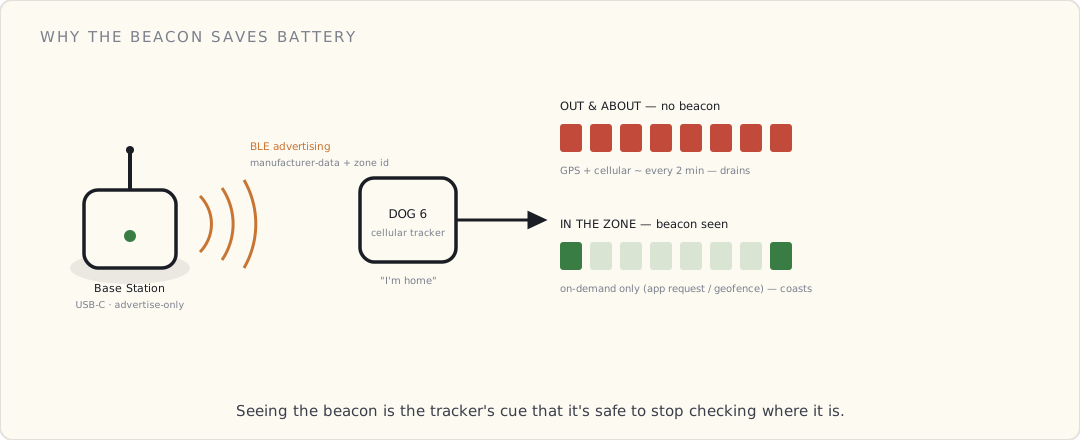
The architectural question
The Power Saving Zone replaces what Tractive previously used as the "is the pet at home?" signal: home WiFi proximity. If the tracker's WiFi could detect the home network's SSID, it'd switch to power-saving. That worked for homes with WiFi reaching all the relevant pet space; it failed in homes with patchy WiFi, in outbuildings, in basements.
The Base Station is a dedicated "home anchor" signal independent of WiFi reach. And the funny thing is how far back that "near home means stop spending battery" instinct goes. The very first Whistle I unboxed twelve years ago leaned on exactly the same idea — it treated home WiFi proximity as the "the dog's home" signal and synced cheaply when it was in range. No dedicated anchor, no extra puck; the home network itself was the beacon. Tractive started from the same place (home-WiFi proximity), hit the same wall (patchy WiFi, basements, outbuildings), and answered it by adding a dedicated short-range beacon you plug in.
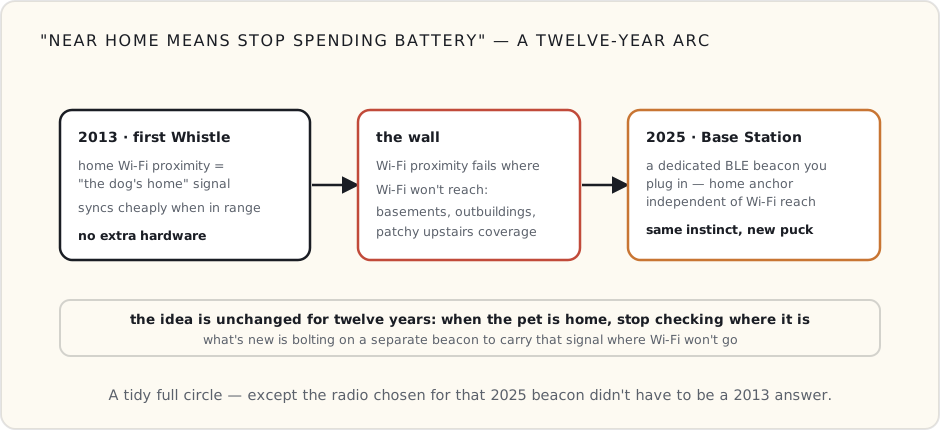
So the "home presence cuts the duty cycle" idea is twelve years old; what's new is bolting on a separate BLE beacon to carry it where WiFi won't reach. Which would be a tidy full-circle narrative — except the radio choice for that beacon, in 2025, is the part that didn't have to be a 2013 answer. The teardown is about what Tractive could have done with it instead.
Opening the case
Tri-point screws around the perimeter (manufacturer-grade tamper resistance — same trick Apple uses on AirPods, makes you go find the right driver). 30 seconds with an iFixit precision set.
Inside:
| Component | Identification |
|---|---|
| Primary SoC | Nordic nRF52840 (under RF shield, 7×7 mm QFN, marking confirmed after shield removal) |
| Power | USB-C input → 3.3V LDO regulator |
| Antenna | PCB trace antenna + U.FL connector for external whip |
| Storage | Small SPI flash (likely 4-8 MB) for firmware staging |
| User I/O | Status LED, push-button |
| PCB | 4-layer FR4, ~50 × 50 mm |
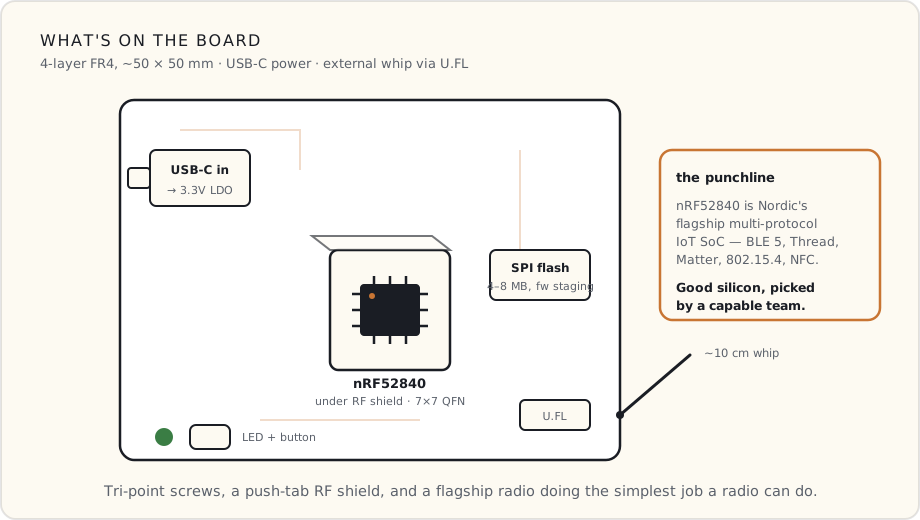
The chip under the RF shield is the interesting one. Push-tab shield (no solder), pulls off easily. Marking confirms nRF52840.
That's the punchline. nRF52840 is Nordic Semiconductor's flagship multi-protocol IoT SoC. It supports:
- Bluetooth Low Energy 5.x — all PHY modes (1M, 2M, LE Coded for ~4× range).
- IEEE 802.15.4 — Zigbee, Thread, Matter underlay.
- Nordic's proprietary 2.4 GHz protocol (ESB / Gazell).
- ANT+.
- NFC-A tag mode (built-in NFC controller).
- Cortex-M4F with FPU, 1 MB flash, 256 KB RAM.
It's the Swiss-army knife of 2.4 GHz IoT radios. Most modern smart-home products under $50 use this chip or its smaller sibling (nRF52832 / nRF52833).
So here's the gap, drawn out: nearly everything this chip can do is sitting idle, and the one thing the firmware switches on is the radio's most basic mode.
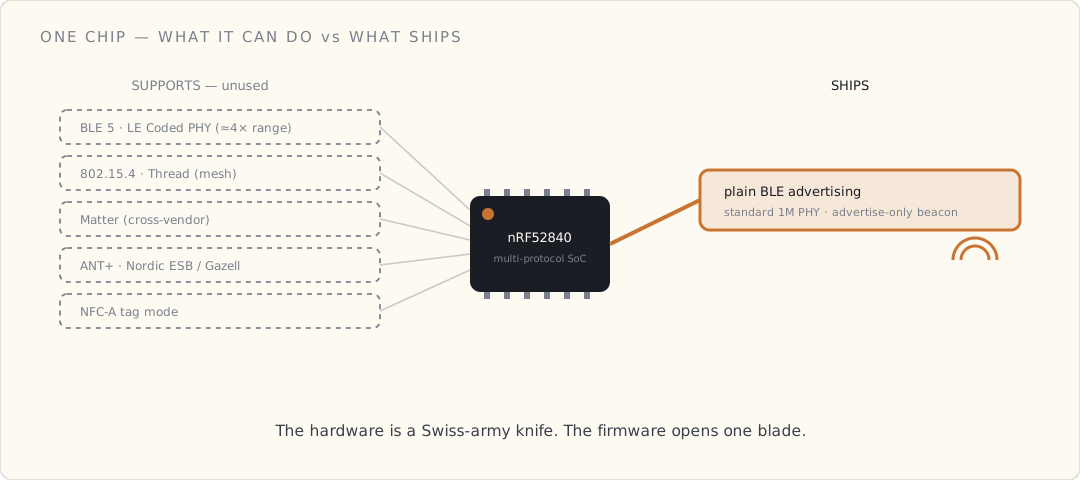
What protocol Tractive actually uses
Sniffing the over-the-air traffic with an nRF52-DK running Nordic's nRF Sniffer into Wireshark:
Plain BLE advertising + GATT. Standard 1M PHY. No coded PHY, no extended advertising, no LE Audio, no 802.15.4 frames, no Thread, no Matter.
The Base Station broadcasts BLE advertising packets with a Tractive-specific manufacturer-data field (Tractive's BLE manufacturer ID is in the Bluetooth SIG assigned-numbers registry — I'm not publishing the specific data-field layout). The tracker, when in BLE range, sees the advertisement, recognizes the manufacturer ID + a base-station identifier in the data field, and switches cellular duty cycle to "power saving."
GATT services on the Base Station expose configuration (range setting, zone identifier) for the Tractive app to write during setup. After setup, the Base Station is essentially an advertising-only beacon. The tracker doesn't need to maintain a GATT connection; it just needs to see the advertising packets.
Standard BLE proximity beacon architecture. 2013-era topology. Reliable, simple, ships.
What Tractive could have used (and didn't)
The nRF52840 supports everything in this list. Tractive used the radio's least capable mode:
LE Coded PHY (4× range, same chip)
Bluetooth 5.0 added LE Coded PHY — a different physical-layer encoding (S=2 or S=8 coded modes) that trades data rate for range. At S=8 coding, BLE achieves approximately 4× the range of the standard 1M PHY with the same TX power, same antenna, same battery. The trade-off is data rate (1 Mbps → 125 kbps) — irrelevant for a proximity beacon that sends a few bytes per advertising interval.
A Base Station running LE Coded PHY S=8 would cover roughly the same area as four standard-BLE Base Stations. Solves the multi-floor house problem the marketing acknowledges (range varies by environmental factors).
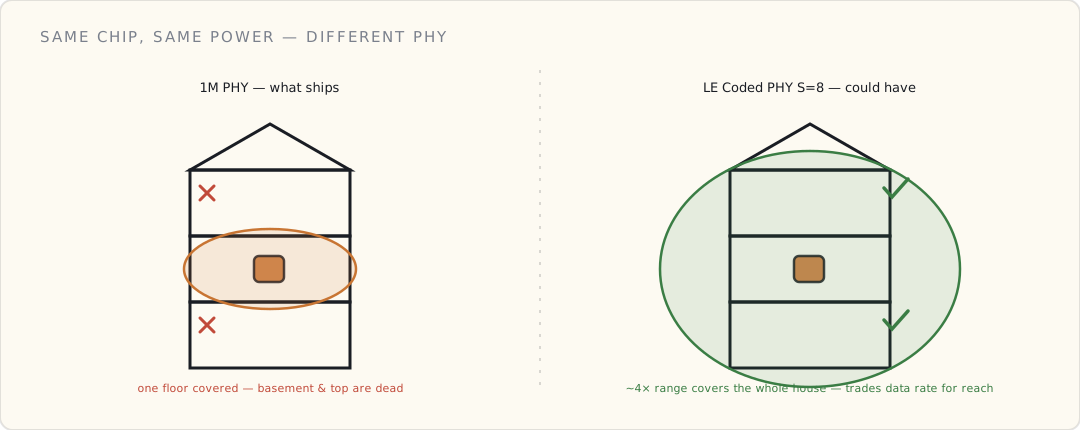
Tractive ships standard 1M PHY. They're using the chip but not the radio's headline 2020-era feature.
Thread (mesh)
802.15.4 + Thread would let multiple Base Stations form a mesh network covering an entire property — outbuildings, basements, second-floor bedrooms, garage. The tracker would see "any Base Station in the mesh" as power-saving, not just "the specific Base Station in line of sight."
nRF52840 supports 802.15.4 natively. Thread requires the Thread stack on the firmware side. Nordic ships SDK support.
Tractive uses none of it.
Matter (interop)
Matter 1.x supports door sensors, occupancy sensors, and generic Thread / BLE-discovered devices. A Matter-compatible Base Station would be discoverable by HomeKit, Google Home, Amazon Alexa, Home Assistant — the user could trigger automations on "tracker entered home zone" without needing Tractive's app.
Tractive ships no Matter support. Closed ecosystem.
Find My-style relay
Apple's Find My third-party API (the one Pebblebee uses) would let every iPhone in the house act as an anchor. The user buys a Tractive tracker; every passing iPhone is a Base Station. No additional hardware needed in dense areas.
Tractive doesn't participate in Find My. Single-vendor network.
UWB (sub-meter ranging)
UWB would require a different SoC (Apple's U1/U2, NXP's Trimension, or Qorvo's DW3000-series). It enables sub-meter ranging, which would let the Power Saving Zone be a precise shape instead of "BLE RSSI fuzzy radius." This is the only alternative that requires different silicon.
Tractive doesn't ship UWB.
Why "2013 architecture with 2025 silicon"
The Base Station's hardware is current. nRF52840 is a 2018 chip with multiple revisions since; the supporting components are 2024-25 commodity. Tractive's engineering team picked good silicon.
The architecture is 2013. Plain BLE advertising — a proximity beacon, the oldest, simplest thing a BLE radio can do, conceptually unchanged since BLE 4.0 shipped in the first Whistle's era. A dumb "I'm here" packet and a tracker that listens for it.
The gap between the silicon's capability and the protocol Tractive ships is wide. They have the radio for LE Coded PHY, Thread, Matter, multi-protocol mesh — and they ship advertising-only BLE.
I understand the why. It's a $19.99 product. The engineering budget is small. Plain BLE works, ships in two sprints, and is well-understood by Tractive's existing team. The alternatives — Thread, Matter, LE Coded PHY — require deeper protocol-stack engineering and more interop testing. That's where the cost gets paid.
But "good enough" with the same silicon could have been meaningfully better. The Base Station could cover a multi-floor home with LE Coded PHY. Two of them could mesh with Thread. Matter would expose it to Home Assistant for cross-vendor automations. Same chip. Different firmware.
The wheel-came-around story isn't a story about optimal architecture rediscovered. It's a story about the vendor reaching for what's familiar. The familiar thing is BLE advertising. The available thing is much more.
The subscription wrinkle
The Base Station is $19.99 hardware + $5/month subscription on top of the tracker subscription.
A passive BLE advertising beacon costs Tractive essentially zero per month to run. The $5/mo is pure margin, justified by "service" — but the device doesn't connect to the internet, doesn't sync anything cloud-side, and operates entirely as a local advertising beacon. The subscription is contractual, not technical.
I'm paying it for now (the device requires the Tractive app to enable the Power Saving Zone integration, and the app requires the sub). If community firmware ever surfaces for the nRF52840 with this role (it's a well-documented chip, the protocol is straightforward, OpenThread + community Matter stacks exist) — I'd flash it and skip the subscription. Same hardware, no monthly fee. That project is in the queue.
What's next
DOG 6 battery test ongoing — 3 weeks in, I'm at 18 days on a charge with the Base Station active. That's already past Tractive's "up to 2 weeks" claim for the DOG 6, and comfortably above Fi's 14-day real-world — the Power Saving Zone is clearly doing real work on the duty cycle. Reporting again once it actually dies.
GPS Cat Mini still on Joule and Boson — both cats have worn them since late 2022. Separately evaluating how the cat tracker performs against the Base Station's power-saving zone; writing that up.
The Base Station teardown is the headline finding: post-Whistle, the vendor that took the category's torch ships an architecture that's twelve years behind what its own silicon can deliver. The category is going to take another product cycle — or another vendor — to actually use the radio it ships.
 Part 42 of 42
 2025 pet IoT — the DIY era, properly arrived
Two things I'd chased for a decade landed in the same year, from the same scrappy independent. In May, Tractive shipped real resting heart-rate and respiratory-rate monitoring — the vitals no consumer collar had managed. In July, Mars sold Whistle to that same Tractive. The giant bailed on the category right as the underdog delivered what it never could. My worst forecasting year, ~56%, and the most instructive.
End of 2025. Closing the annual cadence of the pet-IoT field guide.
Scoring the 2024 forecast
| Prediction | Confidence | Outcome | Verdict |
|---|---|---|---|
| DIY ESP32 pet hardware mainstream | 80% | DIY communities grew; my own feeder + others published builds | ✓ |
| Senior pet mode UX | 35% | Nothing meaningful | ✗ |
| Mars consolidates another player | 80% | Inverted — Mars divested Whistle to Tractive in July | ✗ (direction wrong, high confidence) |
| Local-first pet camera mainstream awareness | 50% | Frigate + Reolink replacing Furbo conversations | ✓ (partial) |
| AI behavior detection stays mostly marketing | 90% | Yes — no breakthrough in 2025 | ✓ |
| Credible non-Mars vitals tracker | 35% | Yes — Tractive shipped resting heart-rate + respiratory-rate monitoring in May, free to existing trackers. The first real consumer vitals, from an independent | ✓ (my 35% was too low) |
| Matter-compatible smart litter or feeder | 45% | Aqara Matter-feeder rumored, not yet shipping | ✗ |
| Long-arc retrospective | 100% | Yes, August | ✓ |
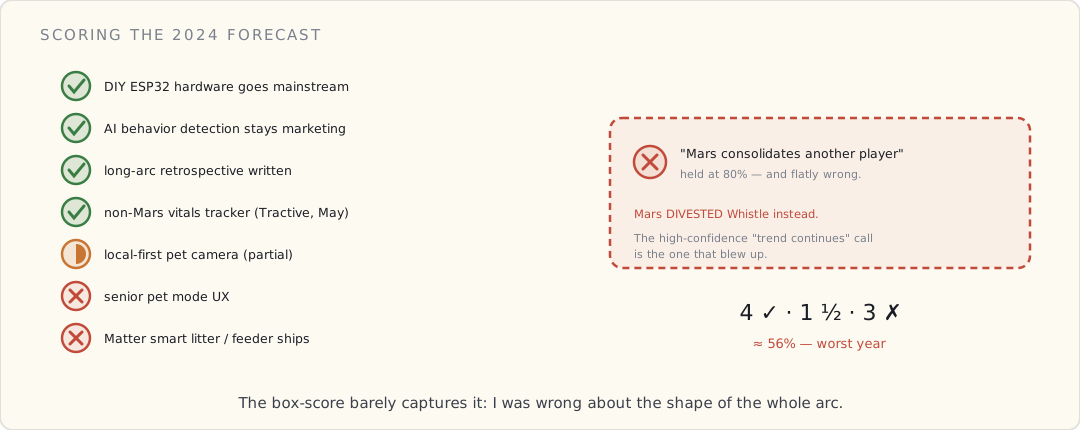
Four hits, one partial, three misses — ~56%, my worst forecasting year, and the most instructive of the twelve. The box-score barely captures why, because the two things I got most wrong were wrong in opposite directions and they're the same story.
I held "Mars consolidates another player" at 80% confidence and it was flatly, directionally wrong: in July, Mars divested Whistle to Tractive. Seven years of watching the empire only ever buy made the one year it sold impossible for me to see coming. That's the classic failure — the high-confidence call resting on "the trend continues" is exactly the one that blows up.
And the prediction I'd lowballed at 35% — a credible non-Mars vitals tracker — actually hit, and I still almost missed it, because I'd spent a decade certain real vitals were perpetually "next year." In May, Tractive rolled resting heart-rate and respiratory-rate monitoring out to its existing trackers, free — derived from motion against a personalized baseline, the first time a mainstream consumer collar measured an actual vital sign instead of inferring behavior. No Whistle, no Fi, no Mars money ever managed it. The scrappy Austrian independent did.
Put the two together and the irony writes itself: the same company that shipped the vitals feature a decade of giants couldn't is the company that bought Whistle two months later. Mars spent nine years owning the device leg and never produced real vitals; the moment it gave up and sold, the buyer had already delivered them. I was wrong about the shape of the arc, and wrong about who'd close the gap — and the answer to both turned out to be the same small name.
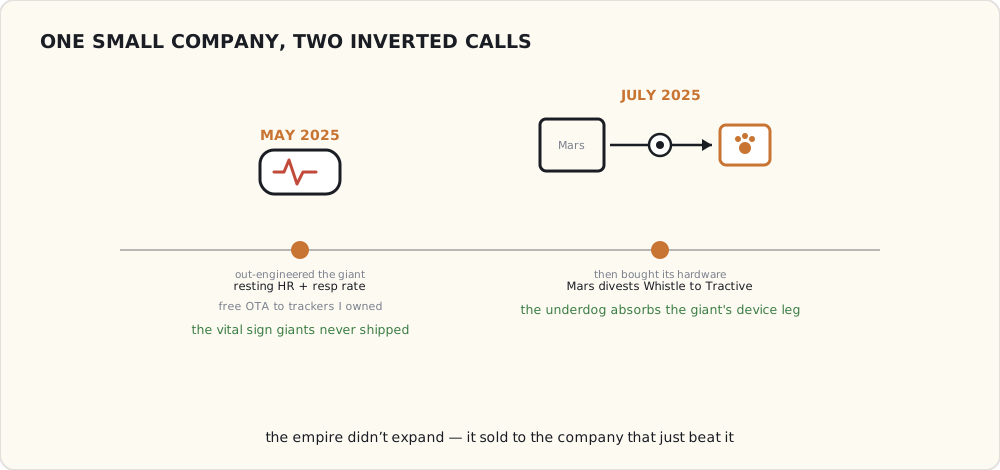
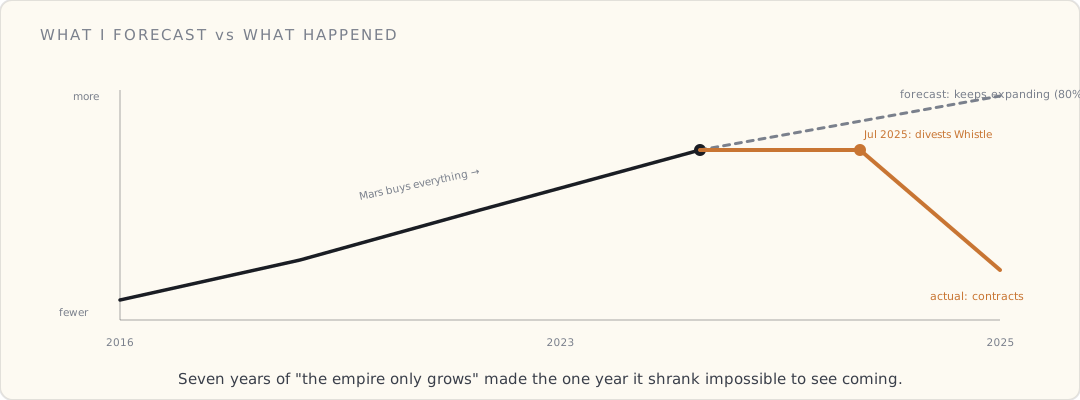
What got added this year
- DIY ESP32 pet feeder for Boson (March).
- Second Pebblebee Clip for Boson's collar (May).
- The long-arc retrospective post (August) — written two weeks after Mars's Whistle divestiture, with the empire-trajectory section revised to acknowledge it.
- Tractive DOG 6 + Base Station (September) — evaluating against Fi for Quark. The DOG 6 is the first collar in the house to report a real resting heart rate and respiratory rate, not just behavior.
- The May vitals update on the cats' GPS Cat Minis — Joule and Boson have worn Tractive's cellular cat tracker since late 2022, and in May the heart-rate/respiratory-rate feature simply appeared on the trackers I already owned, free. A decade waiting for consumer vitals, and they arrived as a software update to hardware that was already on my cats.
- A small DIY ESP32 cat-water-fountain monitor (September) — knows when the water filter needs replacing.
What worked
- Tractive's vitals, finally. After a decade of "health" collars that only ever counted movements, a resting heart rate and respiratory rate showed up against a real per-pet baseline. It's still motion-derived, not a chest electrode — but it's a genuine vital sign, baselined and trended, and it's the first time the category delivered the thing I'd been predicting and being wrong about since the first Whistle. That it came from the independent and not the conglomerate is the year's quiet vindication of everything this notebook has argued about who builds good hardware.
- DIY ESP32 reliability. Eight months in, zero failures.
- Find My pet trackers on both cats. Quietly reliable.
- Quark's Fi battery life is still holding at ~12 days; minor degradation from year 1.
What didn't
- Apple's Find My anti-stalking updates in iOS 18 made Pebblebee Clip more aggressive about bystander alerts. Some friends with iPhones report seeing "unknown tracker nearby" alerts when our cats are outside. Slight UX regression.
- Tractive Base Station's architectural laziness. nRF52840 silicon used as plain BLE advertising — no LE Coded PHY, no Thread, no Matter, no Find My relay. Teardown writeup. 2013 architecture on 2025 components.
- The Whistle data-export window. Six weeks from announcement to dark date; mid-August Mars disabled CSV export. Anyone who didn't extract by August 15 lost their pet's historical data.
Forecast for 2026
| # | Prediction | Confidence |
|---|---|---|
| 1 | We add another dog (Atom-replacement-process eventually) | 65% |
| 2 | Tractive (DOG 6 + Base Station) beats Fi for Quark's next collar | 55% |
| 3 | Mars divests another portfolio piece (BluePearl, a food brand, or another device) | 35% |
| 4 | A Matter-compatible smart litter or feeder ships | 60% |
| 5 | DIY pet-IoT becomes a stable indie maker category | 75% |
| 6 | Community firmware emerges for Tractive Base Station (nRF52840 is openly tooled) | 30% |
| 7 | Apple ships pet-specific Find My API features at WWDC | 55% |
| 8 | Three pets (Joule + Boson + Quark) stay healthy | 80% (the only forecast that matters) |
What I'm buying in 2026
- Whatever Apple ships for pet-specific Find My (rumored at WWDC 2026).
- Quark's next collar — Fi or Tractive DOG 6, depending on how the Base Station's power-saving zone stretches the DOG 6's roughly two-week battery against Fi's real-world fortnight.
- More Tractive evaluation — GPS Cat Mini on the cats, and the DOG 6 battery-test result that decides Quark's next collar.
- A few more ESP32 modules for the next round of DIY pet-IoT projects — possibly including a community-firmware attempt on the Tractive Base Station.
What's next
The series ends on annual cadence here. Going forward, pet-IoT posts will be event-driven — when something interesting ships, when a new pet joins, when something fails publicly.
Forty posts across twelve years (plus this one). Documented arc. The longest single project I've maintained on the blog after the Smart Home IoT series.
Three pets, currently healthy. The data carries forward.
Onto whatever comes next.