Find My pet trackers — Apple's network opens to third-party
Apple opened the Find My network to third-party accessories in 2021. The first generation of certified Find My pet trackers landed in 2024:
- Pebblebee Clip ($30) — small circular BLE tracker with a clip loop, 12-month coin-cell. Not a pet SKU, but small and light enough to live on a cat collar.
- Chipolo One Spot ($30) — generic BLE tracker, marketed for keys but collar-compatible.
- Eufy SmartTrack Card ($25) — credit-card-shaped, fits a harness pocket.
None of these is a pet-specific device — there's no "for pets" SKU here, just general Find My item-trackers small enough to ride a collar. That matters, because it means they carry the same anti-stalking behavior as AirTag-on-collar, the thing Apple specifically warns against for pets. In May, Apple and Google shipped a joint unwanted-tracking standard, and Pebblebee, Chipolo, and eufy all committed to it — so a tracker that's separated from its owner can still announce itself to strangers. There is no "this is a pet, hush" exemption. Worth keeping in mind before you read these as purpose-built pet gear; they aren't.
Tested a Pebblebee Clip for two months on Joule.
What the Find My-certified pet trackers actually are
- BLE advertisement, the same shape as AirTag.
- CR2032 coin cell (Pebblebee Clip: ~12 months claimed).
- Find My network connectivity — any iPhone within BLE range relays an anonymized, encrypted location blob to iCloud.
- No cellular, no GPS on the device itself.
- Visible in Apple's Find My app like any other Find My accessory.
The thing I expected and didn't find: a "pet mode." There isn't one. A third-party Find My accessory is a Find My accessory — it's enrolled through the same Made-for-iPhone program and follows the same unwanted-tracking rules as everything else on the network. The joint Apple/Google standard that landed in May is explicitly device-type-agnostic: a tracker that's been separated from its owner for a while can be made to chirp by a stranger's phone and surfaces a bystander alert, regardless of whether it's clipped to keys or a cat. That's the whole anti-stalking design, and it doesn't carve out pets. So the "is this safe to leave on the cat?" question is the same question as it is for an AirTag — which is exactly the tension I wrote about putting one on Atom's collar.
The piece worth being clear-eyed about is how the tag gets located at all, because it explains everything that follows about where it works and where it doesn't. The tag has no GPS and no cellular — it can't sense its own position. All it does is shout a short, rotating, encrypted "I'm here" identifier over BLE. The locating is done by other people's phones: any iPhone that walks past hears the shout, stamps it with the phone's own GPS fix, and uploads an encrypted blob that only my iCloud account can open. The location of the tag is, quite literally, borrowed from whoever happened to wander by.
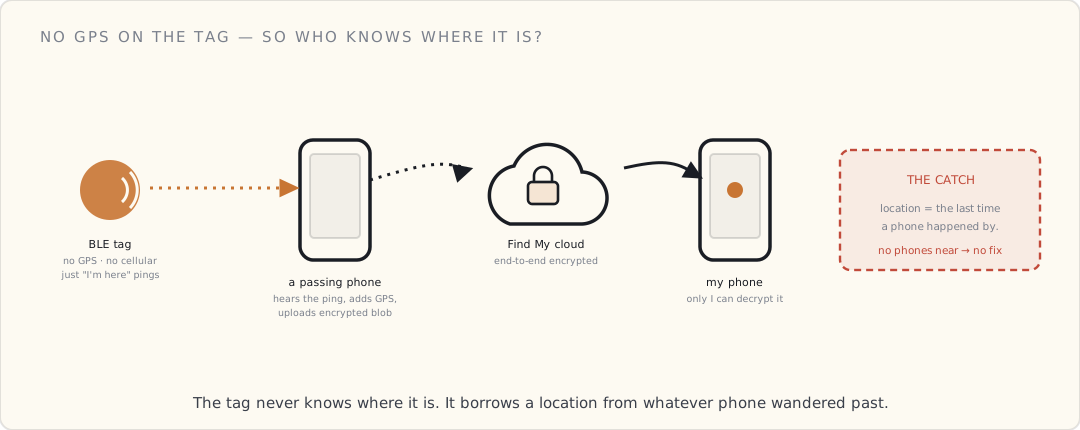
That borrowing is the whole story. It's why the tag is wonderfully cheap and lasts a year on a coin cell — and it's why the location is last-seen, never live.
Joule on Pebblebee Clip
Joule wears the Pebblebee Clip on her collar. She's an outdoor cat (in the new yard, supervised) with SureFlap door access. I wanted to test whether Find My's crowdsourced network sees her on the days she's out.
Density results in my (suburban) neighborhood:
- Within 50m of the house: Joule's tracker is visible in Find My ~95% of the time. Density of iPhones on the street is high enough.
- Within the yard (50-100m): ~80% — fewer iPhone-bearing humans pass by.
- Beyond the yard, in the woods: <20%. Almost no human traffic, Find My doesn't see her.
For "did Joule wander off" — works for confirming she's still in the home BLE area, less useful for tracking her wherever she went.
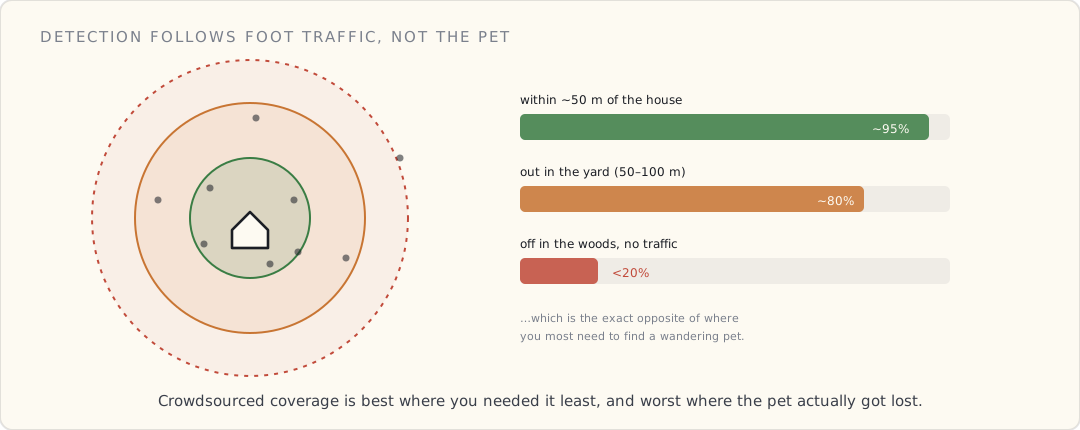
The shape of that result is the thing to internalize: detection tracks foot traffic, not the pet. The crowdsourced network is densest exactly where I least need it — on my own street, where I'd find her anyway — and effectively blind in the woods behind the house, which is the one place a missing cat actually ends up.
What it doesn't do that cellular does
The major gap: no real-time tracking, no continuous location. Find My is last-seen based. If Joule is in the woods and no iPhones pass by, her last-known location is the last time someone walked past with an iPhone — which might be hours ago.
Compare to Fi (cellular):
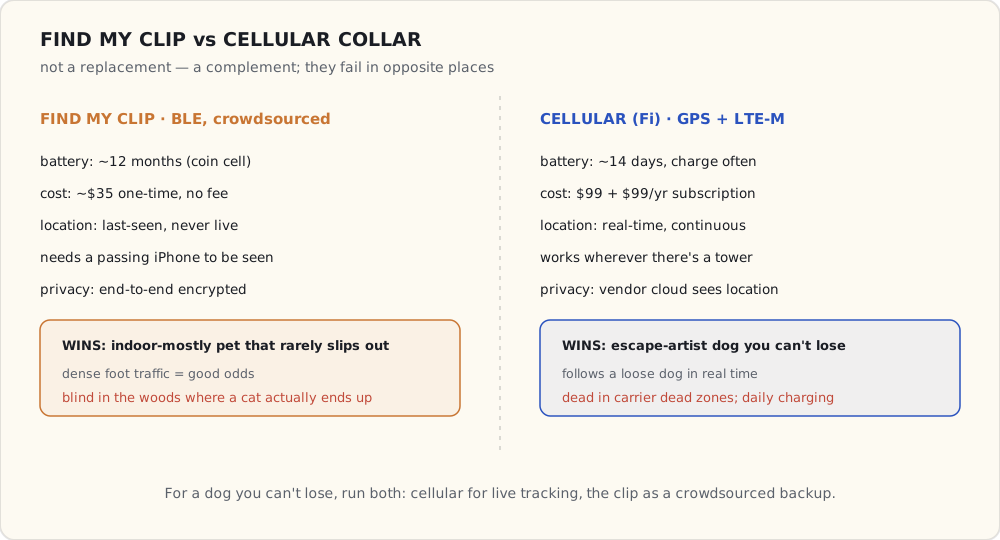
- Fi: 14-day battery, $99 + $99/yr, cellular real-time tracking.
- Find My pet tracker: 12-month battery, $35 one-time, crowdsourced delayed location.
For Atom-style escape-artist outdoor dogs: cellular is the right choice. For Joule-style indoor-mostly cat: Find My is the right complement to the SureFlap door.
The use case where Find My pet trackers shine
Indoor pets that occasionally wander. A house cat that sneaks out one in twenty times when the door opens. A small dog that bolts when the front door is left ajar. These are the scenarios where:
- The escape probability is low (don't need to pay for continuous cellular).
- The recovery scenario is "the cat is somewhere within a mile of home, mostly likely on the block."
- A passing dog walker with an iPhone is likely to detect the tracker within an hour.
In my house: Joule is the right candidate. Boson too (we put one on her after Joule's was working). Atom + Quark — overkill (Quark is on Fi cellular; we don't need the BLE backup).
What Pebblebee specifically gets right vs AirTag
- Smaller form factor: the Clip is roughly 70% of AirTag's footprint and clips flush — less to swing off a collar.
- A clip loop, not a holder: it attaches to a collar directly; AirTag needs a separate (often bulkier) collar holder.
- Replaceable coin cell with a design that makes the swap obvious.
I want to be careful here, because it's the thing the marketing on all of these glosses: the Pebblebee is a nicer form factor for a collar than an AirTag, but it is not a safer-for-pets device in any anti-stalking sense. Both ride the same Find My network and follow the same separation-alert rules. The collar ergonomics are better; the fundamental "a stranger can be told this tracker is near them" behavior is identical. Pick it for the size and the clip, not because it somehow sidesteps the part Apple built on purpose.
What I'm thinking about for Quark
Quark currently wears Fi (cellular). I'm considering adding a Pebblebee Clip as a redundancy — the BLE crowdsourced layer as backup if Fi's cellular gets unreliable (it has, twice this year, in T-Mobile dead zones). Two-tracker redundancy is the answer for dogs you can't lose.
Privacy considerations
Find My data is end-to-end encrypted in Apple's design. Apple itself can't see the location of my Joule. Only my iCloud account can. The crowdsourcing iPhones relay anonymized encrypted blobs.
This is genuinely better privacy than Whistle/Fi's cellular trackers, where the vendor cloud has plaintext location data. For a pet tracker, "the device manufacturer can't track your pet" is a meaningful privacy improvement.
What's next
Year-end review for 2024. Atom's passing was the big personal story. Find My pet trackers + the post-Atom assessment of what I learned over 11 years are the technical stories.