Quark arrives — a second dog, and the pet-IoT baseline starts over
Brought home Quark this weekend — a nine-week-old chocolate Lab, named to the household convention (Atom the Lab, Joule and Boson the cats, now Quark the second Lab; particles and energy all the way down). Atom is eight and a half now and has been gracious about the puppy energy. Joule and Boson are mildly horrified.
And so the pet-IoT setup begins again. Same engineer, second puppy, nine years apart — and the landscape I'm shopping has changed completely. In 2013 I put a brand-new, slightly-risky Whistle on Atom and hoped. In 2022 the right collar is obvious before I open a browser tab, and the most interesting thing about that obviousness is which collar it is.
What's different from Atom's 2013 setup
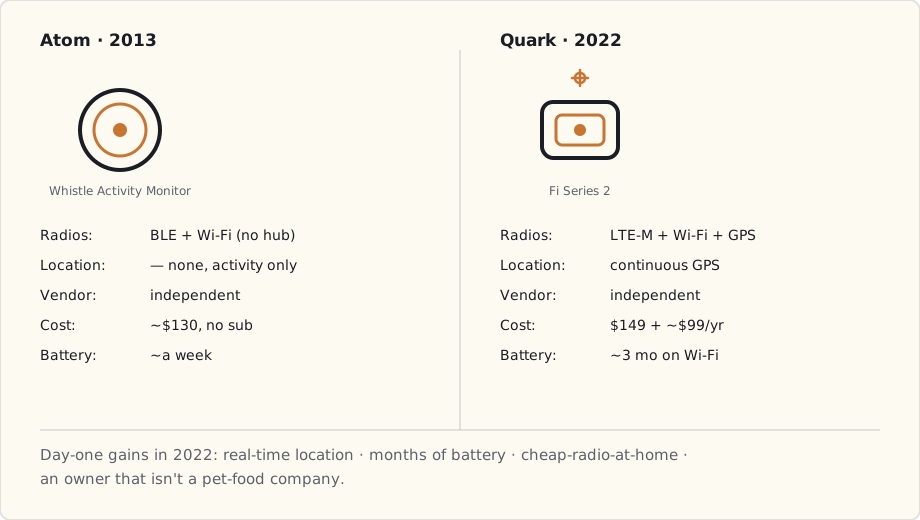
Quark gets a Fi from day one. Set that against Atom's first collar in 2013:
| Atom, 2013 | Quark, 2022 | |
|---|---|---|
| First collar | Whistle Activity Monitor | Fi Series 2 |
| Radios | BLE + Wi-Fi in the puck (no hub) | LTE-M cellular + Wi-Fi + GPS |
| Cost | ~$130, no subscription | $149 device + ~$99/year |
| Battery | 7–10 days claimed, ~week real | up to ~3 months on Wi-Fi; ~2 days in Lost Dog Mode |
| Location | None — activity only | Continuous GPS when out of Wi-Fi range |
| Vendor | Independent (until Mars bought Whistle in 2016) | Independent — not owned by a pet-food company |
| Cloud reliance | High | Lower at home — leans on house Wi-Fi, saves the cell radio for when he's out |
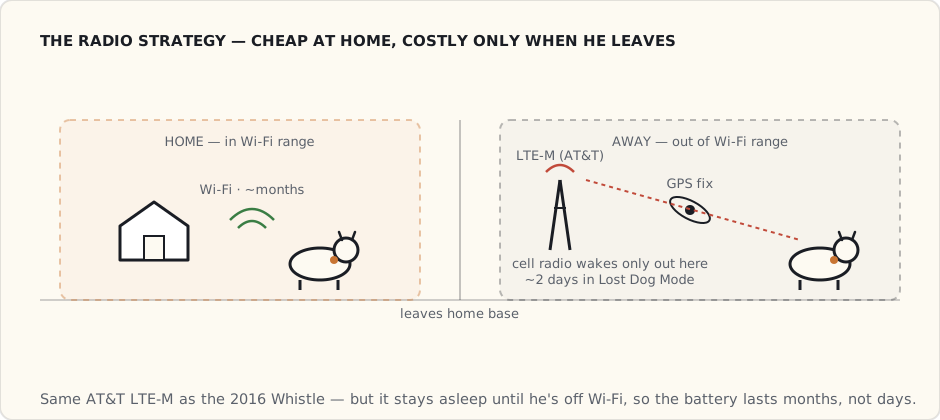
Four things Quark's collar does on day one that Atom's took years to get: real-time location, a battery measured in months instead of days, a sensible radio strategy (cheap Wi-Fi at home, expensive LTE-M only when he leaves), and — the one I care about most after watching Mars absorb Whistle — an owner that isn't trying to sell me dog food.
The quiet irony: Fi runs on AT&T's LTE-M network — the same carrier the 2016 cellular Whistle used. The radio under both is similar. The difference that made me switch isn't the network; it's who owns the data coming off it.
The setup, side by side
Atom's 2013 Whistle setup was a small ritual: a BLE pairing dance, then the Wi-Fi handoff where you join the device's temporary access point and hand over your home credentials, then wait for the first sync. Call it fifteen minutes, and a couple of those minutes were me re-reading the instructions.
Quark's 2022 Fi setup: open the app, tap "add a pet," hold the collar near the phone for the BLE handshake, let the LTE-M SIM self-activate on the cell network, drag a circle on a map to set the home base, snap it on the dog. Eight minutes, no instructions.
It's genuinely less friction for strictly more capability — which is the rare direction for consumer hardware to move. The feature-to-fuss ratio improved while the feature count went up.
The two-dog household, and the data partitioning
Atom (~75 lb adult Lab) wears Fi for location plus a Whistle Health for the behavioral signals — licking, scratching, sleep, eating, drinking — with about eight months of baseline behind it now. Note what that isn't: it's not heart rate or temperature. Nobody's putting real cardiac vitals on a consumer collar yet; the behavioral layer is the frontier, and it's a useful one.
Quark (~14 lb now, headed for 70–80) wears a smaller Fi sized to his current neck. The Fi app shows both dogs on one screen and I tap to switch between them — multi-pet works cleanly, which it had no reason to in 2013 because I only had one instrumented animal.
I'm deliberately not putting a Whistle Health on Quark yet. He's a growing puppy, and "normal" for a puppy is a moving target — the behavioral baselines are tuned to adult dogs, so a wellness monitor on him right now would manufacture noise, not signal. That's a 2024 decision, when he's a year and a half and his normal has settled.
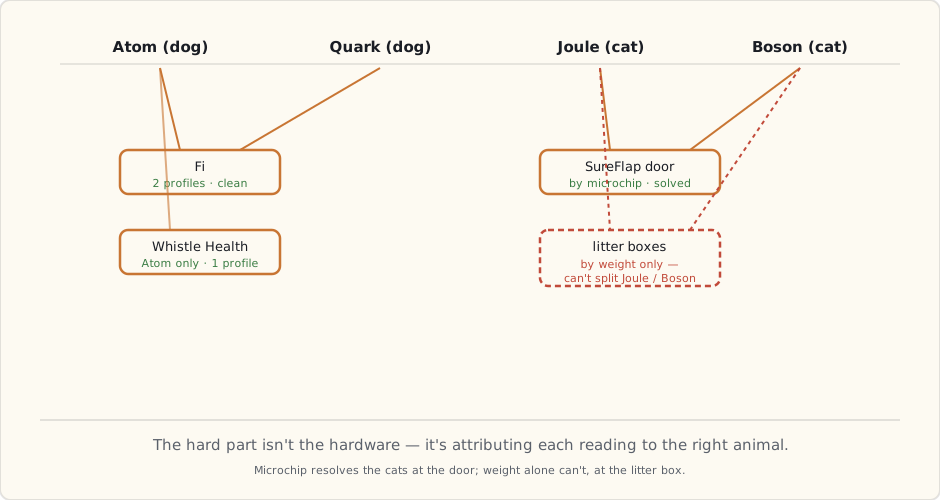
The real engineering problem is that the household data ecosystem now has to keep four animals straight:
- Fi — two dogs, two profiles. Clean.
- Whistle Health — one dog (Atom). One profile.
- The cat door — two cats. The SureFlap reads Joule and Boson by chip; the dogs are far too big for it and use a separate dog-sized door anyway.
- The litter boxes — two cats, and the per-cat attribution is still the unsolved problem. The hardware can weigh the cat on the box; it still can't reliably tell me which cat without me doing the bookkeeping. Joule and Boson are close enough in weight that weight alone doesn't split them.
- The Roomba — navigating around two dogs and two cats now; the treat-conditioning I wrote up on the smart-home side applies to both cats.
Every device's per-pet identification is getting stress-tested at once. The single hardest thing in the house isn't any one gadget — it's attributing the right data to the right animal across five of them.
What I'm reading right now
The Halo Collar reviews keep landing badly. Independent write-ups from animal-behavior people keep making the same point: the virtual-fence boundary is enforced with a static correction — a shock — and that can teach a dog anxiety rather than a boundary. I have a real reason to care this year: the new place doesn't have a fence on the back line yet, and a virtual fence is on the table as an option. So I'm going to get a Halo in hand, test it, and write it up properly next month — with the welfare question front and center, because a GPS chip on a shock collar is still a shock collar.
Quark's data starts today
A nine-week Lab's activity numbers are going to be all over the place for the next year and a half. Right now he does fifteen-to-twenty-five-minute play bursts and sleeps something like eighteen hours a day; in a month or two that flips toward longer activity blocks and shorter naps, and by twelve-to-eighteen months he'll settle into adult-dog rhythm. None of that early data answers "is Quark healthy" — he is, and he's growing fast. The point of logging it now is the trajectory: when the future version of me is looking for an anomaly, this is the baseline it gets measured against.
Welcome, Quark. The data starts today — for the second time in this house, nine years after the first.