Mars divests Whistle to Tractive — collar market state
Mars Petcare sold Whistle to Tractive yesterday. Whistle's cloud goes dark August 31, 2025. Existing customers get a free Tractive tracker if claimed by September 30; active subscribers get remaining prepaid time credited to a Tractive subscription; non-subscribers get 2 months of Tractive sub for free.
Two surprises in one. The empire that's been buying everything for nine years just divested. And Whistle isn't being migrated to a new platform — it's being shut down.
Why Mars sold (a guess)
Mars hasn't said much beyond the press release. Some speculation:
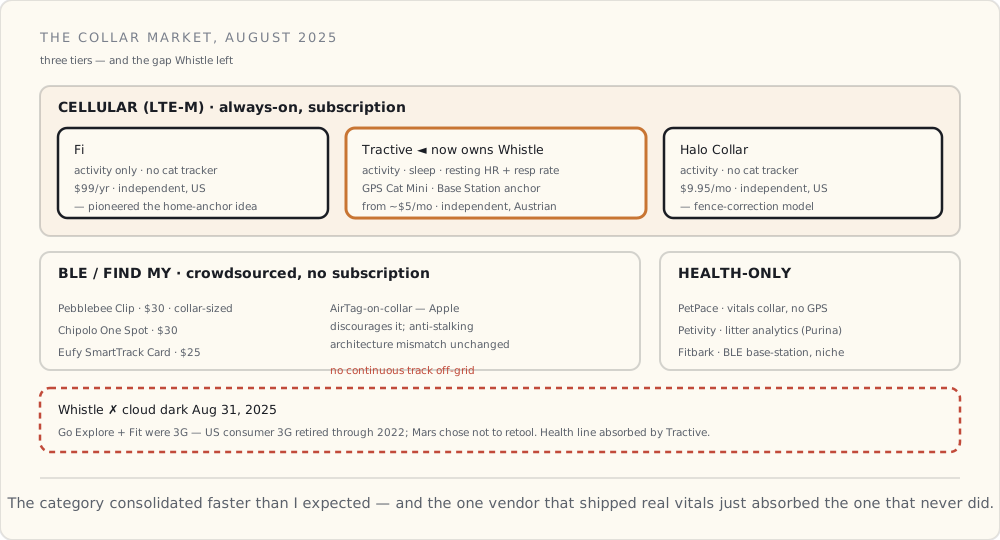
- 3G sunset finished. Whistle Go Explore + Whistle Fit run on 3G cellular. US carriers retired 3G consumer networks during 2022 (T-Mobile in July, AT&T in February, Verizon in December). Whistle's remaining install base has been on borrowed enterprise-IoT 3G that's been retiring per-region since. Funding LTE-M / 5G retooling for an aging consumer fleet was a cost Mars chose not to bear.
- Whistle Health margin. The behavioral-health line (LTE-M, I wrote about in 2021) — activity, sleep, scratching, licking, drinking off one accelerometer — was presumably included in the asset sale, but the announcement messaging is about the 3G models. That health line may have been the smaller revenue piece anyway.
- Data-graph saturation. Mars's strategic logic for owning Whistle was the always-on accelerometer feeding the customer-life data graph. Once Petivity (Purina) collected similar data, once Fi + Tractive populated independent datasets, and once veterinary-data integrations gave Mars cheaper alternatives, Whistle's marginal contribution to the data graph dropped below the maintenance cost.
- The vertical-integration thesis matured past peak. The empire isn't getting bigger from here — it's contracting. Holding niche / low-margin devices in a fragmenting category is harder than letting them go.
That last bullet is the most interesting. The Mars Petcare empire post I wrote two years ago framed Mars as locking down the category. The empire just got smaller. Empires don't divest devices when the strategic value is rising; they divest when the marginal contribution per dollar has dropped below the carrying cost.
The August 31 dark date
Tractive's announcement: Whistle hardware stops working August 31, 2025 at 11:59 PM PT. Servers go offline. Location reporting stops. Activity and health tracking stop. App shows offline.
Compare to Petnet's 2020 collapse — which happened without warning, without communication, without compensation. Whistle's shutdown is being executed cleanly: 7-week notice, free replacement hardware, subscription credit. Mars is doing this right (within the constraint of doing it at all). Petnet's customers got nothing; Whistle's customers get a working alternative.
That's the new precedent: cloud-dependent device shutdowns can be soft-landed when the vendor wants to do it that way. Mars wanted to. Petnet (insolvent) couldn't.
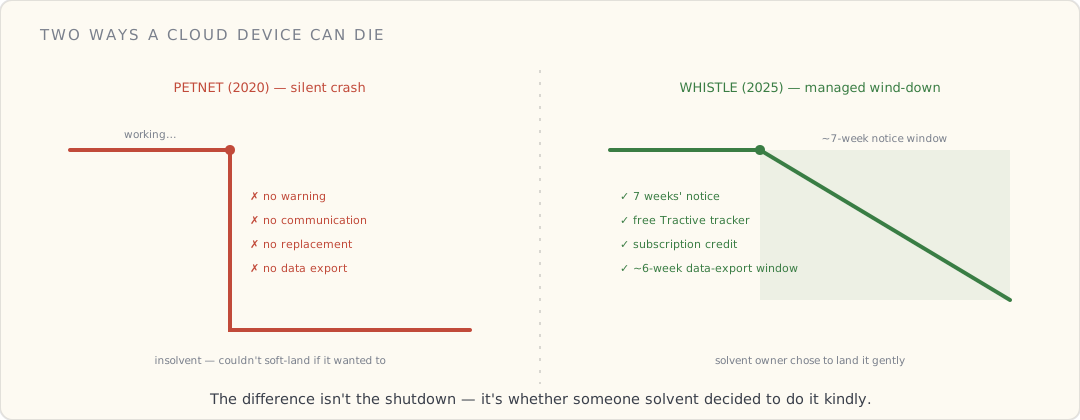
Data-export window matters here: Whistle's app's CSV export was reportedly disabled mid-August, so customers have ~6 weeks from announcement to extract their pet's historical activity and behavioral-health data. The data Mars chose to release back to customers is finite; the rest stays in Mars's data lake. Document your data export options is the post-Petnet doctrine; the Whistle event reinforces it.
What the connected-collar market looks like post-Whistle
Two main cellular collar vendors in the US:
| Vendor | Cellular | Health metrics | Cat tracker | Subscription | Origin |
|---|---|---|---|---|---|
| Fi | LTE-M | Activity only | No | $99/yr | Independent, US |
| Tractive | LTE-M (+ 2G fallback intl) | Activity, sleep, resting HR + respiratory rate (shipped May 2025) | Yes (GPS Cat Mini) | from ~$5/mo | Independent, Austrian |
| Halo Collar | LTE-M | Activity | No | $9.95/mo | Independent, US (returned mine) |
Plus BLE / Find My ecosystem:
- Pebblebee Clip ($30) — BLE crowdsourced, no subscription, small enough for a collar.
- Chipolo One Spot ($30) — BLE crowdsourced.
- Eufy SmartTrack Card ($25) — BLE crowdsourced.
- AirTag-on-collar — Apple specifically discourages it. The anti-stalking architectural mismatch hasn't changed.
Plus health-only / non-tracker:
- PetPace — vitals-focused collar (HR, temperature, pain detection). No GPS. Currently running aggressive "Whistle is dying, switch to us" marketing to former Whistle Health customers.
- Petivity — Purina-owned litter analytics (my review). Health-adjacent, not a collar.
- Fitbark — still around, BLE base-station model, niche.
That's the meaningful set. The category consolidated faster than I expected.
Three things changed in 2025
1. The cat-tracker gap has a credible option. Cat IoT has trailed dog IoT by ~3 years on every axis for twelve years; the missing piece for outdoor cats has been a purpose-built cellular cat tracker. Whistle never made one. Fi never made one. Tractive's GPS Cat Mini — launched late 2022, ~1.4 oz, sized for cats down to ~7 lbs — is the most viable cellular cat tracker at consumer prices. Joule and Boson have worn it since 2022; it covers the off-property outdoor dimension the SureFlap door logs don't capture.
2. Pet vitals finally broke free of Mars — eight weeks before Mars walked away. Here's the timing that makes the divestiture land differently than I'd have guessed. For nine years the most developed consumer pet-health product was Whistle's, and it was behavioral only — scratching, licking, drinking, sleep off the accelerometer, no actual physiology. Then in May 2025, Tractive shipped real vitals: resting heart rate and respiratory rate, pushed as a free software update to its existing trackers (it turns out the sensor was already in the hardware; they just hadn't lit it up). That's the consumer category-first for genuine pet vitals — and it came from an independent, non-food-company vendor. Eight weeks later, Mars divested Whistle to that same vendor. So the data-ownership conflict I documented two years ago didn't resolve by Mars loosening its grip; it resolved because an outsider leapfrogged Mars on the one axis (vitals) Mars never delivered, and then absorbed Mars's device. The health data didn't die with Whistle — it moved to an independent owner and leveled up on the way out. (Caveat for my own household: the vitals rolled out on dog trackers first; feline-baseline vitals for the cats aren't here yet.)
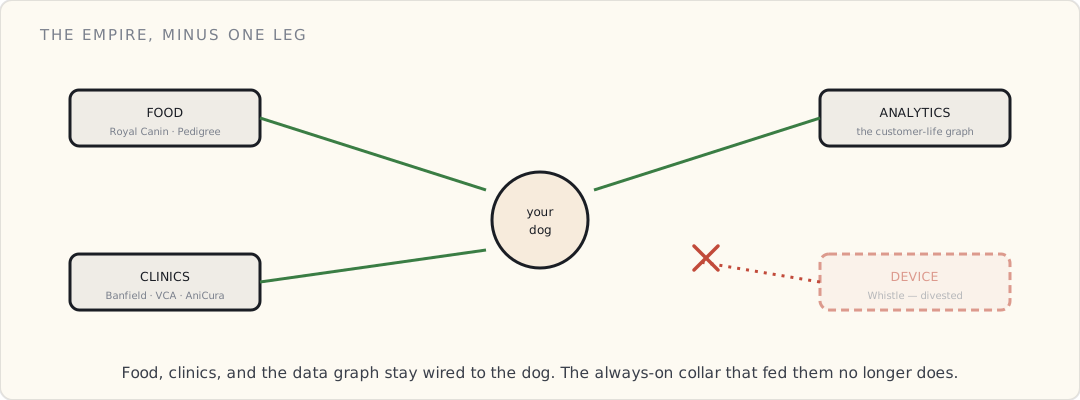
3. The empire framing needs revision. Mars still owns Banfield + VCA + AniCura + Royal Canin + Pedigree + Champion. The vertical integration of food + clinics + analytics is intact. But the device leg of the empire is severed. The recommendation conflict is now lopsided — Mars can push food + clinic + analytics, but no longer has the always-on accelerometer in your dog's collar feeding into its data graph. The data flow that justified the 2016 Whistle acquisition doesn't exist anymore.
What I'm buying
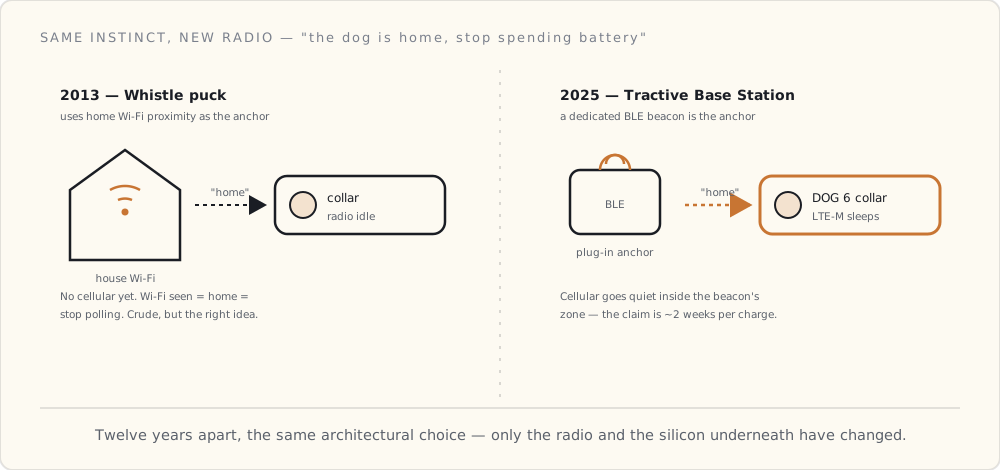
- DOG 6 ($69.99) + Base Station ($19.99) — evaluating against Quark's Fi when his battery degrades. Tractive claims about two weeks per charge on the DOG 6; whether the Base Station's power-saving zone stretches that past Fi's real-world fortnight is the test that decides whether Tractive beats Fi on the engineering Fi pioneered.
- GPS Cat Mini for Joule and Boson — already deployed since late 2022. Their outdoor patterns are well-documented via SureFlap door logs; cellular covers the off-property dimension the door logs don't capture. Will continue evaluating as part of the broader Tractive assessment.
- Not buying: any Whistle device (obviously). PetPace gets a wait.
What's next
Buying the Tractive hardware now, evaluating over the next 4-6 weeks. The Base Station is the genuinely interesting product — a plug-in short-range anchor that tells the cellular tracker "you're home, stop spending battery." It rhymes with the very first device in this notebook: the 2013 Whistle leaned on home-WiFi proximity for exactly that "the dog's home" signal. Twelve years later the instinct is unchanged — only now it's a dedicated BLE beacon instead of the house WiFi, with much better silicon underneath. Same architectural choice, new radio.
Cracking the case open to figure out the radio when it arrives. Writing it up after.