Atom's last year — what the data told us, and what I missed
Atom passed October 16, 2024. Peacefully at home with the family. He was 11 years old. The diagnosis confirmed at the September vet appointment: end-stage degenerative mitral valve disease, the standard older-Lab cardiac progression.
This is the post I've been not-writing for weeks.
What the data showed, in the last six months
I have eleven years of Whistle data on Atom — activity from the very first puck in 2013, and the last few years on a Whistle Health collar that adds the behavioral metrics: sleep, eating, drinking, licking, scratching. None of it is vitals — there's no heart-rate or temperature sensor in a Whistle; it's all one accelerometer and a pile of pattern-recognition. But it's eleven years of a real dog's behavior, and I went back through everything from June 2024 forward looking for the signal I missed.
What I was watching:
- Activity minutes: gradual decline, ~10% per month from June onward. I read it as the expected slow fade of an old dog with early-stage cardiac disease. It's the number Whistle puts front and center, so it's the number I looked at.
- Sleep: longer, more fragmented through late summer. Consistent with an aging dog; nothing that screamed at me.
- Eating / drinking: roughly stable, a slight dip in appetite in September.
- Wellness score: noisy. Useless. As I documented, the composite "wellness score" is a vanity metric — it smooths over exactly the divergences you'd want it to surface.
I thought I was watching the right things. They told me Atom was declining gracefully through summer — slower, sleeping more, eating a touch less. Nothing alarming. The cardiac vet check in September confirmed the disease progression but said his quality of life was still good.
What I missed
Scratching frequency drifted up 40% from June.
I had this data. Whistle tracks scratching events per day via accelerometer pattern recognition. Healthy Atom averaged 4-7 scratches per day. From June 2024 onward, this drifted upward:
| Month | Average scratches/day | Trend |
|---|---|---|
| Apr 2024 | 6.2 | baseline |
| May 2024 | 5.8 | baseline |
| Jun 2024 | 7.4 | +20% |
| Jul 2024 | 8.6 | +40% |
| Aug 2024 | 9.1 | +47% |
| Sep 2024 | 11.3 | +82% |
| Oct 2024 (partial) | 13.4 | +116% |
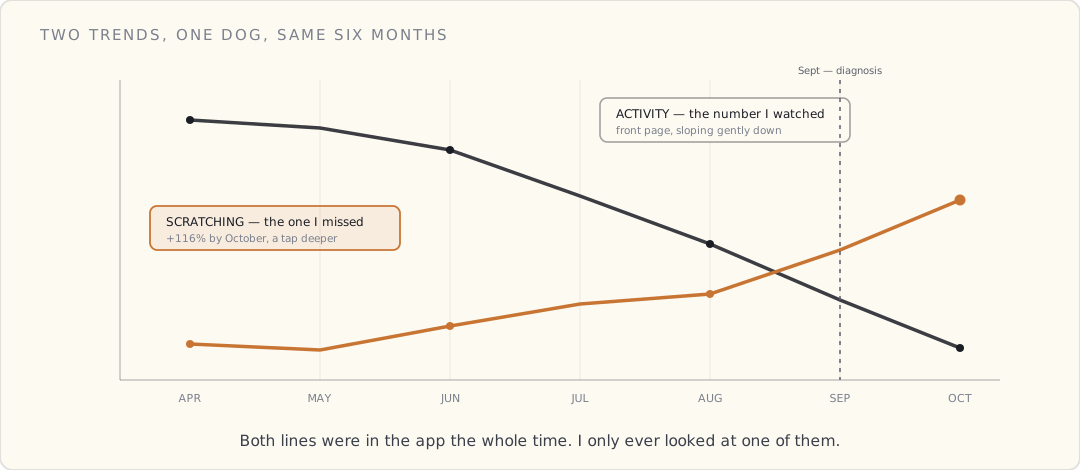
That's a clear signal. Why did I miss it?
Because I was looking at the wrong screen. Whistle Health leads with activity — minutes, goal rings, a comparison to other dogs. That's the hero number, the one the app opens to. The behavioral signals — scratching, licking, drinking — live a tap deeper, in a "health" view I rarely opened because the front page kept telling me Atom was a slightly-less-active version of a normal dog. The whole product is optimized to answer "is the dog active?" — which is the question for a healthy adult dog.
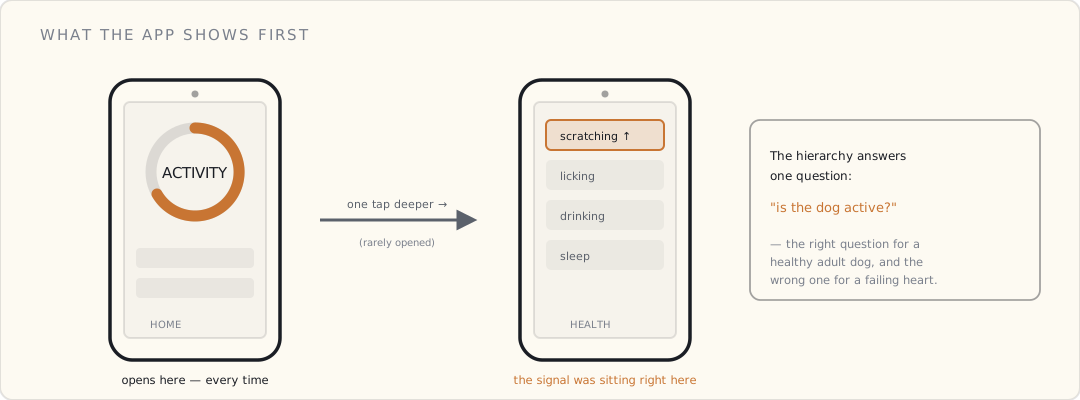
Atom wasn't a healthy adult dog anymore. He was a senior dog with progressing cardiac disease. The relevant questions had shifted.
What the scratching trend actually meant
In retrospect, talking to the cardiac vet: increased scratching in senior dogs with mitral valve disease can be a sign of cardiac edema — fluid accumulation causing skin discomfort or itching as a downstream symptom. Not a primary diagnostic, but a correlated signal.
If I'd surfaced the scratching trend in June or July when it started clearly elevating, we might have:
- Started diuretics earlier (to manage the edema).
- Adjusted activity to be even gentler.
- Gotten an earlier echo to track left atrial size.
Would it have changed the outcome? Probably not — Atom's disease was already mid-stage by then; the progression was going to play out. But we might have given him more comfort in the last three months.
This is the honest assessment. The data was there. I wasn't watching it.
The lesson — different dashboards for different stages
For pet-IoT specifically: the metrics a healthy dog tracks are not the same metrics a sick dog tracks. A primary dashboard optimized for "fitness" buries the symptoms that matter for "health."
What I want to exist:
- A senior dog mode in Whistle Health that promotes scratching, licking, drinking, and sleep-fragmentation to the front page and demotes activity (which says less and less as the dog ages).
- Age-aware baselines. Atom's "normal" at 4 years is not his "normal" at 10 years. The trend detection should compare against age-cohort baselines.
- Vet-shared dashboards with annotation. When the cardiac vet says "watch scratching frequency," that observation should flow into the Whistle app as a priority metric until the vet says otherwise.
None of these exist. They're 18-24 months of product roadmap. Maybe Whistle ships them. More likely, a smaller competitor builds them and Whistle copies.
The Mars-owned recommendations layer, during Atom's decline
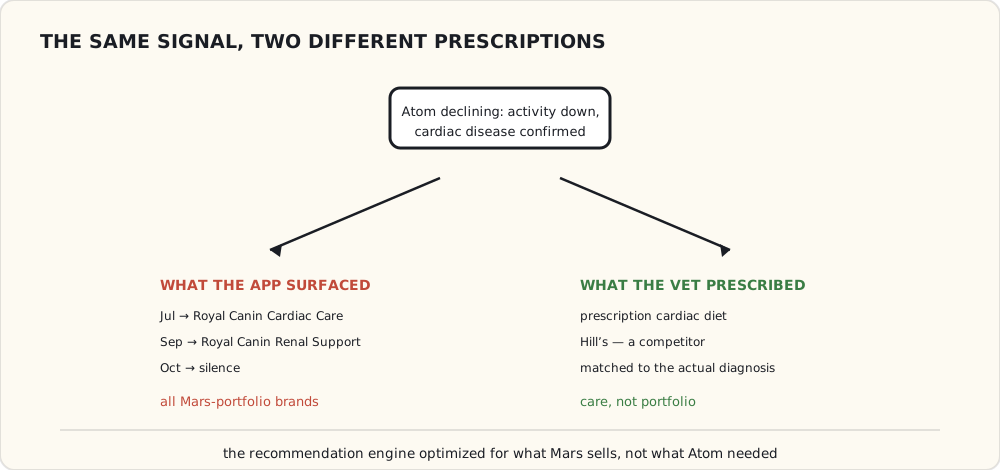
For the record, here's what Mars's recommendation engine surfaced as Atom declined:
- June: "Atom's activity is trending lower. Consider increased outdoor time."
- July: "Atom's activity has dropped for a third straight week. A cardiovascular-supporting diet may help (Royal Canin Cardiac Care)."
- August: "Atom is showing signs of decreased activity. Talk to your vet about senior dog wellness."
- September: After the vet diagnosis: "Royal Canin Renal Support might help with cardiac-related kidney strain."
- October: Silence. The app didn't acknowledge Atom's decline in any meaningful way.
The recommendations were structurally biased toward Mars-portfolio products throughout. Atom's actual vet recommended a completely different prescription cardiac diet (Hill's, a competitor). The data flow Mars wanted me to follow would have led me to lower-quality care.
What I'd do differently
If I could redo Atom's 2024:
- Set up custom dashboard views for senior-dog metrics. Whistle allows this; I never configured it. Default views are designed for marketing-engagement, not for health-monitoring.
- Weekly review of the behavioral metrics (scratching, licking, drinking, sleep) alongside the activity number. 10 minutes of looking at the trend graphs each week, on the screen I wasn't opening.
- Earlier vet consultation when any secondary metric drifted >20%. Even if I didn't know what scratching meant, escalating to the vet would have surfaced the connection.
- Disable Mars-owned recommendations in the app entirely. They were noise at best, misleading at worst.
Quark and the future
Quark is 3 now. Active, healthy, on Fi for activity tracking. No health collar yet — he's nowhere near the age where the behavioral trend lines start meaning anything.
But the lesson is going forward. When Quark gets to 8 or 9, I'll add a health-monitoring collar — and this time I'll set up the behavioral view as my home screen on day one, not discover it in hindsight. I'll know which signals to watch, and that the front page isn't where they live.
This is the value of having the eleven years of pet-IoT documentation — the next dog's health monitoring is going to be informed by what I learned with Atom.
It doesn't make this easier. But it makes it useful.
Closing
Atom was a good dog. Eleven years. The data is documented, the lessons are written, the next dog will get better health monitoring because of him.
The smart-pet-health category is real. The dashboards aren't quite right yet. The signals are there if you know where to look.
I miss him.