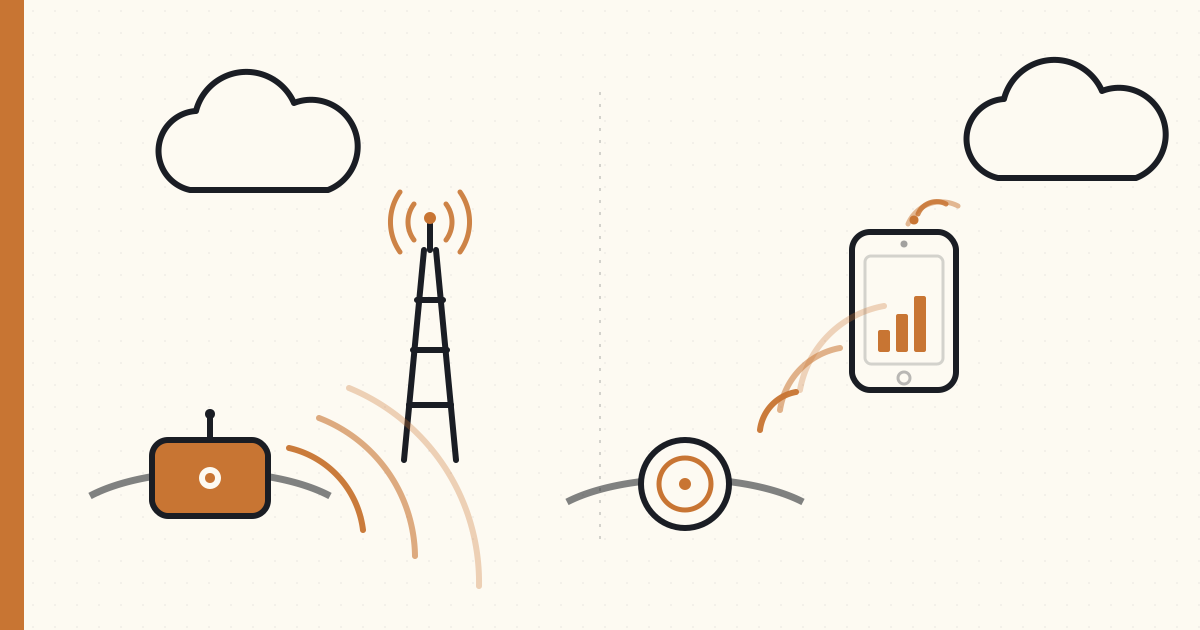
Tagg vs Whistle — cellular vs BLE pet-tracker philosophies
A month in with the Whistle on Atom's collar, and I keep finding myself in the same loop: open the app, look at his activity minutes, feel mildly reassured, then wonder what would happen if he actually got out the front door. The honest answer is the Whistle would have no idea. It counts how much he moves; it has no clue where. Which sent me down a rabbit hole on the other thing on the shelf at the pet store — Tagg The Pet Tracker — and what I found is that these two aren't competing products so much as two completely different bets about what a pet tracker is for.
Whistle shipped six weeks ago. Tagg has been out since 2011 — two years older, and built by people who think about radios for a living. Worth understanding both before I spend more money, because the choice isn't really "which is better." It's "which problem do I actually have."
Tagg: a phone for your dog
Tagg came out of Snaptracs, a subsidiary of Qualcomm. Qualcomm makes cellular chips, and you can feel that in the product — Tagg is essentially a tiny phone you bolt to a collar.
- A chunky plastic puck, around 30 g, that clips on.
- A cellular GSM modem and a GPS receiver inside.
- A rechargeable battery. The box claims up to a month — and that's true if it's sitting still in the charger pocket. The moment it's actually tracking, the modem and GPS come alive and you're looking at two, maybe three days between charges.
- No Bluetooth. No Wi-Fi. Just the cellular link.
It's $99 for the hardware and then $7.95 a month (or $79 a year) for the cellular plan, which rides on Verizon's network — fitting, given the device is essentially a Verizon modem with a GPS chip and a dog attached. Stop paying and the device stops working — there's no offline mode, because without the cellular link there's nothing for it to do.
What you get for that: real-time location, anywhere there's cell coverage. Draw a geofence around the house, and if Atom crosses it, the cloud pushes a "your dog left home" alert to my phone with a dot on a map. There's a basic step-counter in there too, but it's clearly a side feature — the accelerometer is along for the ride.
This is the "what if he gets out" product. Hunting dogs, working dogs, fence-jumpers, the dog you genuinely cannot afford to lose. For that job there's nothing else like it in 2013.
Whistle: a Fitbit that needs to come home
Whistle shipped October 8th, and made the opposite bet down to the silicon.
- A smaller, nicer coin-shaped aluminum puck — same ~30 g, but it looks like a piece of jewelry next to the Tagg.
- Two short-haul radios on board: Bluetooth 4.0 (BLE) and Wi-Fi. No cellular, no GPS. No base station — I went in expecting a wall-powered hub and there isn't one.
- Rechargeable, and the 7-to-10-day battery claim has held up so far — I've been charging it about once a week.
- It gets data off the collar two ways, both straight from the puck. Either it talks BLE to my paired phone and the phone relays to the cloud, or it joins the home Wi-Fi and uploads to the cloud itself, no phone needed. One radio at a time, roughly hourly. Out of range of both, it buffers about three weeks of activity to its flash and dumps the backlog the next time Atom's near my phone or home Wi-Fi.
It's $129 up front and no subscription. The history, the breed comparisons, all of it is free.
What it gives you: activity tracking, calibrated to Atom's breed and age — rest, play, walk, broken out by the day, with a percentile against other Labs his age. What it flatly cannot give you is location. None. The hardware can't sense it, so the app doesn't pretend to.
This is the "how's he doing" product. The healthy dog whose owner wants a trend line. Which, for an eight-week-old puppy who isn't allowed off the property unsupervised, is exactly the problem I have.
The whole thing comes down to the radio
Here's the realization that made the two click into place for me. The price difference, the battery difference, the real-time-vs-not difference — they're not three separate design decisions. They're all downstream of one choice: which radio is in the puck. Everything else falls out of that.
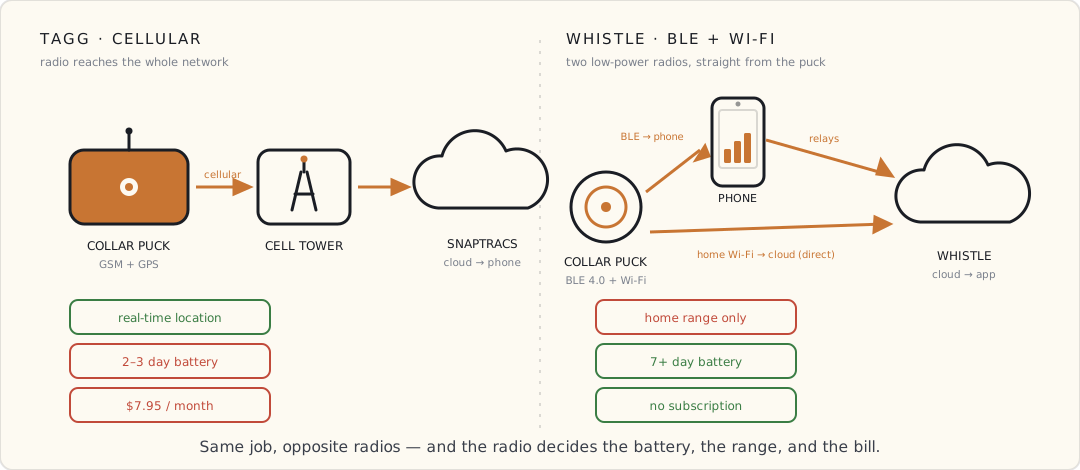
Tagg's path is short and always reaching outward: the puck gets a GPS fix, opens a cellular link straight to the Snaptracs cloud, and the cloud pushes the alert to my phone. End to end that's maybe 30 to 90 seconds — GPS lock, cellular handshake, push delivery. The catch is that a cellular modem can't be deeply asleep and still be reachable; it has to keep waking up to hold its place on the network. A radio that's mostly on is why the battery is mostly dead — two or three days, like I said.
Whistle's path reaches the cloud straight from the puck — two ways — and has a hard boundary. When my phone is near, the collar whispers BLE to it and the phone relays the batch to the cloud; when it's not, the puck brings up its own Wi-Fi, joins the home network, and uploads directly. Either way the app pulls down the day's summary. Both radios sip power next to a cellular modem, and they're never on at once — the puck keeps BLE up for the cheap case and only fires Wi-Fi in short hourly bursts to push a batch — so the collar sleeps most of the time. That's the week-plus battery. But it only works near home or my phone. The instant Atom is out of both — a walk, the car, the vet — the collar quietly buffers to its little flash and goes dark to the cloud until he's back in range of one of them.
Put the two radios on a timeline and the battery story is the whole story. The cellular modem can't ever fully sleep — it has to keep checking in with the tower to stay reachable — so its line is mostly on, and the battery drains in days. Whistle's radios are dark almost all the time and flicker awake just long enough to hand off a batch — a quick BLE advertise to the phone, or a short Wi-Fi burst to the cloud — so the line is mostly off, and the battery coasts for a week.
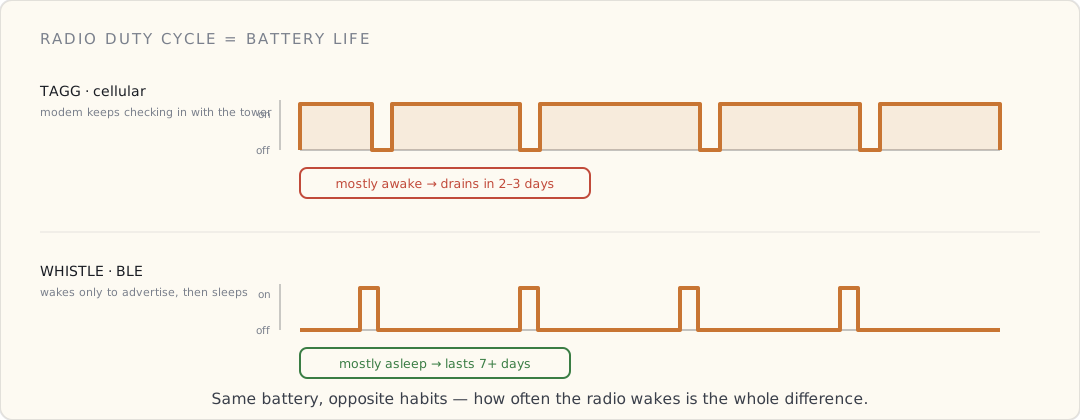
So the two architectures aren't really arguing about price. They're arguing about a physical tradeoff you can't dodge: a radio that reaches the whole cellular network and a battery that lasts the week are, in 2013, mutually exclusive in a 30-gram puck.
What it actually costs over five years
The monthly fee feels like the big number, but stretch it out and it's not even close.
| Tagg | Whistle | |
|---|---|---|
| Hardware | $99 | $129 |
| Subscription / year | $79 | $0 |
| 5-year total | $99 + $395 = $494 | $129 + $129 |
| …plus one battery-death replacement | ~$590 | ~$260 |
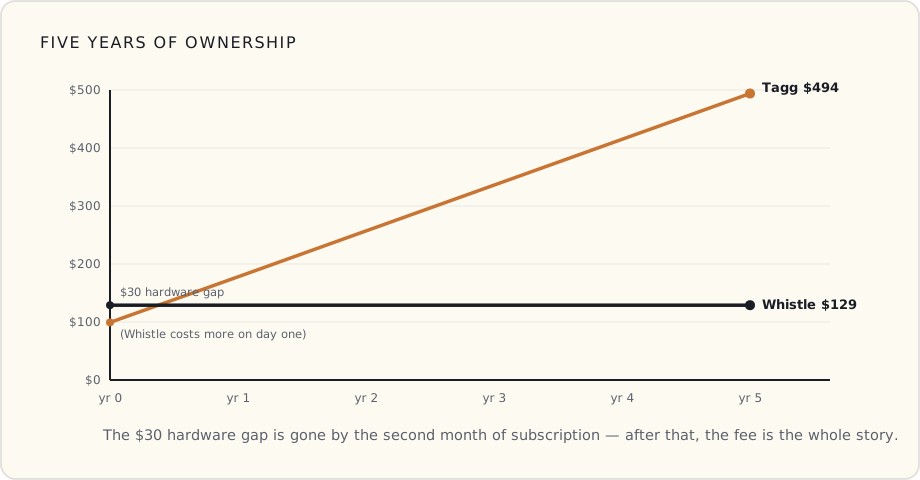
The hardware gap is $30 in Whistle's favor and feels like Tagg's the cheaper entry. Over any real ownership timeline the subscription swamps it — Whistle ends up roughly half the cost for the average dog over five years. You're not paying Tagg for a nicer device. You're paying it for the cellular bytes, every month, forever.
That's not a knock on Tagg. If the thing you need is "find my dog when he's three streets over," $79 a year is cheap insurance and the battery math doesn't matter — you'll charge it constantly and be glad it exists. It's only a bad deal if you're buying it for a job it isn't built for.
So which one for Atom
Laid out as a grid, the decision basically makes itself.
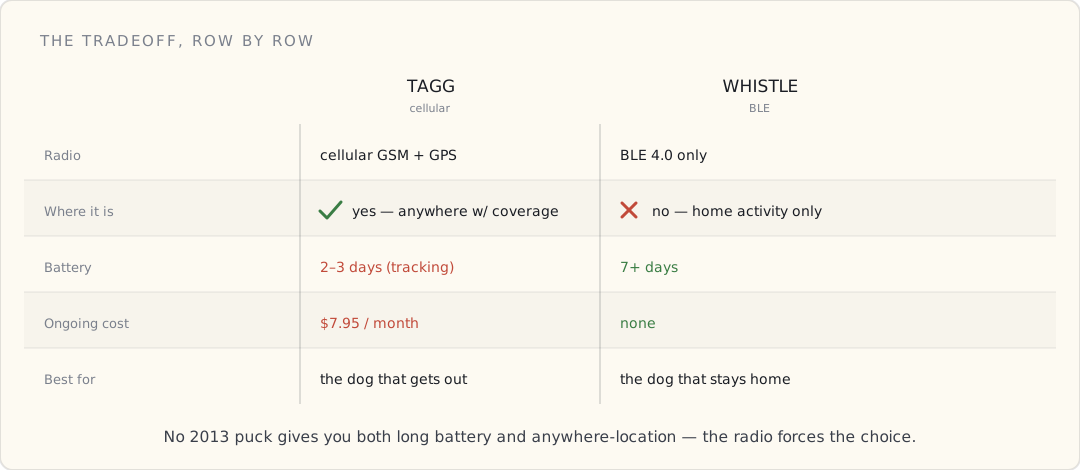
Atom is firmly in the right-hand column. Eight weeks old, never off the property without a leash and a human attached to it. If he goes missing, the tracker is the least of my problems — something has gone very wrong with the human end. What I actually want right now is exactly what Whistle does: a baseline of how a healthy puppy moves, so that a year from now I have something to compare against when I'm wondering whether he's slowing down or I'm imagining it.
If he were a beagle with a nose and a fence to clear, I'd have a Tagg on him by now and I'd grumble about charging it every other night. He isn't. So: Whistle, and the location question stays parked.
Where I think this goes
Both of these are narrow first-generation products, and you can see the move each one has to make.
Tagg already has an accelerometer in the puck — it just doesn't do much with it. Adding real activity tracking is mostly software and a better app; the sensor's already there. The harder problem is the form factor and that monthly bill.
Whistle's missing half is the whole location story, which means cellular and GPS — and that's a much bigger lift, because it drags along the exact battery-and-subscription tradeoff Whistle was built to avoid.
If I had to bet, I'd bet on Whistle making the jump before Tagg fixes its problems. Whistle has the momentum, the nicer hardware, and a brand people actually like; Tagg has the radio expertise but a clunky puck and a fee that's hard to love. The endgame I'd put money on is convergence — one device that leans on its low-power radios while the dog's home, and flips to cellular-and-GPS the moment he isn't. Sip power in the house, spend it only when the dog's actually missing. Split the battery tradeoff across the two situations instead of picking one and living with it.
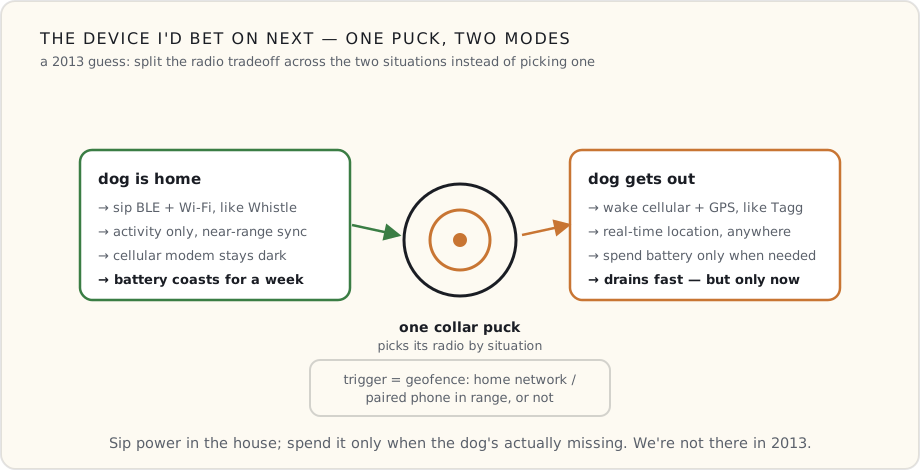
That's the device I'd actually want for Atom: a Whistle that grows a cellular radio for the day he finally figures out the gate. We're not there in 2013. But I'd be surprised if we aren't within a couple of years, and when someone ships it I'll be first in line — and I'll write it up here.
What's next
For now it stays simple: just the Whistle, just activity, and Atom going nowhere unsupervised anyway.
The next member of the household is on the way and is going to be a cat, which throws all of this out the window. Cat tracking in 2013 isn't BLE or cellular — it's a different category entirely: microchips and RFID, short-range and identity-first instead of location-first. So the next one's a primer on that — how the chip under the skin actually works, and why "tracking" a cat means something completely different from tracking a dog.