The bug that wasn't in the mesh
Two admin consoles, one per mesh, cross-seeded so each shows both meshes via the backbone. It worked. Then, after a rebuild, each console showed only its own mesh. Classic "what did I break?" — and the answer, twice in one session, was: nothing in the mesh.
Scare one: the 40-second node
Spawned nodes took ~40 seconds to appear, while removals were instant. The asymmetry was the clue: removal is an event (a tombstone), but appearance waited on a node actually joining the gossip swarm — and with mDNS off (it cross-contaminates every node on localhost), a node had no way to resolve the address of a peer it only learned about through gossip. iroh fell back to a discovery lookup that failed and retried. join_peers takes a node id; it needs an address from somewhere.
The fix was not to invent something — it was to stop inventing something. I started hand-rolling a custom AddressLookup, and the reviewer stopped me: iroh already ships MemoryLookup, a manual address book. The gossip digest already carries each node's location. So: register the location into iroh's built-in book on the receive path. Peers resolve directly, no failed lookup, no 40 seconds. The whole fix was populating an existing extension point instead of building a parallel one. (This is the same instinct the n0 team designs for — the library nearly always has the hook already; the work is finding it, not replacing it.)
Scare two: NeighborUp, then NeighborDown
Convergence fixed, the cross-mesh view still broke on fresh restart. I had a tidy theory — "the address lookup races the join" — and I wrote it into the report as the root cause. It was wrong, and my own data said so: the failing run logged zero address-lookup failures. There was no failed lookup to lose to.
So I stopped theorizing and turned on iroh_gossip=debug against the live, broken consoles. The answer was two lines:
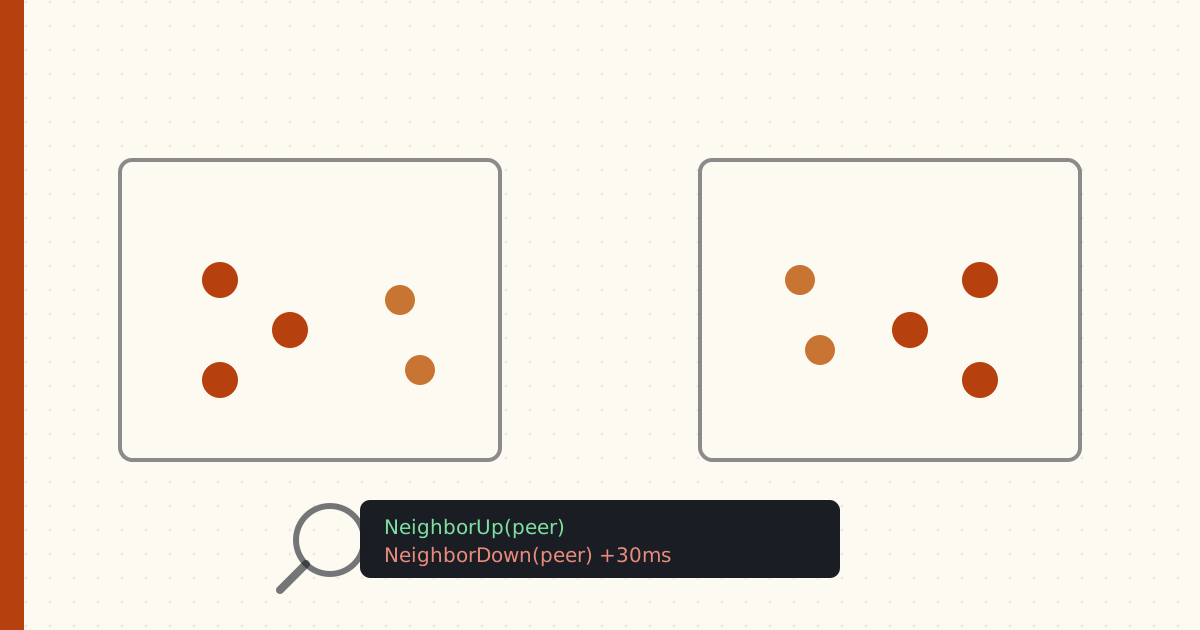
NeighborUp(peer)     — the backbone gossip neighbor forms
NeighborDown(peer)   — 30 ms later, inside a conn{peer} span, it's torn down
The neighbor formed and was immediately killed. Cause: I'd seeded the two consoles bidirectionally — each dials the other. That makes two QUIC connections between the same pair, and the connection bookkeeping had a "supersede" step that, on seeing the second connection, called close() on the first — the one iroh-gossip was using as its backbone neighbor. The mesh wasn't broken. My test setup (bidirectional seeding) tripped a latent connection-management bug.
The fix: don't force-close a superseded-but-live connection. Adopt the newest for the data plane and let the stale one idle-time-out. Critically, this can't hurt the common case — a child only ever dials its console (one direction, one connection, nothing to supersede). With it, bidirectional cross-seed shows both meshes again, summaries flowing both ways.
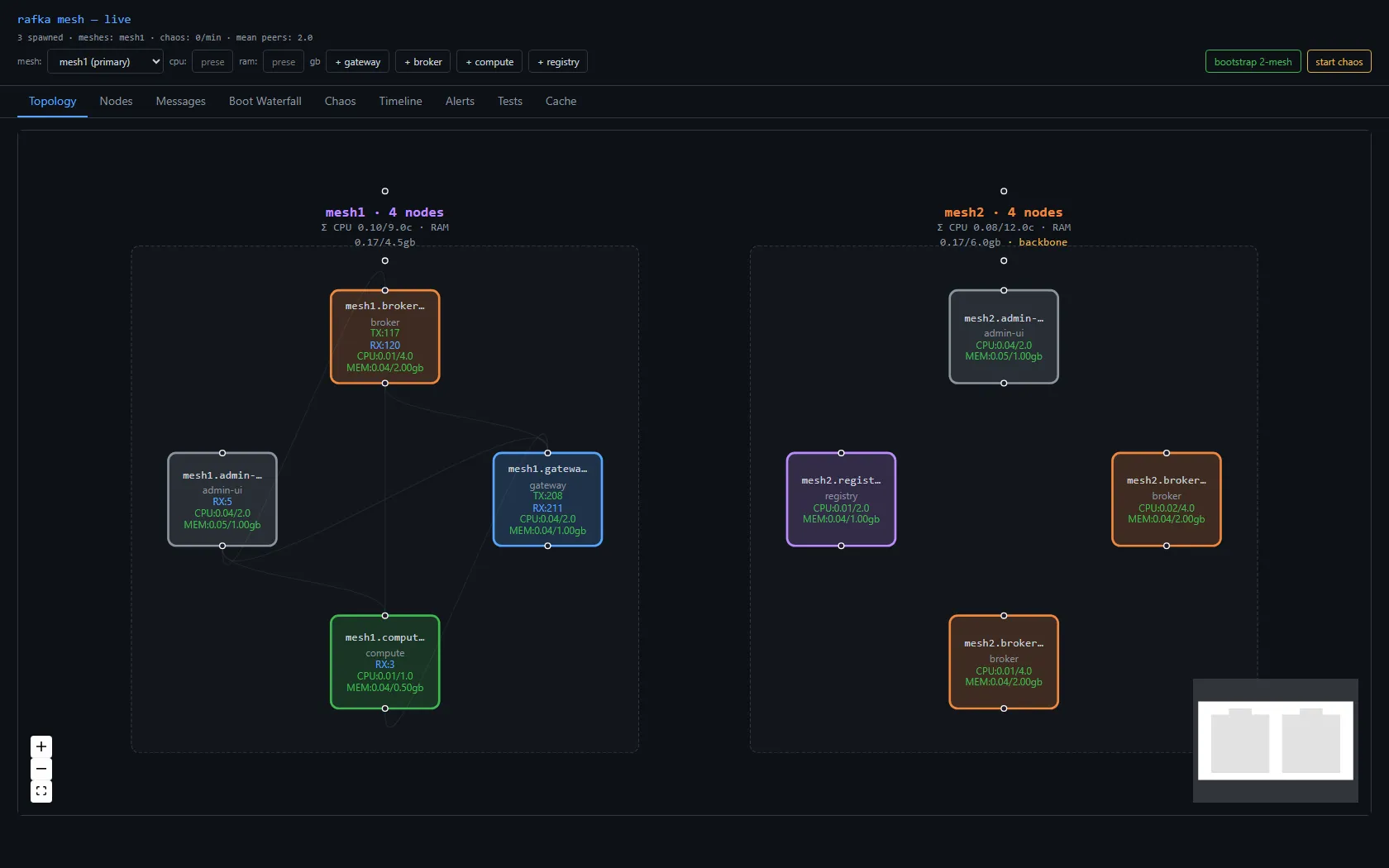
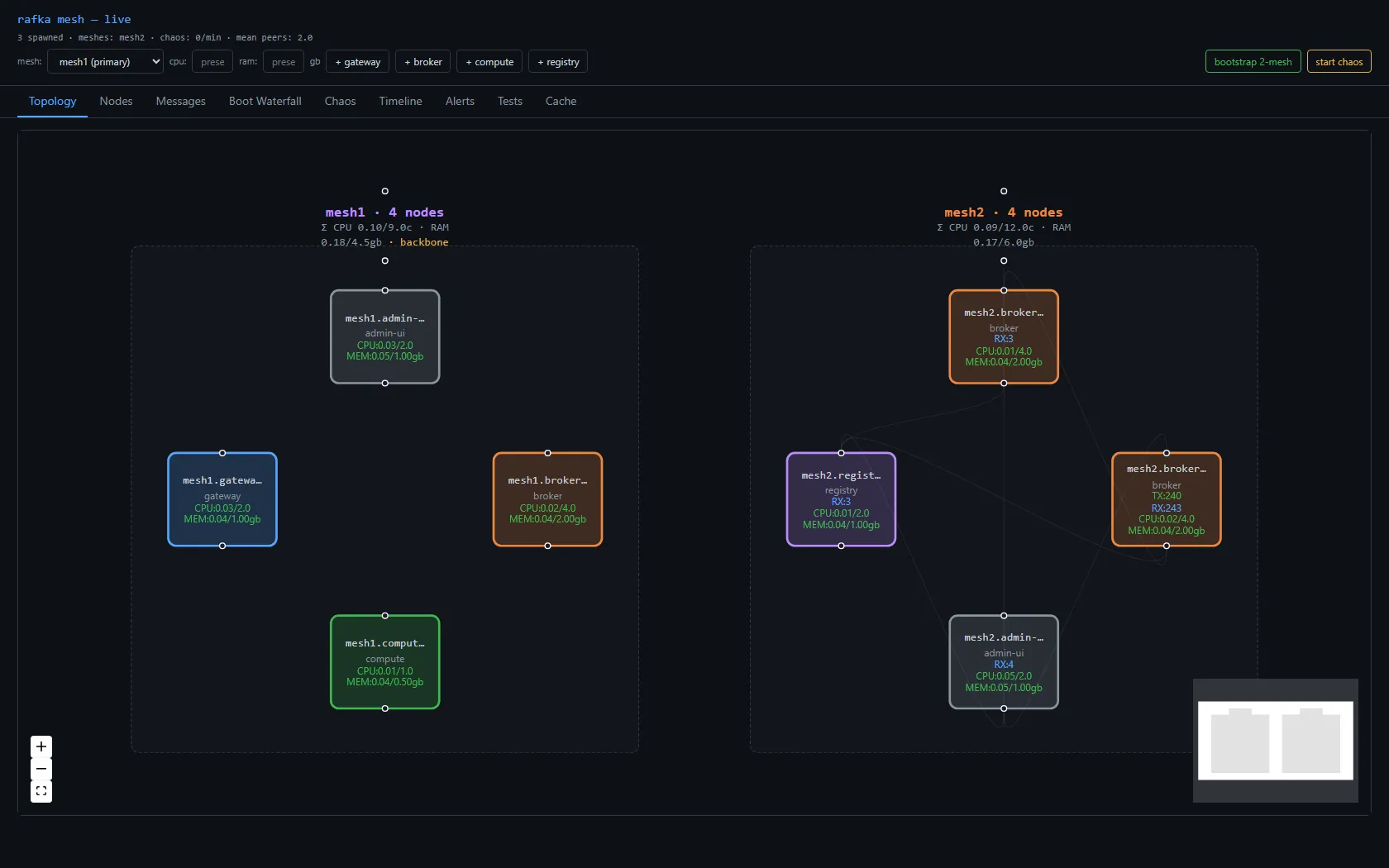
Here is both directions live. Console 1 is mesh1's home and renders mesh2 from the backbone; console 2 is mesh2's home and renders mesh1 from the backbone. The remote mesh's group header is tagged · backbone, and — once the directory started carrying per-node load — every cross-mesh node shows its own CPU and MEM, not a blank box.
The actual lesson
Both scares were the same mistake waiting to happen: trusting a plausible story over the live signal. The first time, a reviewer caught me reaching for a custom component the library already had. The second time, a refuted-by-my-own-logs root cause nearly shipped — and the cure was 30 seconds of =debug on the running system, not another rebuild. The five relaunch cycles I did burn first taught me nothing; the one debug log taught me everything.
When the mesh "breaks" after a change, the cheapest next move is almost never another change. It's to make the system tell you what it's actually doing — and to write your root cause as a sentence you'd be willing to have your own logs contradict.
What I'd tell a team
- Reach for the library's hook before your own. Both the 40-second join and a dozen smaller things dissolved the moment I used the primitive that already existed. A custom component is a maintenance liability you're choosing; earn it.
- A root cause is a falsifiable sentence. "The lookup races the join" sounded right and my logs had zero lookup failures. If you can't state your root cause as something your own telemetry could contradict, you don't have a root cause — you have a guess.
- Debug the running system, don't re-run it. Relaunching teaches you nothing new; one level of
=debugon the live, broken thing usually teaches you everything. The signal is already there — turn it up before you change anything.