Watching a node boot, then a second mesh with no bridge
The performance work earlier in this notebook left me with a substrate that idles when it has nothing to do and stays flat under churn. That was the foundation. This post starts the thing it was a foundation for: a small, observable multi-mesh fabric — named nodes in named meshes, a gossiped directory so any node can find any other, and not one line of bespoke infrastructure I could get from the library instead.
The rule I set on day one and never relaxed: telemetry is the substrate, not a feature. A node that does work without leaving a trace is a bug. So before there was any "product," there was a boot-span chain and a Jaeger instance to read it in.
A node names itself
When you spawn a broker into mesh1, it doesn't get a random hex id and it isn't named by some central authority. It loads (or mints) its own identity, then self-names from it:
node_name = <mesh>.<type>.<first-6-hex-of-node-id> e.g. mesh1.broker.239dc9
The mesh is required — an unlabelled node fails fast — the type is what it is, and the suffix is the first 6 hex of the node's public key, so the friendly name is eyeball-matchable to its unique id. No registry hands out names; identity is the name.
The boot is a span chain
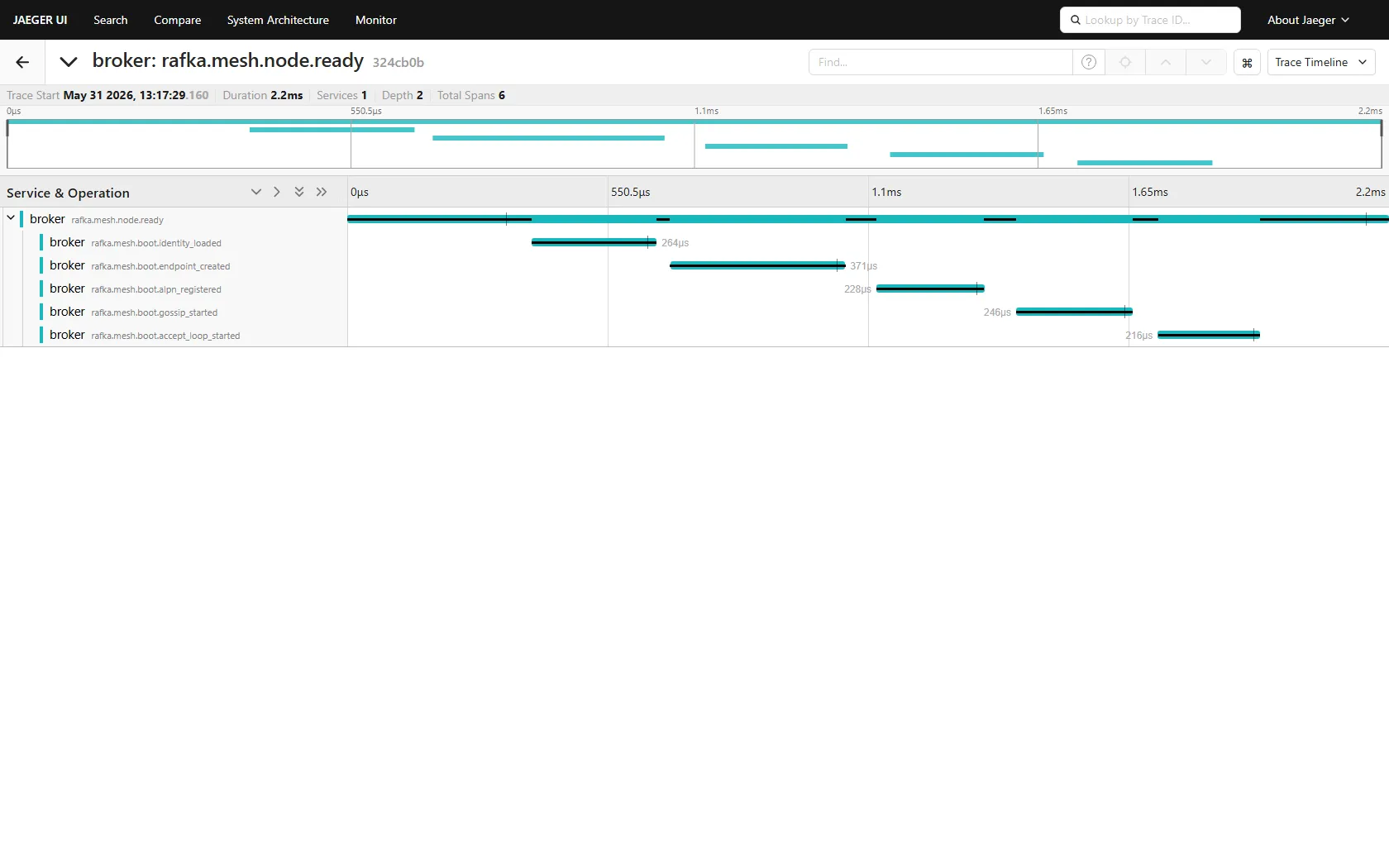
Every boot is one trace rooted at node.ready, with the bring-up steps as children — endpoint_created → alpn_registered → gossip_started → accept_loop_started, each a few hundred microseconds, all under one root. If a node is misbehaving, the trace tells you exactly how far it got before it stalled.
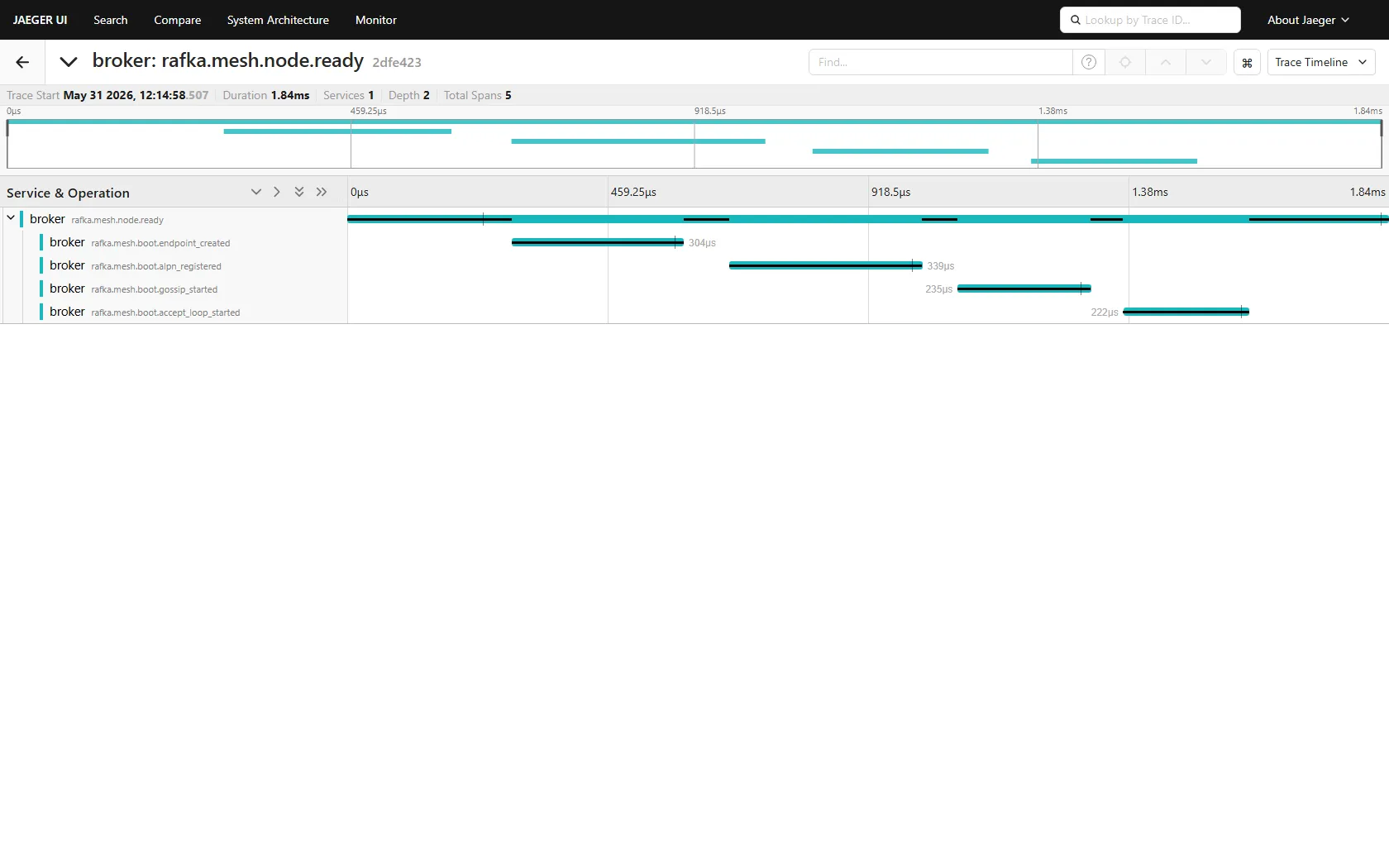
This is the spine. Get the boot chain visible for one node and you can always answer "did it start, and how far did it get" without attaching a debugger.
A topology cache, built from gossip
Each node broadcasts a small digest on its mesh's gossip topic, including its reachable address. Every node accumulates those into a process-local directory — name → {mesh, type, location} — surfaced as a Cache view. This is the thing a node consults to answer "where do I send to reach X?" There's no second gossip system and no database: the cache is the gossip digests, surfaced.

A second mesh — and deleting the bridge
The earlier design had a bridge: a special node that joined two meshes' gossip and shuttled awareness between them. It's the obvious first idea, and it's the wrong one — it's a bespoke piece of mesh infrastructure, and the substrate's whole premise is don't build mesh infrastructure, use the library. So the bridge had to go: out went the bridge node type, its spawn button, its env knobs, the whole crate. Two meshes now run side by side with no node whose only job is to connect them.
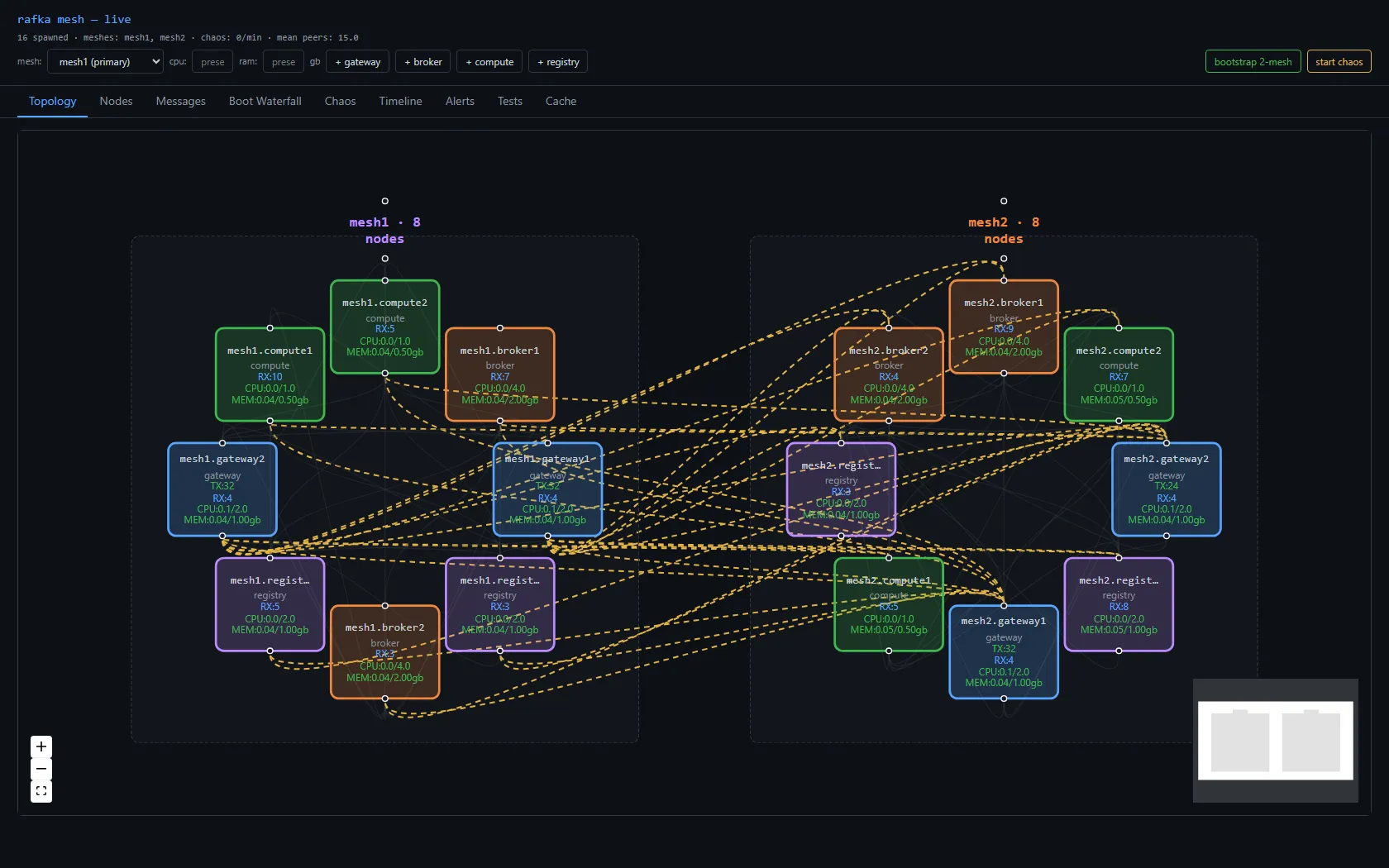
Per-mesh gossip lives on a per-mesh topic (blake3(mesh_id)), so a mesh1 node doesn't see mesh2 by default. The interim answer: the gateway — the node that writes across meshes — also subscribes to the other mesh's gossip, so its directory spans both. A simulated writer on mesh1.gateway resolves mesh2.broker from that directory and sends to it. The proof isn't a line in a log; it's the cross-mesh trace stitching end to end:
The catch (named, not hidden)
"The gateway subscribes to the other mesh's entire gossip" works for two meshes on one host. It does not scale: with many meshes and hundreds of gateways it's an O(meshes²) firehose of every remote node's per-tick digest, and it quietly forces the console to special-case itself as an all-mesh subscriber. That's a real debt, and the next post pays it down with a proper control-plane backbone — after first fixing something more embarrassing: the traces themselves were lying.
What I'd tell a team
- Make telemetry the floor, not the polish. If "does this node work" can only be answered by reading its logs by hand, you'll be reading logs by hand forever. A boot-span chain is cheap and it's the thing you'll lean on every single debugging session after.
- Let identity be the name. Self-naming from the public key means no allocator, no name collisions, no central authority to be down — and a friendly id you can still match to the real one by eye.
- Refuse the bespoke node. A "bridge" felt necessary and wasn't. Every special node type is infrastructure you now own and operate; reach for the library's primitive before you invent one.