Hunting a connection leak the soak test wouldn't explain
I'd already pushed this whole thing public. The mesh worked: nodes discovered each other, gossiped, survived the chaos battery. The four-day soak had already cost me five leaks and taught me to never trust a thirty-second canary. I thought I was done with this class of bug.
Then I ran a meaner soak — kill and respawn on a tight loop, the kind you leave going for hours — and watched RSS climb and never come back down. Same shape on Windows, same shape on Linux. Classic leak, and not the one I'd already fixed.
This is the story of finding it, and the three things that turned out to be wrong at once.
The trap: theorizing about the reap path
The mesh runs an iroh QUIC transport under a HyParView/Plumtree gossip layer. Under churn, peers join and leave the active view constantly, so connections are born and reaped all day long. Every reap path I traced should have worked. The connection loop returned. close() got called. The maps got pruned. I spent hours reading code that, on paper, released everything it touched.
This is the same hole I fell into before the flamegraph post — sitting there reasoning about what the code should do instead of measuring what it did. The lesson refuses to stick the first time, or the second: when a leak resists reasoning, stop reasoning and instrument it.
The breakthrough: count, don't infer
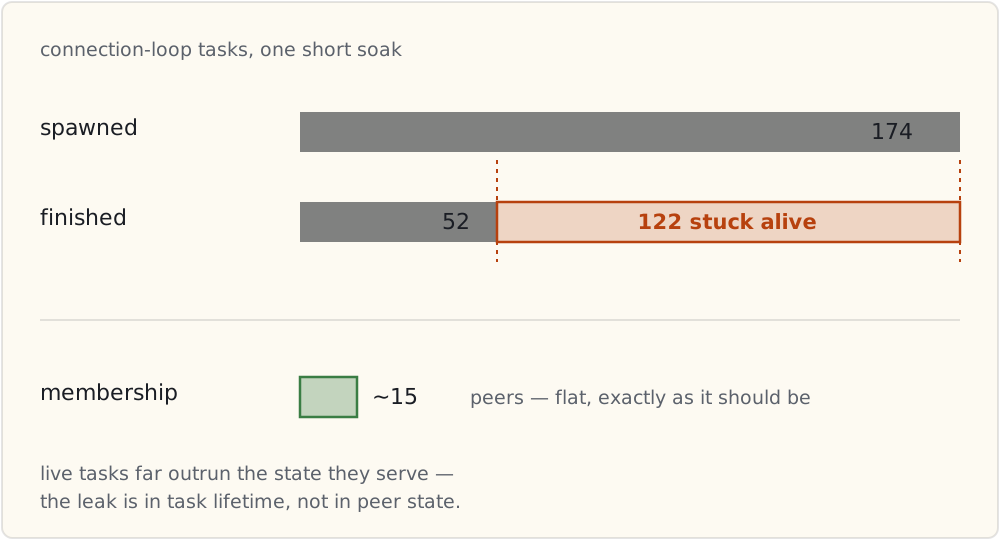
So I stopped reading and added two counters to the gossip actor — connection-loop tasks spawned versus tasks finished — and ran a short soak. The numbers ended the debate:
spawned = 174, finished = 52 → 122 connection-loop tasks stuck alive
Meanwhile the membership map sat bounded at ~15 peers, exactly as it should. So roughly 107 connection-loop tasks had no peer state behind them and yet had never exited. That contradiction — live tasks with nothing to serve — pinned the bug to one place instead of the whole gossip layer.
Root cause #1: a select! arm that switched itself off
Here's the send loop, simplified to the part that mattered:
tokio::select! {
    _ = &mut closed => break,
    Some(msg) = self.send_rx.recv() => self.write_message(&msg).await?,
    // ...
}
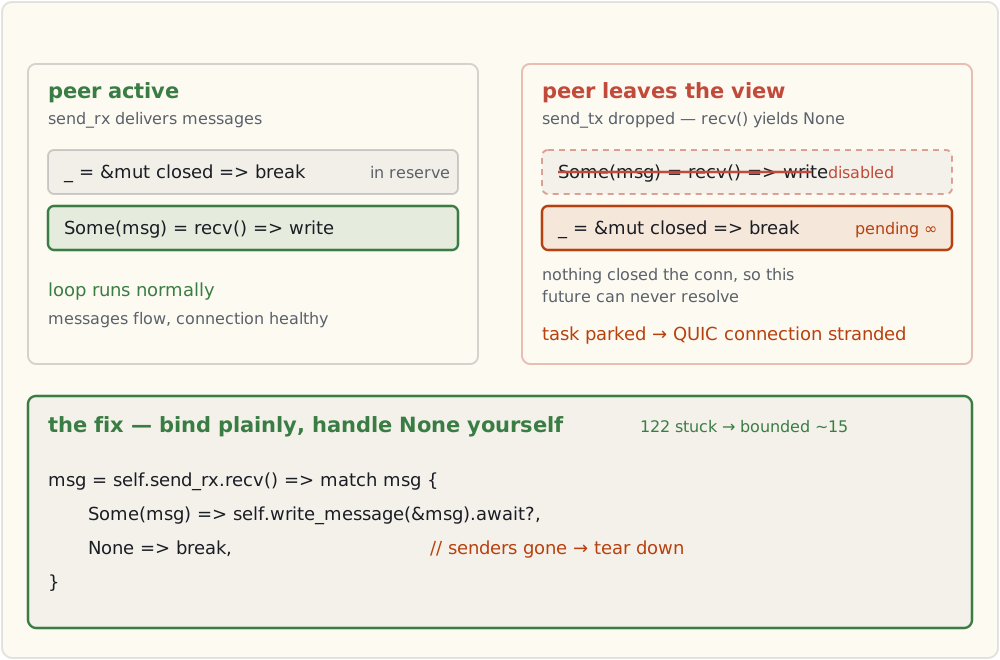
When a peer leaves the active view, its send_tx is dropped and recv() starts returning None. The trap is that the Some(msg) = … pattern doesn't deliver that None to me — when the pattern fails to match, select! disables that branch for the rest of the loop. The branch goes dark.
The only other long-lived arm, _ = &mut closed, stays pending forever, because nothing has actually closed the connection — that was supposed to happen because the send loop noticed the peer was gone. So the loop parks on a future that can never resolve. The send task hangs, the connection loop that owns it never completes, and the QUIC Connection and its driver task are stranded. One leaked connection for every peer that leaves — and the nodes that rotate peers the most leak the fastest.
The fix is to stop pattern-matching the channel closed away and handle the None myself:
msg = self.send_rx.recv() => match msg {
    Some(msg) => self.write_message(&msg).await?,
    None => break, // all senders dropped -> peer gone -> tear down
},
Stuck tasks went from 122 and climbing to a bounded ~15. This is a cousin of the reconnect leak from the soak post — both are a task outliving the thing it was serving — but the mechanism is different and nastier, because the code looks like it handles shutdown. The closed arm is right there. It just never gets a chance to fire.
Root causes #2 and #3, because leaks travel in packs
With connections bounded, a heap profile still grew — slower, but up and to the right. Two more, both smaller, both mine:
- Telemetry retention. The OpenTelemetry tracing layer was floored at
DEBUG. Under churn the network stack emits a debug firehose, andtracing-opentelemetryappends every captured event to the currently-active span's buffer — which is only freed when that span closes. My long-lived actor spans never close. So their event buffers grew without bound. One single 2 MB allocation in the profile turned out to be one span's event vector. The fix was a one-liner: floor the export layer atINFO. - Process-table enumeration. The per-node load sampler built its system handle by enumerating every process on the box, every tick — tens of thousands of transient name strings on Windows, every couple of seconds. It only ever needed our own process. The fix: don't enumerate the world; sample only our own pid.
Neither of those is exotic. Both are the kind of thing that compiles, reads fine in review, and costs you megabytes an hour in production.
The payoff
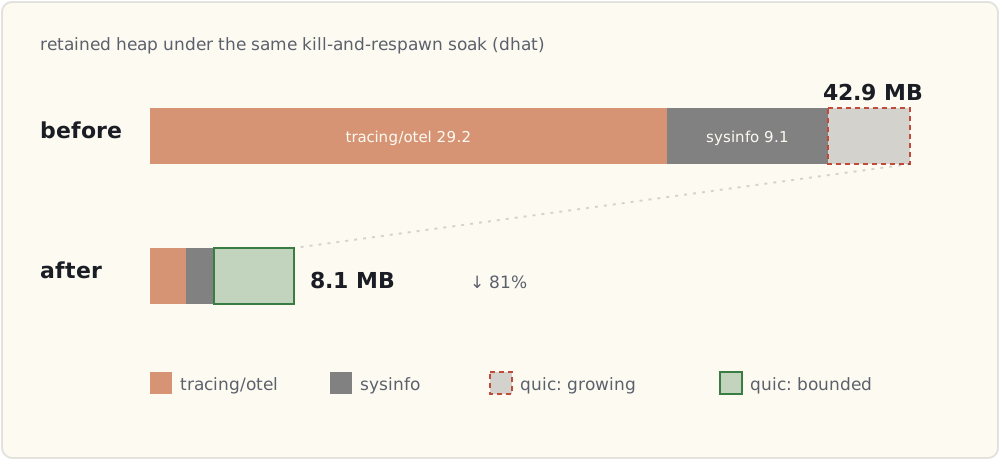
Measured with dhat, before and after, under the same kill-and-respawn soak:
| bucket | before | after |
|---|---|---|
| total retained heap | 42.9 MB | 8.1 MB (↓81%) |
| tracing / otel | 29.2 MB | 2.0 MB |
| sysinfo | 9.1 MB | 1.6 MB |
| quic connections | growing | bounded |
And the thing that actually matters — RSS troughs under sustained chaos went from a monotonic climb to a flat plateau, on Windows and Linux both. Over a 35-minute soak, an observer node's RSS at 140 chaos events dropped from 0.228 GB to 0.115 GB — about 66% lower — and dhat put the QUIC connection bucket at 18.7 MB → 3.85 MB.
Where the bugs actually lived
Here's the part I had wrong going in. I assumed — the way you always do — that the bug was in my code, not the library. The two small ones were: the telemetry floor and the process-table sampler were my config, one-line fixes. But the connection leak itself, the dominant one, was in the stack, and tracing it produced a cluster of fixes I submitted upstream to three crates:
- The gossip layer got the most. The
select!SendLoop footgun above; makingconnection_loopexit (it ran send and receive underjoin!, which waits for both — but the receive half blocks forever onaccept_uni()when a peer leaves locally, so I moved it toselect!); and pruning the per-peer state that outlived removed peers —peer_topics,peer_data, thelazy_push_queueonNeighborDown. Plus regression tests so the leak can't creep back. - iroh itself had a per-remote address cache (
AddrMapbehindmapped_addrs) with no eviction path — it grew once per remote ever seen under churn. The clean-shutdown path now evicts the departing remote's cached addresses. - The QUIC layer underneath leaked a whole connection task, packet spaces, and channels whenever a
Connectingwas dropped before its handshake finished — and before the handshake there's no idle timeout to eventually reap it. The fix was animpl Drop for Connectingthat drains and releases.
Two days of soak-and-profile to find them; the diffs themselves are tiny. That's the usual ratio for a leak that only shows up under sustained churn — the finding is the work, the fix is a few lines.
A thank-you to the people who built this
I want to stop and say this plainly, because it's easy to skip past: I got to find these at all only because the whole stack is open. I'm building on iroh and iroh-gossip — peer-to-peer QUIC, NAT traversal, hole-punching, a relay tier, Plumtree/HyParView gossip — none of which I could have written myself in a reasonable lifetime. It's built by the team at n0 (github.com/n0-computer), and the quality of it is the reason my "substrate" is a few hundred lines instead of a few hundred thousand.
And here's the part that still feels lucky every time: when I did hit real bugs deep in that stack, I could read the exact code, instrument it, prove the fault, and send a fix back — and there's a real, responsive community on the other end to receive it. That's not how it goes with a closed black box, where the best you can do is file a ticket into the void and build a workaround. The n0 folks have done years of genuinely hard systems work — the kind where a single select! arm or a missing Drop is the difference between flat and climbing memory — and they gave it away so the rest of us can stand on it. An enormous high-five to that whole team. We are extraordinarily fortunate to have makers like this, working in the open, on infrastructure this good. Thank you.
What I'd tell a team
- Instrument before you theorize. A spawned-versus-finished counter found in minutes what hours of reading the reap path missed. If a resource leaks, count the thing being created and the thing being destroyed before you reason about why.
Some(x) = exprin aselect!arm is a footgun wheneverexprcan legitimately yieldNone. The failed match disables the branch instead of surfacing the close. Bind the value plainly and match it yourself.- Leaks travel in packs. Fixing the dominant one just unmasks the next. Profile again after every fix — the flat line you were hoping for is usually one more leak away.
- Telemetry is not free. Events recorded inside a never-closing span live exactly as long as the span. A long-lived actor span at
DEBUGis an unbounded buffer wearing a tracing label. - Sometimes it is the library — and that's a contribution, not a complaint. I went in assuming the bug was mine, because it usually is. This time the dominant leak was in the stack itself, and the right ending wasn't a workaround in my code — it was a handful of small fixes submitted upstream so nobody else hits it. A leak found under your churn is worth fixing at the source.
What's next
The substrate is finally flat under churn — for real this time, measured, on both platforms. The fixes are upstreamed and the foundation holds. Which means I can stop poking at the substrate's memory behavior and turn back to the thing this notebook is actually about: making a multi-mesh fabric observable and correct, one sprint at a time.