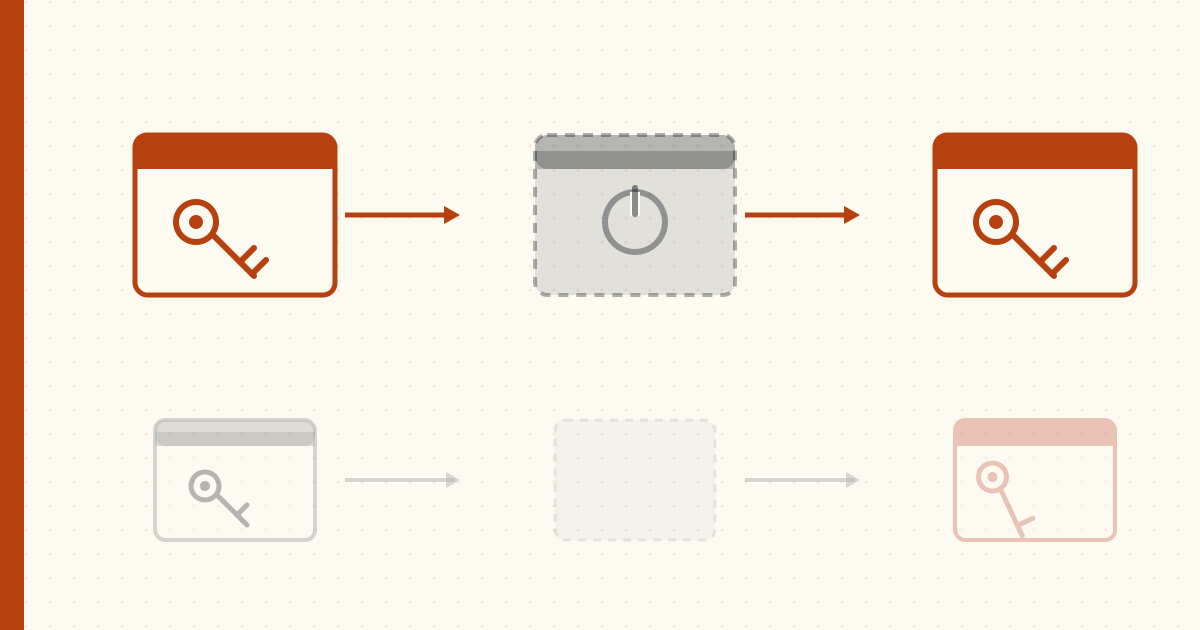
Keeping a node's name across a restart
Restart a node in this mesh and it forgets who it was. Not its data — its name. A node's identity here is an ed25519 keypair, and the node_id is literally the public key; that's how QUIC routes to it. Kill the process and let it boot clean and load_or_mint_identity does exactly what the second half of its name says: with no key to load, it mints a fresh one. The node comes back, but it comes back a stranger. Every peer that knew the old key has to re-establish to what looks like a node it's never seen, and the old entry lingers as stale until it ages out.
For most of the fleet that's correct. Nodes are cattle — interchangeable, disposable, the topology heals around any one leaving. But a handful aren't: a node pinned to a specific port, holding a specific routing role, the kind you restart to roll a config and want the mesh to barely notice. For those few, a new NodeId on every restart is friction you pay on the whole cluster's behalf. So this is the pets-vs-cattle escape hatch: kill the process, bring it back, same identity.
Where the identity actually lives
The key was never the hard part — admin-ui already had the mechanism. Every child node respects RAFKA_NODE_SECRET_KEY: set it to a hex-encoded 32-byte key and load_or_mint_identity uses it directly instead of minting. Admin-ui already pre-mints each child's key before it spawns the process — that closes a race where two concurrent spawns could otherwise land on duplicate names — so the key is sitting in memory the whole time. Stateful restart just keeps it and re-passes it.
The subtler half is the data dir. On first boot the key gets persisted to node-identity.json under E:/tmp/rafka-ui-nodes/<node_name>/, so there are two roads back to the same identity: the env var on the controlled restart path, and that file on any cold boot. Which means the dir isn't where a node stashes its identity — the dir is the identity. Wipe it and you've killed the node's name even if the process is the one you meant. That reframing is the whole reason this feature is more than a function call — because the mesh has a janitor.
What I had to defend against
Normally a node's exit triggers cleanup. Both kill_one — the operator's DELETE — and a background reaper loop wipe the data dir, node-identity.json and all. That's correct for cattle and catastrophic for a pet. So a stateful node carries three guards, and two of them exist purely because the cleanup is racing the restart.
The dir is never auto-wiped. For a node spawned stateful: true, both the explicit kill and the reaper suppress the directory cleanup. The dir is the identity; you don't get to delete it on the node's behalf. Only an operator wiping it by hand, or a fresh non-stateful spawn claiming the same name, clears it.
The SpawnedMeta record survives the kill. Admin-ui keeps an in-memory record of every child it spawned. For an ordinary node that record dies with the process; for a stateful node it persists across the kill — so the restart route can read back the original secret_key_hex and bind_port, and so it stays visible to the reaper's orphan sweep, the pass that wipes any dir not referenced by a live process or a meta entry. Lose the record and the orphan sweep sees a directory with nothing alive behind it and does its job.
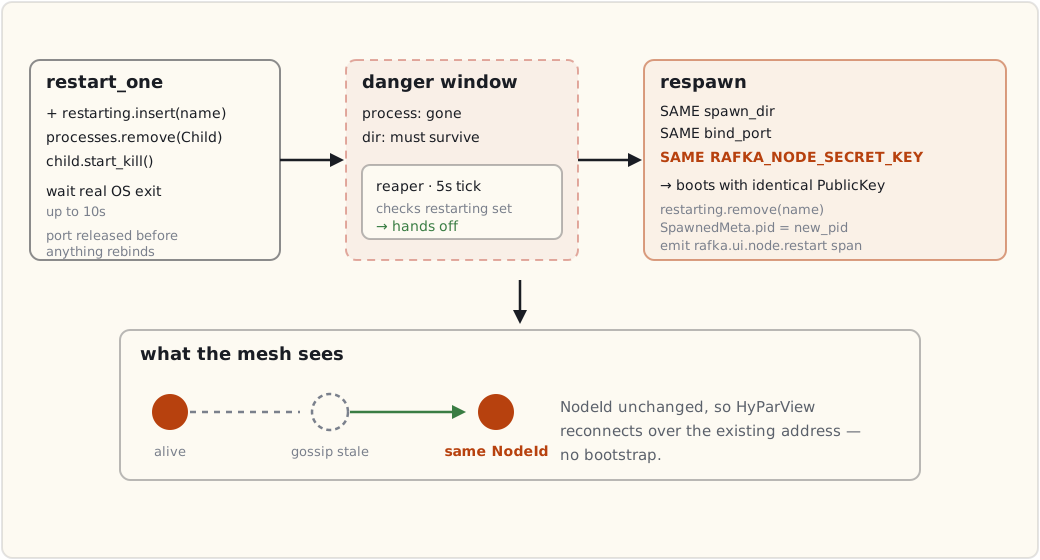
A process-global restarting set. This is the one that bit me. The reaper ticks every five seconds. A restart kills the process, waits for it to actually exit, then respawns — and there's a window in the middle where the process is gone but the dir must survive. If a reaper tick lands inside that window, it sees a dead process and a dir and wipes the identity out from under the respawn. So the node name goes into a process-global DashSet<String> for the duration, and the reaper checks the set before touching anything. One set, two lookups — and without it the feature has a flaky five-second hole that only shows up under exactly the timing you can't reproduce on demand.
Waiting for the process to actually be gone
The restart route is its own function — restart_one — and it deliberately does not call the normal spawn path. That's the load-bearing decision: the normal spawn mints a fresh key, so routing a restart through it would hand the node a new identity, the precise opposite of the point. Instead restart_one reads the SpawnedMeta, rejects with 422 if the node isn't stateful, and rebuilds the command by hand with the same dir, port, mesh, and secret key.
One step in the middle earns its slowness: after start_kill, it waits for genuine OS process exit — up to ten seconds. Not "we sent the signal," but "the kernel has reaped it." That's a Windows reality as much as a correctness one. The node holds a pinned bind_port; until the process is truly gone the OS hasn't released the socket, and a respawn that tries to bind it races the dying process for the port. And on Windows a running executable is file-locked — the same lock that, in an earlier sprint, had me debugging stale binaries for hours because a rebuild silently left the old .exe in place. So you wait for the real exit, then rebind. The ten seconds is a ceiling, not a sleep; almost always the process is gone well under it.
The chaos restart is the opposite on purpose
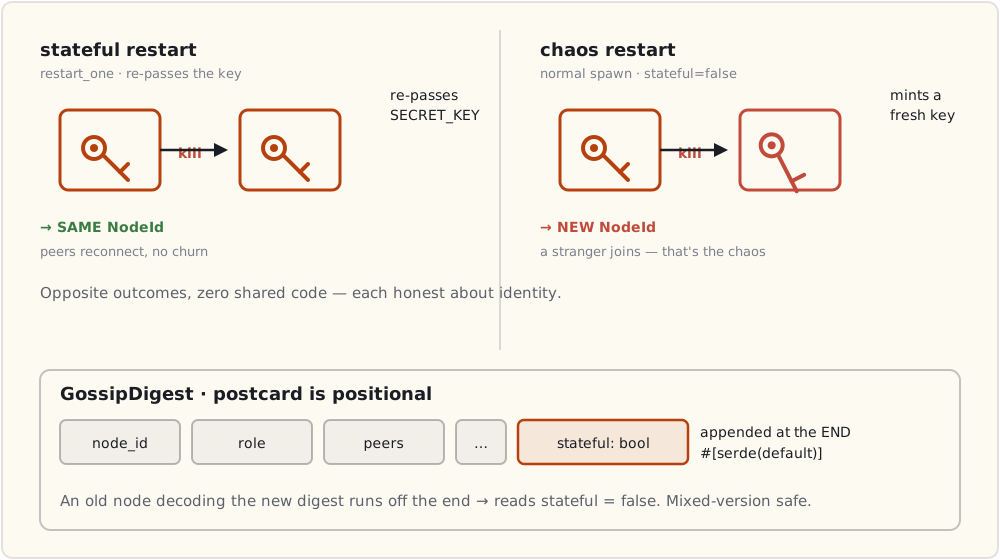
There's already a restart in this codebase, and it does the reverse of this one. The chaos battery has a restart_node primitive that deliberately mints a new identity — because that's the chaos. The whole point of that test is to prove the mesh heals when a node vanishes and a different node joins in its place: same name to an operator's eye, different cryptographic identity to the mesh.
So the two restarts want strictly opposite outcomes, and they share no code. The chaos path goes through the normal spawn with stateful=false and gets a fresh key by design; stateful restart is restart_one, which never touches that path. Keeping them separate isn't tidiness — it's the only way each can be honest about what it claims. Share a spawn and one of them is lying about identity.
One field on the wire
A node now advertises whether it's stateful. Each one appends stateful: bool to its GossipDigest — the payload it broadcasts to every mesh member every two seconds — and admin-ui's topology and heartbeats endpoints surface it so the UI can badge the pets.
The interesting part is where the field goes, and it's a postcard constraint. Gossip is serialized with postcard, which is positional — no field names on the wire, just order. So a new field has to be appended, never inserted, and it carries #[serde(default)]. An old node decoding a new digest runs off the end of the bytes it understands and fills stateful from the default: false. A new node decoding an old digest does the same. The cluster stays mixed-version-safe through a rolling upgrade because the default is the truthful answer for any node that doesn't know the concept yet. Append-with-default is the entire compatibility story — one line of attention at the end of the struct.
What I'd tell a team
- Find the thing that is the identity and refuse to delete it automatically. Here it's a directory holding a key file. The cleanup that's correct for a disposable node is destruction for a durable one. Make the cleanup ask "am I allowed to wipe this?" not "is the process gone?"
- A self-healing mesh has a janitor, and the janitor races you. The reaper that wipes orphaned dirs is exactly right — until a restart creates a window where a live node's dir momentarily looks orphaned. Any background reclaimer on a timer will eventually tick inside your critical section. Carry an explicit "hands off" marker through it; don't hope the timing misses.
- Wait for the real exit, not the signal. "We called kill" and "the OS has released the port and the file lock" are different facts, and on Windows the gap between them is where a rebind fails or a stale binary survives. Gate the respawn on genuine process death, with a ceiling, not a guess.
- When two operations want opposite outcomes, give them no shared code. One restart preserves identity, one destroys it on purpose. Routing both through one spawn forces a flag-soup that lies to half its callers.
What's next
A pet node now keeps its name across a restart, which is the first thing you need before a node can keep anything else across one. The obvious next thing it should keep is its data — a local cache it can answer from directly instead of going back to the mesh for every read. Stable identity is the floor under that: a cache is only worth warming if the node it belongs to is still the same node when it comes back up.