
Is it ready? We iroh'ed out the basics
When this series started it was a hunch wearing a hostile question: can a self-organizing P2P mesh in Rust actually hold up under load, or am I about to spend a year proving it can't? Somewhere between an 80-core box pegged at 100% by eighteen idle nodes and a chaos battery that refused to stop finding leaks, the question quietly stopped being rhetorical. So let me answer the one in the title.
Is it ready to start the real project on? Yeah. It is. We have — and I'm genuinely not sorry — iroh'ed out the basics.
That's the verdict, up top, because I'm not going to make you scroll to the bottom for a shrug. But "it's ready" is a claim, and claims that ride on a wall of green screenshots have a well-documented habit of being lies. So before I take a victory lap, let me show the work that earns the lap.
First, the caveat I refuse to bury under the confetti
Every gorgeous number in this series — RSS flat, CPU at 0.02 cores, zero panics across a four-day soak — was measured against nodes that do almost nothing. They receive a frame, emit a span, ack in microseconds, and go back to their hammock. Those numbers are floors for an empty substrate, not promises for a busy one. The day a node writes a durable record and holds a real backlog, the latency curve and the memory profile are going to develop opinions they don't have today.
I lead with this because it's the single assumption most likely to mug the version of me that builds on top of this next month. The foundation is solid. The foundation is also unloaded. Both are true at once, and only someone trying to sell you something tells you just the first one.
What actually earned the "yes"
Not vibes. I wrote down every claim the substrate makes, sorted them into proven, deferred, and not my problem yet, and then went and ran the provable ones until they either held or embarrassed me in front of Jaeger.
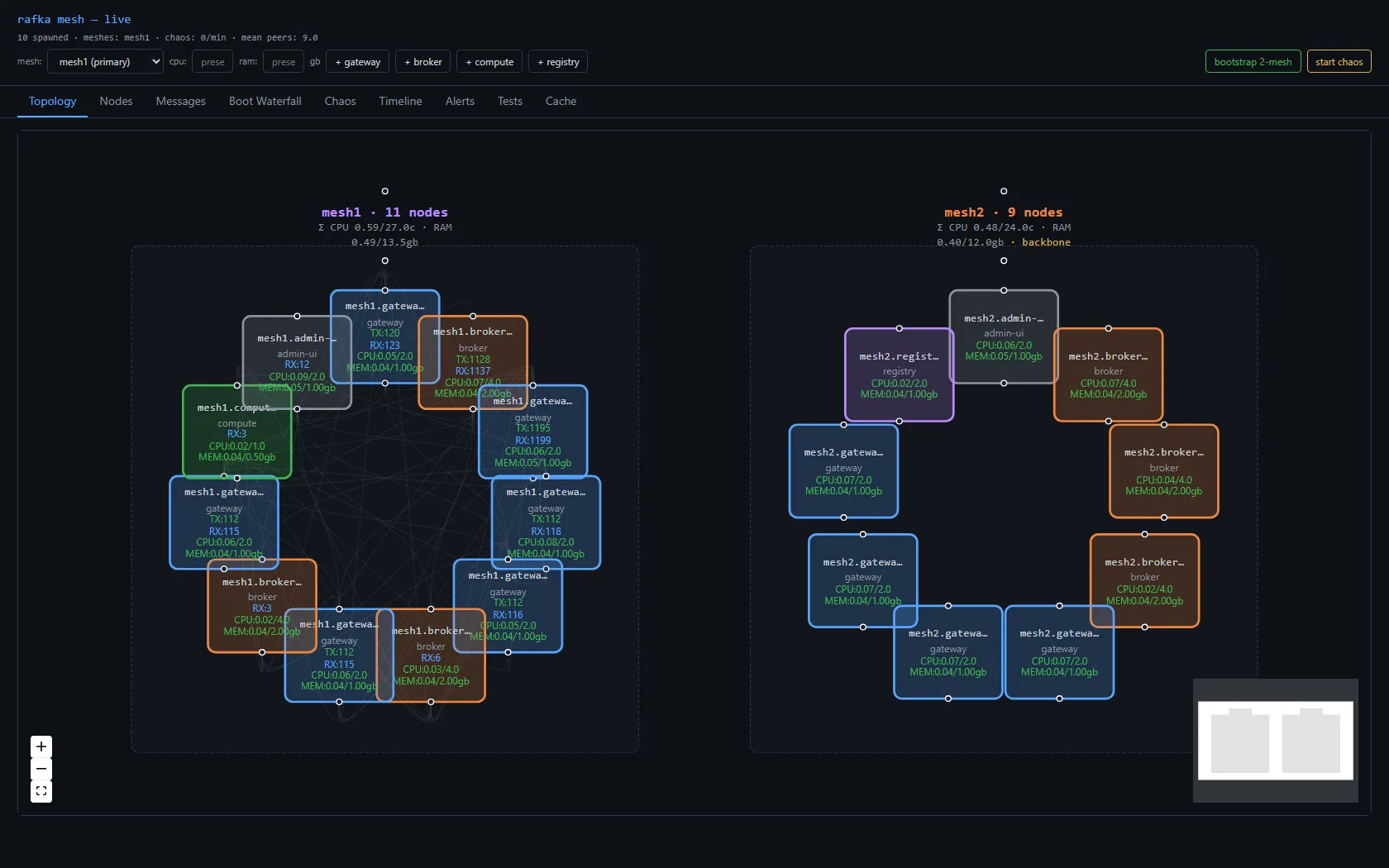
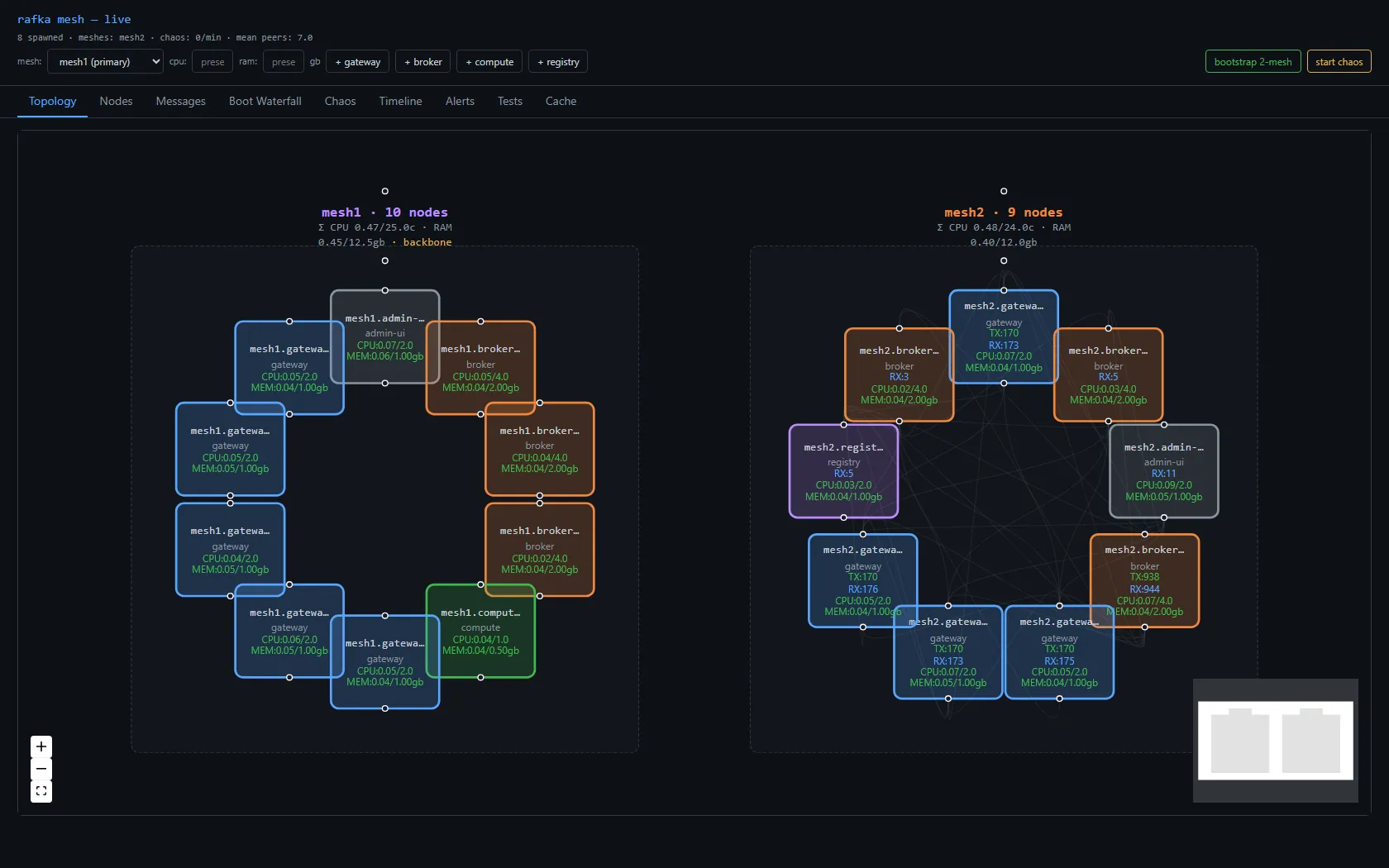
Produce/ack holds under concurrency. I scaled to ten gateways producing at once — each writing to a node in its own mesh and one across the backbone — against five brokers per mesh, and held it for two and a half minutes. 600 produce.handle in 150s (~4/s fleet-wide, dead steady) and 640 produce.ack — the full produce → handle → ack round-trip completing, not fire-and-forget optimism. Zero frame.decode_failed, zero panics, zero QUIC assertions; 20 processes the whole way, RSS flat (+1.2%, which is noise wearing a trench coat).
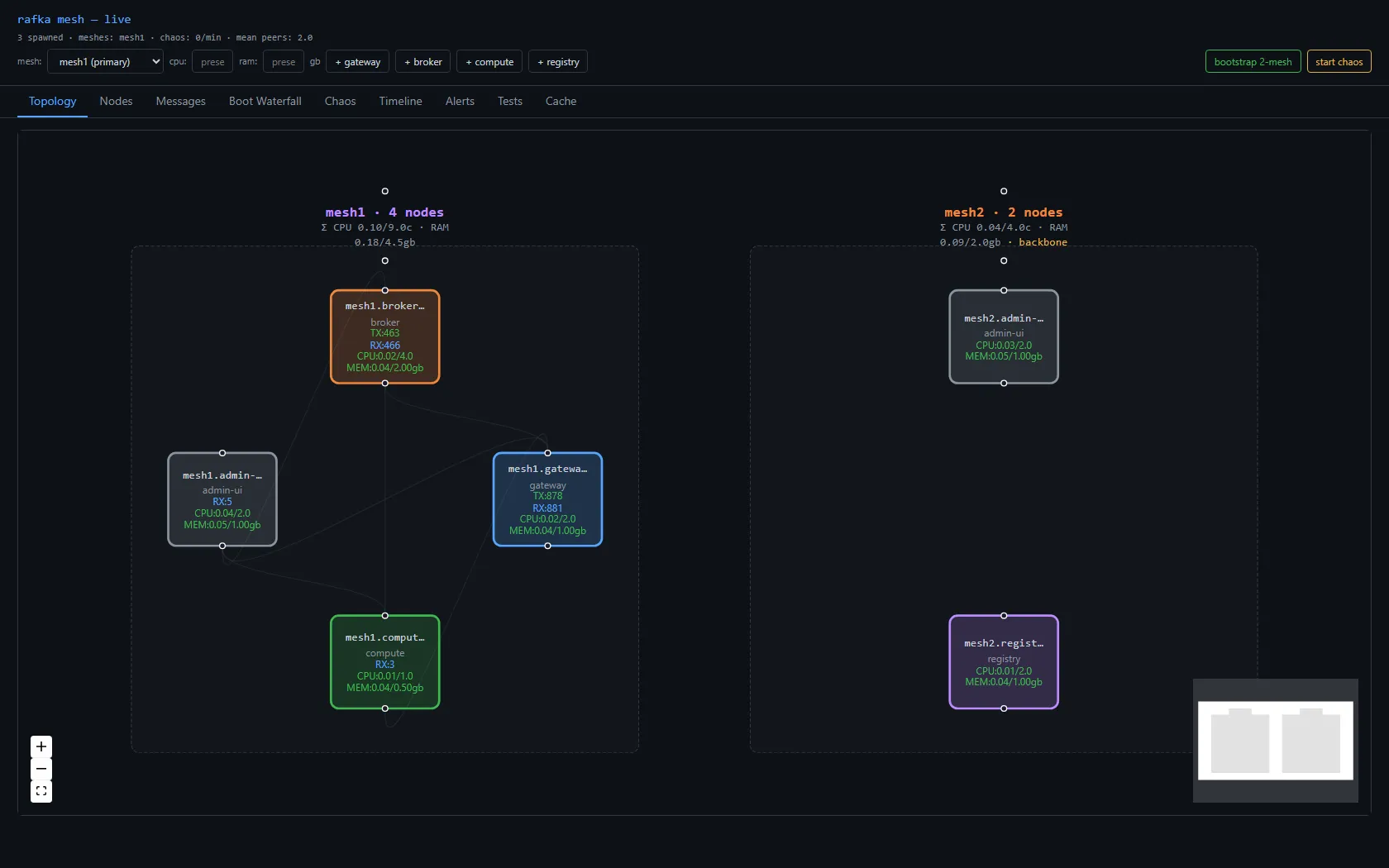
It degrades like an adult and recovers without being asked. I killed both cross-mesh write targets and watched. The gateway didn't crash and didn't spin — RSS flat, CPU ~0.09 cores, no retry storm, no sulking — and the intra-mesh write kept flowing the entire time. Cross-mesh produce.handle fell to 0 during the outage while intra held at 7. Then I brought one broker back, and the cross-mesh write resumed on its own the moment the backbone reconverged. Nobody pushed a button.
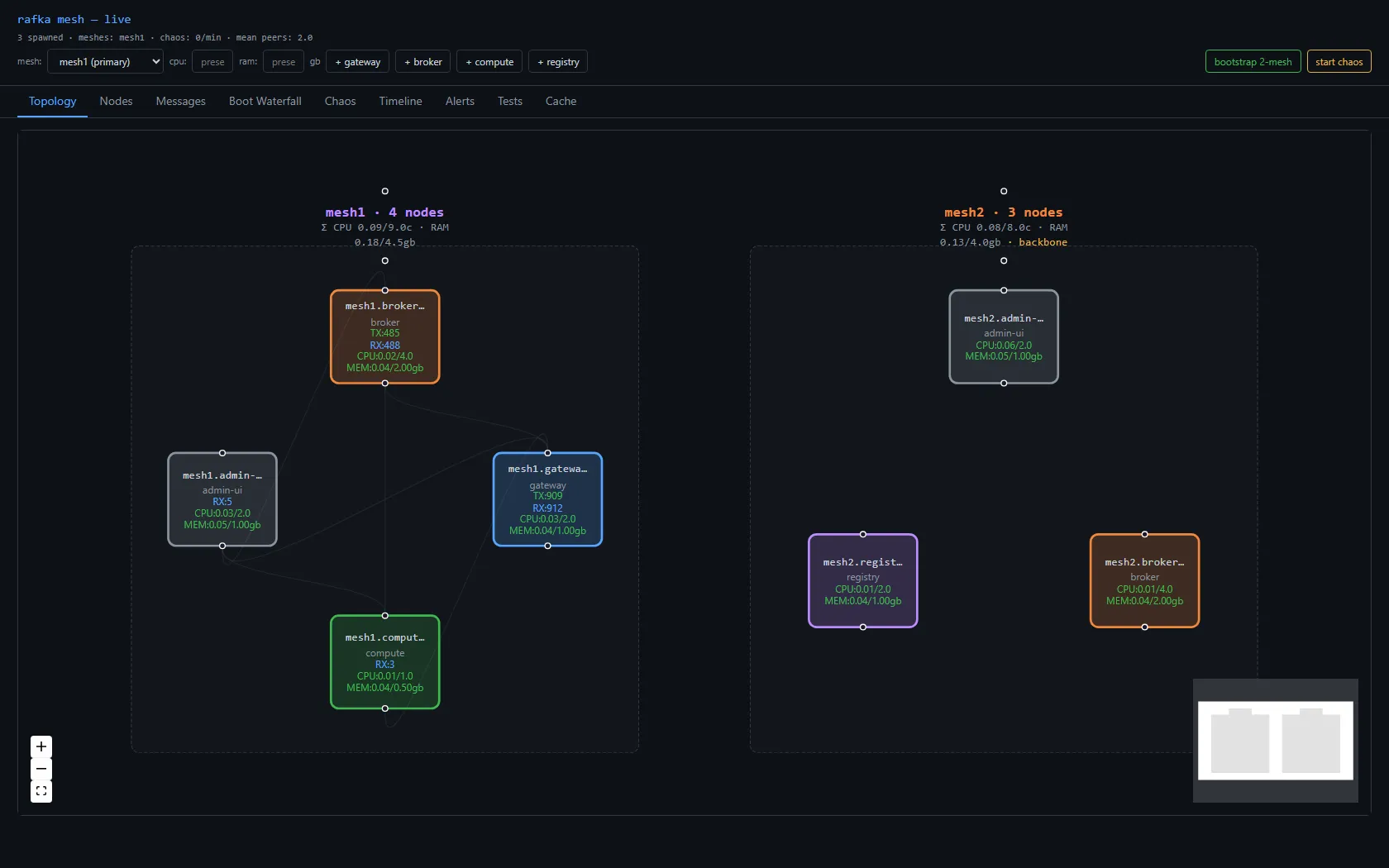
The backbone survives losing its own publisher. The cross-mesh directory is published by one elected node per mesh, on a soft lease. I found the live lease holder by its backbone.published spans, killed it on purpose, and watched the dead-man's-switch do its job: within the lease TTL a different candidate picked up publishing, and the other mesh's console never once lost sight of the first mesh.
And the two layers I bolted on since aren't scaffolding either. Every node now carries a local cache it owns — and, more importantly, one that forgets dead nodes on the mesh's own clock instead of hoarding ghosts forever — and there's a trust boundary that makes a node prove it belongs at the connection before anyone trusts it with data. So the substrate doesn't just know who's alive; it remembers only what's actually alive, and it stopped letting any random process that can speak the wire wander in. That's not a demo with the safeties off anymore. That's a floor you can stand a product on.
What I'm cheerfully not pretending to have solved
Honesty is the entire job of a post titled "is it ready," so here's the short list of things I'll look you dead in the eye and decline to claim:
- True packet-level partitions — severing a live link while the process stays up — needed firewall control I didn't have in this environment. Process-fault recovery: proven. A network that stays up while lying to you: not yet. I'm not going to insult you by pretending a clean
killis the same thing as a cable that's gone quietly insane. - The relay carrying real traffic in anger — proven in an isolated test, but on a single host the direct path correctly always wins, so right now the relay sits there like a lifeguard at an empty pool. It earns its salary the first time two nodes are in different buildings, and not one second sooner.
- Durability, ordering, backpressure, tenancy — these aren't holes in the substrate. They're the product, and they are quite literally next. Asking the mesh to have solved them already is like yelling at the foundation for not having a kitchen.
The verdict, said like I mean it
Is it ready? Yes — ready to start the actual project: the durable, ordered event-streaming layer this entire substrate was always the excuse to build. Not "ready, with an asterisk and a small prayer." Ready in the specific, bounded, single-host sense I just spent three sections earning the right to say. The basics are iroh'ed out. The boring, load-bearing, terrifying-to-get-wrong part is done — which means the fun part finally starts.
A genuine thank-you to the people behind iroh
Here's the one part of this post I won't be a smartass about, because it's the part that matters most.
None of this — not the gossip membership, not the cross-network relay, not the per-mesh topics, not the QUIC transport that just worked across Windows and Linux without me hand-rolling a single line of NAT traversal — none of it is mine. It rests, entirely, on iroh, built in the open by the team at n0.
Go back and reread this series with that in mind. The clean boot in the first post? iroh endpoints. Two meshes talking with no bridge? iroh-gossip. The relay-as-a-postbox, with a security model I got for free? iroh's relay. When I needed to prove that relay actually carries traffic, I did it with iroh's own built-in test_utils — cross-platform, no custom harness. The 40-second-join bug? The fix was to stop hand-rolling an address book and use the MemoryLookup iroh already shipped. Over and over, the right move turned out to be "the thing iroh already does." That is exactly what a genuinely well-designed library feels like to build on — it keeps quietly steering you away from your own worst instincts.
And when I did find real bugs deep in the stack — a connection leak that took two days to corner — the whole thing being open meant I could read the exact code, prove the fault, and send the fixes back upstream, with a real, responsive community on the other end to catch them. That is not how it goes with a closed black box, where the best you can do is file a ticket into the void and light a candle.
It's easy to forget, in a world of green checkmarks, how much of what we build stands on the quiet, sustained, frequently thankless work of open-source maintainers. We are lucky — genuinely, stupidly lucky — to live in a moment where a small team can hand you a substrate this capable, document it well, answer the issues, and ask for nothing back except that you go build something good with it.
So, to the n0 team — a giant, slightly-too-enthusiastic high-five. Thank you for iroh: for building it in the open, for the care in the API design that kept saving me from myself, and for the relay infrastructure and the test utilities and the docs. You made a genuinely hard problem feel approachable, and you made this whole build log possible.
- iroh — the repo: github.com/n0-computer/iroh
- n0 — the company: n0.computer
- iroh — the project site & docs: iroh.computer
If you build distributed systems, go star the repo, read their docs, and consider supporting the work. The whole ecosystem is better for it — and so is everything I'm about to build on top.