The relay is a postbox, not a peer
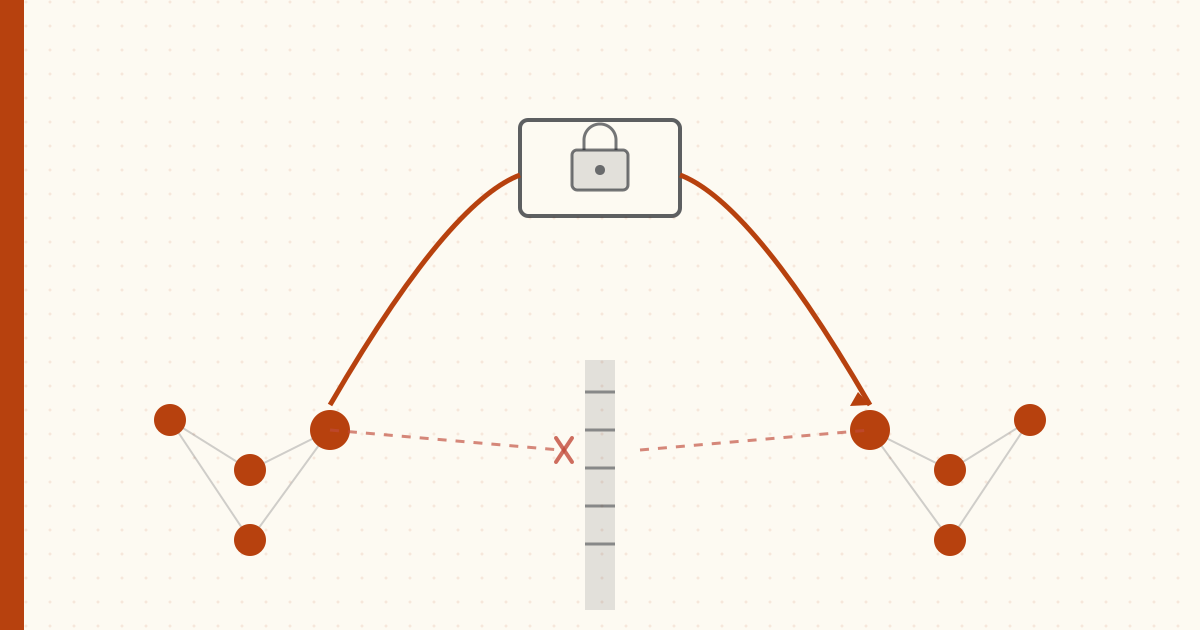
Earlier posts solved awareness: a mesh1 gateway can find out where a mesh2 broker lives, by key, through gossip and the cross-mesh backbone. But knowing an address isn't reaching it. On a real network the two nodes are often behind NATs or firewalls that won't accept an unsolicited inbound connection. That's what the relay is for — and the whole point of this post is that a relay is not a node, and being careful about what it actually is keeps the architecture honest.
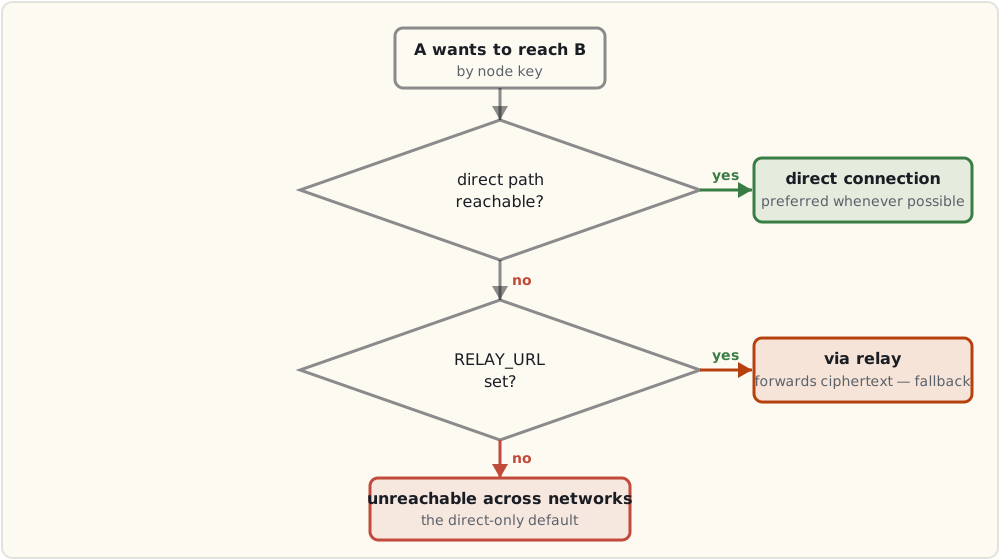
Direct when possible, relay when not
The relay is not something I built — it's iroh's, and that's deliberate. The substrate's whole premise is use the library, don't hand-roll mesh infrastructure. The behaviour is iroh-native:
- a connection starts over the relay (the one path that's reliably reachable),
- iroh then tries to hole-punch a direct path in parallel,
- if direct works, it migrates to direct; if it never works, it just stays on the relay.
So "relay is the fallback" really means the connection stays on the relay when the direct upgrade can't be made. Nodes direct-connect when they can; the relay is there when they can't.
Why the relay ever has "better luck" than direct
It doesn't have magic — it has structural luck. Direct peer-to-peer fails under symmetric NAT or restrictive firewalls because neither side will accept an unsolicited inbound connection. The relay is a publicly reachable rendezvous both sides connect outbound to, and outbound is almost always allowed. So A → relay → B works when A → B directly doesn't. That's the whole and only advantage.
The flip side: on localhost — every node a process on one box — there's no NAT and no firewall, so direct always works and the relay sits idle. That isn't a bug; it's the system working. The relay only earns its keep across real network boundaries — which, as we'll see, is exactly why a localhost test can't prove it carries anything.
A relay is a server, not a node
It's natural to think of the relay as "just another node in the mesh." It isn't, and the distinction is load-bearing:
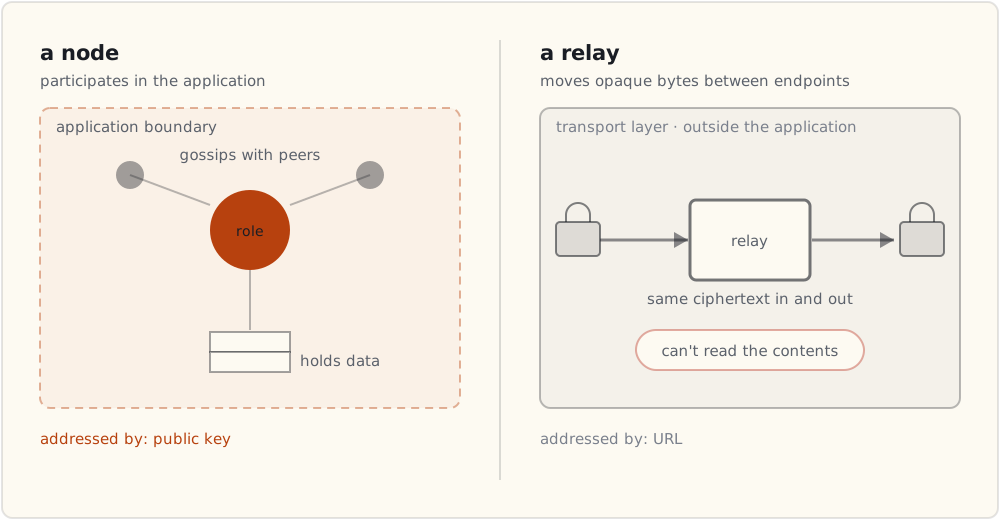
- A node participates in the application. It gossips, it holds data, it has a role — gateway, broker, console.
- A relay is transport-layer plumbing. It coordinates hole-punching and, when a direct connection can't be formed, forwards opaque encrypted packets between two endpoints. It is semantic-blind: it has no idea what a mesh or a message is. In WebRTC terms, it's TURN/STUN, not a peer.
It's the iroh-relay binary, addressed purely by a URL (the one piece of this whole system with a hostname) — while every node is addressed by its public key. It doesn't run our code, doesn't join gossip, doesn't know what a mesh is. It has to live somewhere both meshes can reach outbound — a cloud VM, a DMZ host, an edge box — outside any single mesh's NAT. One relay can serve many meshes; for HA you run a few, geo-distributed, and each node uses its nearest. So a relay is infrastructure you run, not a peer you join.
The part that matters: the relay can't read your mail
The relay secures nothing about the conversation — and that's the point. Security is end-to-end between the two nodes, identical whether the path is direct or relayed:
- Identity is the public key. A node's id is its Ed25519 public key. You don't dial an IP, you dial a key — which is why the directory carries the node id and
connectis identity-based. - The peer connection is authenticated by those keys. The end-to-end QUIC/TLS 1.3 handshake proves the remote end holds the private key matching the id you dialed. Same guarantee on a relayed path as a direct one.
- The relay is a dumb forwarder of already-encrypted packets. It sees ciphertext plus the destination key to route on. It can't read the data (it holds no key), can't impersonate either peer (a MITM attempt fails the end-to-end handshake), can't forge or inject.
The subtlety worth keeping straight: there are two separate TLS layers. The node ↔ relay hop uses the relay's own server cert (Let's Encrypt in prod, self-signed in dev) — it only protects the hop to the relay. The node ↔ node channel is the end-to-end QUIC encrypted under the peers' keys, riding inside that. So when a test trusts a dev relay's self-signed cert, peer-to-peer security is untouched — that flag says "trust this dev relay box," not "trust whoever's on the other end." Peer identity is always verified by key.
Honest threat model: a malicious or compromised relay can hurt availability (drop or delay your packets) and observe metadata (which keys talk, when, how much) — but never content or identity. You trust it to forward, not to read or vouch. The keys do the vouching, point to point, direct or relayed alike.
Proving it carries — the obvious proof is a lie
The relay had been plumbing for a while: configured, registered, the path existed. But "the relay works" was an assertion, not a fact, because on one host iroh always picks direct and the relay never carries a byte.
The obvious move to prove carriage: give a node a relay-only address — a relay URL and no direct socket addr — so the only way to reach it is through the relay. Dial it, send bytes, done. That's a lie, and it's the version that had burned me before. It proves the first packet went via relay. It does not prove the relay carries anything: once the QUIC connection is up, the two endpoints exchange their direct addresses over it and hole-punch. On loopback that succeeds in milliseconds, the connection silently upgrades to direct, and any "is it relayed?" check flips to false the moment after you looked. The test either flakes or "passes" by checking before the upgrade — proving connect-via-relay, not relay-carriage.
Make direct impossible
The fix isn't a cleverer assertion — it's removing the alternative. iroh's endpoint builder has .clear_ip_transports(): bind with no IP transport at all. Then a direct hole-punch isn't slow or unlikely, it's impossible — there is no socket to punch. The relay is the only transport that exists, so a delivered byte can only have come one way, and there's no timing window to race.
The whole proof, using iroh's built-in test_utils (cross-platform — no Docker, no WSL, no external network simulator):
run_relay_server()— a real local relay with a self-signed cert.- Two endpoints: a custom relay map, trust the test cert, and
.clear_ip_transports()so no direct path can exist. - The client dials a relay-only address and runs a bi-stream echo.
- Assert two things: the bytes round-trip and the selected QUIC path
.is_relay().
Bytes came back, over a connection that had no direct path to fall back to. That's relay-carriage, and it's deterministic — green three times out of three, no sleep, no retry.
One number fell out of the related path-failover test worth flagging: when a live connection's direct path dies and it has to cut over to the relay, the cutover took ~15 seconds — iroh's QUIC path-death detection timeout. A write in flight when a path dies stalls for that window before it reroutes; writes after it go straight to relay. It's a one-time cutover cost, tunable via the transport's keepalive/idle settings — a knob to weigh against whatever failover target a real deployment needs.
The honest caveat
This runs against test endpoints, not the live production transport. The production transport takes a relay URL as a string, not a relay map, and has no hook to trust a self-signed cert — and bolting an insecure-skip-verify into the real transport just to test it would be exactly the kind of substrate-edit-for-a-test that doesn't earn its keep. A production relay has a real certificate and needs no bypass. So the claim is precise: the substrate can carry a write over the relay when there is no direct path — proven — not "the live mesh was forced onto the relay in the UI." Know which sentence your green checkmark is under.
What I'd tell a team
- Name the relay correctly and the architecture stays clean. Call it "a node" and you'll be tempted to give it application knowledge, gossip state, a role. Call it what it is — a semantic-blind packet mover — and it stays out of the data-routing logic where it belongs.
- Two TLS layers, two different trusts. "Trust this dev relay" and "trust the peer on the other end" are separate decisions. Conflating them is how people convince themselves a test is insecure when it isn't — or that it's secure when it isn't.
- Refuse to let "the test passed" stand in for "the test checks the thing." The relay-only-address proof passes green on loopback and proves the wrong claim. The discipline that mattered wasn't iroh knowledge — it was writing down the failure mode ("relay-only controls how you first reach the peer, not which path carries traffic after") before coding, where it's obviously not a proof.
What's next
The relay carries, provably, when there's no direct path — and it can't read what it carries. The substrate now has a NAT-traversal story that holds end to end. Next I make "kill that node" a mesh operation instead of an OS one, and turn a node's whole lifecycle into something the mesh broadcasts.