Strands + AgentCore — a year-end agent-stack inventory
A reader emailed last week asking what stack I'd recommend for a new agent project starting in early 2026. I've been on the phone with three CTOs in the last month asking variants of the same question. Year-end inventory post, written in service of that conversation.
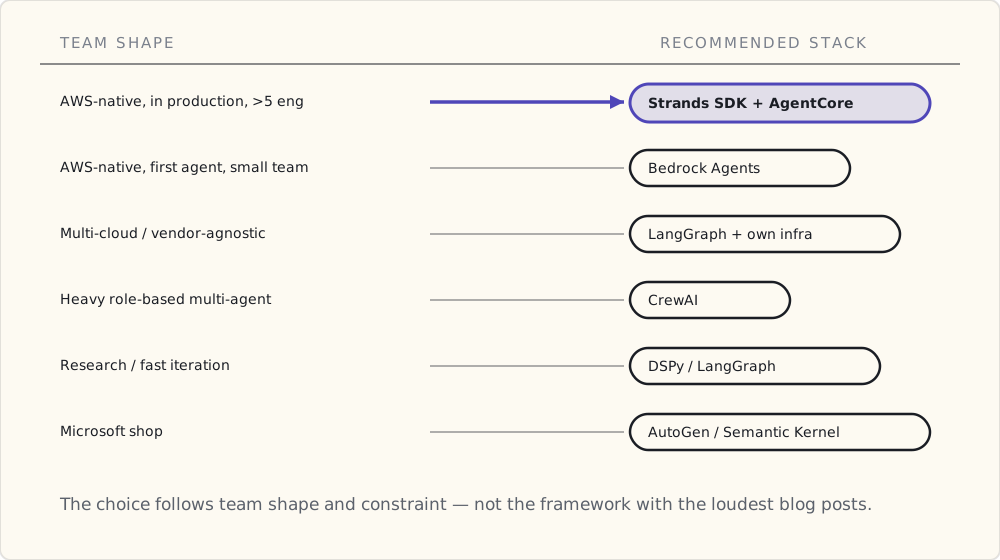
Where I land, by team shape
| Team shape | What I'd pick | Why |
|---|---|---|
| AWS-native, agents in production, > 5 engineers | Strands SDK + AgentCore | Best operational story, lowest maintenance burden, GA since October |
| AWS-native, first agent, small team | Bedrock Agents (still) | Lowest cognitive cost, fully managed, GA'd two years |
| Multi-cloud or vendor-agnostic | LangGraph + your own infra | Best portability, biggest community |
| Heavy multi-agent, role-based orchestration | CrewAI | Cleanest multi-agent abstraction |
| Research / fast iteration, willing to write infra | DSPy or LangGraph | Most expressive |
| Microsoft shop | AutoGen / Semantic Kernel | Better Azure / M365 integration |
If you came here for the punchline and you're an AWS-native team running real production traffic, the short answer is: Strands + AgentCore. The rest of the post is why.
What changed in 2025
Year-end review of what shipped:
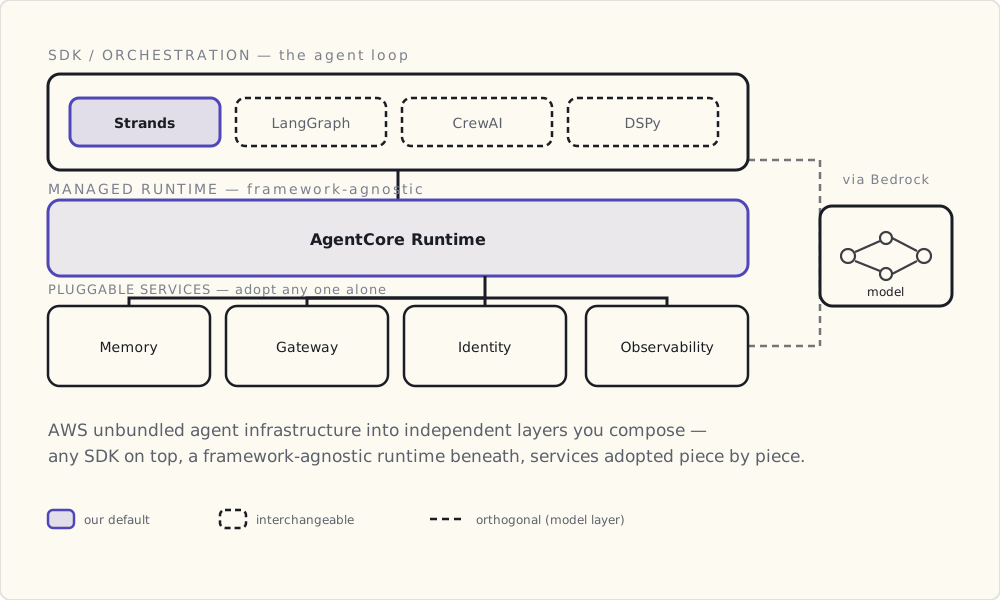
- Strands Agents SDK (open-sourced by AWS, May 2025) — Python framework for agent orchestration. Model-agnostic, framework-agnostic. Replaces the "I'll write my own agent loop" instinct with something AWS now maintains.
- Bedrock AgentCore (announced in preview July 2025 at NY Summit; GA October 13) — modular runtime + memory + gateway + tools + observability + identity. Composable; you can adopt one piece without the rest. GA brought the things that were missing in preview: VPC + PrivateLink, CloudFormation, resource tagging, eight-hour runtime sessions, A2A protocol support, and Gateway connecting to existing MCP servers (not just wrapping your APIs and Lambdas).
- Bedrock Marketplace (re:Invent 2024 → matured throughout 2025) — third-party models behind the same Bedrock API. DeepSeek, more Mistrals, specialized fine-tunes.
- Bedrock Prompt Caching (GA early 2025) — order-of-magnitude cost reduction on repeated prefix prompts. The single biggest lever for agent cost.
- AgentCore Browser + Code Interpreter tools (managed) — replaces the "let's run Playwright in our own Lambda" pattern with a managed alternative.
The story across all five: AWS is shipping the unbundled pieces of agent infrastructure. You get to compose. The composition story is now actually tractable.
How we use Strands + AgentCore
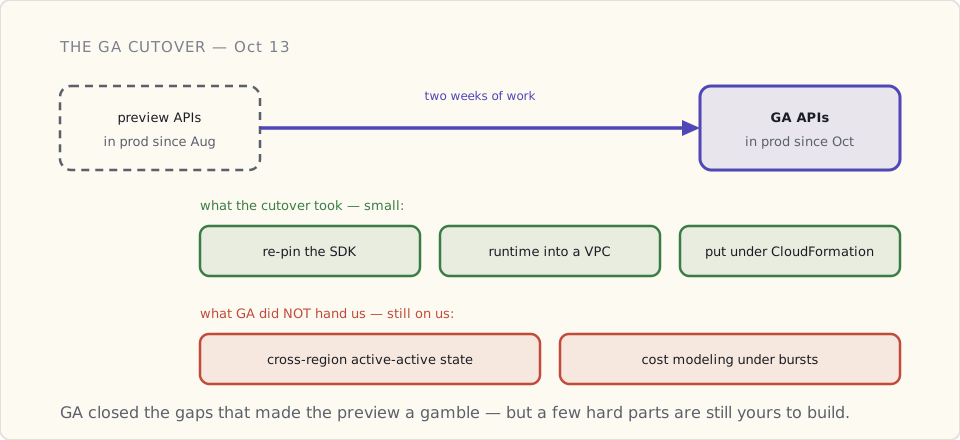
We rode the preview through real traffic from August, then cut over to the GA APIs in the two weeks after October 13 — mostly a matter of re-pinning the SDK, moving our runtime into a VPC now that GA supports it, and putting the whole thing under CloudFormation. Our agent stack today:
- Strands SDK for the agent loop. Python, model-agnostic, exposes a clean event-driven hook system.
- Claude 3.7 Sonnet as the primary reasoning model. Claude 3.5 Haiku for cheap-classification routing. Nova Pro on a few high-volume paths where the cost differential matters and the quality is good enough.
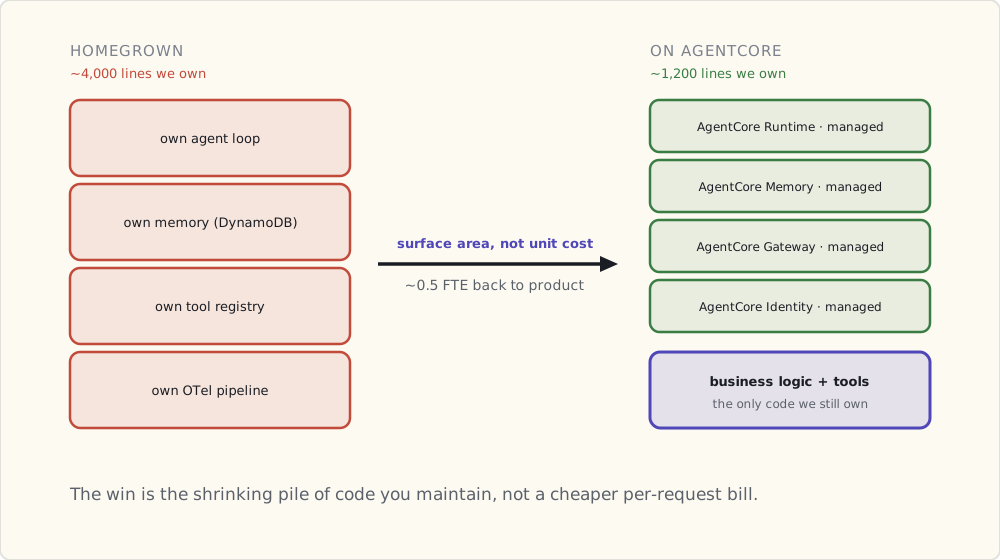
- AgentCore Memory for short-term and long-term memory. Replaced our DynamoDB layer.
- AgentCore Gateway for tool registry. Exposes 20-odd internal APIs as MCP-compatible tools. Replaced the registry we'd built ourselves.
- AgentCore Runtime for the production execution surface.
- AgentCore Identity for delegated authorization (the agent calls tools as the end-user, not as a service principal).
- Bedrock Prompt Caching for the shared system prompt and tool definitions across loop iterations.
- OpenTelemetry → Honeycomb for traces (AgentCore emits native OTel; we kept Honeycomb).
That stack runs about 80,000 agent invocations per day. We maintain about 1,200 lines of code on top — almost all of it business logic and tool implementations. Down from 4,000 lines before the migration.
What I'd defer
Three things to be honest about, even now that AgentCore is GA:
We rode the preview to get here, and that was a real bet. GA landed October 13, but we'd already been on the preview APIs in production since August because we believed the architecture. That paid off — but if you're starting now, you start on GA, and you don't have to make the bet we did. The honest read: GA closed most of the gaps that made the preview a gamble.
Multi-region failover is still mostly on you. GA added VPC, PrivateLink, and CloudFormation support, and the runtime now spans nine regions — but cross-region active-active for your memory and gateway state isn't a turnkey feature. If your business demands it, you're still writing parts of this yourself.
Cost predictability under bursty workloads. AgentCore's per-service pricing means agent cost is now (model) + (memory ops) + (gateway/tool ops) + (runtime time). Modeling cost under spikes requires more care than it did with the monolithic Bedrock Agents pricing. GA didn't change the pricing shape; it just made it the shape you're committing to.
When I'd reach for the alternatives
Honest assessments of where the others win:
LangGraph + your own infra. Win: framework portability and community velocity. The LangGraph community ships patterns faster than AWS does. Win: multi-cloud is real (we run a backup of one agent on Azure OpenAI for compliance reasons; LangGraph handles this without complaint). Loss: more infra you maintain.
CrewAI. Win: best abstractions I've seen for multi-agent role-based orchestration. "The researcher agent talks to the writer agent talks to the editor agent" is a paragraph of CrewAI code. Loss: smaller community, less production-tested.
DSPy. Win: most expressive way to compose LM programs. Lets you optimize prompts via compilation, not hand-tuning. Loss: still feels research-y. The teams I know running it in production are the teams with research-shaped engineers.
AutoGen / Semantic Kernel. Win: if you're a Microsoft shop, the Azure OpenAI + Semantic Kernel + M365 integration is genuinely tighter than AWS's equivalents. Loss: if you're not a Microsoft shop, you're swimming upstream.
What I'm watching for next month
re:Invent 2025 is December 1-5, and with AgentCore already GA, the announcements I'm watching for are the layer above the runtime. Three things:
- A managed eval story specific to agents. Bedrock Model Evaluation exists; it's not yet agent-aware — it grades a model on a prompt, not an agent on a multi-step task. The teams I talk to are all writing their own agent-specific eval setups (mine on top of the open-source eval kit). With the runtime now GA, this is the obvious next gap for AWS to close.
- AgentCore feature depth post-GA. GA shipped the enterprise table-stakes — VPC, CloudFormation, A2A, MCP-server gateway connections. What's missing is the operational depth: turnkey cross-region state, finer cost controls, richer Memory strategies. re:Invent is where I'd expect the first post-GA wave.
- Better cross-cloud / cross-model abstraction. Strands is half this story; AgentCore is half. The third half — true vendor-agnostic agent observability and lineage — is still missing.
The honest framing
The most important framing I've landed on this year: the framework choice matters less than people make it.
A good agent system is mostly: a clear task definition, a good eval set, a tight rubric, well-scoped tools, and a model that's right-sized for the task. Strands vs LangGraph vs CrewAI is a coordination-cost decision, not a quality decision. The teams that ship great agents are the teams with great evals. The framework is downstream.
That said: ride the maintenance curve. If you're an AWS team, having AWS maintain the framework and the runtime saves you a person. Worth it.
re:Invent in a week. I'll write a follow-up if anything significant lands in the agent space. For now: pick the framework that matches your team's experience, not the one with the loudest blog posts, and go ship the eval set first.