Agent-based DevOps with Q Developer — kept vs tossed
We've been running Amazon Q Developer agents across our engineering org for about eight months. Started cautiously, expanded carefully, and pruned hard. What's stayed, what's gone, and the metric that made the case to leadership to keep going.
What we kept
1. Dependency-upgrade agent
The biggest win. Q Developer reads our package.json / pom.xml / Cargo.toml on a schedule, identifies dependencies behind the current safe version, opens PRs one at a time, runs the test suite, and labels the PR by risk.
Three categories of upgrade get auto-merged after CI passes:
- Patch versions with no breaking-change notes
- Minor versions of dev dependencies (linters, type checkers, formatters)
- Security-only updates on dependencies flagged by Dependabot
Everything else opens a PR for human review.
Why it stuck: dependency upgrades are toil. They're not interesting. They're a never-ending background workload that gets deferred until something breaks. An agent that handles 80% of them automatically and surfaces the 20% that need judgment is exactly the right shape for this kind of work.
Number on it: we landed 1,200 dependency-upgrade PRs in 2025 across our repos. Of those, ~950 were auto-merged. The engineering time that recovered is roughly half an engineer-year. Real money.
2. PR review agent (advisory, not blocking)
Every PR gets an automated review pass from Q Developer. It comments on:
- Tests it thinks should exist but don't
- Edge cases it suspects aren't handled
- Patterns inconsistent with the rest of the codebase
The agent's comments are advisory — never blocking. A human reviewer is still required to approve. The reviewer can take or ignore the agent's suggestions.
Why it stuck: it doesn't replace review, it prompts better review. We measured this: human reviewers leave 30% more substantive comments on PRs that the agent has commented on first. The agent isn't smarter than the reviewer; it just primes the reviewer to look harder.
Important nuance: the agent's comments are visibly attributed to the agent. We tried hiding the attribution for a month to see if reviewers would treat them as peer comments. They didn't — they trusted them less. Attribution is a feature, not a bug.
3. Documentation-drift agent
Every time a public API changes in a service, the agent checks whether the corresponding docs were updated in the same PR. If not, it opens a follow-up PR adding the doc changes. The author can edit or close the suggestion.
Why it stuck: doc drift is the single biggest support-ticket source we have. The agent catches about 70% of API changes that would have shipped without doc updates. The other 30% it misses are typically renames or refactors where the doc update is ambiguous.
4. Incident-investigation agent
When PagerDuty fires, the agent automatically pulls together a brief: recent deploys, recent flag flips, related alerts in the last 24 hours, log samples from the affected service, and links to similar incidents from the runbook. Posts it as the first comment in the incident channel.
Why it stuck: the first 10 minutes of an incident are exactly the same 10 minutes every time — somebody pulling up the deploy log, somebody else searching logs, somebody else looking for prior runs of the same incident. Having an agent assemble the brief while humans are still typing "/oncall" buys back those 10 minutes.
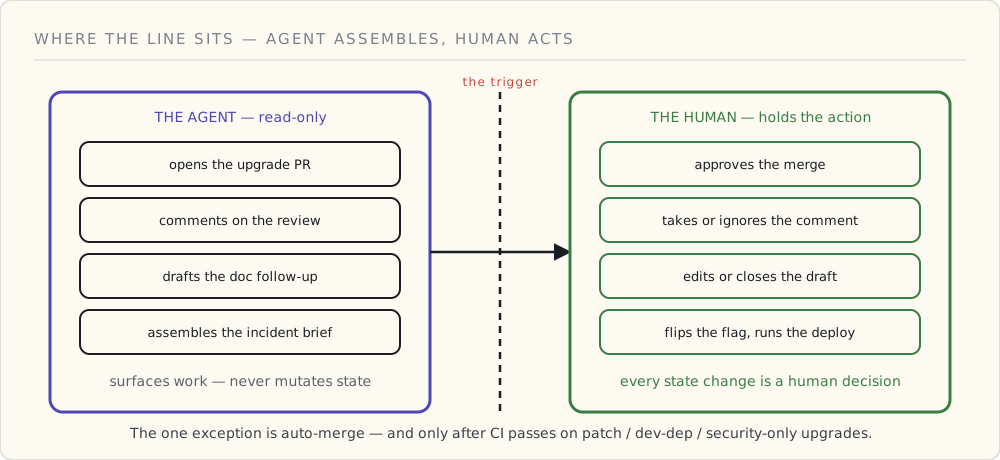
Important caveat: the agent does not take action. No flag flips, no deploys, no anything that mutates state. It assembles the brief; humans decide.
That caveat isn't specific to the incident agent — it's the line that runs under all four kept workflows. Every one of them assembles, suggests, or drafts; not one of them mutates state on its own. The human is always on the trigger.
What we tossed
1. Test-generation agent
Tried for three months. The agent would propose new tests for code that lacked coverage. The tests were syntactically valid, would pass against the current implementation, and were almost universally useless — they tested the implementation rather than the contract, and changed every time the code changed.
We shut it off. Test coverage that doesn't catch real regressions is worse than no coverage; it gives false confidence.
What might work: an agent that generates tests from a specification document (input/output examples, behavioral contracts), not from the existing code. We haven't built it yet.
2. Auto-fix-the-lint agent
Tried for a month. The agent would auto-fix lint and style violations. Sounded great. In practice, it kept "fixing" things in ways that broke contextual decisions an engineer had made deliberately (a // eslint-disable-next-line that was load-bearing, a formatting choice that aligned with a generated file).
We shut it off and went back to humans plus pre-commit. The lesson: the cost of "an agent fixing the wrong thing" is much higher than the cost of "an engineer running npm run lint:fix themselves."
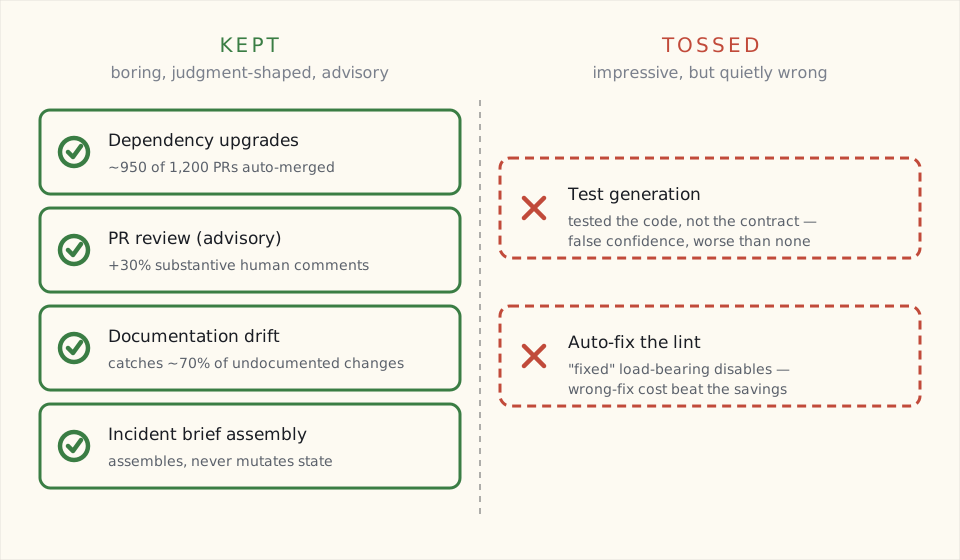
The pattern across the divide is clear once you see it laid out: the agents that stuck were the boring, advisory ones that surfaced judgment rather than substituting for it. The ones we shut off were the impressive ones that quietly produced wrong work a human then had to find and undo.
The metric that kept the program alive
About four months in, our VP of Engineering started asking the right question: is this saving time or generating noise? I'd been measuring agent activity (PRs opened, comments posted) which is the wrong metric — it measures the agent, not the impact.
We switched to engineering-hours-recovered, calculated as:
- Hours we'd have spent on the work the agent automated (dependency-upgrade time, PR-priming time, incident-assembly time)
- Minus hours we spent reviewing agent output that was wrong or unhelpful
- Minus hours we spent maintaining the agent integrations
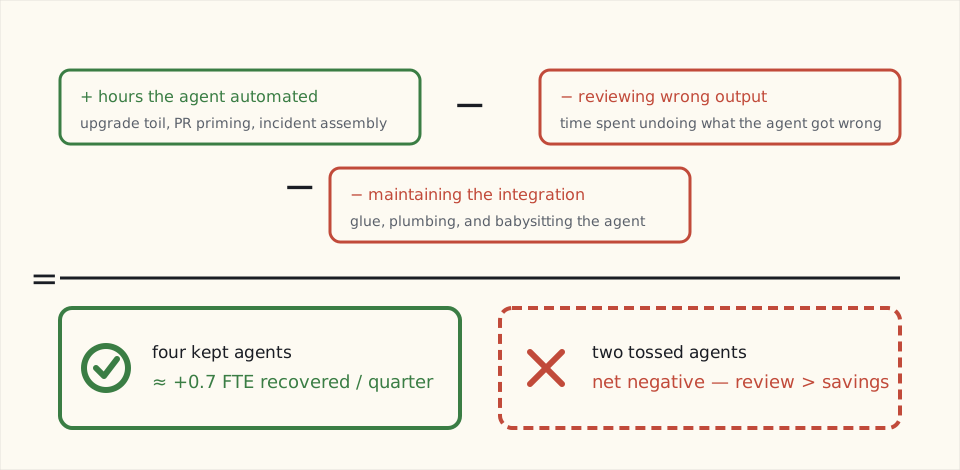
For the four kept agents, the answer was roughly 0.7 FTE of recovered engineering time per quarter across our 24-person engineering org. For the two tossed agents, the answer was negative — we spent more time reviewing wrong agent output than the agent saved.
That metric made the case to leadership. It also gave us the discipline to shut off the tossed ones without arguing about it. The math is the math.
What I'm watching for next
Three near-term things on the watch list:
- Agent-led migrations. AWS Transform is the obvious play here for re-platforming workloads. We have a Java 11 → Java 21 migration coming up. The pilot starts next month.
- Cross-repo refactors. "Rename this concept across 40 repos consistently." Q Developer can technically do this; we haven't trusted it yet. Watching for stories from other teams.
- Compliance evidence collection. We have a SOC 2 audit every year. The evidence-collection part of it is the most agent-shaped work in the world — go to N places, pull M things, format them into the auditor's template. Not yet productized, but it should be.
The thing I'd tell another VP
If you're considering rolling out agentic DevOps in your org:
Start with one workflow. Pick the boring one — dependency upgrades, doc-drift, incident-brief assembly. Avoid the impressive ones (test gen, refactors) until you've built the eval discipline to know when the agent is wrong.
Insist on a metric. Agent-activity counts will fool you. Recovered-engineering-time will not.
Be willing to shut things off. The hardest part of running an agent program isn't standing things up; it's accepting that some of them aren't working and turning them off without feeling like you've failed.
An agent that's wrong 5% of the time is not a 5% problem. It's a trust problem with a percentage attached. The agent has to be right enough that engineers don't develop the habit of double-checking everything — because that habit eats the savings.
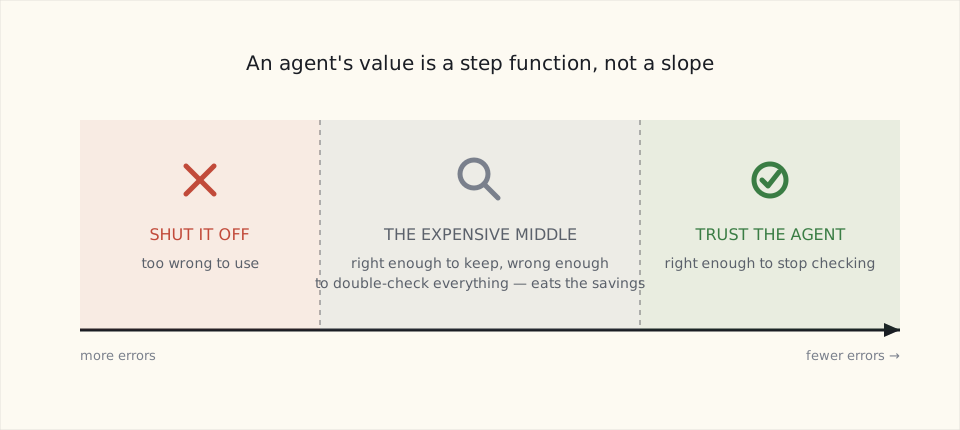
Get to "trust the agent" or shut it off. The middle is the most expensive place to be.
I'll write a year-in review in November.