First week with Bedrock: a PM's read on the September GA
Amazon Bedrock went generally available on September 28th. We've been on a private preview waitlist for months. I finally got the team to spend a week last week porting one of our LLM features off of a direct API integration and onto Bedrock. Notes from that week.
What Bedrock is, in two sentences
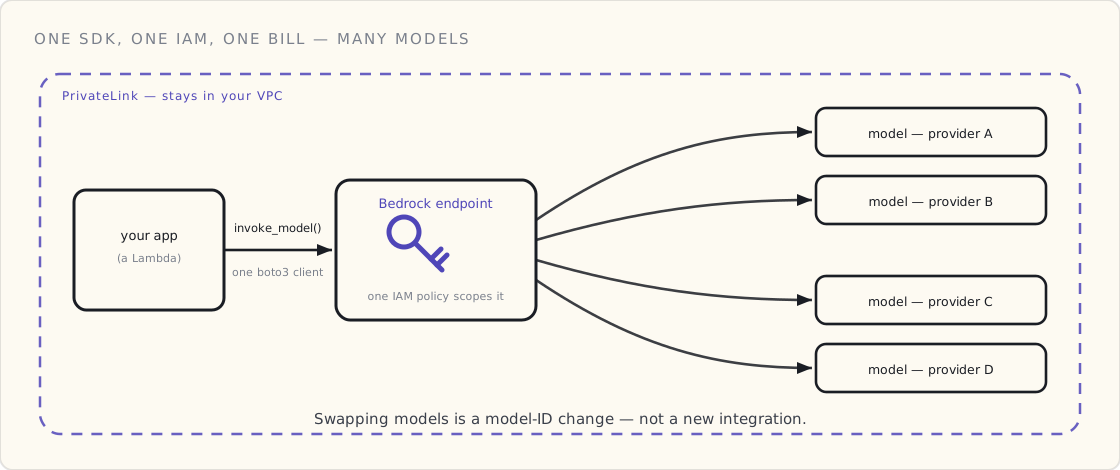
It's a single AWS endpoint that lets you call multiple foundation models — Anthropic Claude, AI21 Jurassic-2, Cohere Command, Meta Llama 2 (the 13B and 70B chat models landed on Bedrock just last month), Stability's image models, and Amazon's own Titan family — through one SDK and one IAM model. You pay AWS, AWS pays the model providers, and your data doesn't leave your VPC unless you let it.
It's not a model. It's a model router.
The two reasons we ported
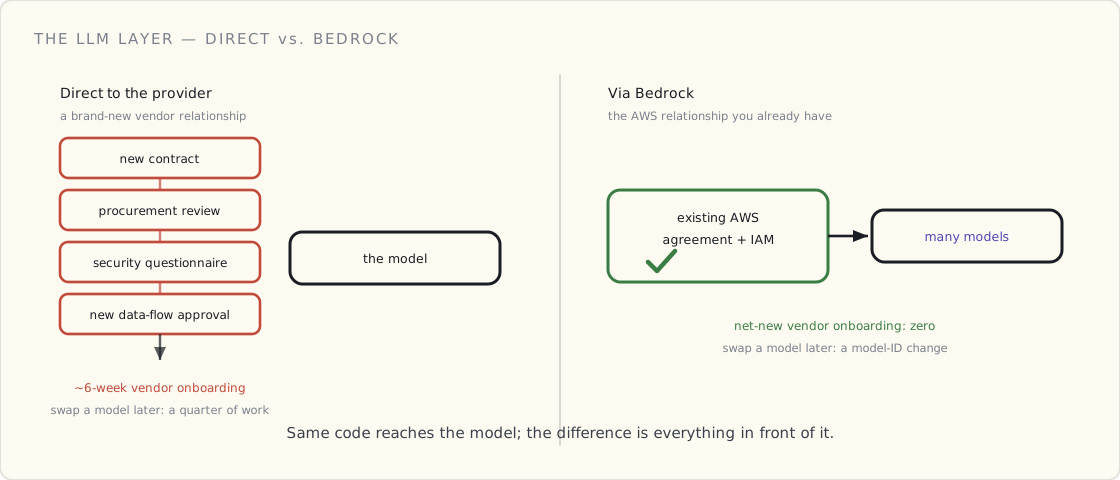
Procurement. Talking to AWS about a model is the same conversation we already have about S3 and Lambda. Talking to Anthropic about a model is a new conversation with a new contract, a new procurement review, a new security questionnaire. Our company's vendor-onboarding process for a new AI vendor is a six-week thing. Bedrock collapses that to zero.
Optionality. We've been calling Claude 2 directly through Anthropic's API. That works fine until the day a competitor's model is meaningfully better on our task and we need to swap. With Bedrock, the swap is mostly a model-ID change in our code; with a direct integration it's a quarter of work. We're not paying for optionality we won't use — Claude is still the best fit on our task right now — but we wanted the ability to swap when the landscape shifts.
What worked in week one
- The SDK is calm.
boto3.client('bedrock-runtime').invoke_model(...). If you've written boto3 once, you've written this once. No surprises. - IAM works the way you'd expect. Bedrock invocation is just another IAM permission. We were able to scope the API key to "only Claude 2, only from this Lambda" in about ten minutes. Doing this with a direct vendor API key would require us to write our own gateway.
- PrivateLink is there. For the parts of our workload that can't make outbound calls, we can keep the whole thing inside our VPC.
What didn't work
- Streaming is uneven across models. Some models support streaming responses; some don't yet. Our UX relies on it, and the abstraction over models leaks here. We had to special-case behavior by model ID, which is exactly what an abstraction is supposed to prevent.
- The pricing took a minute. Per-token pricing varies by model, and the dashboard for tracking spend is not as developed as the rest of AWS Cost Explorer. We're going to have to roll our own per-feature cost tracking until that catches up.
- Provider parity isn't guaranteed day-zero — but it's closer than I expected. My going-in fear was that Bedrock would always trail the provider's own API by a release or two, and that a managed router means you wait for the latest model feature. The Claude 2.1 timeline argued the other way: Anthropic announced it on November 21st with a 200K context window, and it was generally available on Bedrock by the 29th — about a week, and it landed in the same re:Invent window as everything below. So the gap, at least this time, was small. I'm not treating that as a promise. The honest posture is that you can't assume same-day parity for a feature your roadmap depends on; you confirm a specific model and capability is on Bedrock before you commit to it. Bedrock earns its place when the model is good enough and the procurement/security story matters more than being first to a brand-new capability — not because the capability is necessarily late.
The re:Invent additions
Two weeks ago at re:Invent (Nov 27 – Dec 1), AWS dropped a pile of Bedrock additions. The headline:
- Agents for Amazon Bedrock — orchestrate multi-step calls (call a tool, read a knowledge base, call the model, route the result). Went GA at the show. GA two weeks ago is not the same as battle-tested, though — a v1 agent framework still moves under your feet, and I'd rather watch other people find the sharp edges first. We'll run it through a real evaluation, not wire it into anything a customer touches yet.
- Knowledge Bases for Amazon Bedrock — a managed RAG pipeline, basically. Also GA at re:Invent. Same posture: worth a serious look, but I'm not migrating our hand-built retrieval onto a two-week-old managed service on faith.
- Guardrails for Amazon Bedrock — in preview, not yet generally available. Content policies that travel with the model invocation. We need this badly; doing it ourselves at the application layer is fragile. But preview means it can change, so it's not something I'll commit a launch to until it's GA.
Two things newly GA, one in preview, and a lot I'm choosing to wait on. The reality is: we're keeping our app-layer guardrails and our own retrieval for now, and putting Agents and Knowledge Bases through an honest evaluation before we let either near production.
My take after a week
Bedrock is the absence of a vendor lock-in argument. That's the whole pitch. If you're inside a company where the security team and the legal team are the gating risk on shipping LLM features, Bedrock is the answer. If you're inside a startup where the gating risk is "which model is best this week," you're still going direct to the provider.
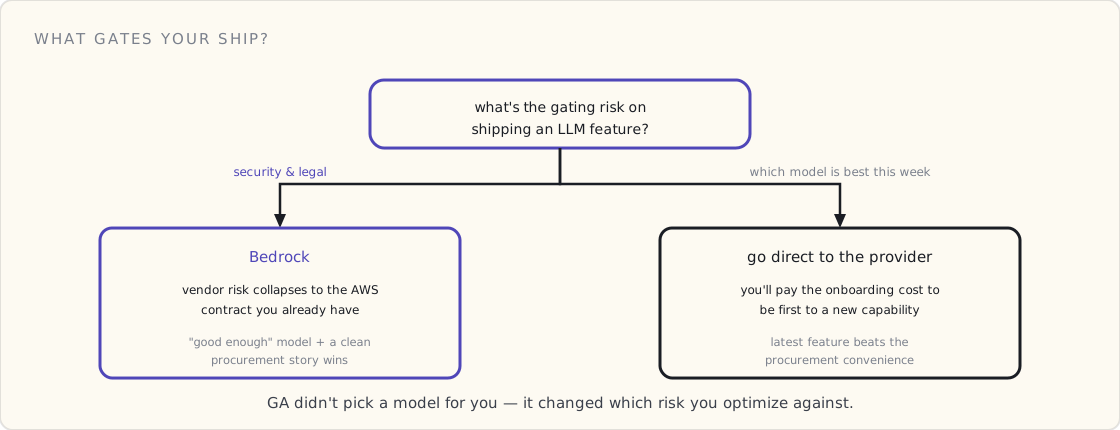
The team I lead is the first kind of team. So we're on Bedrock now. The port took five working days end to end. I'd do it again.
I'll write a follow-up in a couple months once we've had Agents and Knowledge Bases through a real evaluation. For now: useful, boring, and exactly what the procurement conversation needed.