Bedrock AgentCore at Summit NY — what it actually changes
AWS Summit NY was last week. The keynote announced Amazon Bedrock AgentCore in preview. I've spent the last few days reading the docs, the blog posts, and the recordings, and pointing a small internal experiment at it to see if the shape is what I think it is.
The short version: AgentCore is not "Bedrock Agents 2.0." It's a fundamentally different product, aimed at a different problem, and it changes how I'd architect a new agent system today.
What AgentCore actually is
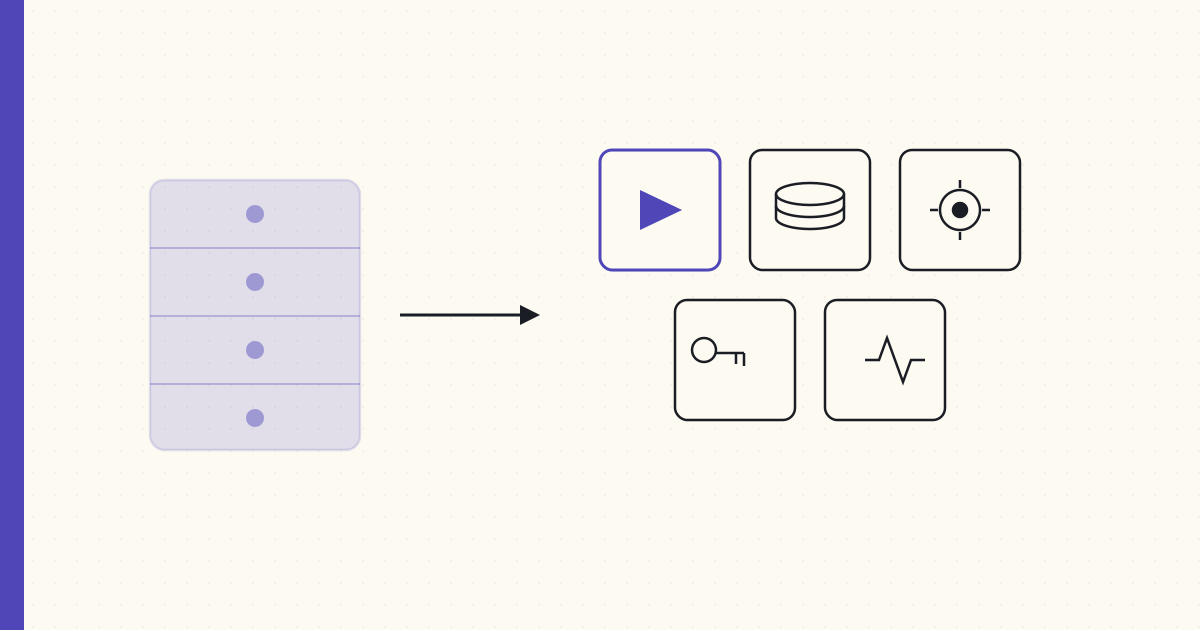
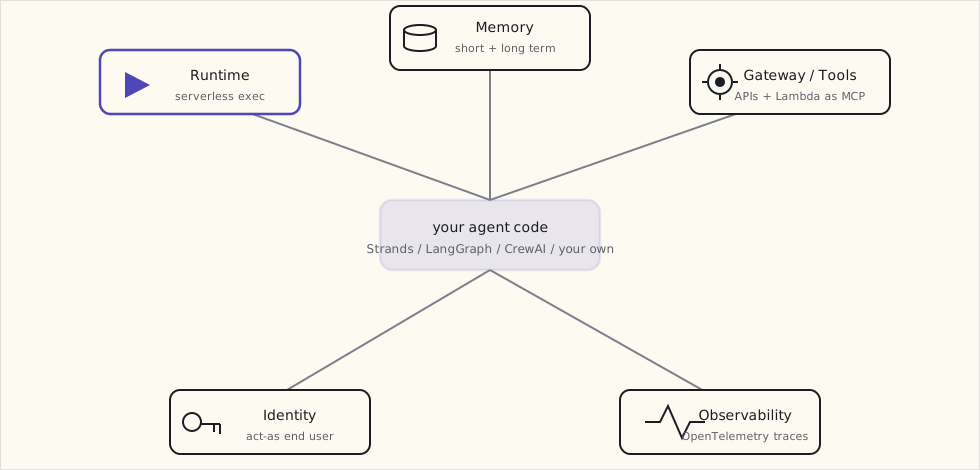
A set of modular, individually-priced services for running agents in production. Specifically:
- Runtime — serverless execution environment for agent code (Strands, LangGraph, CrewAI, your own — doesn't matter, AgentCore is framework-agnostic).
- Memory — managed short-term and long-term memory store, with built-in summarization and retrieval.
- Identity — agent-side IAM, including delegated access to call tools as different end-users.
- Tools — managed tool registry with built-in browser, code interpreter, and external API tools (Gateway exposes APIs and Lambda functions as MCP-compatible tools).
- Observability — distributed tracing across agent steps, native OpenTelemetry.
You don't have to use all five. You can plug in just the memory layer alongside your existing LangChain stack. Or just the runtime. Or just the observability. That is the meaningful shift.
How it differs from Bedrock Agents
Bedrock Agents — the older product, GA at re:Invent in November 2023 — is a monolithic, opinionated agent stack: the loop, the prompt scaffolding, the tool-calling format, the model choice — all integrated. You define action groups, knowledge bases, and a base model, and Agents orchestrates the whole thing.
AgentCore is the opposite design:
| Bedrock Agents | Bedrock AgentCore | |
|---|---|---|
| Shape | Monolithic, opinionated | Modular, composable |
| Framework | AWS-defined loop | BYO (Strands, LangGraph, etc.) |
| Coupling to Bedrock models | Tight | Loose — any model that supports tool use |
| Pricing | All-or-nothing | Per-service |
| Production maturity | GA | Preview |
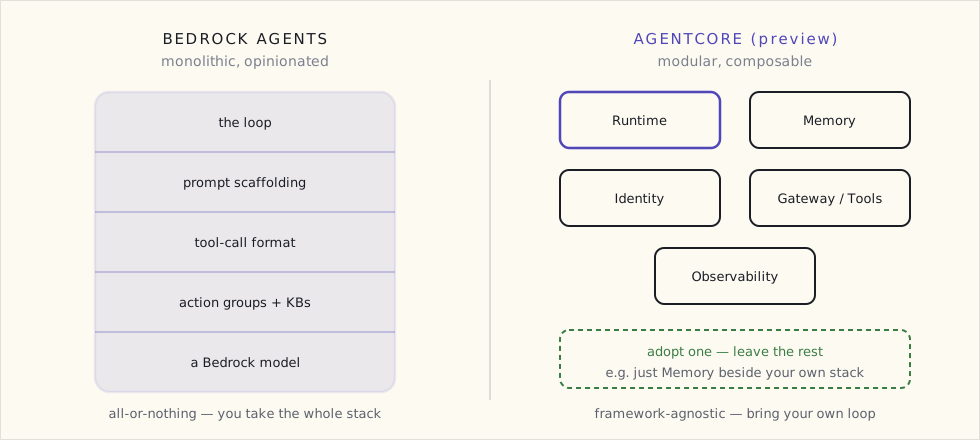
If you're shipping a brand-new agent today, AgentCore is the right shape if you can live with preview status. If you're already on Bedrock Agents in production, you don't have to migrate — but you'll probably want to.
What it changes for us
We've been running agents on a homegrown stack: Strands Agents SDK (open-sourced by AWS back in May) for orchestration, our own memory layer on DynamoDB, our own tool registry, OpenTelemetry to Honeycomb for tracing. About 4,000 lines of code we maintain.
AgentCore replaces roughly 2,800 of those lines with managed services. The work to migrate is real — re-wiring the memory layer is a couple of weeks, swapping our home-rolled OTel pipeline for AgentCore's is another — but it's bounded. Six weeks of engineering for a permanent reduction in surface area.
The math we ran:
- Code we maintain: 4,000 → 1,200 lines.
- Engineers needed to babysit the agent infra: 1.5 → 0.5.
- Per-request cost of memory + tracing infra: ~$0.002 → roughly comparable (AgentCore prices these as managed services; the savings are in maintenance, not unit cost).
The reduction in engineering surface area is the win, not the cost. We get a 0.5-FTE back to build product.
What I'd defer
Preview status is real. Three things to watch before I'd put this fully on the critical path:
- GA timeline. AWS said "later this year" at the Summit. That usually means re:Invent (December). If your launch is in Q4, you're betting on a preview holding up.
- Multi-region failover. The preview runs in a few regions. Once you've moved your memory layer to AgentCore, you depend on its regional availability. Production-shaped HA isn't yet documented.
- Cost predictability at scale. Per-service pricing means agent runs that previously had a single $0.18 model cost now have a $0.18 model cost plus a memory call cost plus a tool registry cost plus a trace cost. We're modeling it on our actual workload; the answers depend on workload shape.
The thing nobody's saying out loud
Bedrock Agents is going to feel slowly deprecated.
AWS won't say that — they'll keep the product around — but the architectural energy has moved to AgentCore. Every example in the Summit talks, every reference architecture, every new feature announcement is in AgentCore terms. Bedrock Agents will continue to exist; it'll continue to get bugfixes. The new patterns are not going to land there.
If you're starting today: AgentCore. If you're already on Bedrock Agents in production: ride it, migrate when AgentCore goes GA, expect to migrate.
Where this fits in the broader picture
Back in May, AWS open-sourced Strands Agents SDK — a Python framework for building agents that's framework-agnostic at the model layer. Now AgentCore.
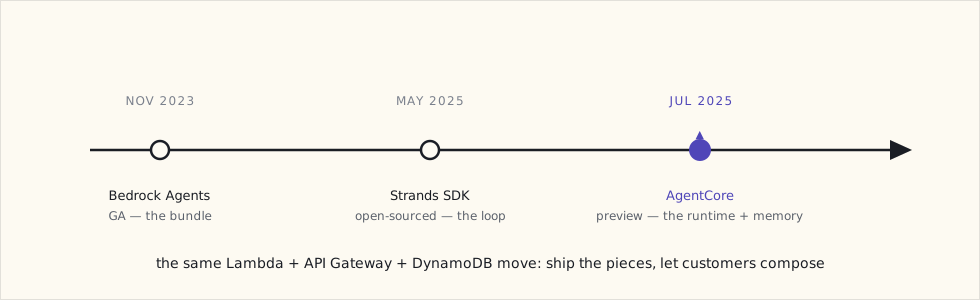
The pattern, looking back: AWS is shipping the unbundled version of "agent infrastructure" piece by piece. Strands is the SDK. AgentCore is the runtime + memory + observability. Bedrock provides the models. Q Developer provides the developer-facing agent surface.
This is the same playbook AWS ran with Lambda + API Gateway + DynamoDB ten years ago — provide the pieces, let customers compose, win on the composition. It worked then. The signs are that it'll work for agents too. AgentCore is the keystone piece that makes the composition tractable.
What I'd do this week
If your team is shipping agents:
- Spin up an experiment in a non-production account. Take a single agent feature, put it on AgentCore Runtime with whatever framework you already use.
- Wire AgentCore Memory in alongside your current memory layer. Run both in parallel for a week. Compare what you get.
- Decide by end of August whether AgentCore is on your post-re:Invent migration list.
We're doing this. I'll write a follow-up in November once we've had AgentCore through a real load test. For now: this is the most consequential agent announcement of 2025, and it's going to reshape how we architect agent systems for the next several years.