BLE vs LoRa vs cellular — the connected-product decision matrix
The engineering team I lead has now argued about wireless choice on three different connected-product designs. The argument always goes the same way, and ends the same way: I ask the same five questions, and the choice picks itself by question two.
I am writing the questions down so I can stop having the argument.
(The rubric started as a one-pager I sketched on my first connected product back in 2018 — the v1 series — where the answer was always BLE because the device had no WiFi antenna. That constraint forced the choice and we never had to argue about it. Without the constraint, the argument expands to fill the room. Hence the rubric.)
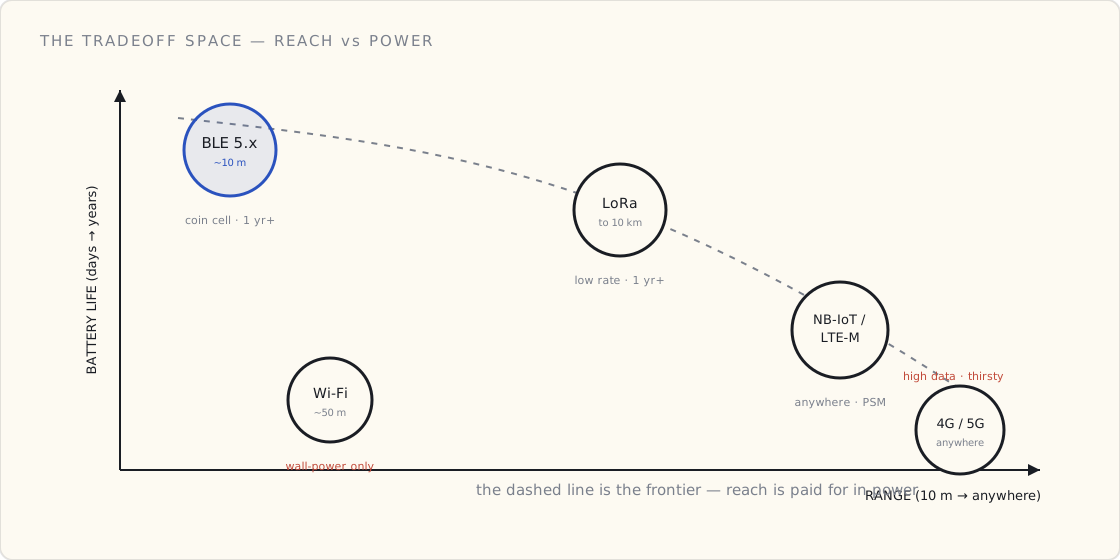
The reason the argument is winnable at all is that the four radios don't actually compete across the whole space — they each own a corner of it. Plot reach against how long the device can run on a battery and you get a frontier: nothing buys you more range without spending more power. BLE lives in the short-range, sips-power corner; cellular lives in the go-anywhere, drinks-power corner; LoRa threads the needle on range if you accept a trickle of data; and Wi-Fi is the odd one out — middling range and the worst battery story of the lot, which is why it only shows up where there's a wall socket.
The five questions, in order
1. How far is the device from the nearest gateway, phone, or router?
| Distance, worst case | Likely answer |
|---|---|
| ≤ 30 m, line-of-sight to a phone | BLE |
| ≤ 100 m indoor, no walls | Wi-Fi if the router exists; BLE mesh otherwise |
| 100 m to 10 km outdoors | LoRa / LoRaWAN |
| Truly anywhere | Cellular (LTE-M / NB-IoT for low data, 4G/5G for high) |
You don't move to the next question until this one is answered. Range is the wireless decision; everything else is a tax on the choice you've already made.
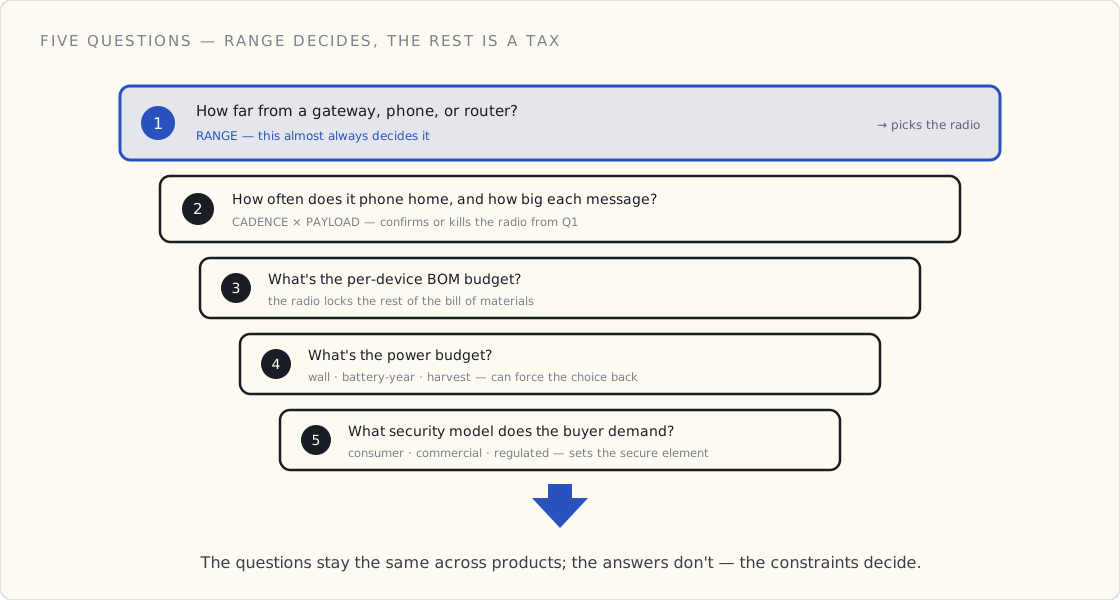
2. How often does it phone home, and how big is each message?
Frequency × payload = bandwidth need × power draw. Both go up linearly; battery life goes down exponentially.
| Cadence | Survives? |
|---|---|
| Once per hour, < 100 bytes | BLE, LoRa, NB-IoT all fine |
| Once per minute, < 1 KB | BLE, Wi-Fi, cellular fine; LoRa marginal |
| Once per second | Wi-Fi or cellular; LoRa is out |
| Real-time / event-driven | Wi-Fi or cellular with sticky connection |
The trap here: if your PRD says "real-time" and your power budget says "two AA batteries for a year," your PRD is wrong. Renegotiate before you pick a chip.
3. What's the BOM-cost budget per device?
Per-unit cost dominates everything at scale. Rough 2024 numbers:
| Component | Per-device BOM |
|---|---|
| ESP32-C3 module (Wi-Fi + BLE) | $1.50 – $3 |
| LoRa module (RAK, Murata) | $7 – $12 |
| Cellular LTE-M module | $12 – $25 |
| GPS module (u-blox) | $4 – $8 |
| Cellular eSIM + data plan, per year | $5 – $20 |
A $40 device with cellular + GPS spends most of its BOM on radios. A $40 device with BLE has $35 left for everything else. The radio choice locks the rest of the BOM, which is why you can't defer it.
4. What's the power budget?
Three regimes, very different design constraints:
- Wall powered — anything goes. Wi-Fi, cellular always-on, frequent polling — no problem.
- Battery, replaceable, year+ lifetime — sub-1 mA average. BLE advertising, LoRa with long intervals, NB-IoT PSM mode. Aggressive sleep states; no Wi-Fi.
- Energy-harvest (solar, kinetic) — sub-100 µA average. Backscatter protocols, beacon-only, no acknowledgments. Real engineering problem.
The power budget often forces the wireless choice retroactively. A year-on-two-AAs spec rules out Wi-Fi before any of the other constraints kick in.
5. What's the security model the buyer demands?
Consumer, commercial, and industrial deployments have wildly different threat models.
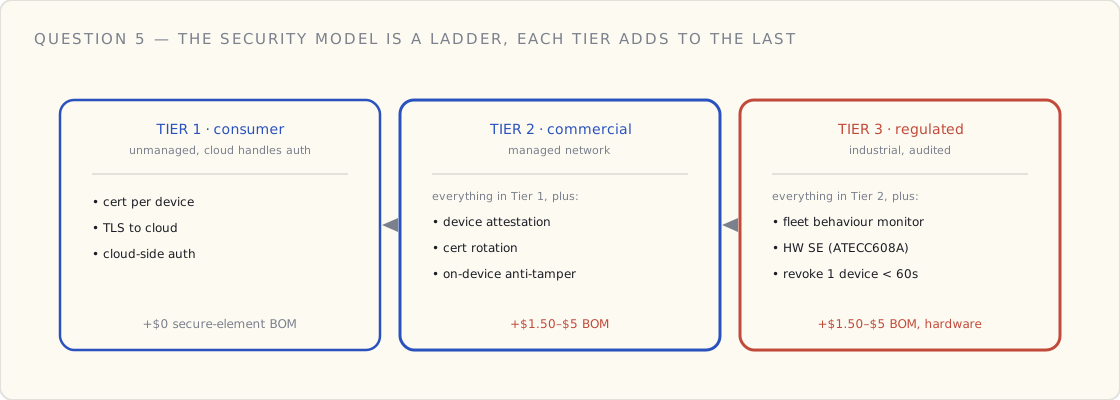
- Consumer / unmanaged — cert per device, TLS to cloud, cloud handles auth.
- Commercial / managed network — add device attestation (TPM, secure element), cert rotation, on-device anti-tamper.
- Industrial / regulated — everything above + fleet behavior monitoring, hardware secure element (ATECC608A, NXP A71CH), the ability to revoke a single device in < 60 seconds.
Tier 2 and 3 add $1.50 – $5 of BOM for the secure element. If the buyer is regulated and your BOM doesn't include this, you have a problem before you ship.
Two worked examples — same rubric, very different answers
Example 1: a connected power tool
Pretend we're scoping a connected power tool — the kind of thing a construction company tracks across a job site.
| Question | Our answer | Implication |
|---|---|---|
| 1. Range? | ≤ 30 m to operator's phone, sometimes 200 m to a job-site gateway | BLE + LoRa dual radio |
| 2. Cadence? | Telemetry every 10 minutes, event-driven on error | Both BLE and LoRa survive |
| 3. BOM? | $8 of radios on a $300 tool | Within range; LoRa pricey but acceptable |
| 4. Power? | Tool's 20V battery — wall-equivalent | All options open |
| 5. Security? | Commercial; fleet-managed by the construction company | Add secure element ($2), cert per tool, anti-tamper |
End result: BLE + LoRa dual radio, secure element, fleet management via AWS IoT Core Thing Groups. The five questions did the work.
Example 2: a consumer Bluetooth tracker (Samsung-SmartTag-style)
Same rubric, a wildly different product. Pretend we're scoping a $30 retail Bluetooth tracker — a tag you stick on your keys, your bike, your kid's backpack — that finds itself via a crowdsourced finder network.
| Question | Our answer | Implication |
|---|---|---|
| 1. Range? | ≤ 10 m to the owner's phone; crowdsourced via every nearby phone running the vendor's app beyond that | BLE only — finder network does the long range |
| 2. Cadence? | Advertising every 2-10 seconds; no scheduled telemetry uplink | BLE advertising mode (no persistent connection) |
| 3. BOM? | $4 of radio on a $30 retail product | BLE single-chip ($1-2 in volume) — only option that fits |
| 4. Power? | CR2032 coin cell, 12+ months expected | BLE 5.0 advertising-only, sub-µA average draw |
| 5. Security? | Consumer privacy + anti-stalking | Rotating identifier per 15 min, AES-128, finder-network E2E encryption (Apple Find My / Samsung SmartThings Find spec) |
End result: BLE 5.0 only. No LoRa. No cellular. Crowdsourced finder network (the vendor's existing installed-base of phones) for the long-range case. Anti-stalking via rotating identifiers — the pressure on this category comes from state anti-stalking legislation and the Apple/Google "Detecting Unwanted Location Trackers" spec finalized this month, which standardizes the unwanted-tracker alerts the platforms now expect.
Same rubric, opposite answer
The same five questions on two products: one wants BLE + LoRa + secure element + fleet management; the other wants BLE-only + finder network + rotating IDs + a sub-microamp average draw. The rubric isn't a recipe. It's a question-list that surfaces the constraints. The constraints decide.
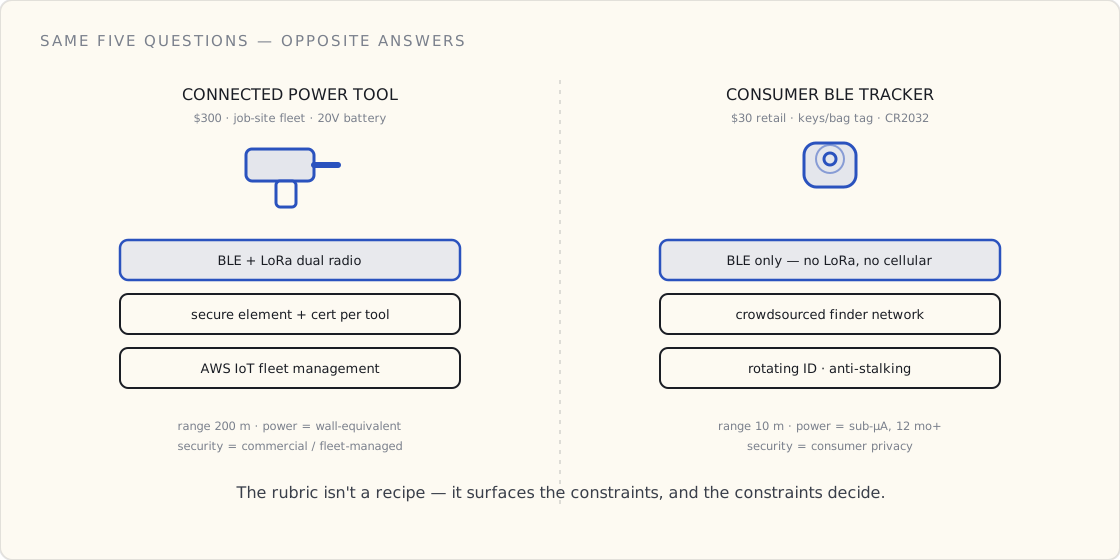
This is the part that makes the matrix portable across product categories: it doesn't tell you what to build, it tells you what to think about. Power tool vs key fob vs medical device vs cattle tracker — the questions stay the same. The answers don't.
What about Sigfox?
Briefly: not anymore. Sigfox filed for bankruptcy in early 2022 and the remaining network has been on uncertain footing since. NB-IoT and LTE-M cover most of the same use cases with operator backing. I would not start a new product on Sigfox in 2024.
The thing the matrix doesn't decide
The matrix decides wireless. It doesn't decide cloud, doesn't decide protocol layer (MQTT vs HTTP — almost always MQTT), doesn't decide topology (device-to-cloud vs device-to-gateway-to-cloud), and doesn't decide OTA strategy. Those are separate decisions that follow the wireless one.
But if you can get the wireless choice settled in twenty minutes instead of three meetings, the rest of the architecture conversation goes much faster. Tape the matrix to the wall.