Speccing a Pet Tracker That Doesn't Need a Subscription
Last time I talked myself into building a pet tracker. This time I do the part that keeps a grudge from becoming a garage full of dead prototypes: the product work, before the soldering iron.
Three use cases, in priority order
- Is my pet home / in the yard? The 95% case. Wants near-zero power, near-zero data, an instant "they left" alert, and activity tracking.
- My pet is off-grid with me — a trail, the woods. No cell coverage. I want to see where they are relative to me.
- My pet got out and is miles away. Rare, high-emotion — and the fear that actually sells trackers.
Most products are built entirely around #3 and bill you monthly for it. But #1 is where pets spend their lives.
The rubric, applied
I make every connected-product team I run answer five questions before picking a radio. Run them on a pet:
- Range? Home is meters. A trail is kilometers. "Lost in the next county" is anywhere.
- How often does it phone home, and how big is the message? A GPS fix is ~12 bytes, and at home you only need a heartbeat. Tiny.
- BOM budget? Consumer. Every dollar of radio locks the rest of the bill.
- Power budget? Small battery, and — per the last post — no charging cult.
- Security model? Consumer. A device cert to the cloud, TLS, no drama.
Answer those honestly and you do not arrive at "always-on cellular for everything." You arrive at a spectrum.
The connectivity spectrum
| Radio | Range | Power | Cost | Good for |
|---|---|---|---|---|
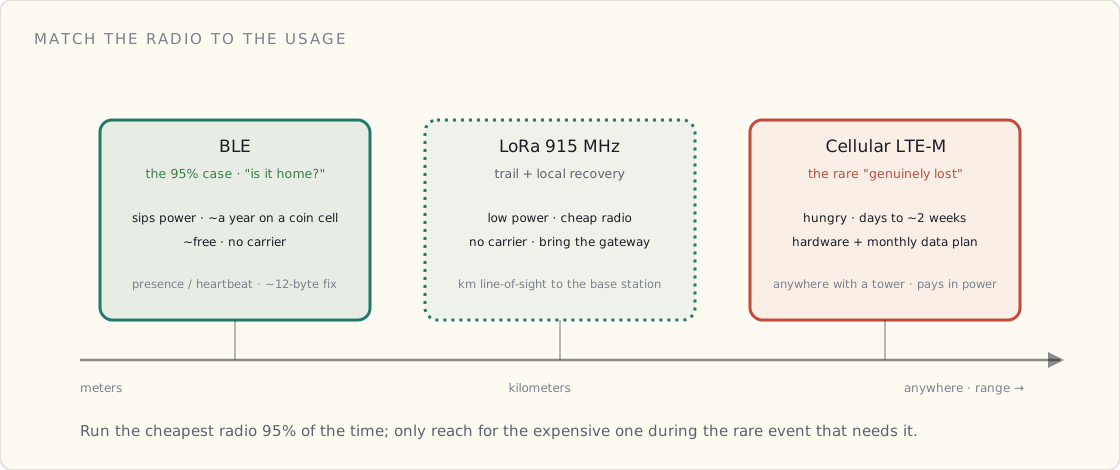
| BLE | meters | sips (an AirTag runs ~a year on a coin cell) | ~free | "Is it home?" presence |
| LoRa (915 MHz) | kilometers, line-of-sight | low | cheap, no carrier | trail + local recovery, if you bring the gateway |
| Cellular (LTE-M) | anywhere with a tower | hungry | hardware + monthly data | the genuinely-lost case |
The whole insight is one line: match the radio to the usage. A pet that's home 95% of the time should be running its cheapest, lowest-power radio 95% of the time — and only reach for the expensive one during the rare event that needs it.
The product line
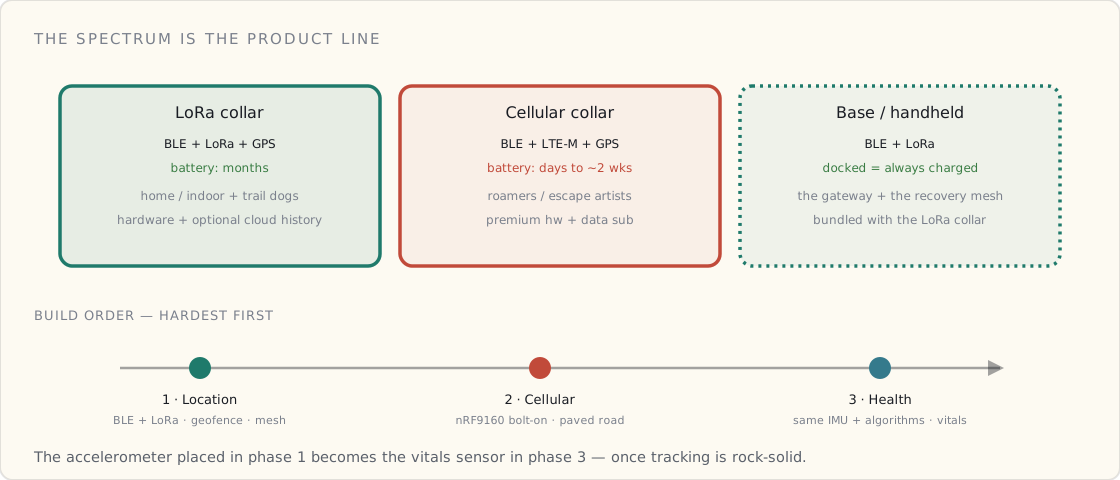
That spectrum is the product line. Three SKUs, so the customer picks their own range / cost / battery trade instead of me guessing:
| SKU | Radios | Battery | For | Money |
|---|---|---|---|---|
| LoRa collar | BLE + LoRa + GPS | months | home/indoor pets; trail dogs (with the base station) | hardware + optional ~$20/yr cloud history |
| Cellular collar | BLE + LTE-M + GPS | days–~2 wks | roamers / escape artists / "find from the couch" | premium hardware + data sub (still under the incumbents) |
| Base station / handheld | BLE + LoRa | weeks (docked = always charged) | every LoRa-collar owner | bundled with the LoRa collar |
The tiered-power trick
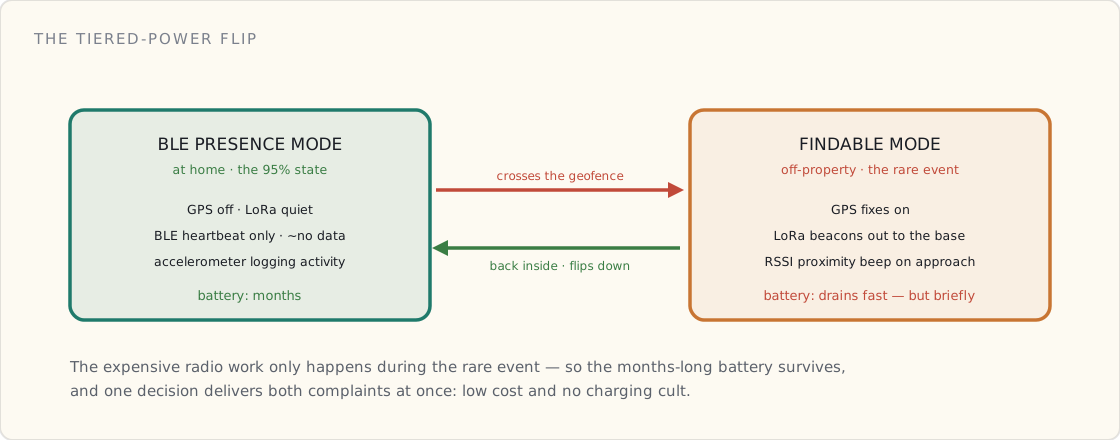
The LoRa collar does one clever thing: it lives in BLE presence mode at home (months of battery, ~no data), and only flips to findable mode — GPS fixes + LoRa beacons — when it crosses the geofence. The expensive radio work only happens during the rare event, so the months-long battery survives. That single decision is what delivers both of the things people complain about: low cost and no charging.
The base station is the network
Normally it's a docked listener at home. But it's built as a handheld in a charging cradle — Garmin-Alpha style — so you grab it off the dock and it becomes a mobile LoRa gateway. Pet got out? You drive a grid around the neighborhood and re-acquire its beacon; the collar's GPS gets you to the block, and an RSSI proximity beep (faster and louder as you close in) gets you to the actual bush. On a trail, you just carry it and watch the pet relative to you, phone over BLE for the map.
And the strategic part: crowdsource the base stations. Every docked unit passively listens for any lost collar nearby and reports it. At neighborhood density that's a pet-specialized recovery mesh — the Apple Find My / Amazon Sidewalk model, seeded by always-on home base stations instead of phones. Tractive can't copy it; pure cellular has no network effect. The honest catch is cold-start: the mesh is only magic once it's dense, so early on recovery leans on you and your own handheld. Same chicken-and-egg every crowdsourced network faced.
Little features that punch above their BOM
A piezo buzzer costs pennies, so both the collar and the base get one:
- Collar: beep to find it (it fell off, or the pet's hiding), a recall/training cue, and a humane no-shock "you're leaving the yard" boundary warning.
- Base: an audible "he got out" alert the moment the pet crosses the geofence or drops off the radio — so you're not glued to the app — plus that proximity beep while you search.
The build phases
- Location — BLE + LoRa. The novel, can't-buy-it part: presence, the geofence flip, the mesh, the base station. The hardest phase, on purpose.
- Cellular. The "anywhere" premium SKU. A paved road (Nordic's nRF9160 + reference firmware), so it's a low-risk bolt-on.
- Health. And here's why it's last: pet vitals are mostly an IMU + algorithms problem, not a new sensor. A sensitive accelerometer picks up the body's micro-vibrations at rest — that's how the incumbents derive resting heart rate and respiratory rate, fur and all. So the accelerometer I put on the collar in phase 1 becomes the vitals sensor in phase 3, once tracking is rock-solid.
A phase-4 idea worth writing down now: the base station is stationary, right where the pet sleeps. It could later carry a mm-wave radar for fully contactless resting vitals — heart and respiratory rate with no collar contact at all. That's the magic version of "the base station is more than a charger."
The honest part
- AirTag already owns cheap + no-subscription + find-my-network at $29. So my moat is not raw location — it's the pet features Apple won't build (activity, sleep, vitals trends, multi-pet, family alerts, vet-shareable data) plus the pet-specialized mesh. The position is Whistle's features, AirTag's price model.
- A LoRa collar can't find a pet past the edge of the mesh and your car's reach. That's exactly what the cellular SKU is for. The line lets the buyer choose.
- At volume the hardware BOM is ~$30. The reason incumbents charge $120/yr is the cellular data plan — remove cellular and you remove the cost basis for the subscription, which is how ~$20/yr for cloud history is honest and still 6× cheaper.
Spec's done. Next post: I stop typing and hit buy.