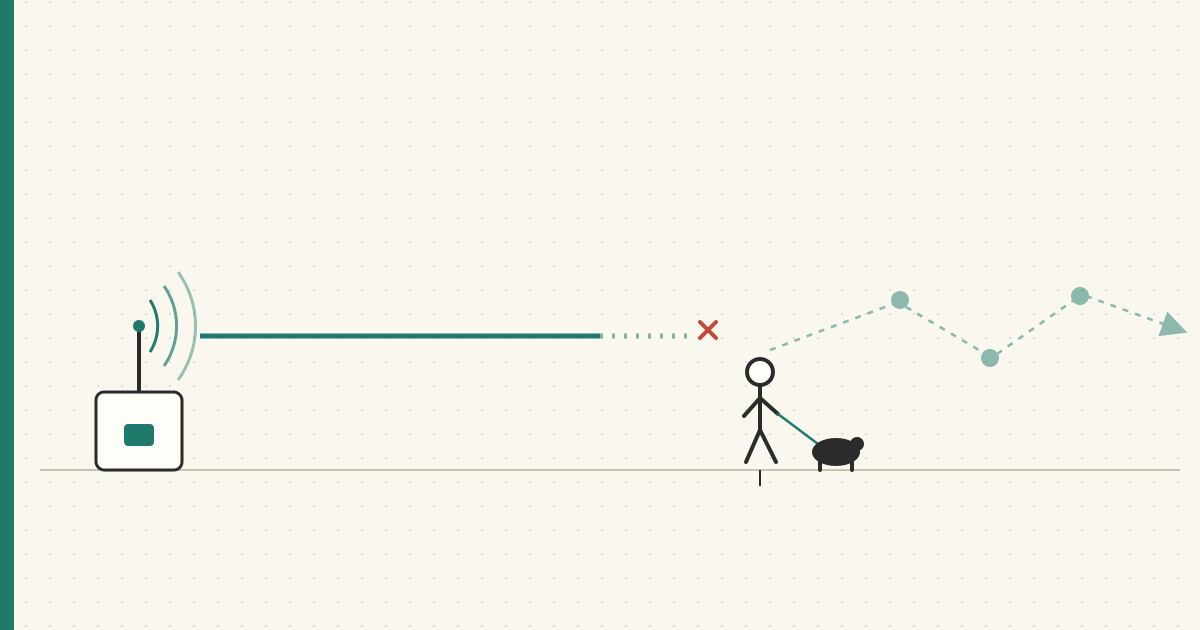
The Range Test: 1,250 Feet Direct — and Miles Through the Mesh
Last post I wrote the scorecard before I ran a single test, so I couldn't move the goalposts once I got excited. Criterion #1 was LoRa range, flagged the make-or-break: if this fails, nothing else matters.
It didn't fail. Here are the first numbers, against the targets I set.
The walk
One node on the move (call it the collar), one node home as the base station, beaconing forced to a 60-second heartbeat so I could catch the exact second the link died — the setup from last post. I started with the link solid and walked a straight suburban line until the heartbeat went stale.
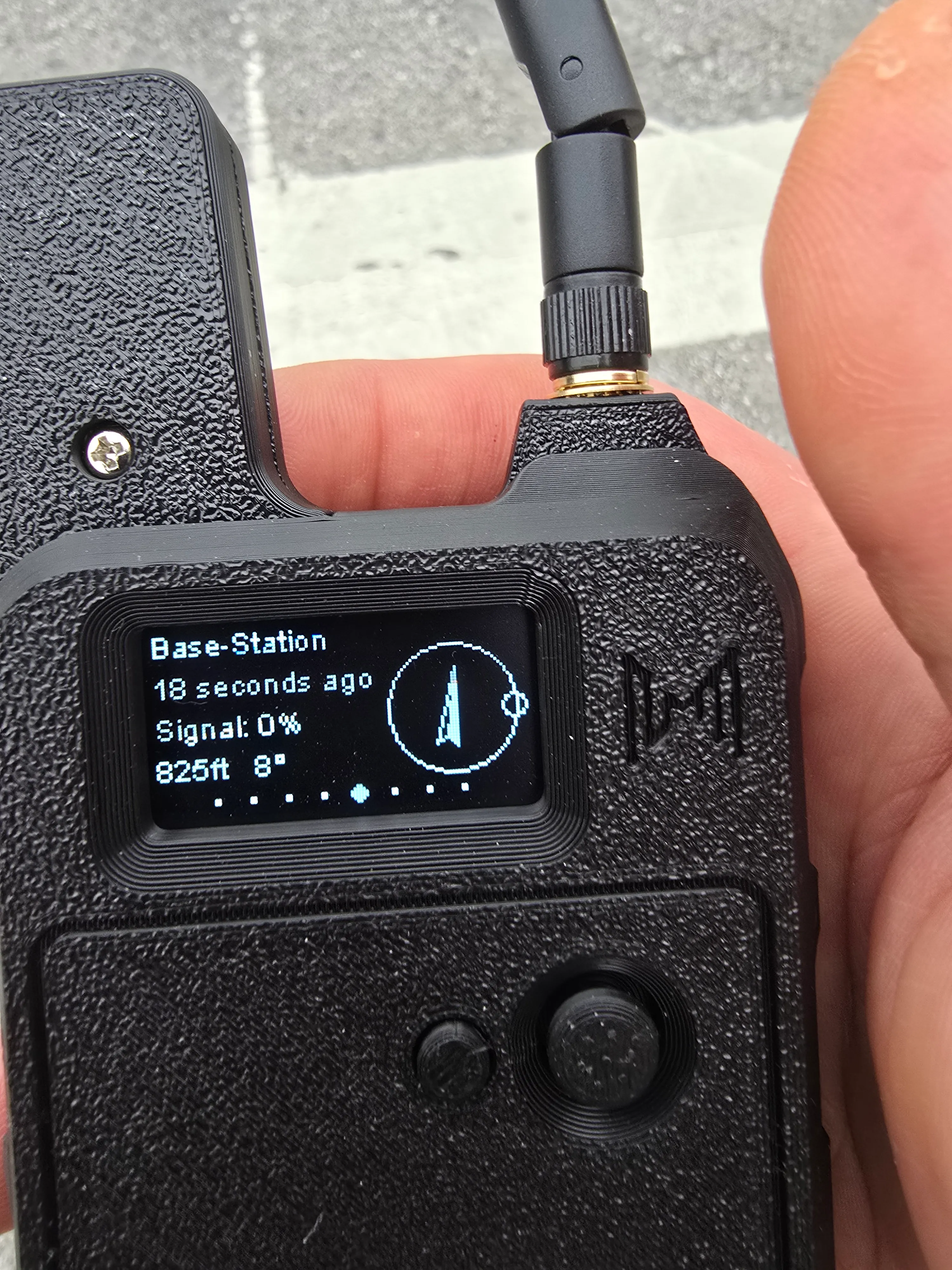
The number: the direct link held to 1,250 feet before the heartbeat went stale and stuck — last-heard climbing to one minute, two, three, no fresh beacons. That's where I stopped.
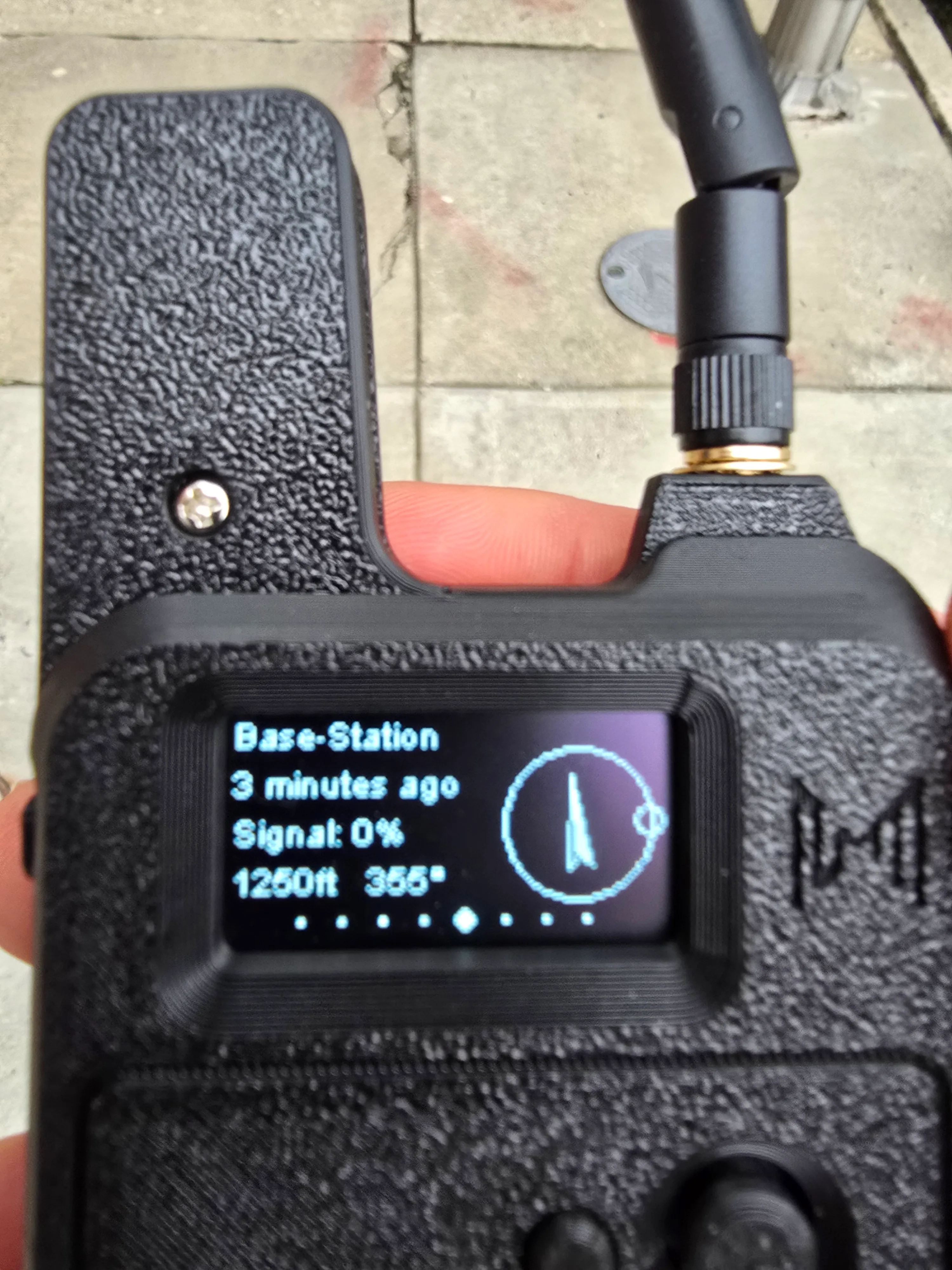
1,250 ft is about 381 meters. Against the scorecard:
| Setting | Target | Result |
|---|---|---|
| Open line-of-sight | ≥ 1.0 km | — not yet walked — |
| Suburban / through houses | ≥ 300 m | 381 m — pass |
| Dense foliage / trail | ≥ 150 m | — not yet walked — |
The suburban bar — the one that matters most for a dog who gets out the front door — cleared, with margin.
Zero hops — why that number is honest
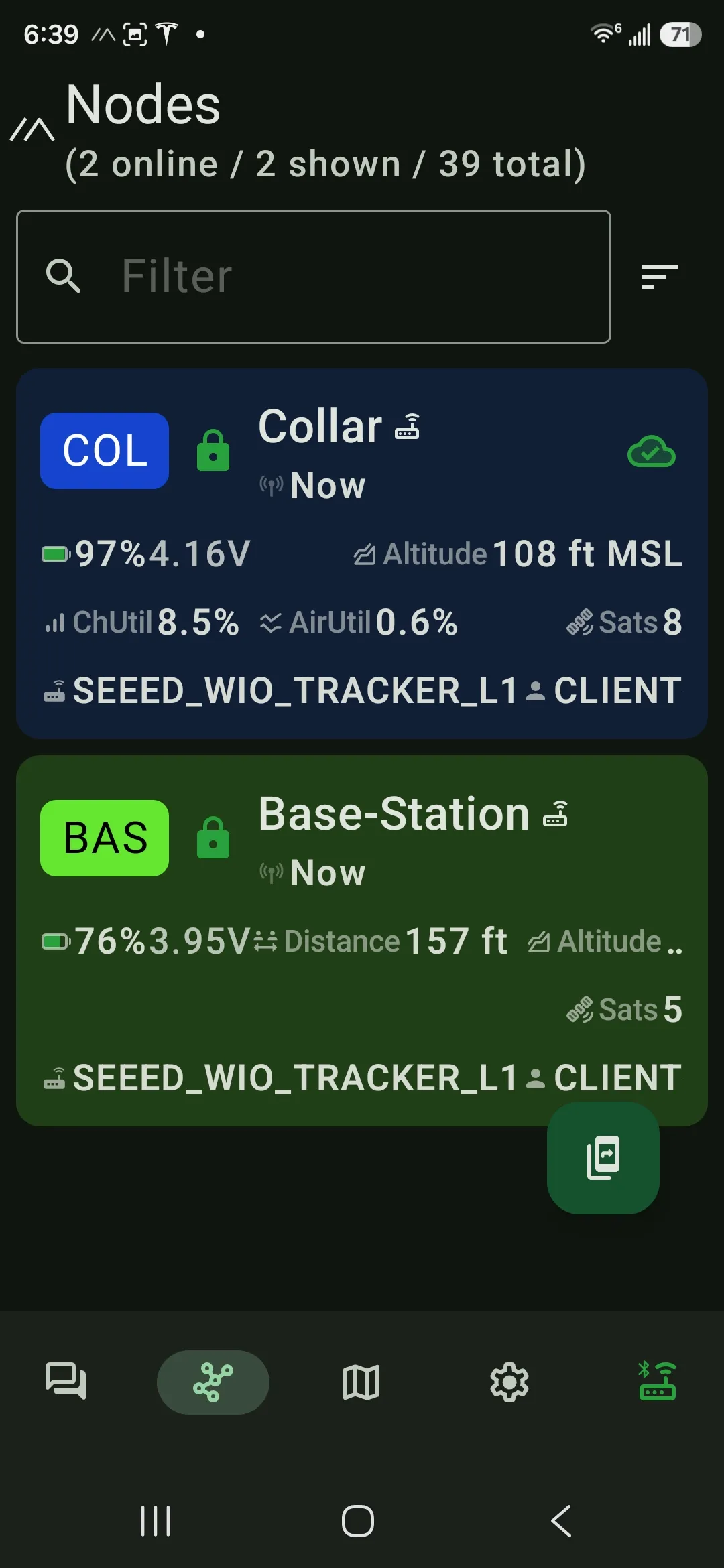
Here's the part I want to be precise about, because it's easy to accidentally cheat a range test. The app showed the base station at Hops Away: 0.
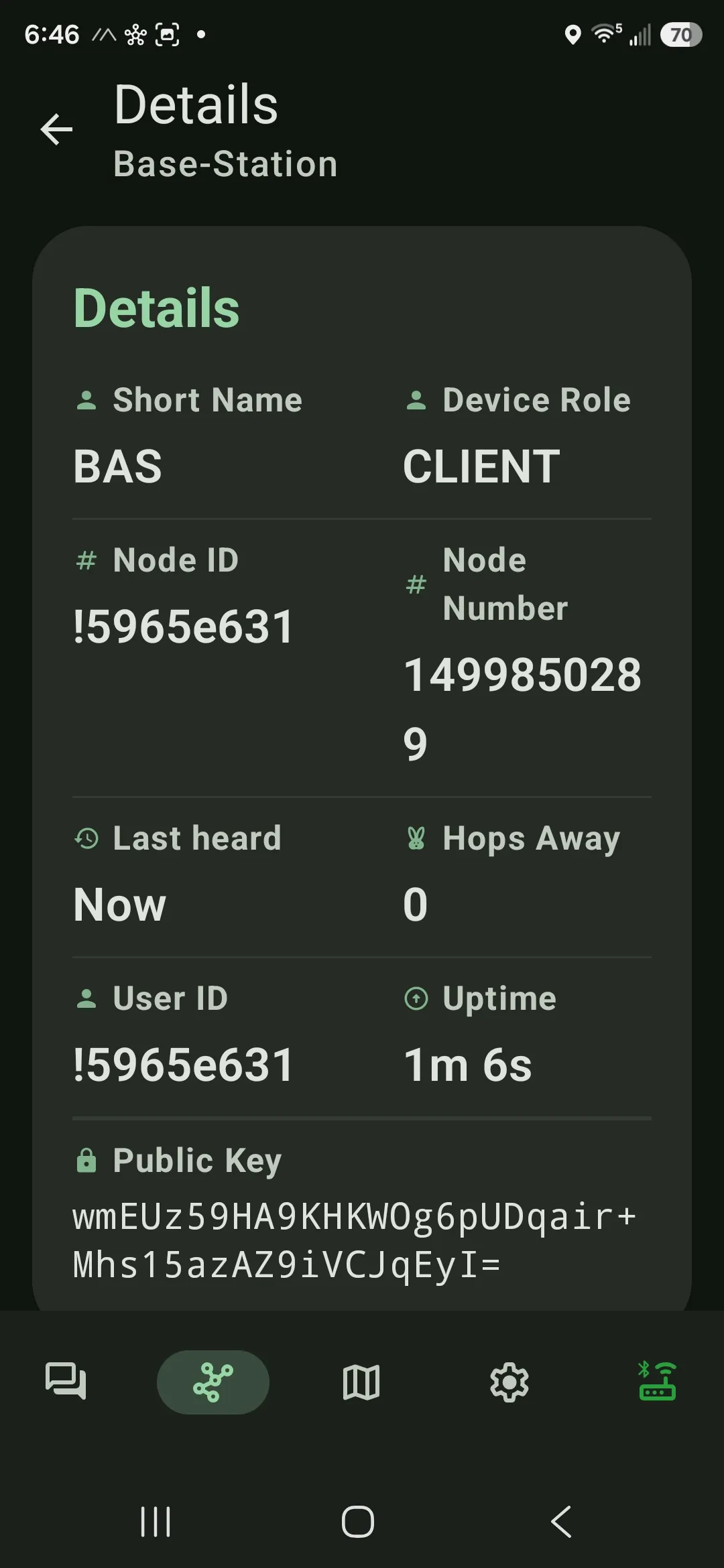
Zero hops means my handheld heard the collar firsthand — the radio itself reached 1,250 feet, with no neighbor's node quietly relaying the beacon and inflating the result. Last post I found 39 strangers' nodes already on the air around my block, so I deliberately moved my two nodes onto their own channel and filtered the view to direct-only. 1,250 feet is the floor: what one radio does, alone, with nobody helping.
And the mesh was already doing miles
Now lift the zero-hop filter off and the story changes scale. Those 39 nodes are a working mesh, and it is emphatically not local. Sort the list by distance and there's a station — Mesh_WYVERN, 33 miles (53 km) out, four hops away:
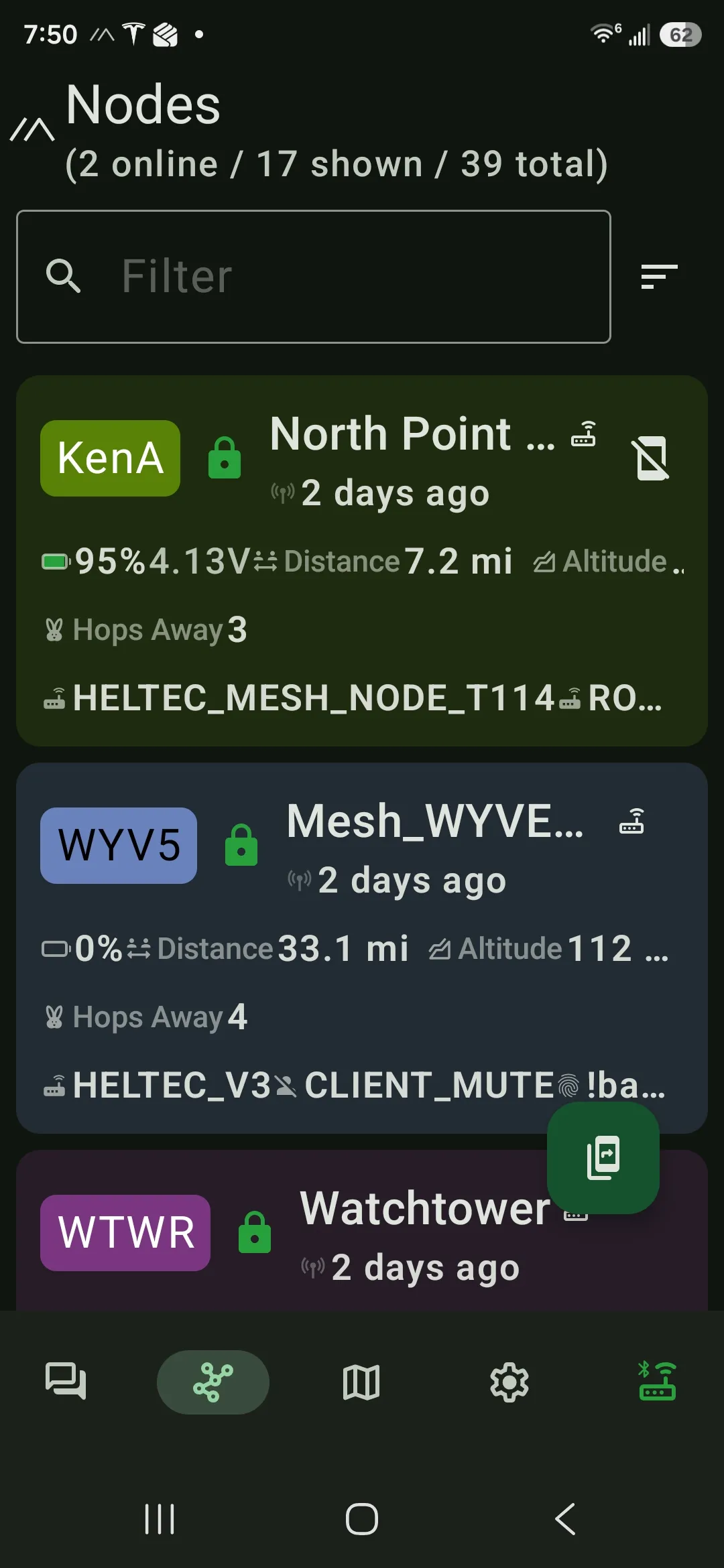
That's the network, not my radio — and my own collar rides it: on earlier runs across the public channel, with beacons free to relay hop to hop, the collar's position came back from about ten kilometers out. The reach my pet's beacon can borrow is measured in miles, not feet.
Put the whole span on one axis and the gap is the story — what my own radio did, against what the mesh carried for nothing:
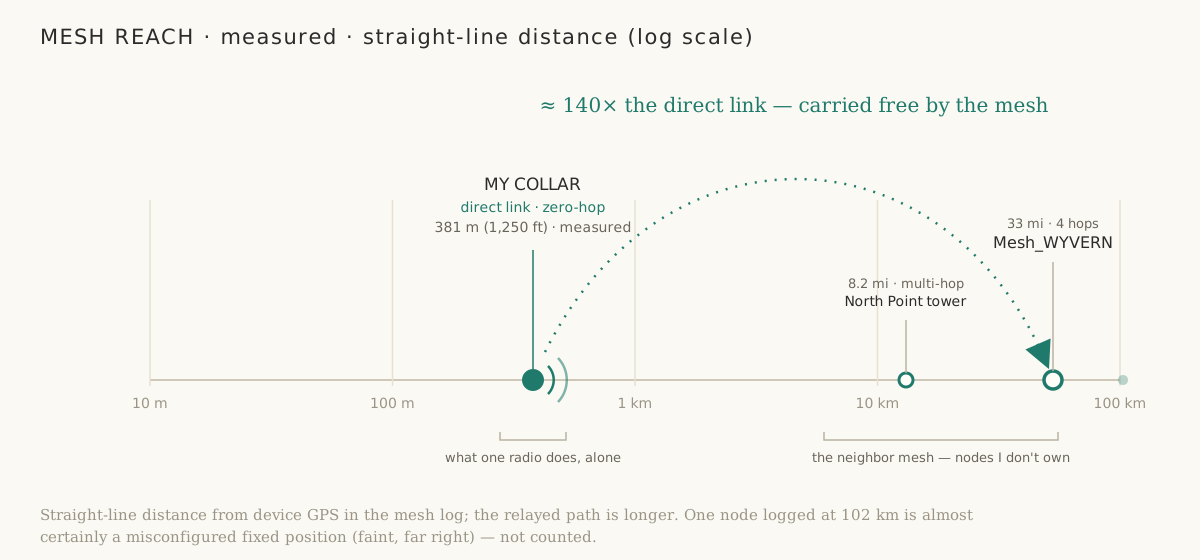
My own radio's direct link tops out around 381 m. On the same axis, the neighborhood mesh reached North Point's tower 8.2 miles out and Mesh_WYVERN 33 miles away over four hops — about 140× my direct range, on nodes I didn't buy and didn't place. (The log even caught a node at 100 km; that one's almost certainly a misconfigured fixed position, so I'm not counting it.)
That's the moat I sketched in the PRD, and I'd assumed I'd have to bootstrap it one sale at a time. Instead it already exists, on my street, before I've shipped anything — the same network effect behind Find My and Sidewalk. Zero-hop clears the bar on its own; the mesh turns feet into miles for free. The direct link is what I can promise; the mesh is the upside I don't have to build.
And I haven't touched the antenna or the power
The 1,250 feet is conservative for a third reason: it's the stock rig. The base is running the little screw-on whip the Wio Tracker ships with — and the Meshtastic crowd is near-unanimous that it's the cheapest weak link to fix, with higher-gain antennas that clearly outrun it. It's a fiddly part to swap on this enclosure, but it's swappable. I also haven't pushed transmit power toward its ceiling.
Both are pure link budget, and link budget turns into range through one clean equation. Every decibel you add — antenna gain on either end, plus transmit power — multiplies range by:
range × 10 ^ ( ΔdB / (10 · n) )
where n is the path-loss exponent: about 3 in the suburbs (free space is 2; dense foliage pushes toward 4). Anchored at my measured 1,250 ft / 381 m:
| Link budget added | Multiplier (n = 3) | Direct range |
|---|---|---|
| +3 dB | 1.26× | ~1,580 ft |
| +6 dB | 1.58× | ~1,980 ft |
| +9 dB | 2.0× | ~2,500 ft |
| +12 dB | 2.5× | ~3,140 ft |
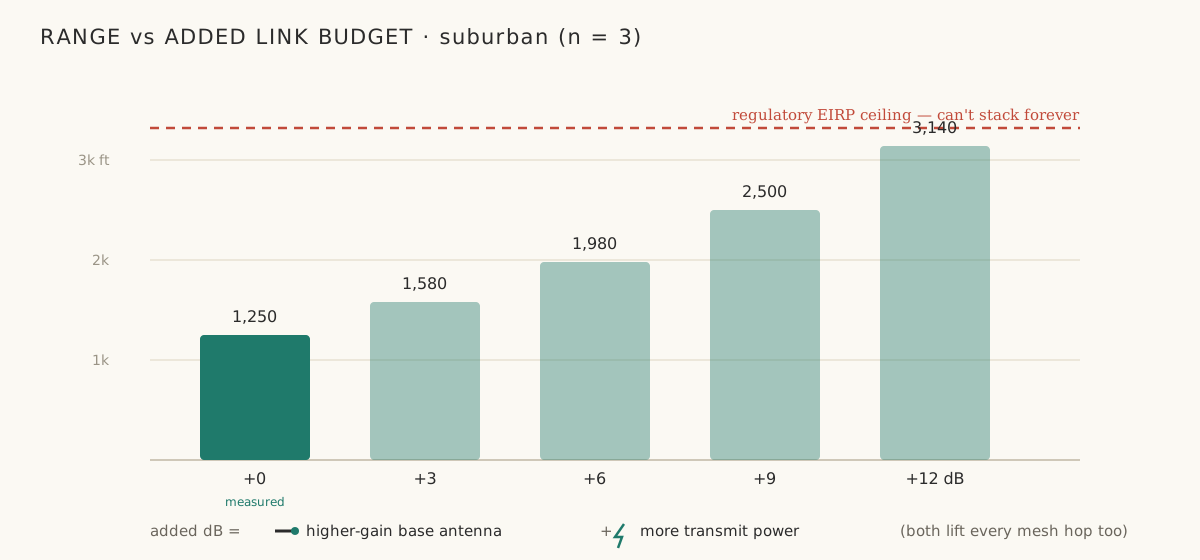
Where those decibels come from: trading the ~2 dBi stock whip for a ~5.8 dBi collinear is about +4 dB, and there's usually a few dB of transmit-power headroom on top — call it +8 to +10 dB on the base side, which the table turns into roughly double the direct link, a quarter-mile-plus. Two honest limits keep it from being free. US 915 MHz ISM has an EIRP cap, so you can't stack gain and power without bound. And the collar antenna can't grow — a cat won't wear a collinear — so the realistic gains live on the base side. The upside: the same decibels lift every mesh hop too, so a better base antenna stretches both the 1,250-ft direct floor and the ~10 km mesh ceiling.
I'll confirm it with a real walk once the new antenna's on. For now it's a model — but the model is just radio physics, and it's why range isn't the thing that worries me.
Messaging works too
The link isn't just position beacons. I sent a plain text from the collar mid-walk and it landed at the base station:
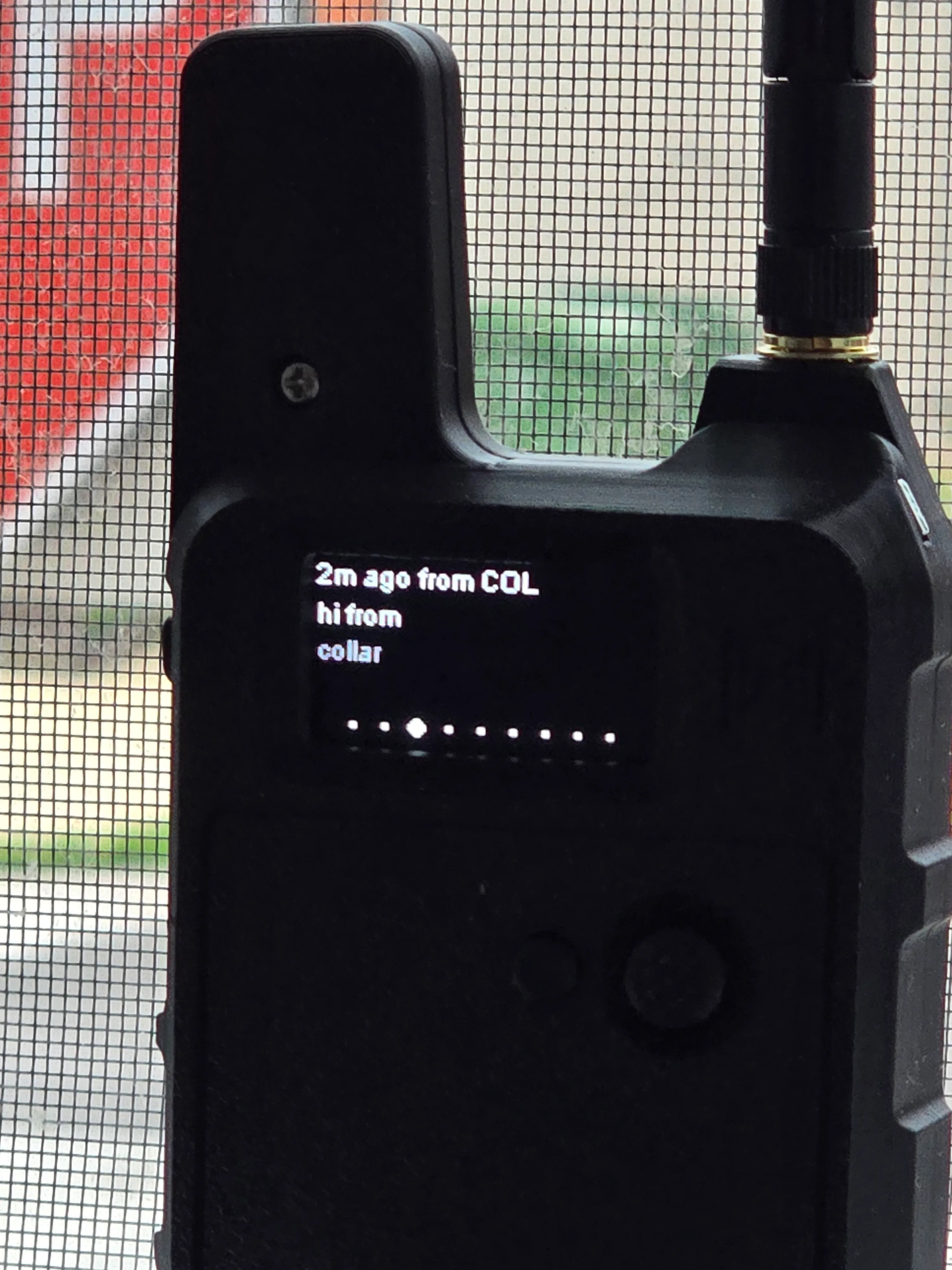
Small thing, big implication for an actual escape: I can ping the collar and get a fix back on demand, not just wait for the next scheduled beacon.
Presence — the heartbeat is the signal
The two walk photos above are also the presence test in miniature: at the start the heartbeat reads seconds ago (home / in range), at the limit it climbs and sticks (away / out of range). That climb-and-stick is exactly the home-vs-away signal the scorecard asks for — clean, with no false "still here" once the radio's truly gone.
The scorecard so far
| Criterion | Status |
|---|---|
| LoRa range — suburban | Pass (381 m, zero-hop) |
| LoRa range — open LOS / foliage | Not yet walked |
| Presence — home/away heartbeat | Looks clean; full 10-transition run to come |
| Messaging over the link | Works both directions |
| GPS — time-to-fix, accuracy | — to come — |
| Battery — active runtime | ~3.5 days at periodic beaconing — pass (continuous GPS + lit screen: ~10 h) |
| Battery — idle / presence runtime | — to come — |
| The Quark test (escape sim) | — to come — |
Where this leaves the build
The criterion that could have killed the project — range — cleared the suburban bar direct, and the neighborhood mesh already extends recovery to miles I didn't have to engineer. The build stays alive. And the other make-or-break, battery, is looking like a pass too: at periodic beaconing the collar projects to ~3.5 days on a charge — past the three-day bar — while a continuous-GPS, screen-lit stress run collapses it to ~10 hours, which is exactly why the production collar runs headless and duty-cycles the GPS. What's left is GPS fix quality, the idle/presence number, and a per-mode bench measurement to make the battery verdict airtight. Those are next.