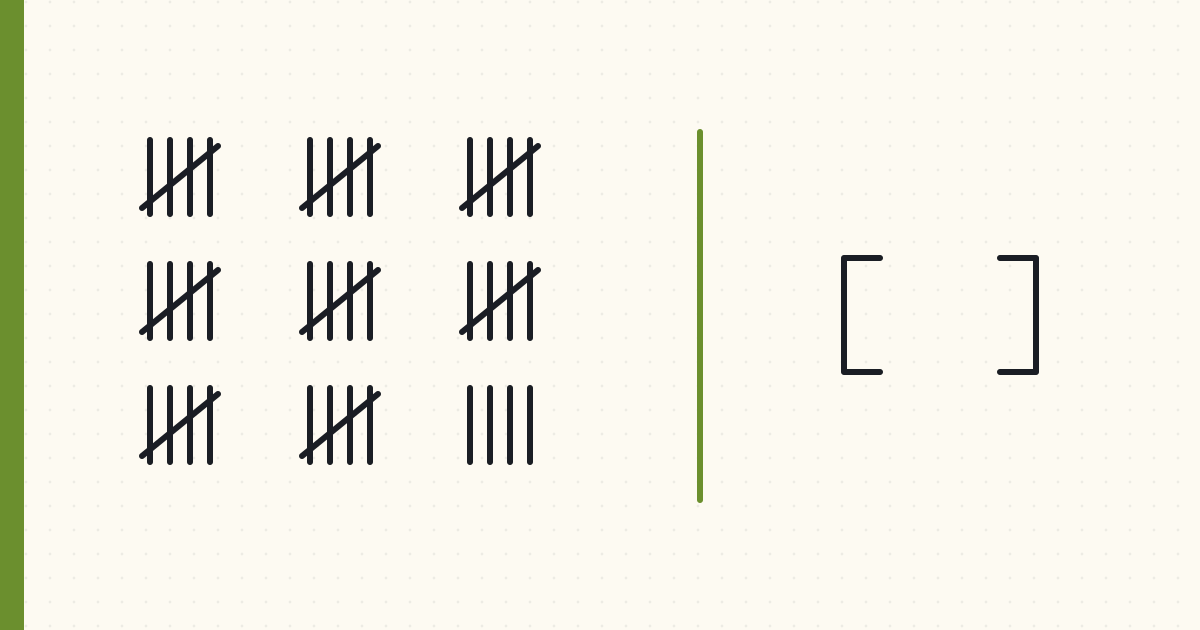
Forty-Four Harness Bugs, Zero Local LLM Limitations: an Accounting
The ranking table is the output of this project. This is the part I'd actually want to read if someone else had written it.
Six of the numbers in that table were measuring my harness, not the models. Here's the accounting, and then the running tally, which is the real result.
Three flat 17s, three different causes
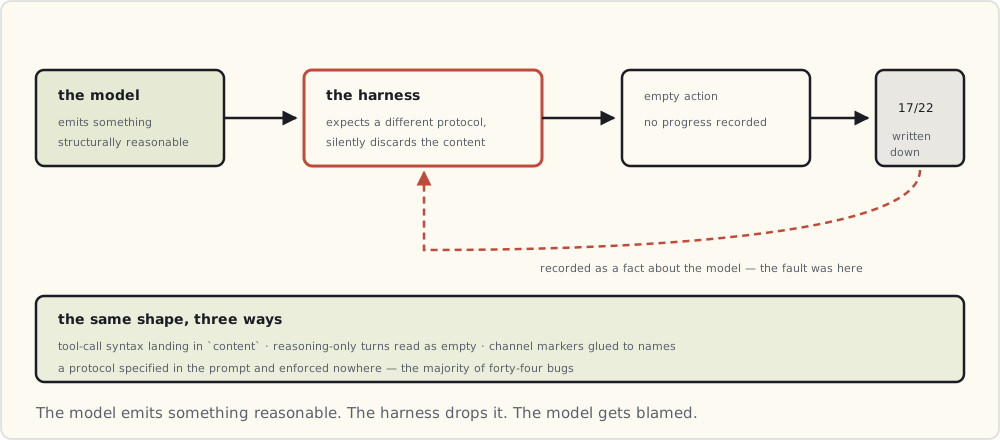
Three models scored a dead-flat 17/22 three times running. All three were harness faults — and each was a different fault, which is why it took so long to see the pattern.
Every one of them was being served with a tool-call parser and then driven through a plain-text protocol. They emitted tool syntax into content, my parser threw it away, and they looked incapable.
| model | what actually broke | before → after |
|---|---|---|
| Laguna-S-2.1 | XML closing tags welded to file paths (app/x.py</arg_value>) — 25–54 corrupted actions per run | 17×3 → 22, 21, 17 |
| Nemotron-120B | reasoning-only turns discarded as empty | 17×3 → 17, 18, 18 |
| gpt-oss-20b | harmony channel markers glued to function names (READCOMMENTARY) | 17×3 → 17×3 (genuinely flat) |
Laguna went from a model I'd written off to one that solves the full contract. Same weights. The only thing that changed was that I stopped discarding its output.
Qwen3.6-35B is the one that should sting most. Its first run produced 82 files of prose and read as a model that couldn't code. That was reasoning leaking into content. Given the right reasoning parser and the tools protocol, the same weights solve the full contract twice out of three and turn in the cheapest cost per solved task in the fleet.
Three zeroes, three holes in the same guard
Three separate 0/22 results were also mine, and each exposed a different hole in the same build guard.
- The guard checked
import appbut never calledcreate_app(). A model wrote valid Python that raised only when the factory ran. 17/22 → 0/22, holdout 0/13, reported as(patched app/__init__.py)— a success. - The guard covered
EDITbut notRUN. A model rewrote a file withRUN python3 << 'EOF', bypassing the edit path entirely. - The guard fingerprinted only
*.py. ARUNthat wrote a non-Python file the app depends on was invisible to it.
All three are closed with regression tests now. The pattern across them is worth more than the individual fixes: each time I plugged the hole at the exact spot the failure appeared, and each time the next failure came through a door two feet to the left. The guard was verifying a proxy — that something imports, that a .py file changed — rather than the property I cared about, which is that the application can serve a request.
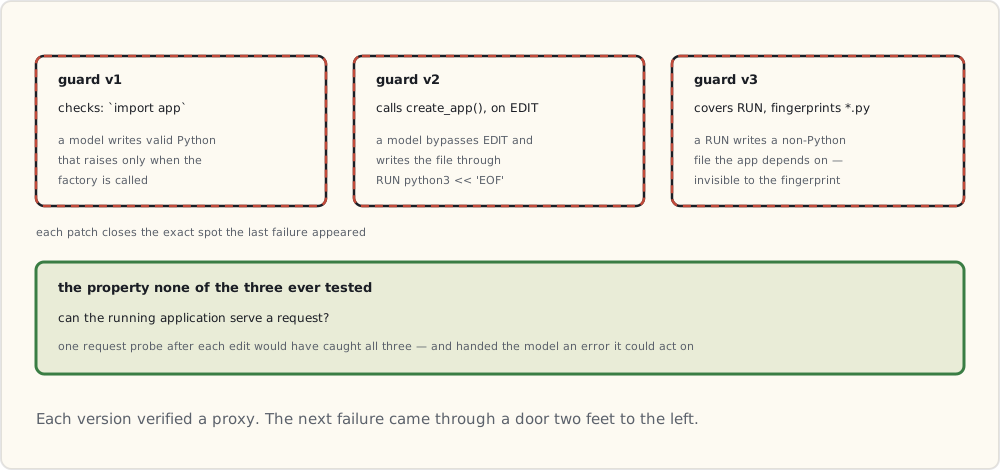
The fix that would have caught all three from the start: one request probe after each edit. Not a smarter guard. A guard that asks the actual question.
The four corrections that changed the outcome
Four times, someone told me in one sentence what was wrong, and each time it took me hours to implement and changed the result.
- "you gave it a cheat code" — my first fast solo benchmark named the stack, showed a worked example lifted near-verbatim from a check, and told the agent to poll the grader. I spent hours arguing the number was contaminated. It was contaminated — and it was also right, which I never considered.
- "it should be accept, revert, or change" — a third verdict turned the reviewer's deletions into repairs.
- "i am your reviewer... stop, fix your code, resubmit" — the repair loop. It produced the first ACCEPT after nine straight rejections.
- "restructure your tests... can you add a member, can you delete a member" — the behavioural contract. The single most effective change in the project.
I notice all four are about the measurement, not the models or the orchestration. Every hour I spent on the parts that felt like engineering was worth less than any one of those sentences.
Two claims I had to retract
"10% better outcome from 1.1% of the code." Reported from two-thirds of the data. The third arm then closed to 22/22 and the framework ranking collapsed into a tie. The honest version — same outcome, 20% faster — is much less quotable.
"The verification gate fired once in six runs, so it's variance." A count taken before the one run that mattered reached the phase where it began declaring DONE. A snapshot generalised into a structural claim, and it inverted the actual finding.
Reading a partial log as a result is the same error as scoring a workspace mid-flight. I did both, on the same day, about the same experiment.
The tally
Forty-four harness bugs. Zero confirmed model limitations.
The dominant shape, over and over: a protocol specified in the prompt and enforced nowhere. The model emits something reasonable, the harness silently discards it, and the model gets blamed.
The sharpest instance is worth the whole project. The solo agent's system prompt said it was graded by accept.py; its kickoff message said check.py. It followed the concrete instruction it received first, ran 60 steps, reported 163/173 (94%) against a grader that isn't the contract, and moved the real criteria from 17/22 to 17/22.
Zero progress, reported as success — because an agent optimises the feedback loop it can actually see. Which is the thesis of this entire project, reproduced by accident, at my expense.
What I'd tell a team
A model that looks broken is a harness bug until proven otherwise. Not as a slogan — as a default. Forty-four to zero is not a close call, and every single time I assumed the other way I was wrong.
Before recording any bad result, check three things: that you can see what the model actually emitted, that your parser accepted it, and that your guard tests the property you care about rather than a proxy for it. All six of my bad numbers would have been caught by the first check alone.
And log what the model received, not just what it sent. My worst bug was two files disagreeing about the grader's name, and it was invisible from either side alone.
What's next
The coding arc closes here. The same method — write the prediction before you look — turns out to be even more necessary when the output is a picture, because a picture is persuasive in a way a score isn't.