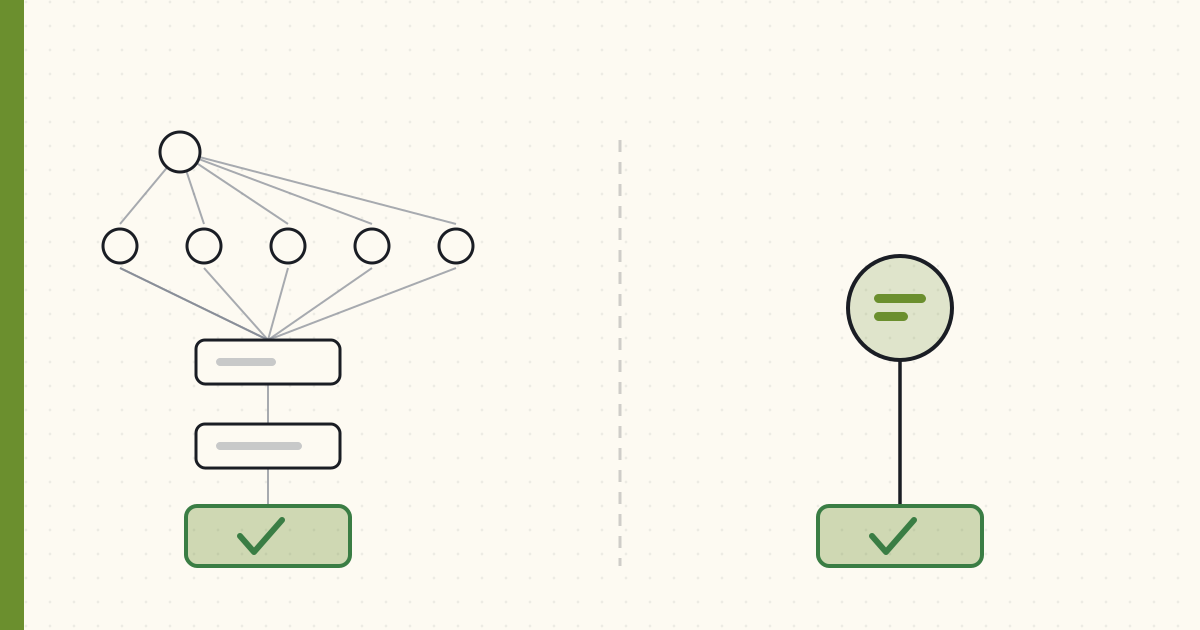
1,200 Lines of Multi-Agent Orchestration, Beaten by One Local LLM Agent
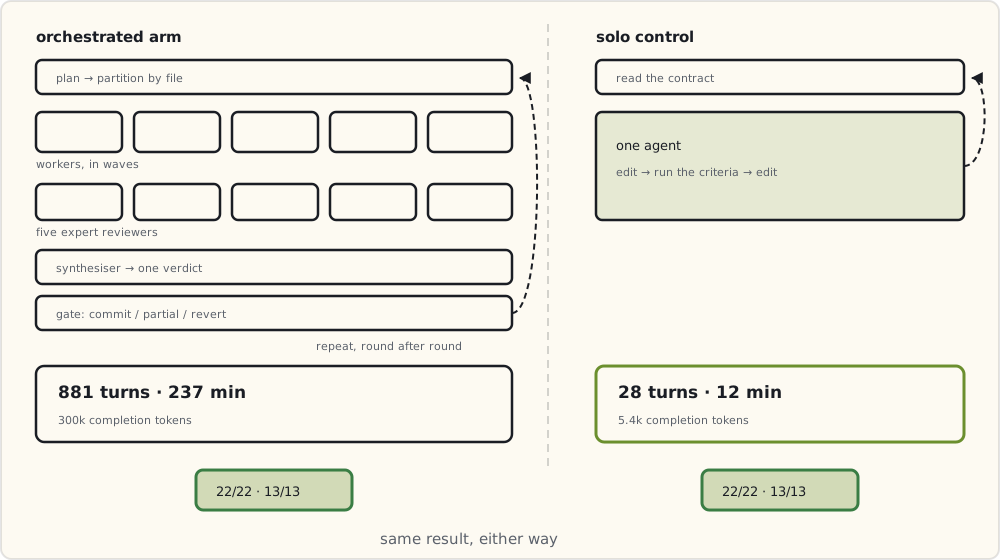
I spent two days building the orchestration. File-partitioned workers, a five-expert review panel, wave scheduling, a synthesiser to turn five opinions into one verdict, repair loops, score backstops. About 1,200 lines of coordination machinery, most of it satisfying to write.
Then I ran a single agent against the same task as a control.
run                result  holdout   time        turns   completion tokens
armA-handrolled     22/22    13/13   237.5 min    881         300k
armB-langgraph      22/22    13/13   190.6 min    802         285k
armC-pydantic       21/22    13/13   160.0 min    979         190k
solo-control2       22/22    13/13    12.0 min     28         5.4k
solo-control3       22/22    13/13    12.0 min     21         5.4k
solo-control4       22/22    13/13    16.0 min     17         9.4k
Three independent single agents each solved the full contract with the holdout intact, in 12–16 minutes, using 30–50× fewer turns and roughly 40× fewer completion tokens than the orchestrated arms. Same baseline workspace, same oracle, same engine load, no answer key anywhere.
The orchestration bought nothing measurable. Not correctness — solo matched the best arm and beat one of them. Not safety — the holdout is 13/13 everywhere. It cost about 13× the wall clock to arrive in the same place.
That's the headline, and it's the least interesting thing here. The interesting part is why it lost.
The orchestration was insurance against a problem I'd already fixed
The five-expert panel existed for a specific reason. My original grader was 229 structural checks — does this class have that attribute, does that module define this column — and three separate workspaces scored 229/229 while shipping the identical defect. Delete a member who's assigned to a task and the task still points at the deleted row. Nothing in 229 checks ever deleted an assignee, so nothing ever saw it.
Given an oracle that blind, building something else to look is a coherent design. The panel wasn't stupid. It was compensating.
Then I replaced the grader with 22 criteria that drive the running application, and the panel's entire reason for existing evaporated. The class of defect it was built to catch is now caught by the oracle itself, in two seconds, every round.
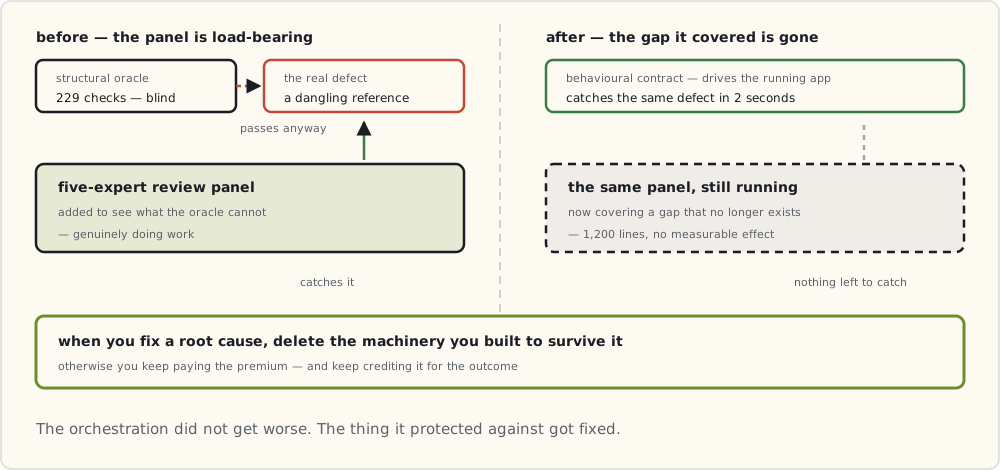
The orchestration didn't lose because multi-agent is a bad idea. It lost because it was insurance against a blindness that no longer existed. Nobody re-evaluated the insurance after fixing the leak — I certainly didn't, until the control run made it unavoidable.
That's the transferable lesson, and it has nothing to do with agents. When you fix a root cause, go back and delete the machinery you built to survive it. Otherwise you keep paying the premium forever, and — worse — you keep attributing your outcomes to it.
What this does not prove
I want to be careful here, because the overreach is very tempting and this project has punished me for it before.
This was a small repair task with a complete contract: five defects, 22 criteria, everything fitting inside one context window. That is precisely the case where decomposition can only add overhead, which makes it the weakest possible ground on which to defend orchestration. Concluding "multi-agent doesn't work" from this data would be exactly the kind of claim I'd criticise in someone else's post.
Three places where coordination may still pay, all of them untested here:
- Beyond one context. The finding that started this whole project was a from-scratch swarm where 238 of 258 tasks wrote a file another task also wrote, destroying about 92% of its own output. Coordination isn't optional there — it is the problem. And a real codebase, which is what I actually want to point this at, exceeds one context by definition.
- Incomplete or ambiguous specs. My contract named every endpoint and stated the deletion rules outright. A review panel is most defensible exactly where the agent has to guess.
- Adversarial regressions, where a locally sensible fix breaks something distant.
The framework ranking, briefly
Three of those arms were a framework bake-off — hand-rolled, LangGraph, Pydantic AI — and I've written that up separately, because the result there is subtler than this one and deserves its own space. The short version: the paper survey's ranking held up, and its reasoning didn't.
It's worth noting what the control run does to that comparison, though. All three arms are now competing to lose to a single agent by a factor of thirteen. Ranking them is still meaningful — but it answers a question that turned out not to matter for this task.
What I'd tell a team
Run the trivial control first. Not because the simple thing usually wins, but because the number it produces is the only thing that makes the complicated result legible. I had a 22/22 from an orchestrated arm and I was pleased with it. That number meant nothing until I knew that one agent got the same score in a twentieth of the time.
I had every opportunity to run it earlier. It cost twelve minutes. I didn't run it because I'd already spent two days on the sophisticated version and the control felt like a formality — which is precisely the psychology that makes it worth mandating rather than leaving to judgement.
And notice the shape of the mistake: I never measured whether the problem still existed. I measured the solution, repeatedly and carefully, against a baseline I'd stopped questioning.
What's next
If fan-out isn't what bought the result, something else did. The next run isolates the smallest possible mechanism — nine lines that refuse to let the agent decide it's finished — and puts it up against the six-agent panel directly.
I did not expect that comparison to go the way it went.