The Agent Framework Bake-Off: LangGraph vs Pydantic AI vs Hand-Rolled, and the 32 Lines That Mattered
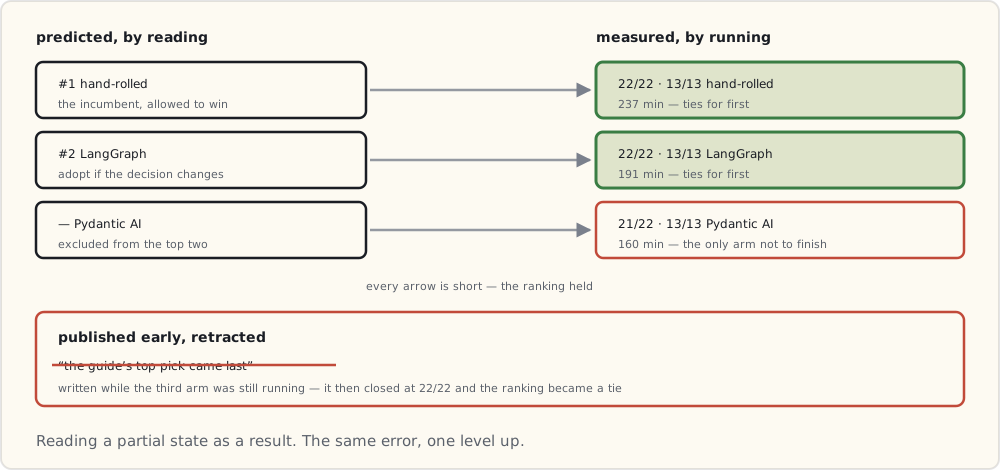
Last week I scored ten agent frameworks by reading their documentation and picked a top two: keep the hand-rolled system, with LangGraph as the framework to adopt if the decision changed. Pydantic AI didn't make the cut — R1–R7, R9, R10 and R12 all unsupported.
Then I built all three and ran them on identical workspaces, same worker, same prompts, same review panel, same gate, with the orchestration wiring as the only variable.
arm                            result  holdout    time      turns
armA-handrolled                 22/22   13/13   237.5 min    881
armB-langgraph                  22/22   13/13   190.6 min    802
armC-pydantic                   21/22   13/13   160.0 min    979
The paper ranking held. The guide's #1 ties for first, and the candidate it excluded from the top two is the only arm that didn't finish the contract.
I'd love to report that as a win for careful desk research. It isn't, and the reason is more interesting than the table.
First, a correction I have to make about myself
I wrote up this result before it was finished.
At the point I published, armA was still running and the numbers I had said the hand-rolled arm was trailing. So I wrote "the guide's top pick came last" — a great line, a clean reversal, exactly the kind of finding that makes a post worth reading. Then armA closed at 22/22 in round 3 and the ranking collapsed into a tie.
That is precisely the error I'd spent the previous week criticising in my own grader: reading a partial state as a result. I did it on the same day, about the same experiment, one level up. The claim was interesting, which is exactly why I should have waited.
Where the survey was actually wrong
Not the ranking. The reasoning underneath it.
The survey scored frameworks on whether they implement R1–R10 as primitives, found that none of them do, and concluded there was nothing to gain from adopting one.
The first half was correct and the measurement confirmed it. Arm B is 84% shared hand-rolled code. Only 32 lines in the entire arm touch a LangGraph primitive.
The second half did not follow.
The gain didn't come from primitives — it came from those 32 lines being harder to get wrong. Five of the thirty harness bugs I hit during this work lived in exactly that surface: a wave loop that died with KeyError: '_unit' on the second wave, a reducer that couldn't be reset between rounds, a field read as problems where the schema emitted concerns. LangGraph's version of those 32 lines has been debugged by more people than mine has.
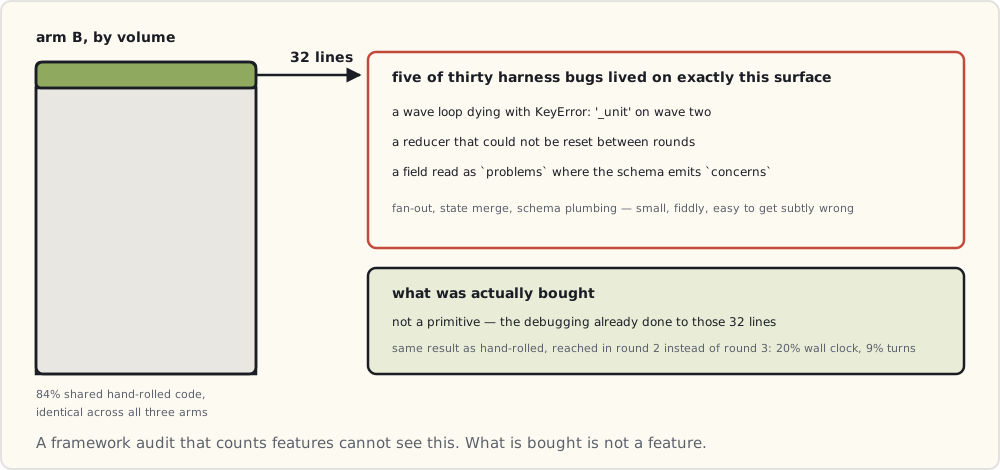
A framework audit that counts features cannot see that, because the thing being bought isn't a feature. It's the accumulated debugging of a small, fiddly surface that I would otherwise get wrong five times.
What LangGraph actually bought
Not a better outcome. Both arms reached 22/22 with the holdout intact.
What it bought was convergence speed — 22/22 in round 2 versus round 3. That's worth about 9% on turns and 20% on wall clock. Real, worth having, and much less than the framing "which framework wins" implies.
I originally reported this as "10% better outcome from 1.1% of the code." That claim is retracted too — it was computed when armA was still trailing. The correct version is: same outcome, 20% faster, from 1.1% of the code. Less quotable. Actually true.
Pydantic AI, fairly
It came last, and the survey predicted it would. But it also ran the fastest wall clock of the three arms at 160 minutes, and its holdout is a clean 13/13 — it did not break anything, it just didn't finish everything. 21/22 with an intact holdout is a respectable failure mode, and a much better one than 22/22 with damage.
It's a well-built library aimed at a different job. The survey's verdict was that it doesn't do what I need, not that it's bad, and the measurement agrees.
What I'd tell a team
When a paper evaluation turns out to be right, check whether it was right for its stated reasons. Mine reached the correct ranking through an argument that measurement contradicted. If I'd taken the ranking as validation of the method, I'd have kept using a method that scores the wrong property — and the next time, when the reasoning and the answer diverge, I'd have had no warning.
And be suspicious of your own best lines. The strongest sentence I wrote about this experiment was the one that was false, and it was strong because it was false — a clean reversal is more shareable than a tie. That's an incentive worth naming out loud, because it doesn't announce itself while you're typing.
The bigger problem with this whole post
All three arms are competing on a task where the orchestration itself may not be earning its place.
While these were running, I set up a control I should have run first: a single agent, no orchestration at all, same contract. I'm writing that up next, and it reframes everything above — not by making the framework comparison wrong, but by making it a careful measurement of something that turned out not to matter much for this task.