
FLUX Can Spell, SDXL Cannot: Local AI Image Models on a DGX Spark
Two models make pictures on this box: FLUX.1-schnell and SDXL-Turbo. Twenty-seven images later, the headline is one sentence.
FLUX can spell. SDXL cannot.
Everything else is detail — but the detail is where the interesting parts live, including two conclusions from an earlier round that turned out to be wrong about the models and right about my own code, which by now is the most predictable outcome in this project.
The method, which matters more than the pictures
Every probe carries three fields written in this order: the prompt, what to expect, and what we got. The expectation is written from the prompt alone, before generating anything.
This sounds like bureaucracy. It's the only thing standing between an honest result and a page of pretty pictures with captions retrofitted to match. Diffusion output is enormously persuasive at a glance, and a caption written after looking will always find something to praise. Writing the target first means the page can't quietly move it.
Every prompt is also chosen to break something. Counting, spatial relations and attribute binding are the three most reliable ways to embarrass a diffusion model, so the funny prompts and the hard prompts are the same prompts. A rubber duck at a cash machine is a counting test wearing a joke.
The headline: legible text
Three exact strings, scored character by character.
| target | FLUX.1-schnell | SDXL-Turbo |
|---|---|---|
DGX SPARK REPAIRS | DGX SPARK REPAIR — dropped the final S | DEGXK PPARR- / SAX RR-ERK DGPARRRESS |
HARNESS BUGS: 44 | exact | HARNESSS HARKNESS / BUGS ARK 445 BAGS BAYS 4.54 44 |
THE ORCHESTRATOR | THE ЛCHESTRATOR — the O collapsed, R missing | THIE THE ORECHESSETTOR SEALATOR |
FLUX: one exact, one off by a character, one partial. SDXL: 0 for 3.
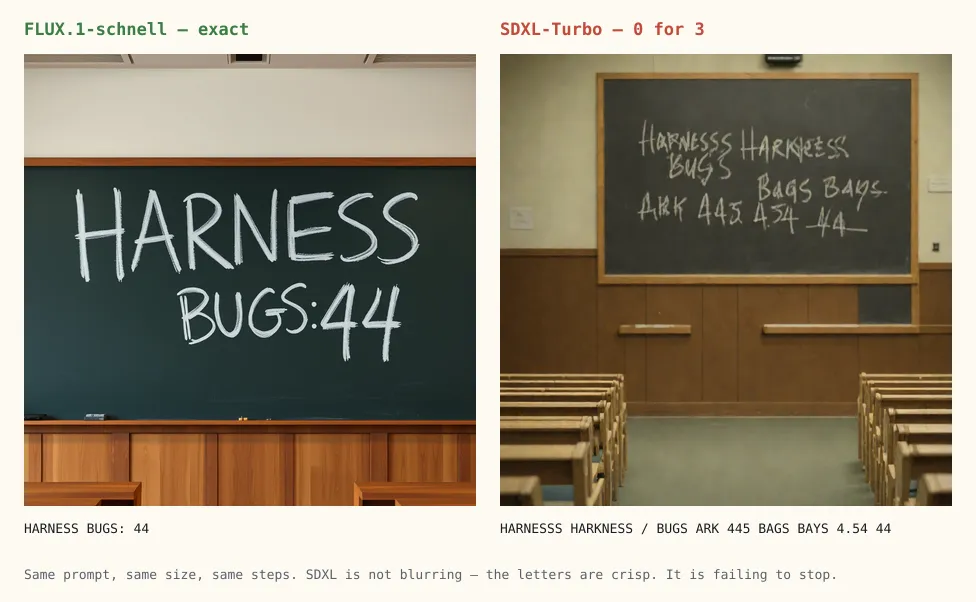
The failure mode is the interesting part. SDXL's problem isn't blur — the letter shapes are individually crisp. Its signature failure is repetition: it renders the phrase two or three times, each version differently wrong. On the chalkboard it eventually wrote 44 — after also writing 445 and 4.54. It isn't failing to draw letters. It's failing to stop.
FLUX has a related tic. Asked for a book cover with a title and nothing else, it produced a clean product shot with a correct spine and shadow — and invented a two-line subtitle of pure gibberish. Unprompted text is where even the good model reverts to texture. That was in the written prediction, and it arrived on schedule.
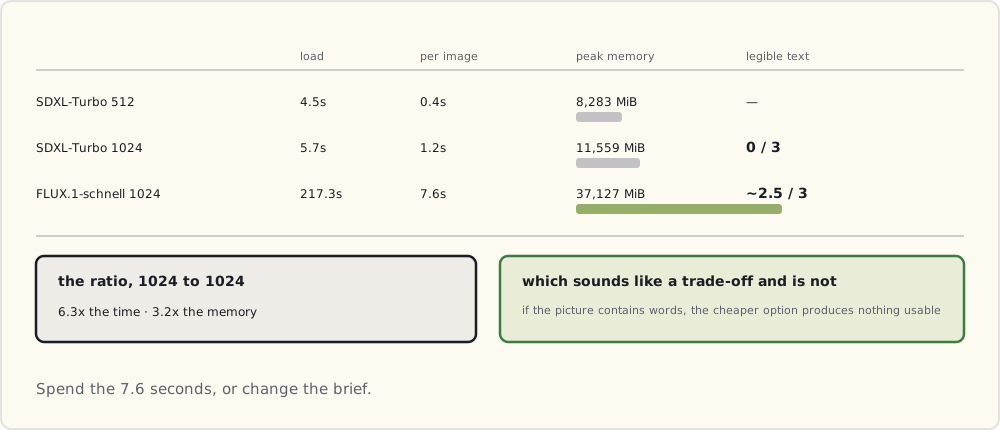
6.3× the time and 3.2× the memory. Which sounds like a trade-off and isn't. If the picture contains words, SDXL is not the cheaper option — it isn't an option. Spend the 7.6 seconds or change the brief.
Resolution is a per-prompt decision, not a setting
The most useful practical finding here is one I nearly deleted.
SDXL-Turbo is a 512-native model. Pushed to 1024 it duplicates single subjects. Asked for "a lone lighthouse," it produced two — one on the cliff, one on a sea stack behind. The prompt contains the word lone, and the extra resolution overrode it.
The obvious lesson would be "run SDXL at 512." That lesson is wrong. On the same sweep, at the same 1024:
- the overgrown data centre gained vines across the ceiling and green LED text on the racks — a clear win
- the clockwork bird schematic became, arguably, the most detailed image produced in the whole set — from the model that loses to FLUX everywhere text is involved
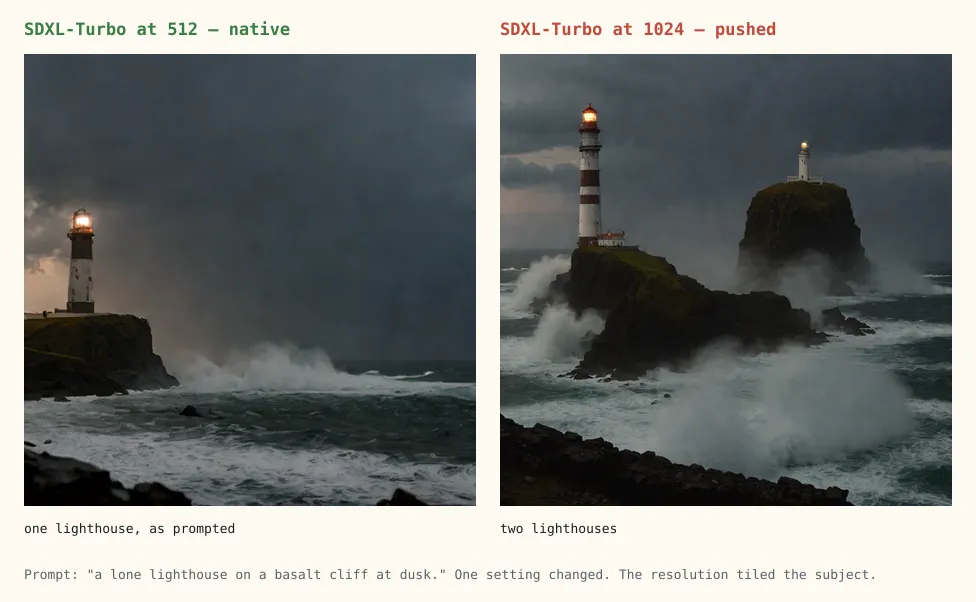
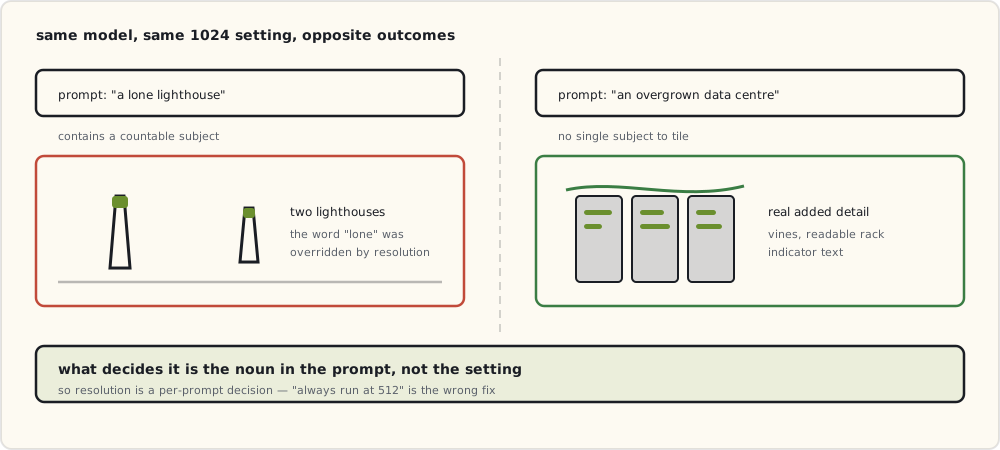
The difference is whether the prompt contains a countable subject. With one lighthouse to duplicate, 1024 breaks the image. With no single subject to tile, 1024 buys real detail. Same model, same setting, opposite outcomes, decided by the noun in the prompt.
The 512 set is the control that makes this visible at all. I deleted it during a rewrite for being redundant and was caught. Without it, "SDXL duplicates at 1024" is an assertion; with it, it's a comparison.
The hard set: six probes designed to fail
| probe | FLUX.1-schnell | SDXL-Turbo |
|---|---|---|
| counting + text (5 ducks) | partial — six ducks | fail — ~19 ducks |
| spatial: on vs under | pass | fail — nothing under, nothing on |
| attribute binding (3 penguins) | near — bow tie bled one position | fail — four penguins, all bow ties |
| hands + tools + sign | partial — correct grips, three arms | fail — two raccoons fused |
| style + long caption | pass — HERE ENDETH THE SPRINT exact | fail — caption illegible |
| scale inversion | pass | fail — concept fusion |
FLUX: 3 pass, 1 near, 2 partial, 0 fail. SDXL: 0 for 6.
Neither model can count. Asked for exactly five ducks, FLUX gave six and SDXL gave about nineteen. Diffusion models have no counting mechanism; they render "a queue of ducks" and the number falls out of the composition. Off by one versus off by a factor of four is a real difference in degree, but neither is a model you can ask for a specific number of things.
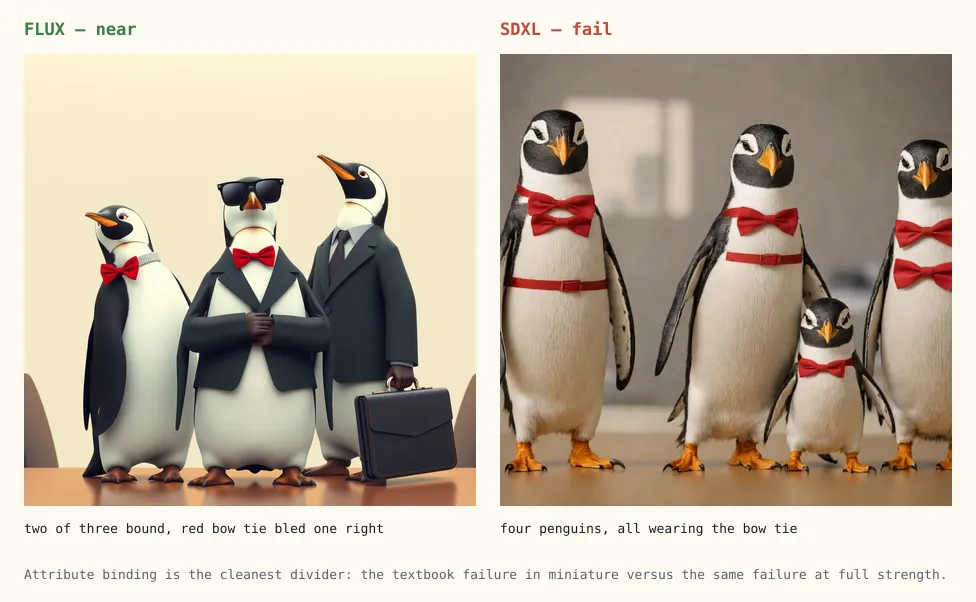
Attribute bleed is the cleanest divider. Given three penguins with three different accessories, FLUX bound two of three correctly and let the red bow tie bleed one position right. SDXL applied the bow tie to all four penguins — it miscounted too — and dropped the other two attributes entirely. The textbook failure in miniature versus the textbook failure at full strength: the most visually dominant attribute wins and spreads.
FLUX's failures are the predicted failures, arriving on time. It got both tools into the correct paws — the hard part — then grew a third arm to hold everything. In every case the written prediction named the failure before the image existed. A model that fails where you expect is far more useful than one that fails at random.
And the prettiest image of the entire run is an SDXL failure: a genuinely beautiful illuminated manuscript, gold leaf and all, featuring two knights, no rubber duck, and an illegible caption. It answers none of the prompt. Grading on beauty would have ranked it first.
What I'd tell a team
Write the expectation before you generate. For text output you can get away with judging after the fact, because a wrong answer usually looks wrong. Image output doesn't work that way — it looks good while being wrong, and your judgement adapts to whatever appeared.
And keep the control set even when it looks redundant. Mine was the difference between an assertion and a comparison, and I'd already deleted it once.
What's next
The same method, applied to video, where a model can render a completely convincing scene and simply decline to perform the action you asked for.