Nine Local LLMs Ranked by Cost Per Solved Task — Seven of Them Have No Price at All
Every model I could serve on two Sparks, run three times against the same 22-criterion behavioural contract from the same 17/22 baseline, with a 13-probe holdout the agent never sees.
Ranked the way I said I'd rank things before I bought the hardware: by what a solved repair costs.
| model | nodes | scores | node busy | 22/22s | machine cost | $ per solved contract |
|---|---|---|---|---|---|---|
| Qwen3.6-35B-A3B | 1 | 22, 22, 20 | 11m | 2 | $0.174 | $0.087 |
| DeepSeek-V4-Flash | 2 | 22, 22, 22 | 16m | 3 | $0.507 | $0.169 |
| Qwen3-Coder-Next | 1 | 18, 17, 22 | 20m | 1 | $0.317 | $0.317 |
| Laguna-S-2.1 | 1 | 22, 21, 17 | 81m | 1 | $1.282 | $1.282 |
| Devstral-2-123B | 1 | 18, 19, 19 | 266m | 0 | $4.211 | never |
| Nemotron-3-Super-120B | 1 | 17, 17, 17 | 148m | 0 | $2.343 | never |
| Nemotron-70B (FP8) | 1 | 20, 2, 18 | 137m | 0 | $2.169 | never |
| Nemotron-120B | 1 | 17, 18, 18 | 54m | 0 | $0.855 | never |
| Qwen3-Coder-30B | 1 | 17, 17, 20 | 12m | 0 | $0.190 | never |
| gpt-oss-20b | 1 | 17, 17, 17 | 10m | 0 | $0.158 | never |
Costs use the model I set out before buying: ~$0.95 per machine-hour, doubled for anything occupying both boxes, charged for the wall clock the node was actually busy.
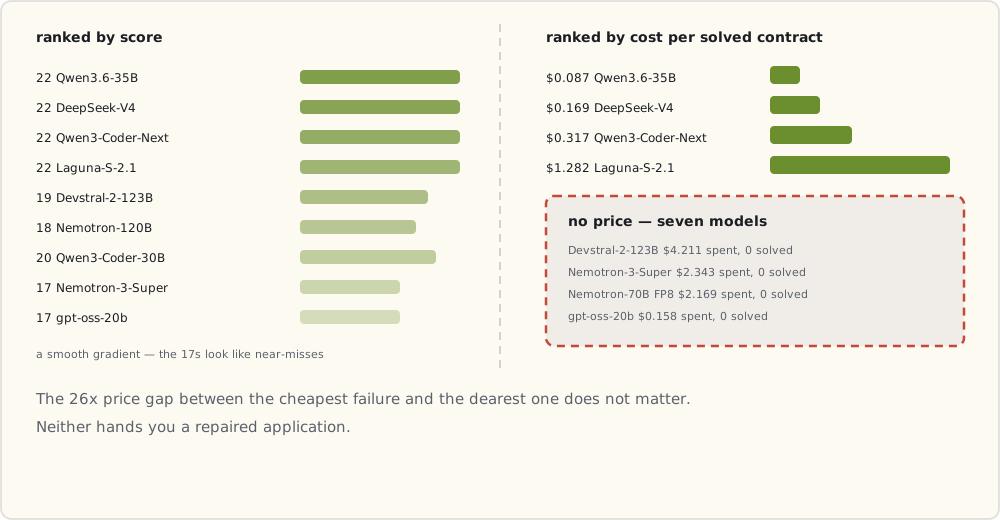
Seven of them have no price
Not "expensive." Undefined. They never produce the artifact, so there's nothing to divide by.
This is the entire argument for the unit, and it took having the data in front of me to feel it properly. On a score ranking, gpt-oss-20b looks respectable and thrifty: 17/22, ten minutes, sixteen cents. On a cost-per-task ranking it's the same product as Devstral-2-123B, which burned $4.21 and 266 minutes to arrive in the same place. The 26× price gap between them doesn't matter. Neither one hands you a repaired application.
The wall at 17/22
Five models fail the same five criteria: B3, B4, B5, C3 and C5 — deleting a team without orphaning its members or tasks, foreign-key validation, and the priority enum. Referential integrity, in a phrase.
This is not a size effect. gpt-oss at 20B and Nemotron at 120B fail the identical set. Devstral-123B spends 121 minutes a run to arrive in the same place. Six times the parameters and twelve times the wall clock buy nothing here.
The models that clear the wall aren't the biggest ones — they're the ones that keep checking their own work instead of declaring victory.
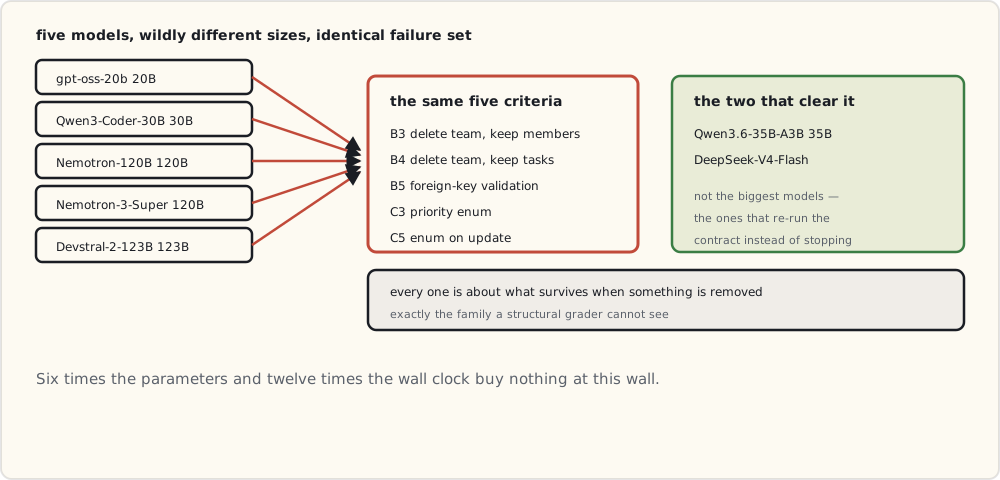
Worth noticing which five criteria. Every one is about what survives when something is removed — the same family of behaviour that my original 229 structural checks were constitutionally unable to see. The hardest thing for these models is the thing my first grader couldn't measure at all.
The two that have a real price
Qwen3.6-35B-A3B at $0.087 — matches the ceiling twice at 35B, on one node, in eleven minutes, and stops when it's done rather than burning the budget. Nothing else comes close on capability per unit of cost.
DeepSeek-V4-Flash at $0.169 — the only model to solve the full contract three times out of three. It's also the heaviest thing in the fleet and the only one needing both nodes, so you pay 1.9× per solved contract for that reliability, and you get a fleet of about three agents instead of sixteen.
Don't read the table as "Qwen is good." The 3.6 generation is doing the work — the Coder variants sit mid-pack at 17–20, and Qwen3-Coder-Next lands at a flat 17.
Caveats that travel with this table
- The protocol column isn't uniform. DeepSeek's 22×3 is a text-protocol score; Qwen3.6's is tools. Five models moved when I switched them, so these aren't strictly like-for-like. DeepSeek's own tools-mode run scored 20/19/0 — but sampling changed at the same time, so it attributes nothing and is excluded.
- Best-of-three flatters the variable models. Laguna spans 17–22 across three runs. DeepSeek and Qwen3.6-35B are the only two consistently at the top.
- Nemotron-70B's row is FP8, quantised on load. The checkpoint on disk is BF16. It is not a BF16 score and must never be quoted as one.
- The 2/22 in that row is real and I checked it carefully: the model wrote a
delete-orphancascade onto the many side of a many-to-one. SQLAlchemy accepts it at import and raises on the first query, so the app builds, registers all 21 routes, and fails every request. That story has its own post. - Everything here is one task. A 22-criterion Flask repair contract is not a benchmark suite, and a model that wins it is not thereby the best model.
What I'd tell a team
Put the undefined column in your table and don't fill it with a large number. The temptation is to write "$∞" or to rank the never-finishers by how cheaply they failed. Both re-import the gradient the unit is designed to remove. Seven rows saying never is uncomfortable to look at, which is the point — it's the honest shape of the result.
And check what your hardest failures have in common before blaming capability. Mine were all one behaviour: cleanup after deletion. That's a much more actionable finding than "the small models are worse," and a score ranking sorted by size would have hidden it completely.
What's next
I've now got a ranking table where six of the numbers turned out to be measuring my own code rather than the models. That accounting is the last post in this arc, and it's the one I'd want to read if someone else had written it.