The AI Grader That Passed the Same Bug Three Times: 229 Checks, Three Agent Workspaces, One Blind Spot
The boxes turned up on a Tuesday. Two DGX Sparks, 121 GB of unified memory each, small enough that both of them plus a laptop take less desk than a monitor stand used to.
I'd spent three weeks writing about what I'd need before I trusted an agent with real code. Within about a day of the hardware arriving I had my answer to whether the scorecard was any good, and the answer was no.
What I built first
Not a benchmark. A grader — because everything I'd written beforehand said the measurement is the thing that has to exist before any result means anything.
So: a deliberately broken Flask application, a spec, and 229 acceptance checks. The checks are structural. Does class Team declare __tablename__ = 'teams'. Does this module define that column. Does that route get registered. They run in about 28 seconds, they're completely objective, and I could write a hundred more in an afternoon.
Then I pointed three very different systems at it: a six-agent local fleet running on the new hardware, and two frontier hosted models working the same task on their own.
All three scored 229 out of 229
Which felt like a great result for about ten minutes.
All three shipped the identical defect. Delete a member who's assigned to a task, and task.assignee_id still points at the deleted row. The application accepts the delete, reports success, and leaves a task pointing into a hole.
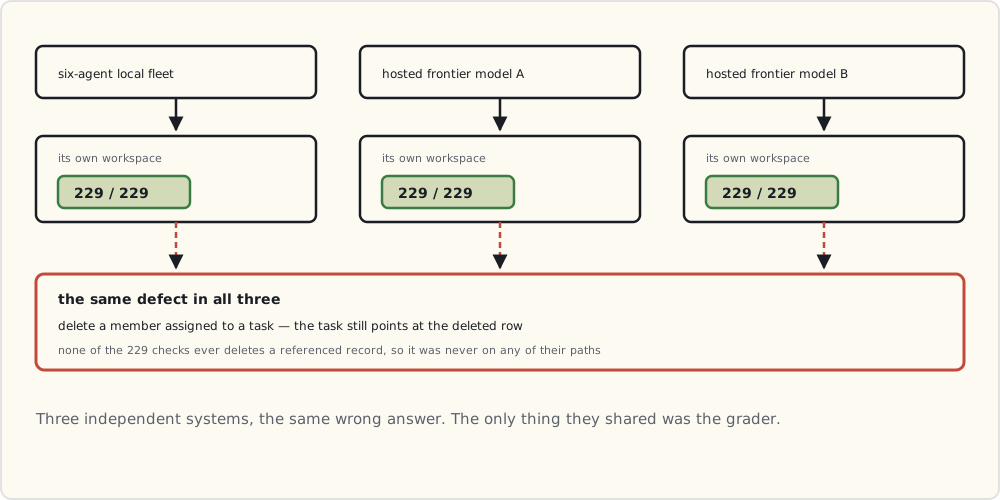
Three independent systems, three perfect scores, one bug. That's not three coincidences. When three different approaches produce the same wrong answer, the thing they have in common is the problem — and the only thing they had in common was my grader.
Why 229 checks couldn't see it
I went through the checks afterwards to find out how a suite that exhaustive misses something that basic. The answer is embarrassing in how simple it is.
Not one of the 229 checks ever deletes a record that something else references.
They confirm structure exists. Classes, columns, relationships, routes, imports, signatures. Every one of them is a question about the code at rest. Not one of them is a question about what the running system does when you take something away.
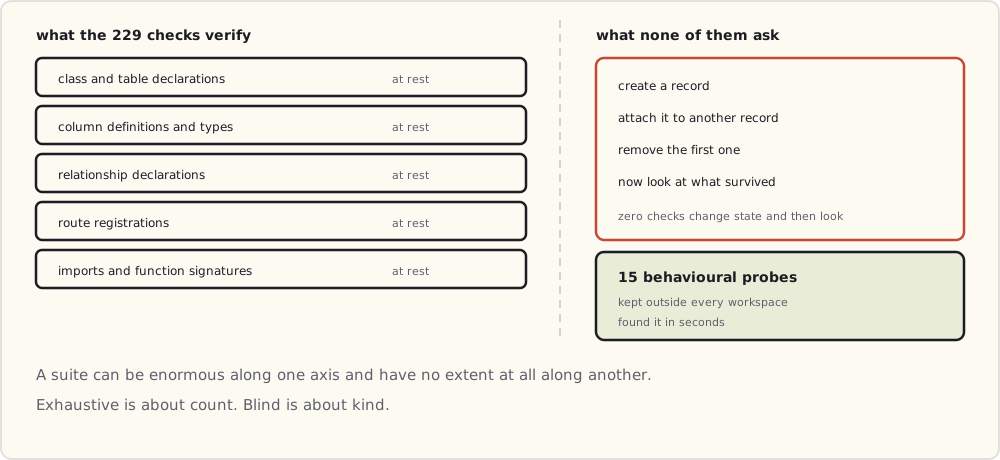
A defect only appears in a suite if some check walks a path that touches it. Adding more checks of the same kind extends the suite along an axis where it's already strong. It buys nothing on the axis where it has no extent at all.
That's the part I'd genuinely not internalised: exhaustive and blind are independent properties. Exhaustive is about count. Blind is about kind. I'd been treating a big number as evidence of coverage.
The fifteen probes that found it in seconds
The thing that caught it wasn't clever. It was a small set of behavioural probes I'd kept outside every workspace — the tripwire from the scorecard post. Fifteen of them, none ever copied where an agent could see them.
They found the dangling reference immediately, because one of them does exactly what a person would do: add a member, assign them a task, delete the member, then ask what's left.
Fifteen questions beat 229 checks, and it wasn't close. Not because fifteen is a better number, but because those fifteen drive the application and the 229 read its source.
What I'd tell a team
Count how many of your acceptance checks change state and then look at what happened. If the answer is zero — if every check is an assertion about structure — you have a suite that will pass a broken system, and its size will make you confident while it does.
The corollary is harsher and I think it's right: a check that never destroys anything can't verify cleanup. Deletion, rollback, cascade, eviction, expiry, revocation — the entire family of "and then it goes away" behaviours is invisible to any suite that only ever builds up. That family is also where the defects with real consequences tend to live.
And when several independent attempts converge on the same wrong answer, stop investigating the attempts. Look at what they share.
Where I was lucky
I want to name this rather than let the post read as foresight: I only caught this because I'd built the holdout first, for reasons that were mostly abstract at the time. If I'd built the 229 checks and stopped, I'd have shipped "three systems solved it perfectly" as a finding, and I'd have believed it, and every number after it would have been built on top.
The holdout wasn't insight. It was insurance I bought before I knew what for, and it paid out on day one.
What's next
The 229 checks are done. Not extended, not supplemented — replaced. What goes in their place took about an hour to write and did more for this project than the two days of orchestration machinery I'd built around them, which is a sentence I'd have found irritating a week ago.