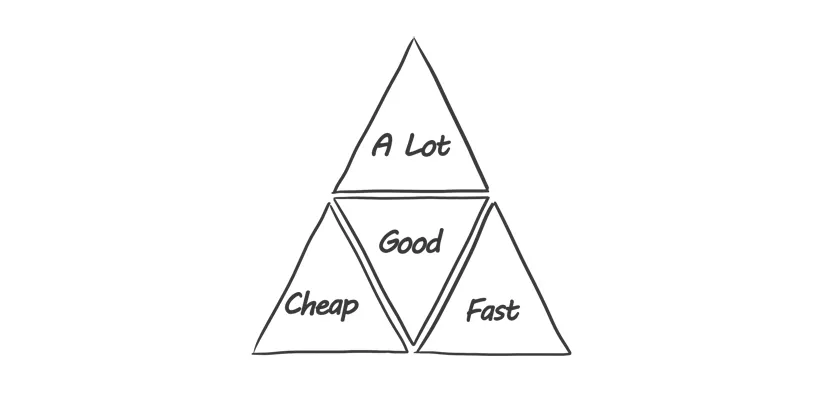
Good, Fast, Cheap — the golden triangle of project management
There are many ways to describe the boundaries of a project. The simplest is "The Golden Triangle" — three constraints (sometimes drawn as four dimensions) that determine both the limits of the project and the criteria for declaring it a success.
The Golden Triangle demonstrates the basic mathematical relationship between its parts: any increase along one axis forces a corresponding change on another. If scope grows, schedule or budget must grow with it. If you hold schedule fixed and budget fixed, scope must shrink — or quality breaks.
Another approach extends the triangle into a hexagon to include scope, time, budget, quality, risks, and customer satisfaction. Useful as a framing — also useful when the simpler triangle is letting a customer slip out the back door of "but I want all three."
The notional variant nobody can deliver
There is a fourth-corner variant of the triangle that's never actually achievable but is still demanded weekly in real meetings:
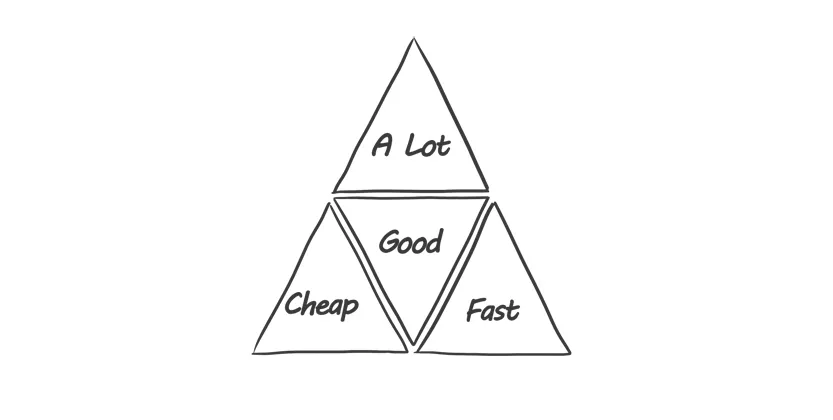
The Golden Triangle of Project Management — pick two, the third is a consequence.
"A Lot — Fast — Cheap — Good" is the set of expectations that can never be achieved simultaneously. It's the result of:
- the customer's (completely understandable) lack of understanding of what the project actually requires
- a lack of trust about the estimates presented at sale time
- the well-documented industry tendency for projects to deviate from original timetable, resources, budget, and scope
Therefore, in order to create a solid basis for the project, its premise must be ambitious but realistic, fully understood, and agreed to by the client up front.
How to actually have the trade-off conversation
The trick is to make the trade visible before the project starts, not in month four when you discover the customer believed all four corners. A few things that work:
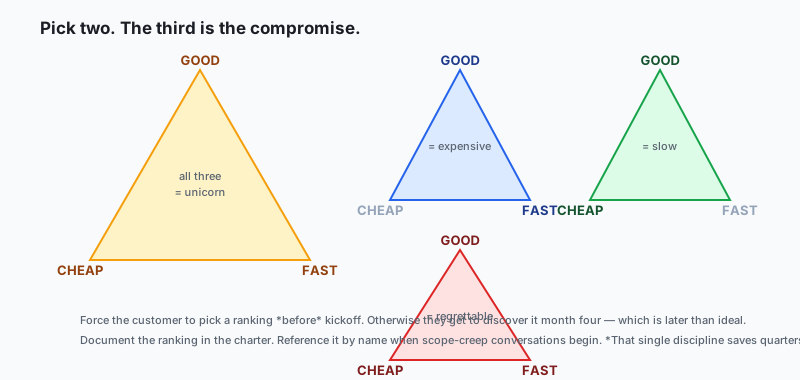
1. Force the ranking, not just the menu. Don't ask "which is more important?" Ask "if I told you we could deliver two of these three perfectly, which two would you pick and which one are you willing to compromise on?" The "compromise" word forces a real ranking.
2. Visualize the slider. Draw the triangle on a whiteboard. Put a dot in the middle. Move the dot toward "Fast" and visually show the other two shrinking. Customers feel the trade-off in their gut once they see it move. A spreadsheet doesn't do this.
3. Pre-commit to the trade-off ritual. Write down which corner gets compromised when reality forces a choice, and store it in the project charter. When month four hits and a re-scoping decision is needed, you don't re-debate — you reference the charter.
4. Use the hexagon when needed. If the customer pushes back on "only three dimensions," upgrade to the hexagon (add risks, quality, customer satisfaction). You're not adding complexity — you're acknowledging the complexity that's already there.
What changes once the customer feels it
In honest order:
- The "scope creep" conversation goes from adversarial to mathematical. "If you add this, here's the corner that gives." Math, not feelings.
- Estimates stop being negotiated down. The customer learns that "negotiating" a 3-month estimate to 2 months is just pre-deciding which corner will fail.
- The mid-project trade-offs land softer. The customer already agreed to a ranking. The re-scoping conversation is a calendar event, not a fight.
- Status updates get more useful. "We're on track" becomes "we're on track along the dimensions we agreed mattered most."
Gratitude beat
Thanks to every project sponsor who's been patient with me drawing the triangle on a whiteboard for the fourth time in the same kickoff meeting. You're the reason this conversation gets cheaper over a career. Thank you.
A few real-world variants worth knowing
The "moving deadline" variant. Customer locks budget and scope, then the deadline shifts left by six weeks because of an external event (trade show, regulatory date, competitor announcement). Quality is the corner that gives — even if nobody explicitly said so. Best practice: identify the first dimensions you'll cut on quality (testing depth? documentation? performance polish?) before the squeeze hits. Pre-decide, don't crisis-decide.
The "phantom scope" variant. Customer says scope is fixed, but the interpretation of each scope item is fluid. Six weeks in, "user can log in" turned out to mean SSO + 2FA + RBAC + audit logging. The corner that gives here is whichever the customer hasn't been forced to rank yet. Best practice: write acceptance criteria for every scope item at kickoff, not as needed.
The "post-launch quality debt" variant. Customer accepts a quality compromise to hit the date, ships, and then expects free post-launch polish. Be very clear at the trade-off conversation that the compromise is permanent unless re-funded. Otherwise the customer believes they got all four corners; you just delivered them in two phases.
The single move that prevents most disasters
Document the trade-off ranking in the project charter, get a signature, and reference it by name whenever a re-scoping conversation starts. Not a clever phrase, no spreadsheet magic. Just the discipline of writing down "if reality forces a choice, time is what we'll compromise on, in this order: scope first, quality second, budget third." Re-read it at sponsor meetings. Re-reference it when the inevitable change request lands.
Most "scope creep" disasters are actually unrecorded-trade-off disasters. The work happened, but nobody wrote down the priorities, so every micro-decision became a re-negotiation. Write it down. Save yourself a quarter.