Mobile applications have become increasingly important for businesses these days, and consumers are demanding higher quality apps for their mobile devices. Adapting to this new demand, testing teams have to evaluate and verify mobile apps before they are launched in the market. Assessing the quality of mobile devices is a time-consuming and a resource-intensive game especially as automating tests for mobile devices can be moderately complex.
Various tools and online resources available to help the testers build tests for the mobile devices, run and record unit tests and automated UI for code libraries and mobile apps, and contribute to testing responsive and fluid web interfaces. There are various tools available for testing mobile applications; some are open-source and some are commercial. Commercial tools are enriched with features but are expensive, whereas open-source tools are the free tools that are available to make the life of testers easy and convenient.
Let’s have a sound look on the top five open-source mobile application tools available to test your mobile apps. (Some of these tools can work on iOS as well as Android!)
~~1. Appium
Appium~~ is an open-source tool used for automating native, mobile web, and hybrid apps. It is available on Android as well as iOS.
~~2. Calabash
Calabash~~ is an automated acceptance testing framework for mobile apps that can be compared to Selenium WebDriver. Note that it is imperative to realize that interacting with a web app from a desktop is quite different from interacting with a native app using a touch screen. Calabash provides APIs that are dedicated to native apps running only on touch screen devices. It is available on Android as well as iOS.
~~3. iOS UI Automation
By using the Automation instrument to automate your UI tests for an iOS app through test scripts that you write to simulate user actions by calling a Javascript programming, UI Automation interface states actions to be performed in your apps as it runs. Throughout the tests, the system returns log information to the tester. As soon as you start automating the tests of UI interactions, you welcome the resources and critical staff to carry out other work. In this way, testers can minimize procedural errors and also shorten the time needed to develop product updates. It is available only on iOS.
~~4. Frank
Frank allows you to write the structured text test, requirements, and acceptance tests, and then execute them against the iOS application. It also includes a powerful app inspector known as Symbiote that helps in attaining information on your running app. It is ** available only on iOS.
~~5. Robotium
Robotium~~ has complete support for hybrid and native applications. Robotium makes it easy to write robust automatic and powerful black-box user interface tests for Android applications. With the support of Robotium, test case developers can write system and user acceptance test scenarios and functions spanning multiple Android activities. It is available only on Android.
~~6. Selenium-Cucumber
Selenium-cucumber is a behavior driven development (BDD) approach to write automation test script to test Desktop Web and Android Web, Apps .
Feature: Learning selenium-cucumber using ruby
          As a tester I want to learn selenium-cucumber

 Scenario: I am learning selenium-cucumber
        Given I know "selenium-webdriver" and "Cucumber"
        When I navigate to "http://www.seleniumcucumber.info"
        And I make use of "Predefined Steps"
        Then I have learned "selenium-cucumber"
How to actually pick between these
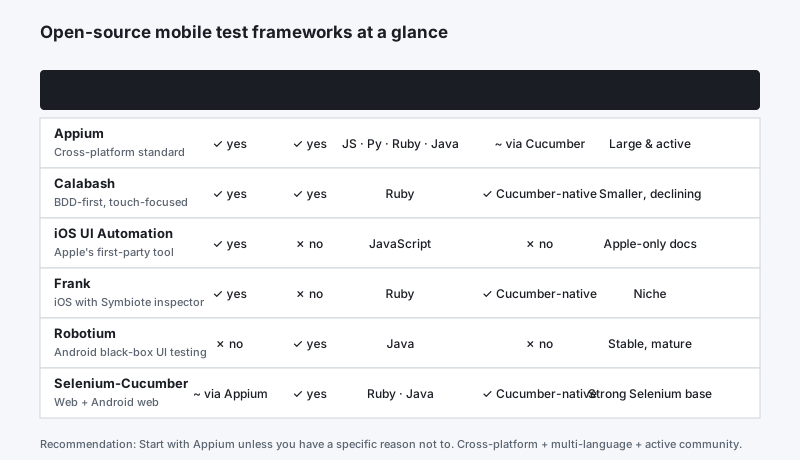
Six tools, three honest decision filters:
1. Platform breadth. If your app is iOS + Android in the same codebase (React Native, Flutter, native cross-team) → Appium or Calabash (both cross-platform). If iOS-only → iOS UI Automation or Frank. If Android-only → Robotium.
2. Language match. Pick the framework whose test language matches what your dev team already writes. Appium → JavaScript/Python/Ruby/Java/C#. Calabash → Ruby + Cucumber. Robotium → Java. Selenium-Cucumber → Ruby BDD. Tests die when they're written in a language the team doesn't speak.
3. Maintenance burden. Open-source tools live and die by community velocity. As of writing, Appium is the safest bet — large active community, frequent releases, broad commercial backing. Calabash and Frank are more niche; check the commit history before adopting.
Best-practice patterns regardless of framework
- Page Object Model. Every framework supports it; almost no team uses it on day one. Adopt it on day two anyway. Your tests will outlive three UI redesigns.
- Run on real devices, not just simulators. Simulators miss timing bugs that production users hit constantly. Use a device farm (BrowserStack, AWS Device Farm, Sauce Labs) at least weekly.
- Wire tests into CI from week one. A test suite that runs on demand and not on every PR will rot. Make it part of the build or it's not real.
- Budget time for test flakiness. Mobile tests are flakier than web tests. Plan for ~10-15% retry overhead and have a system for triaging flake.
When commercial beats open-source
Honest take: for small teams and early-stage products, open-source is plenty. For enterprise teams with 50+ apps, regulated industries, or 1000+ device matrices, commercial tools (Perfecto, Kobiton, Experitest) earn their cost via the device farm, the reporting, and the enterprise support. Don't let "free" become a brittle religion.
Gratitude beat
Big thanks to the maintainers of Appium, Calabash, Robotium, Frank, and Selenium-Cucumber. Open-source test infrastructure is the unglamorous half of every shipped mobile app, and the small teams keeping these projects alive are doing public-good work that almost nobody acknowledges. Thank you.